
Constance Muriel Hawkins (née Brown)
Constance Muriel Brown, born 14 July 1752 in Portsmouth, was the eldest daughter of shipwright Thomas Brown and herbalist Mary Brown née Holt — the third of eleven children raised on Dock Lane. Trained in healing at her mother's side from the age of eight, she delivered her first baby at fourteen: her mother's eleventh child, in a birth that nearly killed them both. She married fisherman James Hawkins in 1771, was widowed in 1781, and became Portsmouth's most trusted midwife for three decades. She died 12 October 1813, aged sixty-one.
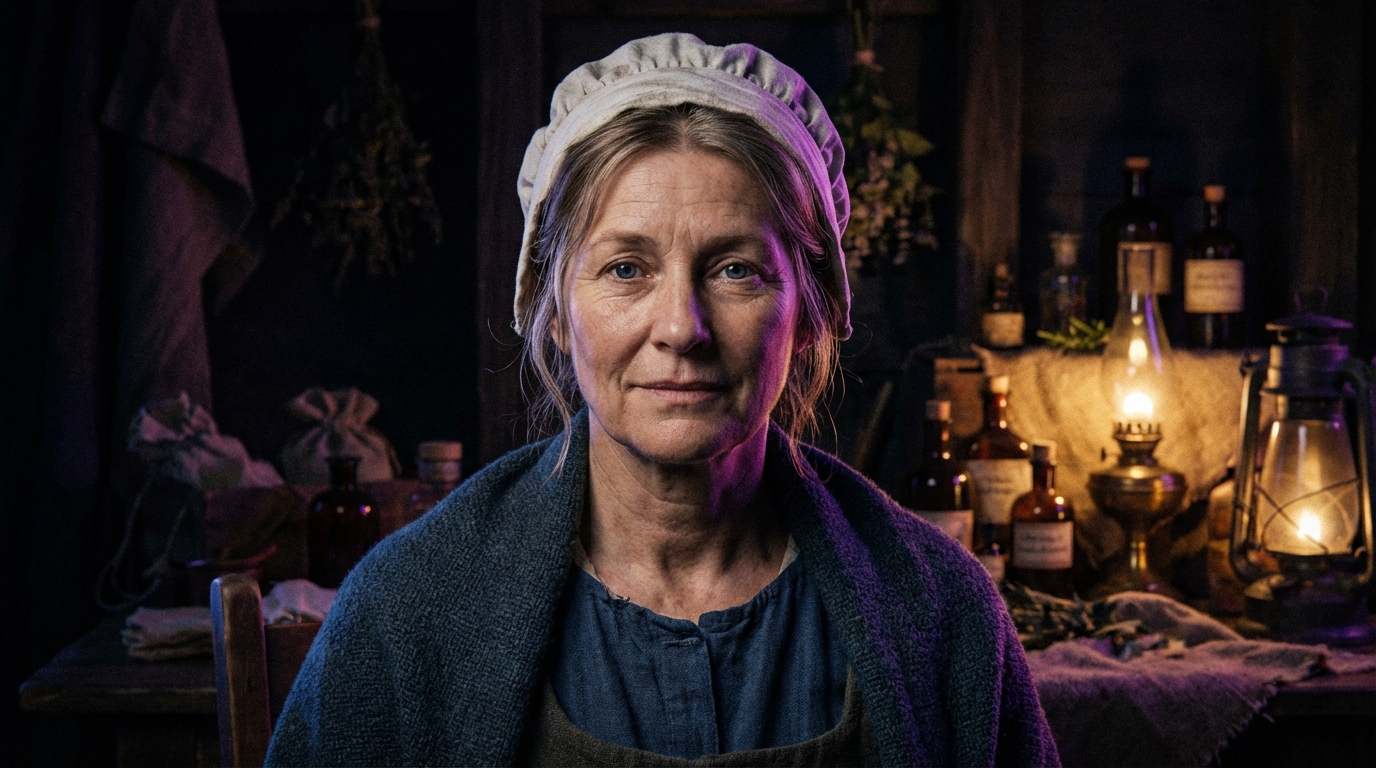
Dockside Childhood and Early Healing
Constance was the third of eleven children born to Thomas and Mary Brown in their cottage on Dock Lane, near Portsmouth Dockyard. Her elder brothers John and Thomas Junior arrived in 1750 and 1751 respectively. After Constance came a succession of children at the intervals that working-class families of the period expected — William in 1754, Henry in 1755, James in 1757, Samuel in 1759, Martha in 1760, Robert in 1762, Anne in 1764, and Eleanor in 1767. Three did not survive childhood: William died at eight months of a chest fever in 1754, Samuel at two after a fall in the yard behind the cottage in 1761, and Anne before her first birthday during the winter of 1765. The losses were not unusual for Portsmouth's dockside streets, where infant mortality was woven into the fabric of family life — mourned in its particulars, endured in its generality.
Thomas Brown was a shipwright at Portsmouth Dockyard, a skilled tradesman whose wages were better than a labourer's but dependent on Admiralty contracts that expanded during wartime and contracted during peace. He was a steady, quiet man who expressed himself through craft rather than conversation and who carried the dockyard home with him each evening in the pitch stains on his hands and the oak shavings caught in his hair. Mary Holt had married him in 1749 at nineteen. She supplemented his income through seamstress work, but her real skill lay elsewhere — in the knowledge of herbs and remedies passed to her from her own mother, the practical healing art practised by working-class women whose neighbours could not afford physicians. Mary knew which preparations eased a fever, which poultice drew infection, which tisane settled a stomach that had rejected everything else. Neighbours sent for her when illness struck, and she went, because going was what the women of these streets did for each other.
The household on Dock Lane was crowded, noisy, and governed by the domestic arithmetic that large families imposed. The cottage had two rooms on the ground floor and a loft beneath the thatch where the children slept in a row on straw pallets, rearranged each time a new baby arrived. As the eldest girl, Constance carried domestic weight beyond her years — cooking when her mother was occupied with the youngest children, managing the boys when they exceeded the cottage's capacity for containment, mending clothes that were outgrown before they were worn through. By the time Martha arrived in 1760, giving Constance a sister at last after a run of brothers, eight-year-old Constance had been functioning as her mother's deputy for as long as she could remember.
It was in this year that Mary began taking Constance on visits to the sick. The visits were not medical in any formal sense — Mary was not a physician, not an apothecary, not a midwife. She was a woman who knew things, and whose neighbours trusted what she knew. Constance carried the basket: the herbs, the clean linen, the small bottles of tincture that Mary stored on the dresser beside the Bible. She watched her mother kneel beside sick neighbours, watched the way Mary's hands moved over feverish skin — assessing, reading, translating the body's signals into information that determined what treatment would follow. She watched her mother attend labouring women, standing at the edge of rooms where birth was happening, absorbing the sounds and the rhythms of a process that was at once ordinary and astonishing and dangerous in proportions that shifted with each delivery.
Mary taught through demonstration rather than instruction, the same method by which she herself had learned — not from books but from years of watching her own mother perform the same tasks in the same streets one generation earlier. Constance absorbed the lessons quietly and with a retention that surfaced months or years later when a situation demanded knowledge she had not known she possessed. By ten she could gauge a fever's severity by touch alone. By twelve she could prepare poultices from memory and knew which was indicated for which wound. By thirteen she had attended enough births at her mother's side to understand the stages of labour, to recognise the sounds that meant progress and the silence that meant trouble, to know when a delivery was proceeding normally and when the quality of a mother's breathing changed in ways that required intervention.
She had watched. She had carried. She had learned. What she had not done was act. The distance between observation and responsibility remained uncrossed until 22 March 1767, when Mary Brown went into labour with her eleventh child. The pregnancy had come after a three-year gap that had led both Mary and Thomas to believe the childbearing was finished. Mary was thirty-seven years old, her body worn by ten previous pregnancies and three burials. The midwife Mrs Graham was attending another birth four streets away on Havant Street and could not come for hours. Constance was fourteen, alone with her mother in the cottage on Dock Lane, and the baby was coming whether anyone was ready or not.
Eleanor Brown was born that morning with the cord wrapped twice around her neck. She survived because her sister's hands, shaking and covered in blood, did what they needed to do. Mary survived the haemorrhage that followed, though it was a near thing. The experience took Constance less than an hour to live through and the rest of her life to understand. Eleanor's eyes were blue — a pale, clear blue that Constance would one day paint onto a door on Oyster Street, decades later, in a gesture of remembrance that required no explanation to anyone who knew the story.
Marriage to James Hawkins
Constance married James Hawkins on 11 June 1771 at St Thomas's Church. She was nineteen. James was twenty-five, a fisherman who worked the Solent in a boat he part-owned with his brother Richard, catching mackerel and herring in summer and cod and whiting through the colder months.
He was not the match her father had envisioned. Thomas Brown had hoped for a tradesman — someone whose income did not depend on weather, tide, and the disposition of fish. But Constance had met James at the Michaelmas fair in 1769, and whatever passed between them had settled into a courtship that Thomas could delay but not prevent. James was steady and kind without being soft about it. He understood that his wife's habit of disappearing at odd hours to attend sick neighbours was not a hobby but a compulsion, and that marrying her meant accepting her time would never belong entirely to him.
They established a household in a rented cottage near the harbour — two rooms, a hearth, a yard shared with three other households. Their domestic economy ran on the combined revenues of James's fishing and Constance's needlework. Good hauls meant meat and coal. Poor hauls meant bread and dripping and the careful rationing that every fisherman's wife in Portsmouth practised as a condition of survival. The margins were thin. They held.
Their first child, Thomas, arrived on 3 September 1772. Mrs Graham attended the birth at Constance's insistence — a decision that reflected not a lack of confidence in her own abilities but a respect for the distance between knowing and doing that the morning on Dock Lane had taught her. Mary followed on 8 February 1775, a quiet, watchful child whose temperament echoed her grandmother's more than her mother's. Samuel completed the family on 20 November 1778, a boy whose restless energy announced itself in the womb and never diminished.
James was a good father in the way that working men of his generation understood fatherhood — present when his work permitted, affectionate through gesture rather than declaration, committed to providing for his family with a reliability that expressed devotion more convincingly than words would have. He carved a wooden doll for Mary from driftwood, shaping it with a fisherman's knife and a patience he did not typically display. He carried Thomas on his shoulders through the harbour streets when the boy was small, and taught Samuel to tie the knots that fishermen used before the child could write his own name.
He also understood, as every fisherman did, that the sea which provided his livelihood would take his life if given the opportunity. The knowledge lived in the household the way damp lived in the walls — always present, rarely mentioned. Constance kissed her husband goodbye each morning he went to sea and did not permit herself to consider the possibility that the kiss might be the last. This was not courage. It was the management of fear through the refusal to give it language, a strategy that worked until the morning it did not.
Widowhood and Midwifery
The storm that killed James Hawkins struck on 14 October 1781, arriving from the southwest with a speed that caught the fishing fleet in open water. Three boats went down. James's was one of them. His brother Richard was pulled from the water by a vessel from Gosport. James was not recovered. His body was never found.
Constance was twenty-nine. Thomas was nine. Mary was six. Samuel was two.
The weeks that followed compressed the practical and the unbearable into a single experience. She fed the children. She kept the cottage. She maintained the domestic machinery that three small lives depended upon, performing each task with the mechanical competence of a woman whose body continued to function whilst the part of her that directed the functioning had temporarily withdrawn. The parish vestry assessed her circumstances and granted relief at the standard widow's rate — enough to cover rent and little else. Needlework supplemented the shortfall, but the hours it demanded competed with the hours the children and the cottage and the unprocessed grief required, and grief was a luxury that survival had already claimed.
It was during these months that Constance began assisting Mrs Graham at births. The arrangement began as expedience — Mrs Graham was ageing, her hands stiffened by the joint disease that afflicted women who had spent decades working in cold rooms, and she needed capable help. Constance needed income. What revealed itself within months was something that had been waiting since the morning on Dock Lane: a calling that circumstance had delayed but could not extinguish.
Mrs Graham trained her through the same method Mary Holt had used — demonstration, proximity, the gradual transfer of responsibility from experienced hands to capable ones. Constance learned to assess a labour's progress by touch, to recognise the presentations that meant danger — breech, transverse, cord complications — and to identify the precise interval between what a midwife could manage alone and the point at which a physician became necessary. She learned that this interval was often measured in minutes, and that the judgement required to navigate it could not be taught from books but only accumulated through the particular education that difficult births provided.
By 1783, Constance had established her own practice, built on the only currency that sustained a midwife's livelihood: reputation. A successful delivery produced a recommendation. A recommendation produced another patient. The chain extended through the dockside streets, carried by women whose trust was grounded not in credentials but in outcomes they had witnessed or heard described by neighbours whose word they valued.
Over three decades, Constance attended hundreds of births across Portsmouth's working-class districts. Her worn leather bag became a recognised fixture in the streets near the harbour — its appearance at a doorway meant a baby was arriving or had just arrived. She delivered straightforward births and terrifying emergencies, healthy infants and stillborn ones, first children and tenth children. She sat with mothers through the hours of labour and stayed through the days of recovery, providing the postpartum care that she considered the most important part of her work — the monitoring, the instruction, the quiet reassurance that no one else would provide if the midwife did not make it her business.
The birth of William Jeffries on 22 April 1785 was one such delivery — a shoulder-first presentation that required the combined efforts of Constance and Dr Cornelius Whittaker to resolve. Whittaker, who had worked alongside Constance at multiple births, held her skills in the quiet respect that competent physicians occasionally extended to midwives whose experience compensated for their lack of formal training.
The work took its toll. The irregular hours meant sleep was a thing negotiated rather than assumed — a knock at the door at any hour of the night meant a baby was coming and the midwife was needed, regardless of what the midwife's own body required. The physical demands — supporting labouring women for hours, maintaining concentration through deliveries that could turn from routine to emergency without warning — exhausted her incrementally, each year requiring slightly more effort than the last to produce the same results. The emotional burden was worse: the stillbirths she could not prevent, the mothers she could not save, the particular silence of a room where a delivery had ended in loss and where the midwife's composure was the only thing preventing the family's grief from becoming despair.
Yet the rewards punctuated the hardship with a regularity that kept her practising long past the point when her body suggested she might stop. A mother's face when a difficult delivery ended safely. An infant's first cry after seconds of silence that felt like hours. The particular trust that a woman in labour placed in the person whose hands would guide her child into the world — a trust so complete and so unearned by anything other than presence and competence that Constance never lost her awareness of its weight.
Later Years and Death
By her late forties, the instruments upon which Constance's livelihood depended — her hands, her eyes, her capacity to remain alert through the small hours — were failing in ways she could manage but not reverse. Her hands ached in cold weather. Her eyesight, strained by decades of work in rooms lit by tallow candles, made the fine assessments that complications demanded increasingly difficult. Her son Thomas, now a shipwright with a family of his own, urged her to stop. Her daughter Mary, who had trained as a nurse at the Naval Hospital, echoed the concern with the quiet persistence of a woman who had inherited her mother's determination and was now deploying it against her. Samuel had joined the Royal Navy at fifteen and wrote letters from ports across the Mediterranean and the Caribbean — letters Constance read by the fire in her cottage on Oyster Street, the cottage with the blue door, painted the colour of Eleanor's eyes.
She reduced her practice rather than abandoning it, referring younger women to the midwives she had trained whilst continuing to attend the families who had relied on her for decades. Mothers who had been delivered by Constance were now bringing their daughters to her for the same service — the generational continuity of trust that constituted a midwife's most valuable and least transferable asset. She also began teaching, passing the knowledge that Mary Holt had given her and that Mrs Graham had refined to a new generation of women whose hands were steadier and whose eyes were sharper and who would carry the work forward when Constance could no longer sustain it.
Constance Muriel Hawkins died in her sleep on the night of 11 October 1813, at sixty-one years of age. She had attended a birth three days earlier — a straightforward delivery on Butcher Row, a third child for a mother whose body knew the work. She came home tired but satisfied, the familiar weariness of a successful birth settling into her bones.
Mary found her the following morning, her face composed, her hands still. The funeral at St Thomas's Church filled the building. Women she had attended came with the children she had delivered, some now adults with families of their own. Dr Whittaker, elderly and retired, attended in the front pew. Neighbours from Dock Lane and Oyster Street and Butcher Row and the dozen other streets where her leather bag and her calm voice had been recognised for thirty years gathered to mourn a woman whose life had been defined by a single, repeated act: arriving when she was needed and staying until the work was done.
She was buried in St Thomas's churchyard beside an empty space — James's body had never been recovered, and the sea that took him offered no grave to visit. The headstone, funded by parish subscription, bore the inscription: "A healer, a mother, a friend." Eleanor repainted the blue door on Oyster Street each spring for years afterward, maintaining the colour with the quiet stubbornness of a woman honouring something that no one had asked her to repay and that she had no intention of forgetting.







