Constance Elira Addleton (née Trenowyth)
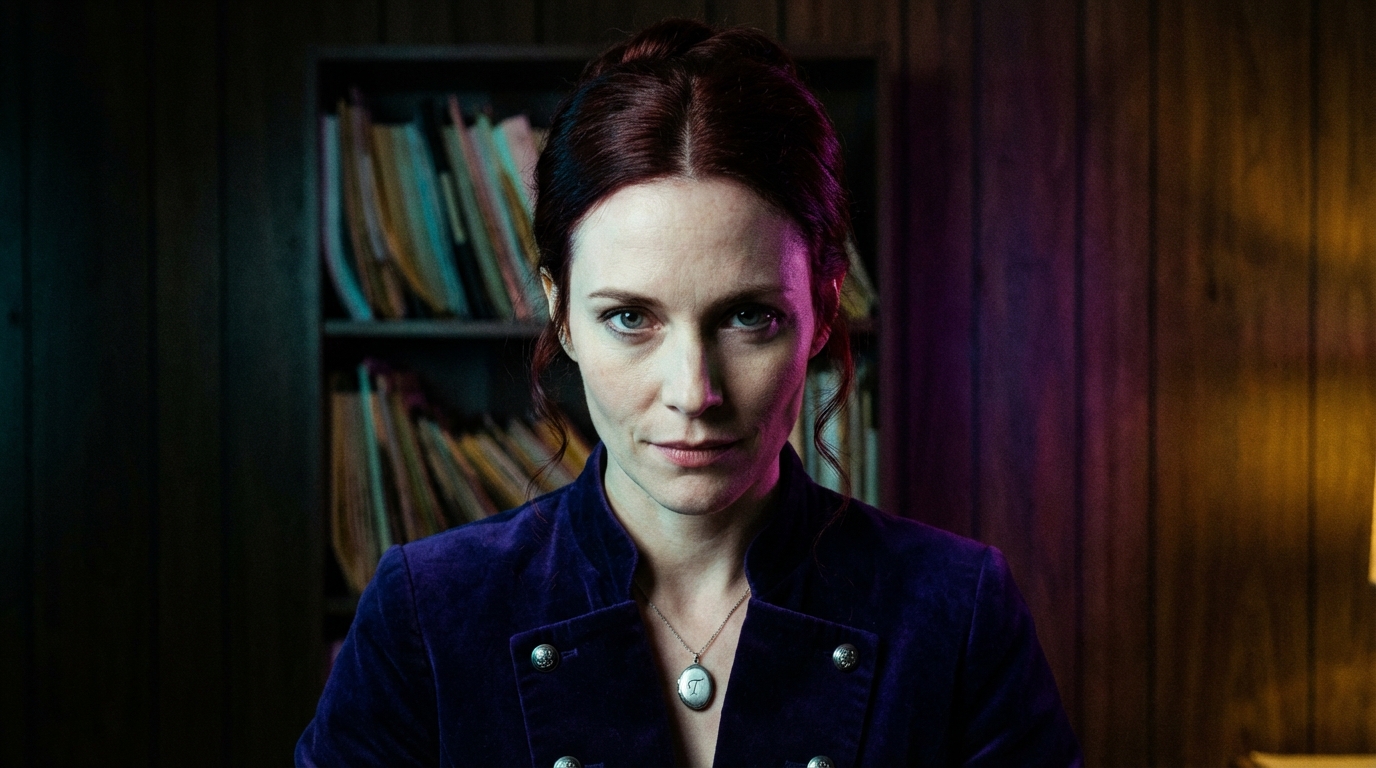
Born in 1939 in Deloraine, Tasmania, Constance Elira Addleton (née Trenowyth) was a psychiatric nurse whose career spanned public mental health institutions and the shadowed operations of the Obsidian Healthcare Group. Known for her methodical nature, sparse speech, and unnerving observational presence, she transitioned from caregiver to "Legacy Priority" resident at Vaucluse Nursing Home. Her cryptic utterances and lingering influence continue to unsettle staff and residents alike.
Cornish Roots and a Meander Valley Childhood
On the morning of 4 April 1939, in a modest stone cottage on the outskirts of Deloraine, Tasmania, Violet Trenowyth laboured through a damp, slate-grey autumn to deliver her first child. The day unfolded in the shadow of an uncertain world—war in Europe drawing closer, the family home chilled by early seasonal cold, and the unyielding presence of Edgar Trenowyth's quiet watch. The moment was less a celebration than a measured acknowledgement of a new life entering a time already heavy with restraint and unspoken worry. They named her Constance Elira.
The Trenowyth lineage traced back to Cornish settlers who had arrived in Van Diemen's Land in the early 1800s, the family name meaning "new farmstead" in the old tongue. That heritage—a blend of austerity, mysticism, and suspicion of outsiders—would shape Constance throughout her long and enigmatic life, though few ever heard her speak of it directly. Deloraine itself, nestled in the Meander Valley with its pastoral rhythms and tight-knit community, provided the backdrop for a childhood defined by order, silence, and careful observation.
Edgar Trenowyth worked as a stonecutter by trade and served as a lay preacher on weekends, a stern and reserved man known for his uncompromising morality and aversion to frivolity. He maintained a complex and emotionally distant relationship with his children, believing discipline to be a form of love—a philosophy his eldest daughter would absorb and transform into something altogether more unsettling. Where Edgar wielded scripture and chisel with stern purpose, Constance learned to wield silence and observation with equal effect.
Her mother Violet, née Greaves, provided a different inheritance. A quiet woman with a deep, abiding interest in herbalism and home remedies, Violet served as the local go-to for minor ailments and whispered cures. She passed on her knowledge of plants and preparations to Constance, who displayed an early aptitude for anatomy, physiology, and calm under pressure. In the shadowed corners of rural Tasmania, Violet quietly cultivated both herbs and her eldest daughter's unsettling gifts—a mother's gentle healing transformed, in time, into something far more calculating.
Three sisters followed Constance: Marion Agatha in 1941, Joan Lillian in 1943, and Sylvia Rose in 1945. Yet even then, within the crowded Trenowyth household, Constance stood apart. Some accounts suggest her siblings found her "unnerving" from childhood—possessed of a watchfulness that made others uncomfortable, a stillness that seemed to absorb rather than radiate. She rarely maintained contact with her sisters after leaving Deloraine in the early 1960s. Marion married and settled in Launceston; Joan died in 1968 under unclear circumstances in Western Australia; Sylvia became estranged, her current whereabouts unknown. Whatever bonds might have formed in that stone cottage dissolved as Constance pursued her singular path.
Training in the Art of Silence
In 1957, at the age of eighteen, Constance left the Meander Valley for Hobart, enrolling in the Certificate of General Nursing programme at Hobart General Hospital. Drawn to order and silence, she found in nursing a vocation that rewarded her natural temperament. A mid-placement review noted her approach as "highly methodical, though emotionally flat"—words that would characterise assessments of her work for decades to come. She completed her certificate in 1960 with commendations for technical precision, if not for bedside warmth.
The following year brought a more significant transition. Constance was selected for the final intake of advanced psychiatric training hosted at the New Norfolk Mental Health Hospital, the institution that had once been known as the New Norfolk Asylum before progressive methods began reshaping its reputation. There, amongst the grand colonial buildings and their troubled inhabitants, she found her true calling—or perhaps her true calling found her.
At New Norfolk, Constance worked under the controversial but influential Dr Harold Pennington, a psychiatrist whose methods straddled the line between innovation and ethical concern. Pennington reportedly "trusted her with high-risk cases," recognising in the young nurse a capacity for detachment that others lacked. During these years, she became familiar with experimental approaches: early psychotropic regimes, sensory deprivation techniques, and what internal documents obliquely termed "unofficial isolation trials" on long-term patients. No official record connects her to the controversial methods that would later taint New Norfolk's legacy, though several patients under her care were subsequently reclassified as "non-responsive."
Constance completed her advanced psychiatric training in 1963 and was immediately offered a position as Senior Nursing Officer at the same institution. She accepted, beginning a three-decade tenure that would see her rise through the psychiatric nursing hierarchy whilst the broader mental health landscape transformed around her. Through deinstitutionalisation, through scandal, through the gradual closure of the old asylum system, Constance remained—methodical, silent, and unnervingly poised.
A Marriage of Convenient Silences
In the winter of 1965, during a rotation at Hobart General Hospital, Constance met Arthur Malcolm Addleton. Born in 1928, Arthur was an anaesthetist and former military physician whose wartime service had left him with his own capacity for compartmentalisation. Their meeting occurred through professional channels—hospital rotations that brought psychiatric staff into contact with surgical teams—but what drew them together was something less tangible than shared schedules.
They married later that year in a ceremony that acquaintances would later describe as "strangely quiet." The union was noted by some as neither affectionate nor openly hostile—a marriage existing in a peculiar equilibrium that seemed to satisfy both parties without requiring the conventional performances of romantic devotion. Arthur understood silence; Constance required it. Their household operated on unspoken agreements and carefully maintained distances.
In 1967, Constance carried a pregnancy to term, only to deliver a stillborn daughter. The loss, never publicly discussed, became an invisible presence haunting their quiet household. No further children followed. Whether by choice or circumstance, the Addleton home remained childless—a space defined by the absence of the ordinary chaos that children bring, maintained in the meticulous order that Constance required.
Arthur died of a heart attack on a February evening in 1996, under Constance's care at their home. The autopsy proved inconclusive, complicated by delays in refrigeration and record discrepancies that were never satisfactorily explained. Official cause of death: cardiac arrest. Unofficial speculation: varied and unresolvable. In death, as in life, Arthur remained within Constance's methodical sphere—a final patient whose story ended with characteristic ambiguity. She never remarried, never spoke publicly of her husband, and disposed of most of his personal effects within weeks of his passing.
The Obsidian Years
The closure of many public psychiatric institutions in the 1990s forced a generation of specialised staff to seek new employment. For most, this meant adaptation to community mental health services or retirement. For Constance Addleton, it meant transition into something more opaque.
Internal Obsidian Healthcare Group memos—unavailable to the public but referenced in anonymous whistleblower reports—list Constance as one of several "legacy care agents" reassigned to internal placements within the group's aged care and palliative wings. Her official designation from 1995 to 2004 was Special Assignments Nurse within what documents cryptically identified as Department H-13. The precise nature of these assignments has never been disclosed. Staff at Obsidian-affiliated sites who encountered her during this period recall her presence as "silent, observant, and unnervingly poised."
Obsidian Healthcare Group, founded in 1938 by Hobart-born industrialist Alastair Prometheus Blackwood, had always operated with a singular goal: to control the full continuum of human care under one vertically integrated structure. Its corporate parentage afforded Constance access to resources and latitude unavailable in public healthcare settings. Internal policies included mandatory biometric identification systems, confidentiality clauses extending beyond employment termination, and segmented departmental access that limited inter-role communication. Within this architecture of institutional secrecy, Constance thrived.
Rumours of Obsidian's involvement in covert research programmes—particularly those concerning memory degradation and identity mapping—had circulated since the 1990s. Constance's participation, if any, was never proven, but the frequent presence of anonymous "consultants" at facilities where she worked was noted in several internal journals. Former colleagues have spoken anonymously of surveillance paranoia, subtle isolation of dissenting voices, and unexplained internal transfers. One retired facility manager described his final months working alongside Constance as "like working in a glass corridor—visible, functional, and entirely watched."
She was quietly "retired" from formal Obsidian duties in 2004 following a departmental restructure. The years between 2004 and 2009 remain unaccounted for in any official record—a five-year lacuna in a life otherwise meticulously documented. Then, in 2010, she reappeared at Willowbrook Retirement Village, an Obsidian-affiliated facility on Queensland's Gold Coast, not as a resident but as a casual palliative care supervisor. Whether her presence there was formalised or represented something more informal remains unclear. She remained until 2017, when declining mobility necessitated her own transition to care.
Arrival at Vaucluse
On 4 May 2018, Constance Elira Addleton arrived at Vaucluse Nursing Home in Lindisfarne, Tasmania, listed as a standard high-care intake. The official reason for her transfer cited early signs of vascular dementia and limited mobility. Yet those who received her noted that she showed minimal signs of deterioration upon arrival—her cognitive faculties, whilst selective in their application, remained formidable. Her personal file, tagged "Obsidian: Handled," contained encryption overlays and was flagged "Do Not Transfer" following internal review.
She was assigned to Room 3C, a corner suite in the west wing with reduced surveillance—an unusual accommodation for a supposedly standard intake. The room overlooked the facility's garden, though Constance showed little interest in the view. She arranged her few possessions with precision: photographs of no one staff could identify, a set of old brass ward keys attached to a faded leather fob, and a black notebook that she kept in her bedside drawer.
The keys became the subject of immediate speculation. Vaucluse had no corresponding locks—the facility had been modernised with electronic access systems years earlier. Yet Constance carried the keys constantly, their soft jangling a signature sound that preceded her appearances in corridors and common rooms. When asked about them, she offered only silence or cryptic deflection.
The black notebook proved equally mysterious. Several staff reported experiencing inexplicable discomfort upon touching it—an unease they struggled to articulate beyond references to "wrongness" and "heaviness." No one successfully removed it from her room, though whether this reflected Constance's vigilance or something less explicable remained a matter of whispered debate.
The Deaths of August 2018
Constance's arrival at Vaucluse coincided with—or perhaps precipitated—a troubled period in the facility's history. The summer of 2018 witnessed disappearance, death, and revelations that would leave permanent marks on institutional memory.
Jane Elisabeth Lahey, a ninety-two-year-old former schoolteacher and matriarch of a prominent Tasmanian family, had been resident at Vaucluse since June 2017. Her terminal pancreatic cancer diagnosis meant her remaining time was measured in weeks rather than months. In her final days, Jane experienced vivid nightmares about Killerton Enterprises—a name that would recur in broader investigations—calling out names that staff could not identify. She died on 4 August 2018.
Robert Hugh Gangley, known universally as Bob, had occupied a room down the corridor from Jane for years. A cantankerous retired postal clerk known for his caustic wit and unfiltered complaints, he had been Jane's friend since they were teenagers exploring Tasmania's rainforests together. His unexpected death on 7 August 2018—just three days after Jane—raised quiet questions among staff, particularly given minor procedural irregularities in his final hours and his muttered references to "keys that don't unlock anything real."
When staff informally questioned Constance about Jane's sudden passing, she replied only: "He never gave the key back. That's how the rot begins." The statement was recorded in a nurse's personal notes but never formally reported. Its meaning—if meaning existed beyond the cryptic—was never determined.
Nursing logs for that weekend were notably incomplete. A junior carer who left the facility shortly after later described the atmosphere as "eerily quiet, like the place was holding its breath." The timing of the deaths, their proximity to Constance's arrival, and her enigmatic utterance created a constellation of coincidence that some found difficult to dismiss as mere chance.
The Quiet Authority of Room 3C
In the years following the deaths of Jane and Bob, Constance settled into a peculiar role at Vaucluse—technically a patient, practically something more ambiguous. She operated with unusual latitude within the facility, moving through corridors in her self-operated electric wheelchair (rumoured to be self-modified with legacy medical toggles), appearing in unexpected locations, observing with the same unsettling attention that had defined her nursing career.
Staff morale on the west wing declined markedly following her arrival, with several resignations citing "personal discomfort" and "atmosphere issues." New staff assignments to Room 3C were avoided when possible, with long-term aides rotated on three-week shifts due to what personnel files euphemistically termed "accumulative fatigue and vivid dreams." A support worker described Constance's presence as "like someone watching the world from behind a glass wall."
She rarely initiated conversation, preferring symbolic or ambiguous language when she did speak. Highly observant, she appeared to notice things staff and other residents did not—approaching individuals with comments that referenced information they had never shared, anticipating events before they occurred. Residents reported strange dreams after interactions with her, dreams they struggled to recall upon waking but which left them unsettled for days.
Her relationship with the facility's various mysteries remained subject to speculation. She had connections to Obsidian Healthcare that predated her arrival, professional experience in psychiatric methods of uncertain ethics, and knowledge of institutional secrets that most staff preferred not to contemplate. The brass ward keys she carried seemed to jangle louder in certain corridors—particularly near the west wing, where Room 7 had been sealed since 1997 and where the facility's internal mythology concentrated most densely.
Cryptic Incidents and Continuing Presence
By 2025, Constance Elira Addleton remained at Vaucluse—eighty-six years old, officially classified as "Palliative Observation – No Code Response," and tagged in Obsidian's internal registry under the subclass "Legacy Priority – Hold in Place." Her cognitive status fluctuated: lucid in brief windows, otherwise largely mute or cryptically responsive. She was known to be awake during thunderstorms, when she reportedly spoke more freely, though her statements were seldom recorded coherently by the staff who witnessed them.
Several incidents in 2024 and 2025 reinforced her reputation for unsettling prescience. On 13 February 2025, a night-shift worker was reportedly "locked in" Room 3C with Constance for nearly thirty minutes. When finally retrieved, she was found standing motionless, whispering: "There are no doors left." She transferred out of state shortly thereafter and refused to discuss the incident.
On 30 May 2025, a local inspector reviewing Obsidian's compliance schedule for elder care reported that Constance looked directly at him as if they already knew each other, and said: "Thelma was clever. But cleverness is no match for preparation." The reference to Thelma—presumably Thelma Jeffries, Jane Lahey's longtime friend who had gone missing following the Jeffries Manor Massacre—suggested awareness of events and connections far beyond what any nursing home resident should possess.
No known family visits had occurred in the previous three years. Constance refused all external clergy and psychological consultation. The black notebook remained in her bedside drawer, still producing discomfort in anyone who attempted to handle it. Room 3C had become something of an exclusion zone within the facility—acknowledged, avoided, and never quite explained to new staff beyond cryptic warnings to "let her be."
The Weight of Carried Knowledge
Constance Elira Addleton's life defies simple categorisation. She was simultaneously a methodical nurse and a keeper of disturbing secrets, a devoted professional and an instrument of ethically questionable programmes, a patient requiring care and a presence that unsettled those tasked with providing it. Her story illuminates the shadowed spaces where healthcare intersects with institutional power, where silence becomes both protection and weapon, and where the boundaries between observer and participant blur beyond recognition.
Her detailed journal entries—donated, according to facility records, to the State Library's Folklore Archive—describe Vaucluse as "a place of great peace... and great secrets." Scholars who have examined fragments of her writings study them for their narrative symbolism and implied warnings, finding in her sparse prose evidence of a woman who understood more than she revealed and revealed just enough to disturb without enlightening.
Whether Constance serves as witness or architect of the darkness that seems to gather around her remains uncertain. Her brass keys jangle in corridors where no locks exist. Her cryptic utterances reference events before they unfold. Her presence transforms atmospheres and troubles dreams. She carries the weight of decades spent in institutions that valued discretion over transparency, in programmes that required participants to forget as well as observe.
At eighty-six, mostly immobile but still watchful, she endures in Room 3C—a living repository of secrets that Obsidian Healthcare seems unwilling to release and perhaps unable to contain. The rot she spoke of continues, as it always has. And Constance Elira Addleton, née Trenowyth, watches it spread with the same methodical attention she has brought to everything in her long, enigmatic life.







