Connor Pavel Novak
Connor Novak, born in 2003 in Elizabeth, South Australia, was the younger child of Stefan Novak and Kylie Hammond and was six when his father abandoned the family. Raised by his mother in working-class Elizabeth Downs and shadowed by the fear that he would become his absent father, he drifted through school before a motor-mechanic apprenticeship — and the example of his grandfather Pavel and his sister Taryn — gave his restless, practical hands a trade and a footing. He stayed.
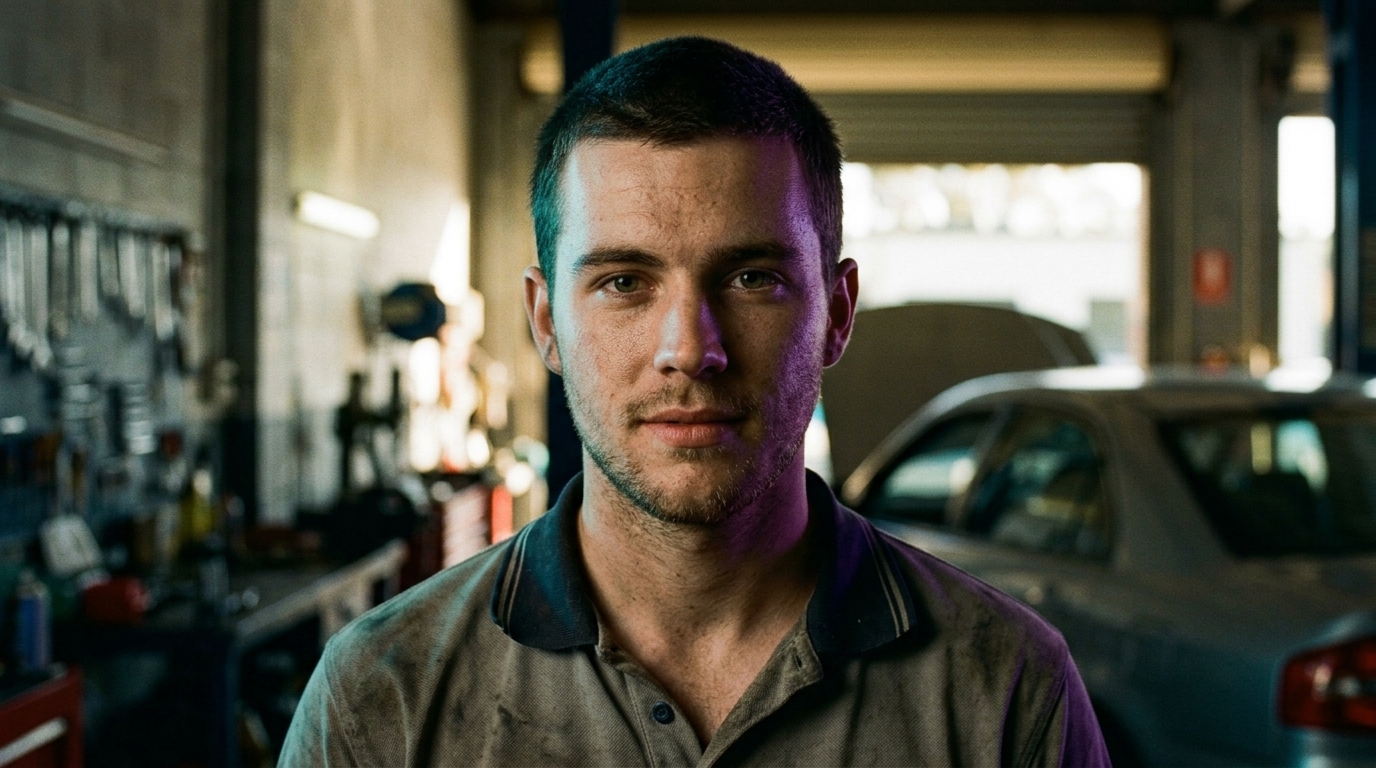
The Boy Who Came Late
Connor Pavel Novak was born on the 22nd of August 2003 at the Lyell McEwin Hospital in Elizabeth Vale, the second child and only son of Stefan Novak and Kylie Novak (née Hammond). His middle name was his grandfather's. In the Novak way — the same that had handed Stefan himself the name of a grandfather he scarcely knew — the boy was given the name of Pavel, the Czech fitter who worked the line at the Holden plant, and it would turn out, against every reasonable expectation, to be the truest thing about him.
He arrived at a poor moment, in the middle of one of his father's longer stretches out of work, into a household where money was the weather and the forecast was seldom good. His sister Taryn was five when he was born, old enough to be enlisted as a small second mother, and the bond that formed between them in those years — fierce, complicated, and load-bearing — would outlast everything else in his childhood.
To Kylie, stretched thin and frightened, the new baby was both another mouth and a fresh reason to keep going. To Stefan he was a son, and for a little while the fact of a son seemed to steady him, though the steadiness never held for long.
The family moved twice in Connor's first years, each rental smaller and cheaper than the last, until they came to rest in a three-bedroom Housing Trust house on a tired street in Elizabeth Downs — not the worst street in the suburb, as his father liked to say, as though that were a thing to be proud of. It was the house Connor would grow up in, and very nearly the only fixed point of a childhood that had few others.
He was a placid baby and a busy small boy, into everything, forever taking the backs off torches and remote controls to see what was inside. Where Taryn was all sharp edges and watchful intelligence, Connor was easier, sunnier, slower to take offence — a child who wanted to be liked and generally was. It was only later that anyone thought to be frightened by how exactly, in his open good nature and his clever hands and his trouble sitting still, he resembled the father who would not stay.
Family Tree
Six Years Old
He was six when his father left.
On a Tuesday morning in February 2010 Stefan went out to a shift and did not come back, and the manner of it — no note, no telephone call, the joint account emptied, half the wardrobe bare — was a thing Connor was too young to take in and too young to be shielded from. Where Taryn, eleven and old enough to understand, forged her hurt into a hard and durable anger, Connor had only questions. He did not understand where his father had gone, or why, or whether it was something he had done, and the not-understanding settled into him in a way the anger never could.
For weeks he asked when Dad was coming home, and the adults' careful, deflecting answers taught him slowly that the question itself was a kind of wound he ought to stop pressing. His father never reached back across the silence. In later years Stefan would post a birthday card to Taryn, and would once go so far as to find Connor on the internet and begin a message before deleting it unsent — so that Connor, in the end, was the child his father did not even manage to try for, a distinction he would only understand much later, and would carry without ever quite naming it.
The particular cruelty of being six was that he could not even hate the man cleanly. Taryn had years of memory to be angry with — the rows, the lies, the lateness — but Connor had almost nothing, a handful of fragments that might or might not have happened: a kick of the footy in the backyard, a hand resting on his head, a voice. He kept those few scraps and, in the way of abandoned children, polished them into something better than they had probably been, an idealised father who bore little resemblance to the man his mother and sister had every reason to despise.
It made for a quiet friction in the house — Connor wanting to remember a dad, the others needing him gone — that took years to wear away, and never entirely did.
What he learned, without anyone teaching it to him, was that his mother would not leave. Kylie rose the morning after Stefan vanished and went to work, and the morning after that, and the relentless, unglamorous fact of her presence became the floor beneath Connor's childhood. He did not thank her for it, any more than children ever do. But he absorbed it, and in the end it shaped the man he became far more than the absent father ever could.
The Ones Who Stayed
The house that raised him was poor, run on routine, and crowded with the women who held it up. Kylie kept the household like a ledger, the mornings timed to the minute and the budget tracked to the dollar, and what she could not give in softness she gave in sheer reliability.
Taryn, five years ahead of him and ferocious on his behalf, cooked the dinners when their mother worked late, stood over his homework, and got him out of the house on the mornings their father had once made dangerous. She was the nearest thing he had to a second parent, and he loved and resented her for it in roughly equal measure, the way boys do the sisters who raise them.
The steadying presences of his childhood were not confined to that house. A few suburbs over, in the old fibro place where his father had grown up, were his grandparents — Pop Pavel, with his heavy accent and his straight rows of staked tomatoes and his shed full of tools, and Nan Dorothy, who was no blood relation to Connor and behaved as though she had never once noticed it. Their house, smelling of brewed coffee and engine oil, was the nearest thing to a refuge his childhood offered, and he was sent there often and went gladly.
Dorothy was not a warm woman in the demonstrative way, but she was unfailingly there — biscuits and cordial on the table, lollies pressed on him against his mother's wishes, a flat and unsentimental affection that asked nothing of him in return. She had spent her life looking after other people's people, and in Connor and his sister she had, late and unlooked-for, something close to grandchildren of her own.
And there was his grandfather. Pavel did not say much and did not need to. He put a spanner in the boy's hand and showed him how a thing came apart and went back together, how to listen to an engine and find the fault rather than curse it. In the quiet of the old man's shed, the radio low and grease working into the creases of their hands, Connor found something he found nowhere else: the company of a man who was glad of him and expected him to stay.
He was far too young to know that he was being handed, in those long afternoons, the one inheritance of the Novak men that had ever been worth having. He only knew that he liked it there, and that his Pop was the steadiest thing in his world.
The Father in the Mirror
Adolescence very nearly undid him. He followed Taryn to Fremont-Elizabeth City High School, an institution doing decent work against long odds, and he was, by every account, a bright boy who could not be bothered — quick to grasp a thing and quicker to lose interest in it, sullen with teachers, happiest out behind the oval where the lessons could not reach him. He was not a bad kid. He was a bored one, and boredom in Elizabeth had a way of finding the cracks that swallowed too many like him.
By fifteen he was running with a rougher crowd, the boys who had already half given up on themselves. There were scrapes — a police caution over a stolen scooter taken for a joyride, a suspension or two, nights his mother sat up with the kitchen light on, not knowing where he was — and there were the mates who did not come through it whole, one to a gaol sentence at nineteen, another lost to the drugs that moved so easily through those streets. Connor walked close enough to that edge to feel the cold air rising off it. What saved him was not wisdom; he had little of that yet. It was, in the end, fear.
The drinking had begun early, the way it did for half the boys he knew, and for a while it was nothing — cans in a park, a session that ran into a Sunday. But Connor, alone among them, was watching himself for it. He had grown up inside a cautionary tale and he knew its shape exactly: the charming, clever, restless man with the good hands and the bad habits, who drank and drifted and finally walked out the door. He had been told, in a hundred small ways, that he was his father's son, and somewhere in his teens the resemblance stopped being a remark and became a threat.
There was a night — he was sixteen, and drunk enough to frighten himself — when he caught his own reflection doing something his father might have done, and he afterwards counted it as the night he decided not to be Stefan. It was not a clean decision and it did not hold perfectly. But the wariness it left him with, the lifelong habit of watching for his father surfacing in himself, became, strangely, the very thing that kept him safe.
His grandfather did not live to see him steady. Pavel suffered a stroke, and then another, and the old man who had shown him an engine was moved into a nursing home in Salisbury, where Connor visited him through the strange, diminishing last stretch and sat beside a Pop who less and less often knew his face. Pavel died in November 2017, when Connor was fourteen, and the loss of him — the one steady man, the one who had stayed — landed harder than Connor had the words for. He stood at the small funeral in the Salisbury chapel and did not cry where anyone could see him. He had learned that much from the men of his family already.
Hands to Hold
What pulled him back from the edge, in the end, was a trade. His mother's brother Wayne had been a mechanic in the northern suburbs all his working life — the uncle who kept the family's tired cars running for the price of the parts — and somewhere in the worst of Connor's teens Wayne began letting the boy hang about his workshop, handing him jobs, putting all that restlessness to use. After Pavel, it was Wayne who became the practical older man at Connor's shoulder, and the timing of it may have saved him.
The workshop gave Connor what school never had: work his hands understood, older men who expected him to turn up and gave him no quarter when he didn't, and the plain dignity of a job done properly with a wage at the end of the week. He scraped through Year 12 — barely, but genuinely, the first real thing he had ever finished — and went straight into a motor-mechanic apprenticeship, some of it under Wayne and some at a franchised workshop in the north.
The trade fitted him the way it had fitted his grandfather, and the symmetry was not lost on the family. The same mechanical gift that Pavel had carried out of the Vítkovice ironworks, that Stefan had been handed and let fall, came to rest at last in the grandson, who closed his hand around it and held on. Connor was good at it — better than he had ever been permitted to feel he was good at anything — and being good at something steadied him as nothing in his life had managed to before.
He took to the rhythm of it: the early starts, the diagnosis of a fault by sound and feel, the satisfaction of sending a thing back out the door working that had come in broken. The men of the workshop were not gentle with him, and he did not need them to be. They were reliable, and they were there, and they expected him back on Monday, and for a young man assembled out of so many departures, being expected back was a quietly powerful thing.
Toolbox and Washing
He grew up slowly, and unevenly, and a good deal later than his sister. Taryn had gone first and gone furthest — university, a degree, a career in conservation, the first of their branch to break clear of the postcode — and though Connor would never have followed her into a lecture theatre, he had absorbed more of her example than either of them quite admitted: the flat refusal to accept that an Elizabeth address settled the question of a life. When she moved out to a unit in Smithfield in 2024, the Elizabeth Downs house fell quiet, and Connor, the last child left in it, became more than ever the one his mother leaned on.
He leaned back in the only language the men of his family had ever spoken with any fluency, which was the language of doing rather than saying. He could not have told his mother that he loved her — the Novak men were hopeless at it, and he was no exception — but he kept her car on the road and her gutters clear, came and went from the house with his toolbox and his washing, and was, simply and reliably, there. It was the same wordless devotion his grandfather had shown a lifetime before, the love that worked itself out in provision and presence, and in Connor, for the first time in three generations, it had arrived in a Novak man who did not also, in the end, leave.
The family's strange brush with notoriety touched him only lightly. When the wealthy Melbourne Novaks erupted into the news in 2023 — the art-collector cousin, the murder investigation, the tabloids unrolling their family trees from Prague to Elizabeth — Connor found the whole circus more absurd than wounding. The rich relations meant nothing to him; he had never met them and never expected to. What angered him was not the scandal itself but the way it reached in and upset his mother and his Nan, and beyond that he gave it very little thought. He had an engine to rebuild, and a far more pressing loss of his own coming.
Dorothy died in her sleep in August 2024. The grandmother who had slipped him lollies and minded him through the leanest years went quietly, and Connor, twenty by then, helped carry her and stood at the larger, warmer funeral that her long, undemonstrative decency had earned.
His father did not come — could not face the children he had abandoned, the family said — and Connor felt the absence less as fresh grief than as confirmation. Whatever softened, idealised version of Stefan he had carried out of his bewildered boyhood had long since worn through, and what was left in its place was a plain and oddly unbitter understanding: the man had left, and the people who stayed were the ones who counted.
By 2026 Connor Novak was twenty-two, and nearer the end of his apprenticeship than its beginning — a qualified set of hands in all but the final paperwork, with a trade, a wage, and a steadiness that the people who had feared for him at fifteen had not quite dared to expect. He still drank, but warily, with one eye always turned on himself. He still lived half at his mother's and half out in the world, a young man not yet fully launched, with a girlfriend the family had taken to and a future whose shape he had not yet settled.
He was not a finished thing, and he knew it. But he had done the one quietly enormous thing that everyone around him had hoped for and no one had dared to ask of him aloud. He had grown up in his father's shadow, carrying his father's restlessness and his father's clever hands and the name of the grandfather they both descended from, and he had not become his father. He had stayed.
In a family of men who left, in a line that ran from Ostrava to Elizabeth on a long current of departures, that was no small inheritance to turn back — and Connor, Pavel's namesake and, as it happened, Pavel's truest heir, had turned it back with grease worked into his hands and almost nothing to say about it.







