4338.206 · July 25, 2018 AD
Concrete, Control, and Other Lies
At Bunnings, Beatrix fights bureaucracy, fragile tempers, and a looming sense of unreality—all for a printout on concrete. But the true fracture comes not from the errand, but from Gladys’s quiet betrayal, a man who shouldn’t be there, and a message from Leigh that changes everything. Again.
"Some days fall apart in loud, obvious ways. Others just fracture—quietly, under the weight of errands and expectations."
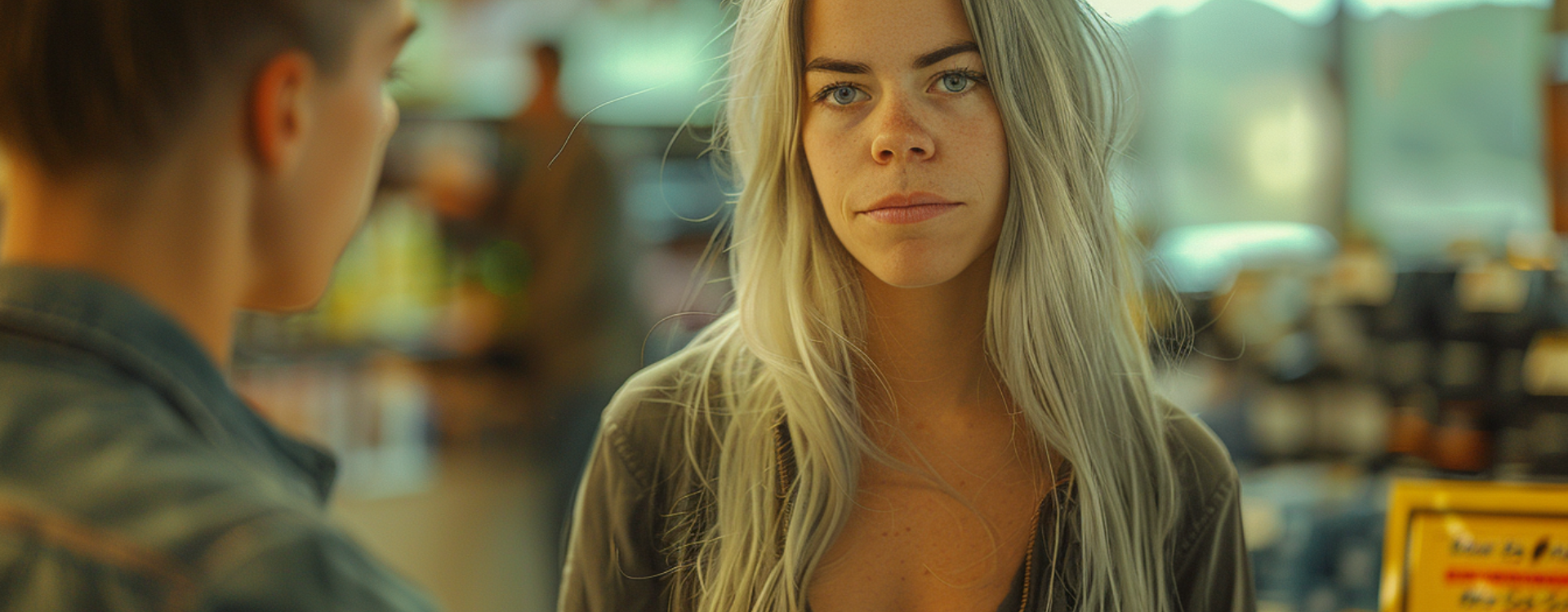
"Next please," the woman at the Bunnings special service counter called out, her voice echoing slightly in the cavernous, dimly lit space filled with the scent of sawdust and metal. Her tone was bland, almost mechanical—just another cog in the relentless churn of retail service. The air carried the faint chill of too-strong air conditioning, biting at the back of my neck as I stepped forward, the rubber soles of my joggers scuffing softly against the polished concrete floor.
I glanced briefly over my shoulder at Gladys, who was loitering aimlessly near a display of hose fittings, then turned back to face the counter. The woman behind it wore a faded green vest and an expression that bordered on boredom.
"Hi," I began, trying to inject a note of friendliness into my voice, though it came out sounding slightly too bright, like cheap brass. "I’m after some information on pouring concrete, please." My hands found each other and clasped automatically at my waist, fingers curling and uncurling as I tried to project composure.
"Just a minute," the woman replied without looking up, already swivelling towards the ancient, dust-dulled computer beside her. Her fingernails clacked against the keyboard, sharp and methodical, as she navigated her way through the digital labyrinth of PDFs and how-to guides. I waited, stomach churning with a peculiar blend of impatience and anxiety. We didn’t have time to linger. Every minute spent here felt like a coin flipped, fate choosing between discovery or escape.
"There we go," she finally said, her voice a notch more cheerful, as she turned the screen towards me with a sort of performative flourish that suggested she’d done this same task a hundred times already that morning.
I leaned in, squinting at the document that appeared on the screen. Something about mixing ratios and curing times blinked back at me in clinical black text, but I barely registered it. I didn’t even bother to read the top line. What do I care for concrete, really? The entire errand felt surreal—this dispassionate guide to building something solid and permanent, while our own lives were on the verge of crumbling under everything we were hiding.
It was just another checkbox, another task in the great theatre of pretending everything was normal.
"Great. Can I get that printed please?" I asked, my smile so forced it felt brittle, a transparent film stretched too thin across my face.
"We don’t do printing," the woman replied bluntly, her voice flat. The fluorescent light above her flickered, casting a momentary shadow over her face that only seemed to deepen the stern set of her jaw.
"Oh, come on! It’s what, two pages?" I retorted, my patience fraying by the second. I could feel the heat rising in my cheeks, the simmering edge of irritation prickling beneath my skin. This day had already wrung me out—emotionally, physically—and now this woman, with her clipped tone and robotic adherence to policy, was one bureaucratic brick wall too many.
"Company policy," she replied with a shrug and a turned-up nose, her expression carved from indifference. It was a dismissal, pure and simple, delivered with the kind of empty coldness that grated against every nerve. Her nonchalance stung like a slap, as if the logic of my request were beneath her notice.
"Well, that’s a shit policy. Look, I’ll even pay you to—" My protest was abruptly cut short as a young man stepped in from the side, his voice breaking through the tension like a sudden gust of wind through a stagnant room.
"Just print the damn pages for her, Lara. It’ll take you two seconds," he told her, his tone firm, though not unkind. There was a warmth in his voice, a flicker of decency that caught me off guard. For a moment, the oppressive atmosphere seemed to lighten, like a cloud lifting.
Lara released a loud, theatrical huff, the sound reverberating across the sterile, too-bright counter like a minor explosion. Her expression twisted in annoyance, and I braced myself for further resistance. But instead, she spun sharply to the side, her movements clipped and irritable as she reached towards the printer. The machine wheezed to life with a mechanical hum, spitting out pages with all the enthusiasm of a reluctant servant.
Without a word, she yanked the freshly printed sheets from the tray and slapped them onto the counter, her palm pressing them down with a finality that was as petulant as it was satisfying. The papers slid towards me, and I took them without a word, biting back the retort that burned at the back of my throat.
Jake—if that was his name, I decided he looked like a Jake—flashed a brief, knowing smile. A small gesture, but in that moment, it felt like someone had seen me, acknowledged the absurdity, and extended a quiet nod of solidarity.
I returned a tight-lipped smile, clutching the pages like they were a hard-won prize in a world that insisted on making everything more difficult than it needed to be. The paper was still warm in my hands, its edges slightly curled from the heat of the printer—ridiculously symbolic, like some fragile artefact wrested from a petty tyrant.
Eyes narrowing at the woman—not just in anger, but also in a silent promise of remembered grievances—I collected the papers, holding onto my restraint like a thin shield. My jaw tensed. A dozen biting responses flitted through my mind, but I let them die on my tongue. Not today. Not her.
Turning my attention to the man who had stepped into the fray, I felt a mix of gratitude and mild embarrassment. It was one thing to hold your ground, another to need rescuing from a printer policy.
"Thank you," I said, my voice carrying a note of genuine appreciation, softening the sharpness that had defined the last few minutes. I paused, letting my eyes flick to his name tag, confirming what I’d already decided. "Jake," I finished, smoothing over the moment with as much grace as I could muster.
"No problem," replied Jake, his voice light, tinged with amusement. "Enjoy your concrete," he added with a smile that actually reached his eyes—a rare sight in a place like this.
I didn’t mean to, truly. The guy was nice, genuinely so. But my eyes rolled instinctively anyway, a reflex born of long habit and thin patience.
"Yeah," I replied, the word dry as dust, laced with a lack of enthusiasm that belied the flicker of gratitude underneath. Before turning to leave, I gave Lara one last glare over my shoulder—a silent parting shot that said more than words ever could. She met it with blank indifference, unmoved. No surprise there.
"Rude bitch," I heard Lara mutter under her breath as I walked away, her voice low but sharpened with venom. The insult sliced through the air like a thrown dagger, petty and meant to sting. My grip on the pages tightened instinctively, the edges crumpling beneath my fingers.
But no—I stopped myself. I wasn’t going to give the cranky woman the satisfaction of another round, wasn’t going to let her drag me into some pointless, ego-fuelled exchange. With every step I took away from the counter, I forced myself to breathe, to unclench my fist and smooth out the papers. Each movement became an act of defiance, of calm reclaimed, of composure won back inch by inch. I would not carry her bitterness with me.
Not today.
I soon found myself navigating through an aisle crammed with an extensive array of shelving solutions, each one promising organisation and ease—a tidy lie dressed up in glossy packaging. It was a jarring contrast to the chaos of my current search for Gladys. The shelves towered on either side, metal giants that cast long, skewed shadows beneath the flickering industrial lights. Their orderly presence only served to highlight the disarray swirling in my head. Still no sign of her.
I slowed my steps, the soles of my joggers scuffing softly against the polished concrete. My eyes scanned the rows ahead, past neatly stacked particle board, rows of metal brackets, and signs boasting "Heavy-Duty Strength!" and "Easy Assembly!" But of Gladys, there was no trace. I frowned, a crease knitting between my brows as an uneasy flicker of doubt took hold. Surely, I hadn’t taken that much longer than her. She should’ve been waiting—shouldn’t she?
"Excuse me," I said, stepping towards a young servicewoman crouched near the end of the aisle, her focus trained on a stack of price tags she was meticulously updating.
Her hands moved with the calm of someone well-practised in quiet routine. She looked up, blinking once as if surfacing from deep concentration, then turned to face me with an open, curious expression.
"How can I help you?" she asked, her tone warm, not the forced cheer of customer service, but something more genuine—soothing in a way I hadn’t expected.
I let out a breath I hadn’t realised I was holding. "I’m looking for my sister," I said, brushing a stray strand of hair behind my ear. "We were meant to meet up here—she was coming to get an assortment of shelves." I tried to keep my voice light, but the edge of worry must have slipped through. Even something as mundane as misplacing Gladys now felt like one more thread tugging at the fabric of my sanity.
"About this high, with reddish-brown hair down to here?" the woman asked, gesturing to mid-back. Her name tag caught the overhead lights: Melissa.
"That’d be her," I replied, a relieved smile tugging at the corners of my mouth. Just hearing someone describe her felt like confirmation that she hadn’t vanished into thin air. The tension I’d been holding eased slightly, a knot slowly unravelling.
Melissa chuckled softly, a light, genuine sound that drifted through the space like a breeze. "She had quite a large order. Jarod went to help her take it outside," she said, her smile widening.
Of course she did. That tracks. I should’ve known Gladys wouldn’t go halfway on anything—not even shelves.
"Thank you, Melissa," I said with honest gratitude. Her kindness, unexpected yet sincere, felt like a balm against the abrasiveness of the day. One small, human moment of normality amid the absurdity. I tucked it away in my mind like a lucky coin.
With a renewed sense of direction, I made my way towards the exit, Melissa’s helpfulness still echoing pleasantly in my thoughts. The tension coiled tight across my shoulders began to loosen, the burn of earlier irritation dulling with each purposeful step. Reuniting with Gladys now took on a fresh urgency—equal parts anticipation and exasperation.
I stalked across the asphalt car park in a huff, my joggers hitting the ground with sharp, deliberate thuds. The vast expanse of bitumen stretched out like a stage, and I, the unwilling actor, stormed across it, bracing for my next scene. The chill in the late afternoon air stung my cheeks as I spotted her—near the far end, beside our truck, the familiar shape of her form framed against the fading light.
There she was. Gladys.
I could see her gesturing animatedly, thanking a young man—Jarod, presumably—as he slid the tailgate shut. She moved with an energy I hadn’t expected, her face lit with that spark she always got when she felt she’d solved something cleverly. She turned, hand reaching for the driver’s side door.
My stomach dropped.
"Gladys!" I shouted, my voice sharp in the cold air, urgent and raw. I broke into a run, joggers skidding slightly on loose gravel, lungs heaving not just from the exertion, but from the flood of frustration rising in my chest. I needed to reach her before she took the wheel. That one symbolic act—taking the driver’s seat—wasn’t trivial. It was mine.
"Did you get it?" asked Gladys, her voice light, tinged with what sounded dangerously like excitement. She was completely unaware of the storm that had gathered behind my eyes.
"You didn’t have to leave me there!" I snapped, waving the crumpled papers like a battle standard, the edges now softened and curled in my sweat-damp grip. The sheets were meant to represent something useful, purposeful. Instead, they had become my evidence—proof of being abandoned.
"I didn’t leave you there," Gladys shot back, climbing into the cab with maddening calm. "Jarod offered to help," she added, as if the explanation would somehow erase the bristle in my chest.
The door slammed shut behind her with a hollow thunk that rang out across the car park like a gavel hitting the bench. Decision made. Scene ended. No room for rebuttal.
I turned my back to the truck, fists clenched by my sides. This wasn’t just about the seat. It never had been. She knew I wanted to drive. Knew that being behind the wheel meant more than steering—it was control, direction, agency. It was being the one to keep us from crashing. And she’d taken it from me with a shrug and a smile, like it didn’t matter at all.
A thin, tall man caught my attention from across the car park, cutting through my frustration like a blade through cloth. He was half-shrouded in shadow near the corner of the building. He wasn’t moving—just standing there. Still. Intent. There was something in the way his shoulders tilted forward, in the unnatural stillness of his limbs, that sent a ripple of unease crawling over my skin.
I froze, the papers in my hand forgotten as I squinted towards him. His presence didn’t feel like coincidence. No trolley. No bag. No reason to be there—except to watch. And I was certain that’s exactly what he’d been doing.
My breath caught in my throat. A cold, instinctive dread began to bloom in my chest, a quiet alarm bell that chimed deep within my bones. I tried to look away, to shake the chill from my spine and dismiss the feeling as paranoia—but the certainty that his eyes hadn’t left us refused to lift.
"You getting in then?" Gladys’s voice broke the moment, snapping through the rising tension like a stone through glass. She leaned out the window, her face expectant and unaware, her tone brushing off the fear tightening my chest.
Before I could reply, a large white van pulled up behind the truck, its engine humming low as it waited for a nearby car to reverse. It rolled to a gentle stop, momentarily obscuring my view of the building’s corner—of him. The interruption lasted only seconds, but the moment the van trundled forward again and cleared my line of sight, my stomach dropped.
He was gone.
The corner stood empty now, as if the man had never existed. No lingering figure, no departing footsteps. Just bare concrete and shadowed light.
I blinked, heart hammering against my ribs like a warning drum. A lingering question sat heavy in me: had I imagined him? Or had he meant to be seen?
The earlier argument with Gladys dissolved in an instant, swept away by the raw urgency coursing through me. The instinct to drive had vanished, replaced now by a sharper instinct—get away.
Forgetting my stubbornness and letting fear take the reins, I yanked open the passenger door and climbed inside, my movements brisk and clipped.
"Let’s get out of here," I ordered, the command in my voice sharper than intended, a jagged edge betraying the anxiety clawing at my insides.
I shut the door with a firm thud and immediately locked it. A small act, maybe, but it felt like the only barrier I had between us and whatever had just disappeared into the shadows.
The engine started with a clunky rattle, coughing like an old man in winter, a mechanical protest that echoed the strain of the day. As the truck shuddered to life beneath us, I instinctively glanced out the window, half-expecting to see that lanky, silent watcher materialise again from the shadows. But the space where he had stood remained hauntingly empty. Still, the feeling lingered—that eerie sensation of being observed. It clung to me like smoke, acrid and impossible to shake.
Gladys manoeuvred us through the car park, her grip on the wheel tight, but I could see the fatigue in her posture, the way her shoulders sagged between each cautious turn. The truck jolted over a speed bump, and my thoughts were momentarily scrambled—until the sharp ping of my phone snapped me back.
A notification had appeared, glowing with quiet menace on the screen. My stomach twisted even before I read it. I already knew—knew—this message wouldn’t bring peace.
Leigh: Change in plans. Package on your bed – needs delivery. You’ll get address soon.
"No!" The word erupted from my mouth, loud and unfiltered, startling even me. It rang through the truck like a crack of thunder, shattering the already brittle calm.
Gladys braked harder than necessary, eyes darting towards me. Her expression was taut with irritation, laced with unspoken questions. "What now?" her gaze seemed to demand, but before she could voice it, I cut in.
"I need to go home," I said bluntly, too rattled to care about tone, unable to coat the urgency with tact. There wasn’t time. The message had flung open a door to something darker, more immediate, and I could already feel it creeping closer, cold fingers brushing the back of my neck.
She stared at me, her eyes hard, unyielding. Her lips parted in protest, but before a single word could be spoken, a sharp honk blared from behind. The ute behind us was impatient, its driver gesturing angrily through his windscreen. But Gladys didn’t hesitate. With a sharp crank of the wheel, she took a left, cutting boldly into traffic, her sudden decisiveness both reckless and remarkable.
I grabbed the door handle out of instinct as the truck veered onto the new path. My heart was thudding hard enough to hurt, and still I could feel Leigh’s message pressing down on me. This wasn’t just a change in plans. This was a shift in the air—an escalation.
My phone buzzed again, a second vibration that pulsed through my hand like a warning shot. I hesitated. I didn’t want to look, not really. But I had to.
Slowly, I tilted the screen towards me.
Leigh: 655 Main Road Berriedale @ 7.15pm
The digits burned into my brain, as if they had been carved there with a hot brand. A time. A place. A deadline I hadn’t agreed to but couldn’t refuse. The weight of inevitability sank deep into my bones.
Whatever Leigh had left for me… I was about to walk straight into it.







