4344.35 · February 4, 2024 AD
Coffee with Aylin
Aylin Demir has called four times. Mira Osman has answered none of them. When her oldest friend finally corners her into a Sunday afternoon at a Beyoğlu café, Mira finds herself caught between the warmth of a decade-long friendship and the silence her work demands. Aylin sees everything — the exhaustion, the evasion, the grief Mira won't name — and asks the question Mira can't answer honestly. Some secrets don't protect the people who keep them. They just hollow out everything around them.
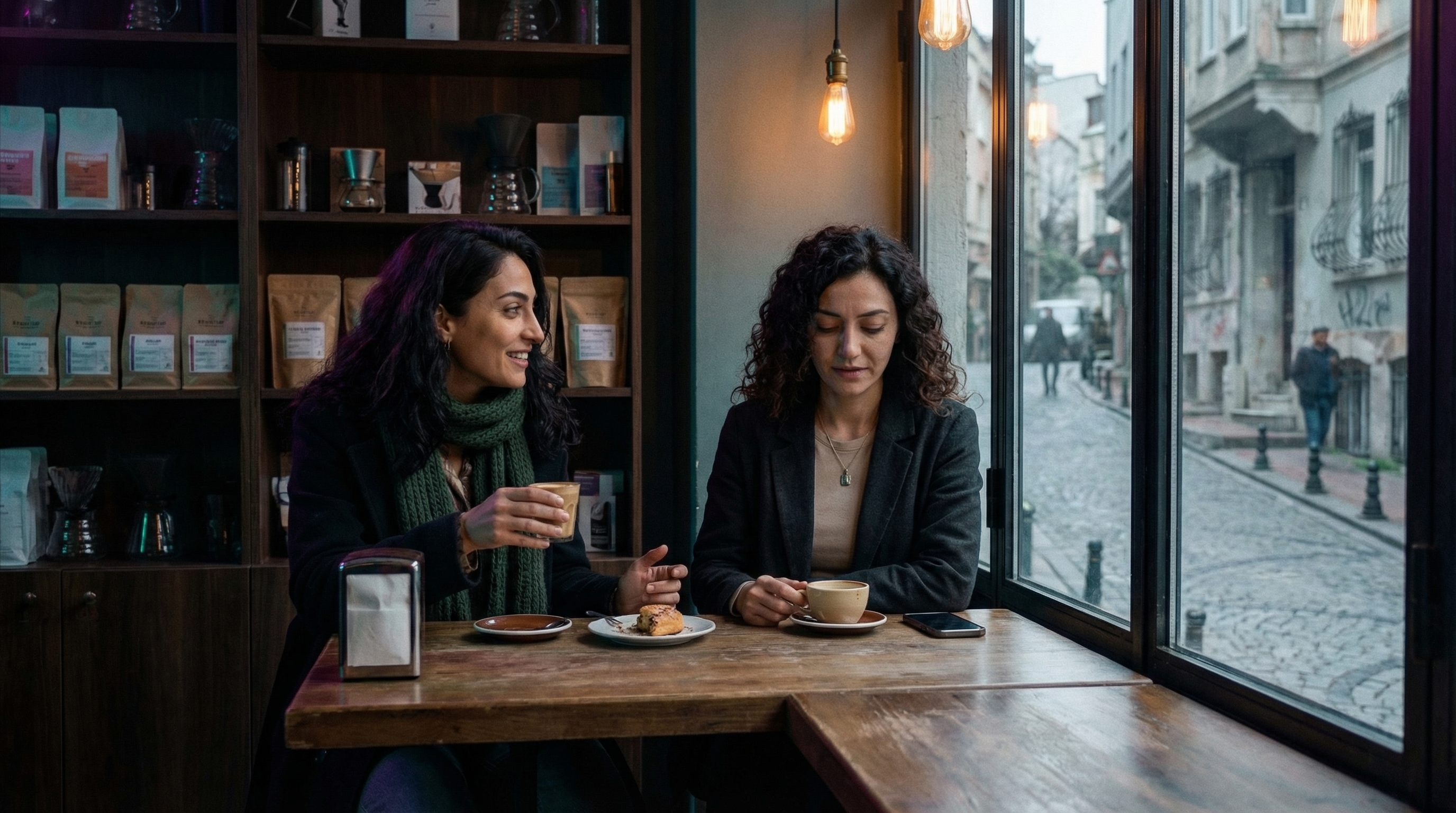
"The hardest part isn't the secrecy. It's smiling at someone you love and knowing the smile is a wall."
Aylin had chosen Kronotrop on Serdar-ı Ekrem Caddesi, which was exactly the kind of place she always chose—bright, airy, the sort of speciality coffee shop where the baristas knew the altitude at which your beans were grown and would tell you about it whether you asked or not. I preferred the old-style çay houses where nobody asked your name and the glasses came tulip-shaped on silver trays and nobody expected you to have opinions about single-origin processing methods.
But Aylin had chosen, because Aylin had been the one to insist on this meeting, and because I owed her at least three returned phone calls and a month of normal human behaviour I hadn't delivered.
She was already there when I arrived. Of course she was. Aylin Demir was constitutionally incapable of being late to anything, a quality she attributed to her mother's influence and which I attributed to the fact that she'd spent four years at Boğaziçi arriving twenty minutes early to every lecture whilst the rest of us scrambled in with wet hair and half-eaten simit. She was sitting at a corner table by the window, winter light falling across her dark hair, scrolling through her phone with the particular intensity of someone composing something she'd delete before sending.
She looked up when I walked in and her face did that thing it always did—broke into a grin that was simultaneously warm and accusatory, the kind of smile that said I'm so happy to see you and you absolute disaster of a human being in equal measure.
"Mira Osman." She stood, pulled me into a hug that smelled like her usual perfume—something amber and woody that she'd been wearing since third year. "You are alive. I was starting to draft the missing person report."
"I'm sorry," I said, and I meant it. "I've been—"
"Buried in work. I know. You're always buried in work. Sit down. I already ordered you a flat white because you take forty minutes to decide and I refuse to wait that long."
I sat. The café was half-full—Sunday afternoon regulars, laptops open, the low hum of conversation mixing with the espresso machine and something acoustic playing through the speakers that I couldn't quite identify. Through the window, Serdar-ı Ekrem Caddesi sloped downhill towards Galata, and a cat—orange, imperious, absolutely convinced the pavement belonged to it—sat on the ledge outside watching pigeons with predatory disinterest.
Aylin studied me with the frank appraisal she'd perfected over ten years of friendship. We'd met during orientation week at Boğaziçi in 2014—both of us archaeology students, both of us slightly lost on campus, both of us ending up at the same table in the South Campus canteen because every other seat was taken. She'd been reading Elif Şafak; I'd been translating Akkadian verb forms for fun. She'd looked at my notebook, looked at me, and said, "Is that cuneiform? That's either the most impressive or the most concerning thing I've seen this week."
Ten years. She'd since pivoted from archaeology to journalism—she was now a features writer for Cornucopia, the English-language arts and culture quarterly, writing long-form pieces about Ottoman architectural restoration and contemporary Istanbul gallery scenes and the quiet war between heritage preservation and property development. She was good at it. She was good at most things she tried, which had always been one of the mildly infuriating aspects of being her friend.
"You look tired," she said. Not unkindly. Just factually.
"I'm fine."
"You have circles under your eyes that could store rainwater. When did you last sleep properly?"
"I sleep."
"That's not what I asked." She wrapped both hands around her own cup—oat milk cortado, because Aylin had opinions about milk alternatives the way other people had opinions about politics. "I asked when you last slept properly. Eight hours. In a bed. Without waking up at 3 AM to go and stare at whatever old document has currently kidnapped your brain."
I laughed, because she wasn't wrong. "It's been a busy few weeks."
"A busy few weeks," she repeated. "You ignored four calls, three texts, and a voicemail in which I was genuinely entertaining. I made a joke about your clay tablets. It was my best material."
"I heard it. It was decent."
"It was exceptional and you know it." She sipped her cortado. "So. Talk to me. What's happening with you? And don't say 'work,' because work is not a personality, no matter how hard you try to make it one."
The flat white arrived, carried by a barista with a man bun and the quiet confidence of someone who believed deeply in the transformative power of properly extracted espresso. I wrapped my hands around the cup, let the warmth seep into my fingers. It was cold outside—February in Istanbul, grey skies, the Bosphorus wind cutting through the streets—and I hadn't worn a thick enough coat because I'd been distracted when I left the flat, thinking about Fragment 847-C and whether Tariq would respond today even though it was Sunday and he almost certainly wouldn't.
"I found something at work," I said. Which was true. Spectacularly insufficient, but true.
Aylin raised an eyebrow. "Something good?"
"Something... potentially significant. It's hard to explain."
"Try me. I write about Ottoman hamam restoration for a living. My threshold for obscure historical excitement is higher than you think."
And this was the moment. The moment that came in every conversation with every person I cared about, the point where the truth pressed against my teeth and I had to swallow it back down. Because I couldn't explain. Couldn't tell her that I'd found a 4,500-year-old employment contract bearing the name of a man whose bloodline had been tracked across four millennia by an organisation that officially didn't exist. Couldn't explain that I was now searching archives worldwide for additional fragments of his story. Couldn't describe the particular quality of excitement and dread that came from suspecting you'd stumbled into something vast and terrifying and desperately important.
Couldn't mention The Preservation. Couldn't mention the bloodline. Couldn't mention Azariel.
"It's a document," I said. "Old. Potentially connected to other documents I've been looking for. It's probably nothing, but it might be something, and I've been spending a lot of time trying to find out which."
Aylin waited. She was good at waiting—journalistic instinct, the understanding that silence often extracted more than questions. But I had nothing more to give her.
"That's it?" she said eventually.
"That's it."
"You disappeared for a month because you found a document that might be something."
"It's been three weeks, not a month."
"Oh, well then. Three weeks of radio silence over a document. That changes everything. I retract my concern entirely."
I deserved that. I knew I deserved it. Aylin's sarcasm was proportional to how much she cared, and right now she cared quite a lot.
"I'm sorry," I said again. "I know I've been absent. It's not intentional. I just get—"
"Consumed. I know. I've watched you do it for a decade, Mira. You find something that interests you and the rest of the world just... stops existing." She leaned forward, elbows on the table. "But that's not the same as being okay. And I'm asking if you're okay."
The directness of it caught me off guard. Aylin had always been capable of shifting from banter to sincerity without warning, like a river that looked shallow until you stepped in and found the depth.
"I'm okay," I said.
"Are you? Because your grandmother died two months ago, and you barely talked about it at the time, and you haven't mentioned her since, and now you've vanished into your work in a way that even by your standards is extreme. And I'm sitting here watching you check your phone for the third time since you sat down—"
I put the phone face-down on the table. I hadn't realised I'd been doing it.
"—and I'm wondering whether 'I found a document' is actually code for 'I'm not coping and I don't know how to say it.'"
The café noise seemed to recede. The espresso machine hissed. Someone laughed at a table near the door. The orange cat outside had moved on, replaced by a grey one with a torn ear who looked like it had seen things.
"I'm not using work to avoid grief, if that's what you're asking," I said. Though even as I said it, I wasn't entirely certain it was true. The timing of the discovery—Ayşe dying in December, the tablet appearing in January—had collapsed grief and purpose into something I couldn't easily separate. Was I obsessed with Azariel's trail because it mattered, or because chasing it meant I didn't have to sit still long enough to feel the full weight of losing the woman who had shaped my entire adult life?
Both. Probably both.
"Nene would have been excited about what I found," I said, and my voice did something I hadn't expected—thinned slightly, caught on something just below the surface. I took a sip of coffee to cover it.
Aylin's expression softened. "I know she would have. She was always your biggest champion, even when nobody understood what either of you were actually doing." A pause. "You know, I came to her funeral and I realised I barely knew her. You talked about her all the time at university, but I'd only met her twice. Once at your graduation, once at that iftar your parents hosted. She seemed... formidable."
"She was."
"And you miss her."
"Every day."
Aylin reached across the table and squeezed my hand. Her fingers were warm from the cortado. "Then stop disappearing, you idiot. The dead don't need us. The living do."
It was the kind of thing Aylin said—blunt, unsentimental, and so precisely right that it hurt. I wanted to tell her everything. Wanted to explain that the disappearing wasn't carelessness but necessity, that the work I was doing wasn't private-collection cataloguing for wealthy families but something so much larger and stranger and more frightening that I sometimes lay awake at night wondering if I was losing my mind. That my grandmother hadn't just been a formidable old woman who loved history—she'd been a soldier in a four-thousand-year war to protect something most people didn't know existed.
I wanted to tell Aylin about the bloodline. About the vaccine. About Fragment 847-C sitting in a Cairo archive, possibly containing evidence of a slave transaction witnessed by a man who'd died four and a half millennia ago. About the fact that I couldn't get vaccinated, couldn't explain why, couldn't tell anyone what I carried in my blood or why it mattered.
But the first rule of The Preservation was silence. Had been silence for four thousand years. Archive Keepers did not share. Did not confide. Did not pull friends into a world they couldn't understand and shouldn't have to carry.
So I squeezed her hand back and said, "You're right. I'll be better."
"You always say that."
"I always mean it."
"And then you find another fascinating scrap of clay and I don't hear from you for six weeks."
"This time will be different."
"Mira." She fixed me with the look she used when interviewing evasive gallery owners. "Don't promise me different. Just promise me you'll answer the phone when I call. Even if it's just to say 'I'm alive, I'm obsessed, I'll surface eventually.' I can work with that. What I can't work with is silence."
"I promise."
"Good." She released my hand and picked up her cortado. "Now. Tell me something real about your life that isn't work. Have you eaten today? Have you been outside this week? Have you spoken to another human being who isn't a dead Mesopotamian?"
I laughed. A real laugh, the first one in weeks that didn't feel like performance. "I had breakfast. Toast. And I'm outside right now."
"Toast doesn't count as a meal, and leaving the flat under duress because your friend threatened to report you missing doesn't count as going outside."
"You didn't threaten to report me missing."
"I was working up to it." She grinned. "How are your parents? Have you called them?"
"Last week. Baba asked if I'd considered applying for a university position again. Anne asked if I was eating enough vegetables."
"Both excellent questions. Are you? Considering university, I mean. Not the vegetables. I already know the answer to the vegetables."
"I'm not. The work I'm doing now is more important than—" I stopped myself. More important than what? Than a legitimate academic career? Than the life my parents understood and approved of? I couldn't explain why, couldn't justify the choice in terms that made sense outside of a context I wasn't allowed to share. "It's where I need to be right now."
Aylin studied me again. That quiet, appraising look that made her a good journalist—the ability to hear what people weren't saying as clearly as what they were.
"You know," she said, "sometimes I feel like there's a whole part of your life I don't have access to. Like you've got a room in your flat that you keep locked, and every time I ask about it you tell me it's just storage."
My chest tightened. She was closer than she knew.
"Everyone has private rooms," I said.
"Sure. But most people's private rooms don't make them vanish for weeks at a time." She held up a hand before I could respond. "I'm not pushing. I'm just telling you what it looks like from the outside. It looks like you're carrying something heavy and pretending it weighs nothing."
The accuracy of that was almost unbearable.
We sat with it for a moment. The café continued around us—cups clinking, the barista calling out an order, winter light shifting across the table as clouds moved over Beyoğlu. Normal life. The kind of Sunday afternoon that millions of people were having across Istanbul right now, catching up with friends, drinking coffee, talking about work and family and the small, ordinary business of being alive.
I wanted this. Wanted the ordinariness of it. Wanted to be the kind of person who could sit in a café on a Sunday and not be mentally cataloguing every archive in the Eastern Mediterranean for fragments of a Bronze Age scribe's employment history.
But I wasn't that person. Hadn't been since I was twenty-one, since Ayşe had shown me a clay tablet in a Karaköy café and asked me what I saw.
"Tell me about you," I said, steering us onto safer ground. "How's the Cornucopia piece going? The one about the Süleymaniye restoration?"
Aylin let me redirect. She always did, eventually—pushed hard, then relented when she saw the wall wasn't moving. It was one of the things I loved about her, and one of the things that made me feel worst about the lies between us. She respected my boundaries even when she could see they were costing me something. Even when she knew they were costing us something.
She talked about her article—the politics of restoration funding, the tension between modernisation and preservation, the particular frustration of interviewing bureaucrats who used fifty words to say nothing. She was animated, funny, passionate about the subject in a way that made me remember why we'd been friends in the first place. We'd both cared about the past. Both understood that old things mattered, that history wasn't dead weight but living architecture, that preserving what came before was essential to understanding what might come next.
She just didn't know how literally I'd ended up living that conviction.
We talked for another hour. She told me about a man she'd been seeing—Emre, an architect, met him at a book launch in Kadıköy, three dates so far, cautiously optimistic. I told her about the pigeon that had somehow got into the Karaköy facility last month and caused mild panic among the conservation team. She told me about her mother's ongoing campaign to convince her that twenty-seven was practically middle-aged and grandchildren were a reasonable expectation. I told her about the documentary I'd watched about Göbekli Tepe and how the new dating evidence was rewriting everything we thought we knew about Neolithic ritual practice.
It was good. It was normal. It was the closest I'd felt to myself in weeks—the version of myself that existed outside of Archive Keeper responsibilities, outside of bloodlines and ancient contracts and the slow-building panic of knowing something terrible had happened to the world and not being able to tell anyone.
But even as I talked and laughed and drank my flat white, part of me was somewhere else. Part of me was in Cairo, in an archive I'd never visited, wondering about Fragment 847-C. Part of me was in Sub-Level Three of the Karaköy facility, standing in dust that hadn't been disturbed in two centuries, holding a clay tablet that had changed everything. Part of me was in my flat, surrounded by cold tea and notebooks and photographs arranged under a lamp at angles I kept adjusting because maybe, if I got the light exactly right, they'd reveal something new.
Part of me was always somewhere else. That was the cost.
We said goodbye on the street outside. The afternoon had dimmed towards early evening, the light going grey-gold over Beyoğlu's rooftops. Aylin pulled her scarf tighter—emerald green, she'd always had better colour instincts than me—and hugged me again.
"Call me back next time," she said into my shoulder. "Don't make me hunt you down."
"I will."
"And eat something that isn't toast."
"I'll try."
She pulled back, held me at arm's length, studied my face one more time. Whatever she was looking for, she either found it or decided it could wait.
"You know I love you," she said. "Even when you're being impossible."
"I know. I love you too."
"Good. Then act like it." She kissed my cheek—a very Aylin gesture, warm and bossy and full of the particular kind of love that refuses to be polite about caring—and turned down the hill towards Galata, phone already in hand, probably texting Emre, returning to a life that made sense in ways mine had stopped making sense years ago.
I watched her go. The emerald scarf disappeared around a corner. A tram rattled past on İstiklal Caddesi, one block over. The call to prayer would start soon—it was almost sunset—and Istanbul would do what Istanbul always did at this hour, pause for a moment between the noise of the day and the noise of the evening, the whole city taking a breath.
I walked the other direction, up through the narrow streets towards Cihangir. The air was cold and smelled like roasting chestnuts from a vendor's cart on the corner. I bought a small paper cone of them, because Aylin had told me to eat something and chestnuts were technically something. They were warm in my hands. Small comfort. Real comfort.
I thought about what Aylin had said. It looks like you're carrying something heavy and pretending it weighs nothing.
She wasn't wrong. She was almost never wrong about me, which was both the gift and the curse of having a friend who paid close attention. She could see the shape of the secret even if she couldn't see the secret itself. Could feel the distance between us growing wider with each conversation where I gave her half-truths wrapped in real affection and hoped she wouldn't notice the difference.
But she noticed. Of course she noticed.
I climbed the hill to my flat. Let myself in. The mess was exactly as I'd left it—notebooks, printouts, photographs of the Kisura contract, five glasses of abandoned tea marking the geography of my obsession across every available surface. The Bosphorus was darkening outside my window, cargo ships moving like slow thoughts through the strait, their lights beginning to blink on against the falling dusk.
I put the chestnuts on the kitchen counter. Washed two of the tea glasses. Opened the window for exactly thirty seconds—long enough to let the cold air shock me, short enough not to freeze the flat.
Aylin was right about everything. I was tired. I was grieving. I was carrying something heavy and pretending it weighed nothing. I was losing my grip on the ordinary world, retreating into archives and fragments and the consuming search for a man who'd been dead for four and a half thousand years.
And none of that was going to change. Because the work mattered. Because the bloodline was collapsing. Because somewhere in the scattered archives of the ancient world, Azariel's story was waiting to be found, and I was the person looking for it, and there was no one—not Aylin, not my parents, not anyone—I could share that burden with.
I stood at the window. The call to prayer began, rising from minarets across the city, layering voice upon voice until Istanbul itself seemed to vibrate with the sound. It was beautiful. It was always beautiful. Four years of living in this city and it still stopped me, every time, that ancient human impulse to fill the sky with longing.
I picked up my phone. No email from Tariq. I hadn't expected one. It was Sunday.
I put the phone down. Ate a chestnut. Looked at the Bosphorus.







