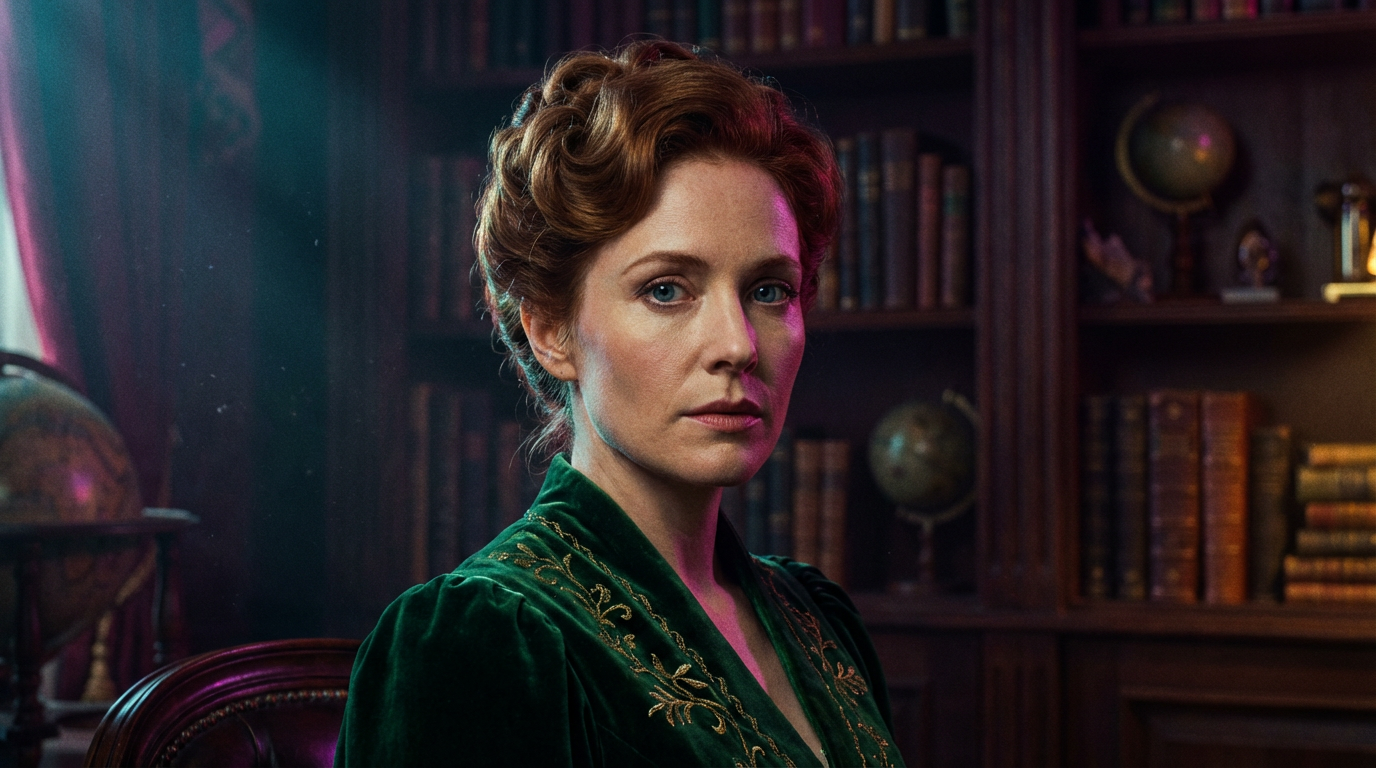
Clara Winifred Blackwood (née Johnson)
Clara Winifred Blackwood, née Johnson (1847–1918), was a Launceston-born woman whose social acuity and domestic management sustained both the Blackwood household and the professional reputation of her husband, Robert Cornelius Blackwood, for nearly five decades. She navigated Hobart's social and institutional landscape with an intelligence that her formal education had not been designed to cultivate, and died of influenza in the final months of the Great War, at the age of seventy-one.
Early Life and Family
Clara Winifred Johnson was born on 8 May 1847 in Launceston, Tasmania, the third of six children born to Edmund Arthur Johnson, a merchant dealing in agricultural supplies and livestock equipment in the northern Tasmanian districts, and Harriet Johnson, née Foley, the daughter of a Deloraine farmer whose family had settled the Meander Valley in the 1820s. The Johnson household occupied a comfortable weatherboard house on Charles Street, within walking distance of Edmund's premises near the Tamar wharf, and the rhythms of Clara's childhood were shaped by the seasonal patterns of the rural economy that her father's business served — the autumn livestock sales, the spring orders for fencing wire and seed drills, the winter quietness when bad roads reduced the northern districts to something approaching isolation.
Clara's siblings arrived with the regularity that the 1840s and 1850s demanded of Tasmanian families. Her eldest brother, Edmund George Johnson, born in 1843, eventually took over the family business. Her sister Harriet Mary, born in 1845, married a Devonport timber merchant and bore seven children in eleven years, a trajectory that Clara observed with the mixture of affection and private horror that women of her era reserved for the reproductive experiences of their close relatives. Clara herself was followed by twin boys, Arthur and James, born in 1850, of whom Arthur survived to adulthood and became a stock agent in the Midlands whilst James died of diphtheria at the age of four — a loss that cast a particular shadow over the household during Clara's formative years. The youngest, Florence, born in 1853, trained as a nurse and spent much of her adult life in Melbourne.
Edmund Johnson was a practical man whose commercial success derived from understanding what farmers needed and supplying it without fuss. He was not intellectual, not ambitious beyond the scope of his business, and not inclined toward the social aspirations that wealthier Launceston families pursued. Harriet managed the household with the brisk efficiency of a woman who had grown up on a farm and who regarded domestic competence as a form of intelligence that drawing-room accomplishments merely decorated. The combination produced in Clara a temperament that valued practical capability over theoretical knowledge, social observation over social performance, and the quiet management of complex situations over the public assertion of opinions that might disrupt them.
Education and Youth
Clara's education reflected the modest expectations that Launceston's mercantile class held for their daughters during the 1850s and 1860s. She attended a local girls' school where she received instruction in reading, writing, arithmetic, French, needlework, and the elementary natural history that the curriculum included as a concession to intellectual development without quite intending to produce it. She was a capable student whose teachers noted her quickness of understanding without predicting any particular future for it — a judgement that was accurate in the narrow sense that no future available to a Launceston merchant's daughter in the 1860s required the kind of intelligence Clara possessed, and inaccurate in the broader sense that the life she would eventually build demanded it constantly.
Her real education occurred outside the classroom. Clara learned to read social situations with the same attentiveness that her father brought to assessing livestock and her mother to managing a household of eight — observing who deferred to whom in conversation, which marriages were functioning and which were performing, whose charitable enthusiasm masked whose commercial ambition, and what the gap between what people said and what they meant revealed about the structures of power that governed a small colonial city. This capacity for social observation was not unique to Clara, but the precision with which she exercised it and the practical uses to which she eventually put it distinguished her from women whose intelligence expressed itself in more conventional forms.
She was not beautiful in the way that attracted immediate attention, but she was attractive in the way that rewarded sustained observation — fine-boned, alert, with a directness of gaze that some men found disconcerting and others, including eventually Robert Blackwood, found reassuring. Her manner was warm without being effusive, competent without being intimidating, and possessed of a humour that emerged in private settings with a sharpness that her public composure did not advertise. She was, in short, the kind of woman whose capabilities were invisible until you needed them, at which point they proved to be exactly what the situation required.
Courtship and Marriage
Clara met Robert Cornelius Blackwood in 1868, during a social gathering in Launceston that connected the northern districts' commercial families with Hobart's professional establishment. Robert was twenty-three years old, recently qualified in law and newly joined to his father's firm. Clara was twenty-one, unmarried, and possessed of an understanding of colonial Tasmanian society that Robert's English education and Hobart-centric career had not equipped him to match. Their introduction was facilitated by the overlapping commercial networks that linked her father's agricultural supply business with the legal services that Blackwood and Associates provided to the northern districts' landowners and merchants.
The courtship that followed was conducted with a pragmatism that both parties understood and neither considered inadequate. Robert needed a wife whose social competence would complement his professional capabilities and compensate for the interpersonal limitations that his analytical temperament imposed. Clara needed a marriage that would provide the scope and the setting for the kind of life her intelligence was suited to manage — something more complex and more consequential than the Launceston existence she had outgrown without the means to leave. The match was arranged through the conventional negotiations between families, assessed by both parties with the honest evaluation of mutual advantage that characterised colonial marriages at their most functional, and formalised on 12 June 1870 at a ceremony in Launceston that Clara's mother organised with the same brisk efficiency she brought to everything else.
Clara moved to Hobart following the wedding, entering a world that was simultaneously larger and more constrained than the one she had left. Hobart's professional class operated according to social codes whose subtlety exceeded anything that Launceston's more straightforward mercantile culture had prepared her for, and the first year of her marriage required an apprenticeship in the unwritten rules of a society whose hierarchies were maintained through nuances of invitation, precedence, and conversational tone that Clara had to learn by observation rather than instruction. She learned quickly. The social intelligence that her Launceston schooling had failed to cultivate and her upbringing had developed by accident proved ideally suited to the demands of her new environment, and within two years of her arrival she was managing the Blackwood household's social programme with a competence that Robert's colleagues attributed to breeding and that Clara knew to be the product of sustained, deliberate attention to the mechanics of a world she had not been born into.
The Blackwood Household
The household that Clara established in Hobart functioned according to an implicit understanding between husband and wife that was never formalised because formalisation would have required acknowledging its terms. Robert managed the firm, the law, and the professional relationships that sustained Blackwood and Associates. Clara managed everything else — the domestic staff, the social calendar, the hospitality that connected the firm to its client base, the household finances whose careful administration ensured that Robert's professional income translated into the visible prosperity that Hobart's professional class expected of its leading families. The arrangement suited both temperaments and exploited both capacities, and it produced a household that operated with an efficiency whose seamlessness obscured the considerable effort required to maintain it.
Clara's role as hostess was her most publicly visible contribution and the one that attracted the recognition — always expressed as compliment rather than acknowledgment — that her domestic management did not. The social gatherings she organised brought together legal, academic, and commercial figures whose interactions served the firm's interests whilst appearing to serve only the cause of pleasant conversation. She was skilled at placing guests in configurations that would produce useful connections, at steering conversations away from topics that might generate friction, and at creating an atmosphere of ease that encouraged the kind of unguarded exchange from which professional opportunities emerged. Robert understood the value of what she did without entirely understanding how she did it, and his gratitude expressed itself through the steady reliance that became, over time, a form of dependence that neither partner examined too closely.
The couple had three pregnancies. Thomas Alastair Blackwood was born on 15 July 1871, a healthy boy whose arrival provided the heir that the Blackwood professional dynasty required and whose name — inevitably echoing his grandfather's — announced the continuation of a lineage that Clara had married into and that her son would be expected to sustain. A second child, a girl, was born in the autumn of 1872 but survived only six days, her lungs unable to manage the damp Hobart air that the winter's cold had made treacherous. Clara's grief was sharp and contained — she withdrew for a fortnight, returned to her household duties, and did not speak of the loss again in any context that Robert or others later recorded. Their daughter Evelyn Rose Blackwood arrived on 2 December 1873, her safe delivery restoring a domestic equilibrium whose disruption Clara had managed with the same competence she brought to everything, and at the same personal cost.
The Inner Life
Clara Winifred Blackwood's private experience of the life she managed so capably is difficult to reconstruct from the evidence that survives. She did not keep a journal — or if she did, it was destroyed or lost after her death. Her letters, those that remain in family collections, are practical in tone, concerned with domestic arrangements and family logistics, and reveal almost nothing of the emotional or intellectual life that must have existed behind the composed surface she presented to the world. The absence of personal documentation is itself revealing: Clara lived in a manner that prioritised function over expression, and the possibility that she might have had thoughts, feelings, or ambitions that the role of a managing partner's wife did not accommodate was not one that the surviving record was designed to preserve.
What can be inferred from the testimony of those who knew her is that Clara was more observant than she was observed — that she saw more of the people around her than they saw of her, and that the asymmetry was both her professional asset and her personal isolation. She understood Robert's anxieties about his father's legacy more clearly than Robert understood them himself. She perceived the tensions within the firm before they surfaced in meetings. She recognised, in her daughter Evelyn's growing passion for women's education and suffrage, an ambition whose scope exceeded anything Clara's own generation had been permitted to imagine, and she supported it with a quiet practicality that expressed approval without requiring the articulation of principles that might have complicated her position within Hobart's conservative social establishment.
She read — novels, principally, consumed in the evenings after the household was settled and Robert had retreated to his study with the case files that occupied his post-dinner hours. The reading was private, unshared, and apparently extensive, judging from the collection of volumes that remained in the house after her death. Whether the fiction provided pleasure, escape, companionship, or merely the occupation of hours that would otherwise have been empty, Clara's silence on the subject — characteristic of her silence on all subjects relating to her inner experience — leaves the question unanswered.
The War Years
The Great War that began in 1914 reached the Blackwood household through the particular anxieties of a family whose connections to the conflict were institutional rather than personal. Thomas Alastair, at forty-three, was too old for enlistment, and the firm's legal work shifted to accommodate the wartime contracts and regulatory changes that the conflict generated. Clara managed the domestic adjustments that wartime conditions imposed — the reduced availability of imported goods, the reallocation of charitable energies toward the war effort, the social gatherings whose tone shifted from professional cultivation to patriotic support — with the adaptability she had demonstrated throughout her married life.
The war also brought Clara into closer contact with the suffering that peacetime prosperity had insulated her from. She participated in the voluntary organisations that supported soldiers' families, contributed to the Red Cross committees that Hobart's professional women were expected to staff, and witnessed, through the experiences of families whose circumstances were less protected than her own, the costs that the conflict exacted upon people whose sons and husbands did not have the luxury of being too old or too essential to serve. The exposure affected her — friends noted a quietness in her manner during the later war years that exceeded her customary composure — though whether this represented the accumulated weight of sustained engagement with grief or the early symptoms of the illness that would kill her, no one at the time could distinguish.
Death
The influenza pandemic that swept the world in the final months of the Great War arrived in Tasmania with the indiscriminate efficiency that characterised the disease's progress across every continent and every social class. Clara developed a cough on Monday 5 August 1918 that she attributed to the cold weather and treated with the remedies that minor illness had always responded to. By Wednesday the cough had deepened into something that her breathing could no longer accommodate, and Robert summoned the family physician, whose examination confirmed what the speed of Clara's deterioration had already suggested. She was confined to bed, her fever climbing through the night, her breathing increasingly laboured as the infection overwhelmed lungs that seventy-one years of Hobart's damp winters had left vulnerable.
She died on 14 August 1918, nine days after the first cough. The rapidity of the illness left the household in a state of disorientation that Robert's administrative competence could address practically but not emotionally. Thomas Alastair and Evelyn Rose were both in Hobart and both present during the final days, though the infectious nature of the disease limited the contact that Clara's condition permitted. She was conscious until the final morning, aware of her family's presence in the house if not always in the room, and apparently calm in a way that those attending her found more distressing than panic would have been — the composure of a woman who had managed crises for so long that the management continued reflexively even when the crisis was her own extinction.







