Cihangir, Istanbul, Turkey
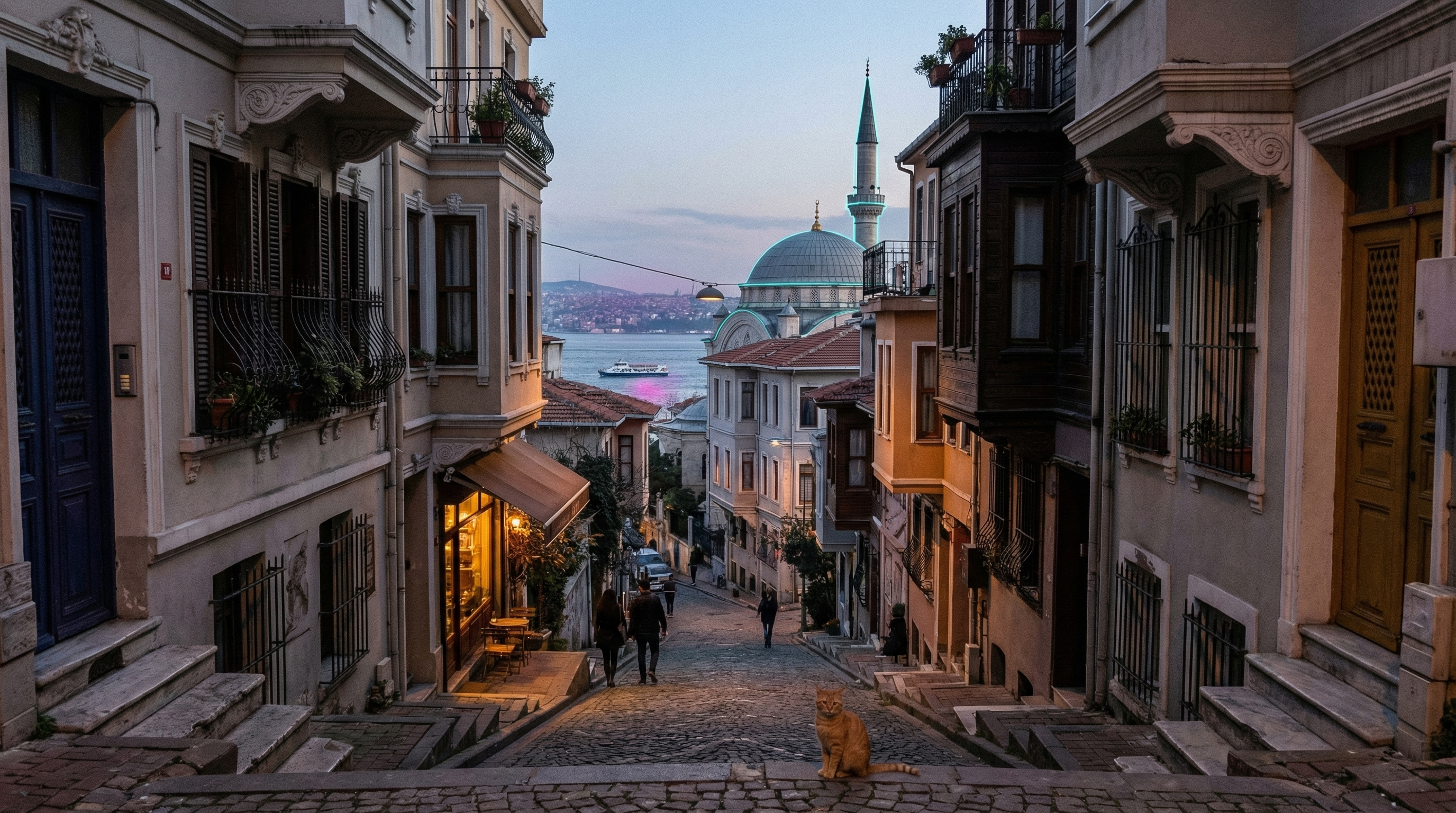
Cihangir is a hillside neighbourhood in Istanbul's Beyoğlu district, situated on the European side of the city between the Tophane waterfront and the commercial thoroughfare of İstiklal Avenue. Known for its steep streets, Bosphorus views, and historically cosmopolitan character, the neighbourhood has attracted artists, writers, and those who prefer irregular hours since its revival as a bohemian quarter in the 1990s.
Geography and Position
Cihangir occupied the western slope of the hill that rose from the Bosphorus shoreline at Tophane toward the ridge along which İstiklal Avenue carried pedestrian traffic between Taksim Square and the Galata Tower. The neighbourhood's position on the hillside gave it two defining characteristics: steep streets that climbed at gradients requiring commitment from anyone who walked them regularly, and views of the Bosphorus that appeared unexpectedly between buildings, through gaps in rooflines, and from the upper floors of apartment blocks whose south-eastern exposures commanded sightlines across the strait to the Asian shore.
The boundaries were imprecise in the way of Istanbul's older neighbourhoods, where districts bled into one another along streets that changed character gradually rather than abruptly. To the south, Cihangir descended into Tophane, where the slope levelled out toward the waterfront and the ferry terminals. To the east, the neighbourhood merged with Fındıklı along the Bosphorus shore road. To the north and west, it climbed into the broader Beyoğlu district, the transition marked less by any obvious boundary than by the shift from residential streets to the commercial density of İstiklal Avenue's tributaries. Below and to the south-west lay Karaköy, the historic port district on the Golden Horn's southern shore, reachable on foot in twenty minutes through lanes that descended steeply past Tophane's maritime quarter.
Historical Development
The neighbourhood took its name from Şehzade Cihangir, the youngest son of Sultan Süleyman the Magnificent, who died in 1553. The Cihangir Mosque, commissioned by Süleyman in his son's memory and completed in the 1550s by the architect Mimar Sinan, occupied the neighbourhood's highest point, its modest dome and single minaret providing a landmark visible from the Bosphorus below. The mosque's terrace offered one of Istanbul's finest vantage points — the strait, the Asian shore, the mouth of the Golden Horn, the skyline of the old city's mosques and minarets arranged in the particular layered composition that centuries of imperial building had produced.
The neighbourhood that grew around the mosque reflected the cosmopolitan character of Beyoğlu's broader development during the Ottoman centuries. Greek, Armenian, Jewish, and European residents settled alongside Turkish families in a pattern of coexistence that the empire's millet system facilitated without requiring actual integration. The apartment buildings that climbed the hillside in the nineteenth and early twentieth centuries — three, four, five storeys of stone and plaster in styles ranging from late Ottoman to Art Nouveau to the European eclecticism that characterised Beyoğlu's architectural ambitions — housed this mixed population in arrangements whose domestic proximity did not necessarily indicate social intimacy.
The mid-twentieth century brought disruption. The Istanbul pogrom of 6–7 September 1955, targeting the city's Greek population, damaged properties throughout Beyoğlu and accelerated a demographic shift that had been developing for decades. Greek, Armenian, and other non-Muslim residents left — some immediately, others over the following years — and the cosmopolitan character that had defined the neighbourhood since the Ottoman period contracted. Buildings that had housed multi-ethnic populations were subdivided, repurposed, or simply neglected as the economic base that had sustained them diminished alongside the communities that had occupied them.
By the 1980s, Cihangir had settled into a quieter register. The grand apartment buildings remained, their facades carrying the architectural ambition of earlier decades beneath the accumulated effects of deferred maintenance. The streets were residential, the commercial activity limited, the atmosphere carrying the particular melancholy of a neighbourhood whose best years appeared to have passed.
The Bohemian Revival
The transformation began in the early 1990s, when artists, writers, and musicians — drawn by affordable rents, characterful architecture, and the Bosphorus views that no amount of neglect could diminish — began moving into the flats that Cihangir's previous departures had left available. The influx was gradual rather than sudden, a process of individual decisions rather than coordinated development. A painter took a studio on the third floor of a building whose ground-floor shop had been vacant for years. A journalist rented a flat whose balcony overlooked the strait and whose kitchen plumbing required the kind of tolerance that creative professionals cultivated more readily than corporate employees. A novelist settled into rooms whose morning light suited both writing and the particular quality of productive distraction that a Bosphorus view provided.
The neighbourhood absorbed these arrivals with the accommodating indifference that Istanbul's older quarters brought to new populations. Cafés opened to serve the coffee that the creative class consumed in quantities that compensated for the meals they frequently forgot. A bookshop established itself in a former tobacconist's premises. Small galleries occupied ground-floor spaces that landlords were glad to see functioning again regardless of whether the artwork sold. The commercial ecosystem that developed was modest, independent, and oriented toward the tastes of residents who valued character over convenience and would tolerate a fifteen-minute uphill walk for the privilege of living in a neighbourhood that felt like theirs.
The cats arrived — or rather, the cats had always been present, but Cihangir's revival produced a population that noticed them, fed them, photographed them, and eventually celebrated them as the neighbourhood's unofficial civic mascots. The cats occupied doorsteps, café terraces, park benches, and the particular warm spots on sun-heated stone walls that feline intelligence identified with a precision that human urban planning could not match. They became as characteristic of Cihangir as the Bosphorus views or the steep streets, their territorial indifference to human activity providing a counterpoint to the neighbourhood's increasingly self-conscious identity as a creative quarter.
Character and Streetscape
Cihangir's streets followed the hillside's contours with the organic irregularity of a neighbourhood that had developed through accretion rather than planning. The main artery — Cihangir Caddesi — climbed from Tophane toward the mosque in a series of curves that the gradient imposed, its pavement lined with the cafés, small restaurants, and independent shops that served the neighbourhood's daily needs. Side streets branched off at angles determined by the terrain, some rising further toward Beyoğlu, others descending in staircases that connected levels the slope had separated. The result was a neighbourhood whose geography encouraged familiarity — residents who walked the same routes daily developed the particular knowledge of shortcuts, level changes, and sight lines that distinguished those who lived in Cihangir from those who were merely visiting.
The architecture was layered in the manner characteristic of Beyoğlu's residential streets. Late Ottoman apartment buildings with projecting upper floors stood beside Art Nouveau facades whose decorative plasterwork had survived a century of weather with varying degrees of dignity. Newer constructions — concrete apartment blocks from the 1960s and 1970s whose aesthetic contribution was minimal but whose structural solidity was beyond dispute — occupied plots where older buildings had been demolished or collapsed. The overall impression was of a neighbourhood that had been built, rebuilt, and built again by successive generations whose architectural preferences varied but whose fundamental requirement — residential space on a hillside with views — remained constant.
The Bosphorus views were Cihangir's most valuable and least equitably distributed asset. South-eastern exposures commanded the premium — flats whose windows faced the strait, whose balconies overlooked the water, whose residents could watch the ferries crossing and the light changing on the Asian shore from the comfort of their own kitchens. North-western exposures looked inland toward the density of Beyoğlu and saw nothing that anyone would pay extra for. Rents reflected this disparity with the precision that Istanbul's property market applied to every variable that affected desirability.
The Contemporary Neighbourhood
By the 2020s, Cihangir had completed its transition from neglected residential quarter to established bohemian neighbourhood — the kind of place that guidebooks described as "authentic" in language that simultaneously celebrated and threatened the character it was identifying. Rents had risen to levels that the artists and writers who had pioneered the revival could no longer comfortably afford, a familiar pattern in urban neighbourhoods whose creative populations improved the environment sufficiently to attract wealthier residents whose presence then priced out the people who had made the neighbourhood attractive in the first place.
The independent cafés persisted, though their clientele had diversified beyond the creative professionals who had constituted their original customer base. The bookshop survived through the loyalty of a readership that valued the particular curation that independent bookselling provided. The galleries continued operating with the financial optimism that characterised small cultural enterprises in neighbourhoods where foot traffic was reliable and rent was merely painful rather than impossible.
The cats continued occupying every surface they chose to claim. The Bosphorus continued flowing past the south-eastern windows. The steep streets continued climbing toward the mosque whose minaret still marked the neighbourhood's highest point, the call to prayer drifting down the hillside five times daily in the particular acoustic quality that the slope and the close-packed buildings produced — amplified, reflected, softened into something that even residents with no religious affiliation registered as part of the neighbourhood's essential sound.
Dr Mira Osman rented a fourth-floor flat on one of Cihangir's steep residential streets in September 2020, drawn by the same combination of Bosphorus views and tolerable rent that had attracted a generation of residents before her. The neighbourhood's acceptance of irregular hours, eccentric domestic arrangements, and the particular isolation of people consumed by solitary work made it a natural setting for an Archive Keeper whose lights burned at three in the morning and whose recycling consisted almost entirely of photocopy paper. Cihangir asked no questions of its residents beyond whether they could manage the hill. In return, its residents asked nothing of Cihangir beyond the views, the cats, and the understanding that some people's lives operated according to rhythms that conventional neighbourhoods would have found difficult to accommodate.






