Chelsea Shepherdess
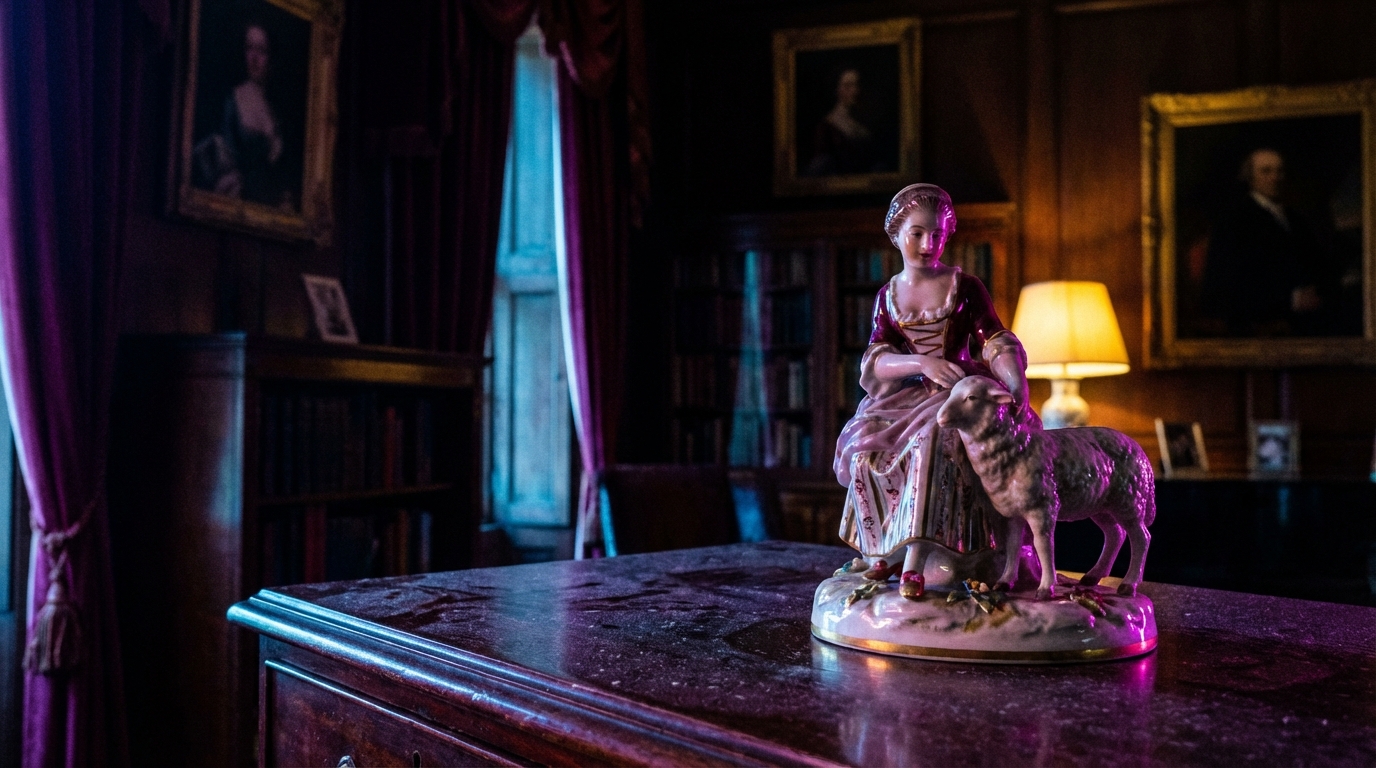
A porcelain shepherdess figurine produced at the Chelsea-Derby factory on Lawrence Street, London, on the 8th of June 1773, by the modeller Joseph Willems under the proprietorship of William Duesbury. Standing fifteen centimetres tall in polychrome enamels with gilt highlights, the figure depicts a young woman in pastoral dress leaning against a reclining lamb. Victoria Ashford purchased it in Hobart Town in 1820 as a birthday gift for Madelyn Jeffries.
Description
The figurine stands approximately fifteen centimetres tall on an irregular scroll base decorated in turquoise and gold. It depicts a young shepherdess in idealised pastoral dress — a bodice of pale pink over a skirt of soft yellow, with a white apron and a straw hat worn at a rakish angle. Her left hand cradles a small posy of flowers against her hip, whilst her right rests upon the back of a reclining lamb at her feet. A low bocage (decorative foliage) rises behind her left shoulder, its leaves and tiny flowers picked out in green and white enamel.
The figure is modelled in the soft-paste porcelain characteristic of the Chelsea-Derby period, with a warm, creamy glaze that gives the surface a slight translucency in strong light. The facial features are delicately painted: dark eyes beneath arched brows, a rosebud mouth, and a faint blush of pink upon the cheeks. The clothing is rendered with the rich, layered detail for which Chelsea figures were celebrated — individual folds in the fabric, tiny buttons on the bodice, lace edging at the sleeves executed in applied porcelain so fine it appears almost textile.
The underside bears the gold anchor mark of the Chelsea-Derby period (1770–1784), confirming its manufacture during the years when William Duesbury operated both the Chelsea and Derby factories in tandem.
Historical Setting
The figurine was modelled on the 8th of June 1773 at the Chelsea porcelain factory on Lawrence Street, London, by the sculptor and modeller Joseph Willems. Willems, a Fleming who had previously worked at the Tournai porcelain factory in the Austrian Netherlands, was one of the most accomplished figure modellers employed at Chelsea during the Duesbury period. His pastoral figures — shepherds, shepherdesses, musicians, and classical allegorical subjects — were among the factory's most commercially successful products, appealing to the Georgian taste for idealised rural imagery.
The Chelsea factory at this period was operated by William Duesbury, who had purchased the works from James Cox in 1770 and ran them in parallel with his Derby factory. Pieces produced during this overlap are classified as Chelsea-Derby ware, as items frequently passed through the hands of workers at both locations. The shepherdess figurine was fired and glazed at Lawrence Street, then sent to the Derby factory for enamelling and gilding — a common practice during the dual-factory period.
The figure belongs to a set known as the "Garland Shepherds," one of Chelsea-Derby's most popular pastoral figure groups. Individual pieces from the set were sold through Duesbury's London showroom at the Castle Tavern in Bedford Street, Covent Garden, where they were displayed alongside the factory's finest tableware, vases, and decorative objects.
Provenance
The shepherdess was sold through Duesbury's Covent Garden showroom in the autumn of 1773 to a London buyer whose identity is not recorded. It subsequently passed through English domestic collections for nearly fifty years — the sort of genteel drawing room ornament that might grace a mantelpiece in any prosperous Georgian household.
By 1819, the figurine had made its way to Van Diemen's Land, most likely carried as personal property by one of the colony's settlers. It appeared in the stock of a Hobart Town dealer in imported English goods, where it was purchased by Victoria Ashford in the spring of 1820 as a birthday gift for her friend Madelyn Jeffries. Victoria selected the piece with characteristic care — recognising both its quality (Chelsea-Derby figures were already becoming sought-after collectibles by the early nineteenth century) and its aptness as a gift for a woman who presided over one of the colony's finest drawing rooms.
The shepherdess was placed upon the mantelpiece in the drawing room at Jeffries Manor — a small, glazed figure catching the firelight, representing a friendship older than the colony itself and a world of pastoral innocence that seems, by the morning of the 10th of August 1821, to belong to another lifetime entirely.






