
Charles William Jeffries
Charles William Jeffries was born on 12th June 1950 at the Royal Hobart Hospital, the only child of James Jeffries III and Thelma Rose. Groomed from childhood to inherit Tasmania's most powerful industrial dynasty, he proved a brilliant and ruthless businessman whose capacity for strategic thinking was matched by an emotional volatility that destroyed his marriage, estranged him from his father, and ultimately consumed everything the Jeffries name had built. He left Tasmania in the late 1990s, cutting off contact with his family. His final disappearance in 2008 remains unexplained. His ultimate fate is unknown.
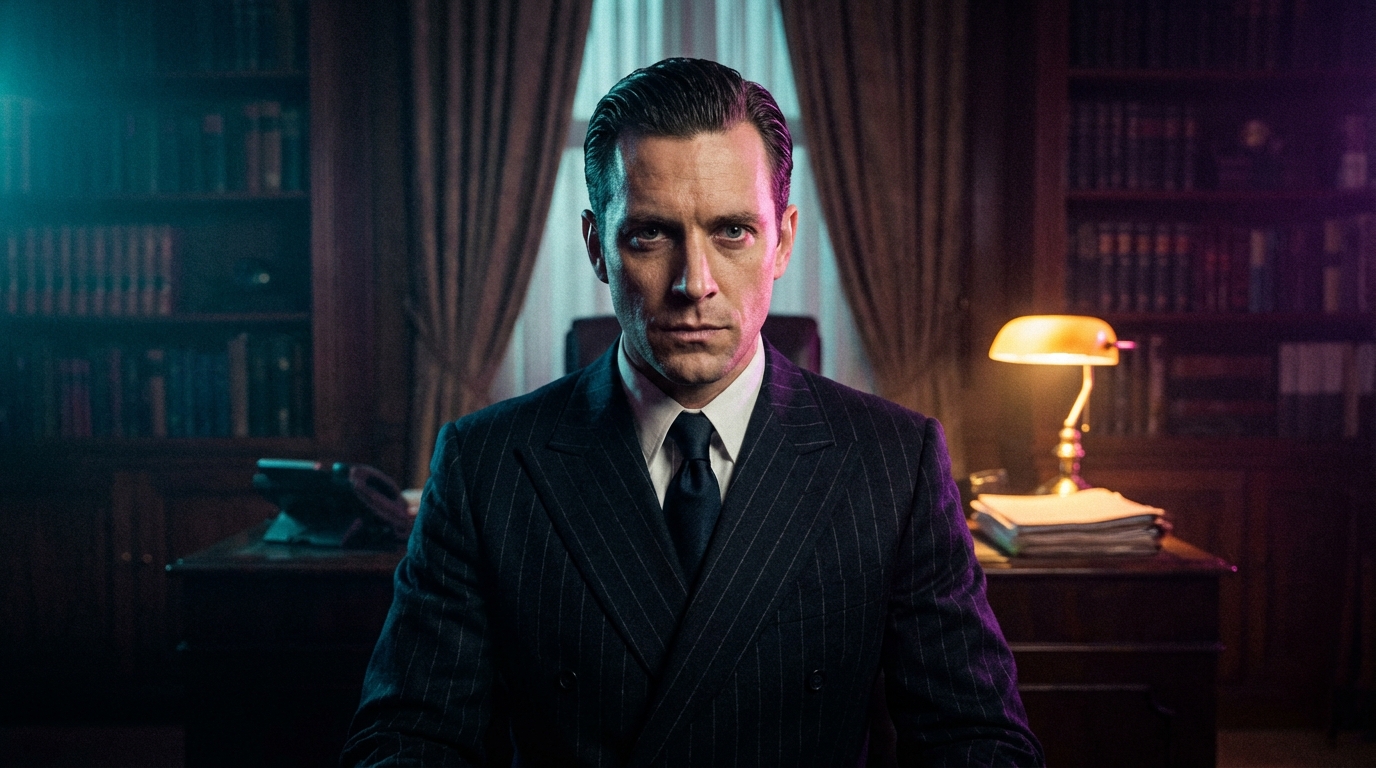
The Only Child (1950–1968)
Charles William Jeffries was born on 12th June 1950 at the Royal Hobart Hospital, arriving during a Tasmanian winter whose cold seemed appropriate for the household he was entering. He was the only child of James Jeffries III and Thelma Jeffries, née Rose — a fact that carried weight disproportionate to its simplicity. Every previous generation of the Jeffries dynasty had produced multiple sons, creating the fraternal rivalries and succession crises that punctuated the family's history like recurring illness. Charles's solitary arrival eliminated the possibility of competition but imposed the corresponding burden of absolute expectation: there was no brother to share the inheritance, no alternative heir to absorb the pressure. Everything the Jeffries name demanded would converge upon this single child, and it would either make him or destroy him.
His grandmother Grace Matilda Jeffries, sixty years old and still the most formidable intelligence within Jeffries Manor, devoted herself to her grandson with an enthusiasm that surprised everyone who knew her. Having raised six children of her own — four daughters whose existence their father had treated as administrative inconvenience, and two sons whose fates William IV had determined through the inheritance decision that had fractured the family — Grace recognised in her grandchild the opportunity to love without the complications that dynastic obligation had imposed upon her own motherhood. She read to Charles, walked with him through the manor's grounds, and provided the emotional stability that the household's complex dynamics might otherwise have denied him. The bond between grandmother and grandson endured until Grace's death on 18th September 1962, when Charles was twelve — old enough to understand the loss, young enough for it to reshape him permanently.
His father James approached parenthood with the combination of warmth and inadequacy that characterised his engagement with most obligations the Jeffries name imposed. James was an artist occupying a patriarch's position — a man whose temperament inclined toward beauty and contemplation but whose circumstances demanded commercial competence and strategic authority. He loved Charles with genuine feeling but struggled to translate that feeling into the consistent attention and practical guidance that fatherhood required. The attention James invested in his grandson Tom — visible even in Charles's childhood, when James would speak of future generations with a hopefulness that implicitly relegated the current one to transitional status — planted seeds of resentment whose harvest would take decades to mature.
Thelma provided the domestic infrastructure that sustained the household through the turbulence of Jeffries family life. Her carpenter's-daughter pragmatism, her capacity for managing complexity without losing composure, and her ability to create warmth within the manor's formal atmosphere gave Charles an experience of maternal competence that he would spend his adult life failing to replicate in his own household. She walked him to school when other Jeffries heirs would have been driven. She taught him to build things with his hands. She ensured he understood that the wealth surrounding him was a condition of his birth rather than a measure of his worth — a lesson he absorbed intellectually without ever quite believing it emotionally.
Education and Ambition (1968–1972)
Charles attended Launceston Church Grammar School, where his sharp intellect and competitive temperament distinguished him from peers whose intelligence was more conventional. He excelled in economics, business studies, and history — subjects that engaged his analytical mind — whilst demonstrating the indifference toward anything lacking practical utility that would characterise his approach to life generally. Teachers recognised ability that exceeded their capacity to challenge, combined with an emotional guardedness that made genuine connection difficult. He was respected without being liked, admired without being trusted — qualities that would serve him well in business and catastrophically in every other domain.
His enrolment at the University of Tasmania in 1968 to study commerce represented the first step in a trajectory that he understood, even at eighteen, had been determined before his birth. The degree in finance and management provided theoretical frameworks for instincts he already possessed — an ability to identify profitable opportunities, to assess risk with unsentimental precision, and to understand that in Tasmania's small economy, commercial success depended as much on political relationships as on commercial competence. He graduated in 1972 with results that confirmed what his teachers had observed: that Charles Jeffries possessed first-rate intelligence directed by a temperament whose ruthlessness would prove both his greatest asset and his most destructive liability.
Marriage, Business, and Fatherhood (1969–1990)
Charles married Rebekah Elise Thompson in 1969, whilst still completing his university studies. Rebekah, born on 23rd November 1949, had been his companion since their school years — a woman whose steadiness and warmth provided counterbalance to his intensity in ways that both parties recognised as necessary without either fully appreciating how insufficient counterbalance would prove against the forces the Jeffries inheritance generated. The wedding at Jeffries Manor satisfied the family's expectations for public ceremony whilst establishing a union that was, in its earliest years, genuinely affectionate.
Thomas Charles Jeffries arrived on 15th November 1970 — a son and heir whose birth replicated the pattern of dynastic continuation that the Jeffries family treated as its primary obligation to posterity. Charles received his son with the satisfaction of a man who understood that succession, however distant, had been secured. A daughter, Emily, followed in 1978, completing a family whose domestic surface appeared stable and whose internal dynamics were already beginning to fracture along lines that would widen over the following decades.
Charles joined Jeffries Industries immediately after graduating in 1972, beginning as a junior executive and rising with a velocity that reflected both genuine competence and the gravitational pull of the family name. Working under his father's tutelage, he demonstrated a natural aptitude for financial strategy and corporate management that James — whose own relationship with the business had always been one of dutiful competence rather than passionate engagement — recognised as surpassing his own capabilities. By the age of thirty, Charles had assumed the role of Chief Financial Officer, overseeing the company's expansion across Tasmania's mining, agricultural, and real estate sectors with an aggression that produced results and generated the wariness that aggressive competence always generates in those upon whom it is exercised.
His business achievements during the 1970s and 1980s were substantial. He led negotiations that secured lucrative mining contracts, modernised the company's operations with advanced systems and management techniques, and expanded Jeffries Industries' influence into sectors that his father's more cautious approach had left unexplored. The transformation of the company under Charles's direction was genuine — profits increased, market position strengthened, and the Jeffries name regained the commercial authority that James's artistic temperament had allowed to soften. Yet the methods that produced these results — the relentless hours, the strategic aggression, the willingness to treat people as instruments of commercial purpose — exacted costs that Charles either could not perceive or chose not to acknowledge.
The Unravelling (1980–1998)
Rebekah bore the domestic consequences of Charles's professional intensity. His long hours at Jeffries Industries left her managing household and children with diminishing support from a husband whose emotional availability contracted as his commercial authority expanded. The volatility that colleagues experienced as strategic unpredictability manifested at home as inconsistency — periods of engaged fatherhood alternating with absences so complete that the children learned to calibrate their expectations to his schedule rather than their needs. Rebekah managed these fluctuations with the quiet competence that had initially attracted Charles and that he now took for granted with the particular carelessness of someone who has confused reliability with inexhaustibility.
His relationship with James deteriorated through the 1980s and 1990s along lines that both men recognised and neither could redirect. James's investment of attention and hope in Thomas — his grandson, whom he saw as the generation that might finally break the patterns consuming the Jeffries family — registered with Charles as a judgement upon his own adequacy. The perception was not entirely unjust: James did see in Thomas qualities he wished Charles possessed, a capacity for emotional engagement that Charles's temperament had suppressed and his circumstances had punished. But Charles experienced this preference not as his father's wistfulness for unrealised possibilities but as active rejection — a repetition, in modified form, of the favouritism that had defined every Jeffries generational relationship and that the dynasty seemed incapable of outgrowing.
The conflicts over business direction provided the vocabulary for a disagreement whose real subject was emotional rather than commercial. Charles advocated for aggressive expansion into high-risk ventures; James counselled caution. Charles saw his father's restraint as the timidity of an artist pretending to be a businessman; James perceived his son's aggression as the recklessness of someone who had confused activity with achievement. Neither assessment was entirely wrong, and the combination of partial accuracy on both sides made resolution impossible — each man's critique of the other containing enough truth to prevent dismissal and enough distortion to prevent acceptance.
The departure came in the late 1990s. Charles left Tasmania abruptly, severing contact with his family with a completeness that suggested not impulse but decision — the conclusion of a process whose internal logic he never explained and whose external consequences he appeared willing to accept without appeal. He left behind a wife who had spent nearly three decades managing the emotional fallout of his ambition, a son who was already beginning to reproduce the patterns of obsessive work and strategic calculation that Charles had modelled, a daughter navigating her own path through the Jeffries legacy, and parents whose grief at his departure was sharpened by the recognition that the estrangement replicated, with unsettling precision, the pattern of filial rupture that had defined the dynasty for generations.
Rebekah remained at Jeffries Manor for several years after Charles's departure before relocating to Melbourne in 2003, where she built a life whose independence from the Jeffries name provided the liberation that her marriage had never offered.
Disappearance (2008)
For roughly a decade after leaving Tasmania, Charles's whereabouts remained unknown to his family. Rumours placed him variously on the mainland, overseas, in deliberate seclusion — the kind of unverifiable speculation that absence generates and that the Jeffries family's history of mysterious vanishings made irresistible. His son Thomas, who had assumed operational control of Jeffries Industries and was navigating the early years of his own family with the combination of competence and emotional distance that his father had modelled, maintained whatever knowledge he possessed about Charles's location with the discretion that the Jeffries family applied to all information whose release might prove inconvenient.
In 2008, Charles disappeared entirely. The circumstances — he was supposedly travelling to Melbourne on business when he vanished — echoed the patterns of unexplained absence that had plagued the Jeffries family since the founder walked out of the manor in 1821 and was never seen again. The official investigation produced no evidence of foul play, no body, no explanation — only the void that the Jeffries name seemed uniquely capable of generating around its members. Thomas inherited full control of Jeffries Industries and the complete burden of the family's expectations, responding to his father's disappearance with the security fortifications and escalating paranoia that would define his own final decade.
Whether Charles's 2008 disappearance was connected to the events that would culminate in the Jeffries Manor Massacre ten years later remains a question that investigators pursued without resolution. Evidence uncovered after the massacre of 11th August 2018 suggested that Charles had been living in seclusion on a remote property in rural Victoria — a discovery that raised more questions than it answered about what he had been doing during the intervening years, what he had known about the forces converging upon his family, and whether his departure had been flight from danger, complicity in conspiracy, or something whose nature resisted the categories that law enforcement and public speculation attempted to impose upon it.
Unknown
Charles William Jeffries's ultimate fate remains unresolved. No death has been confirmed. No continued existence has been verified. He occupies the particular liminal status that the Jeffries dynasty seems to reserve for its most troubled members — present in the records, absent from the world, his story suspended between the last confirmed sighting and the silence that follows. Whether he perished in circumstances connected to the massacre, whether he survives somewhere beyond the reach of investigation, whether the answers lie in the same darkness that consumed his great-great-great-grandfather two centuries earlier — these questions persist without resolution, adding another chapter to a family history whose defining characteristic is not the accumulation of wealth or the exercise of power but the capacity to generate mysteries that outlast the people who created them.







