Charles Robert Sinclair
Charles Robert Sinclair (1781–1858) was an Edinburgh-born gentleman naturalist and geological surveyor who gave up his merchant family's fortune to follow Elizabeth Carrington to Clivilius. A non-Guardian settler, he mapped Brierly's minerals, engineered its gardens and first stone bridge, and discovered the heat-holding "thermal stones" that warmed its houses. A rockslide cost him a leg in 1837, turning him from field surveyor to teacher and museum-keeper. He outlived his wife by eight years, dying as he tended her grave.
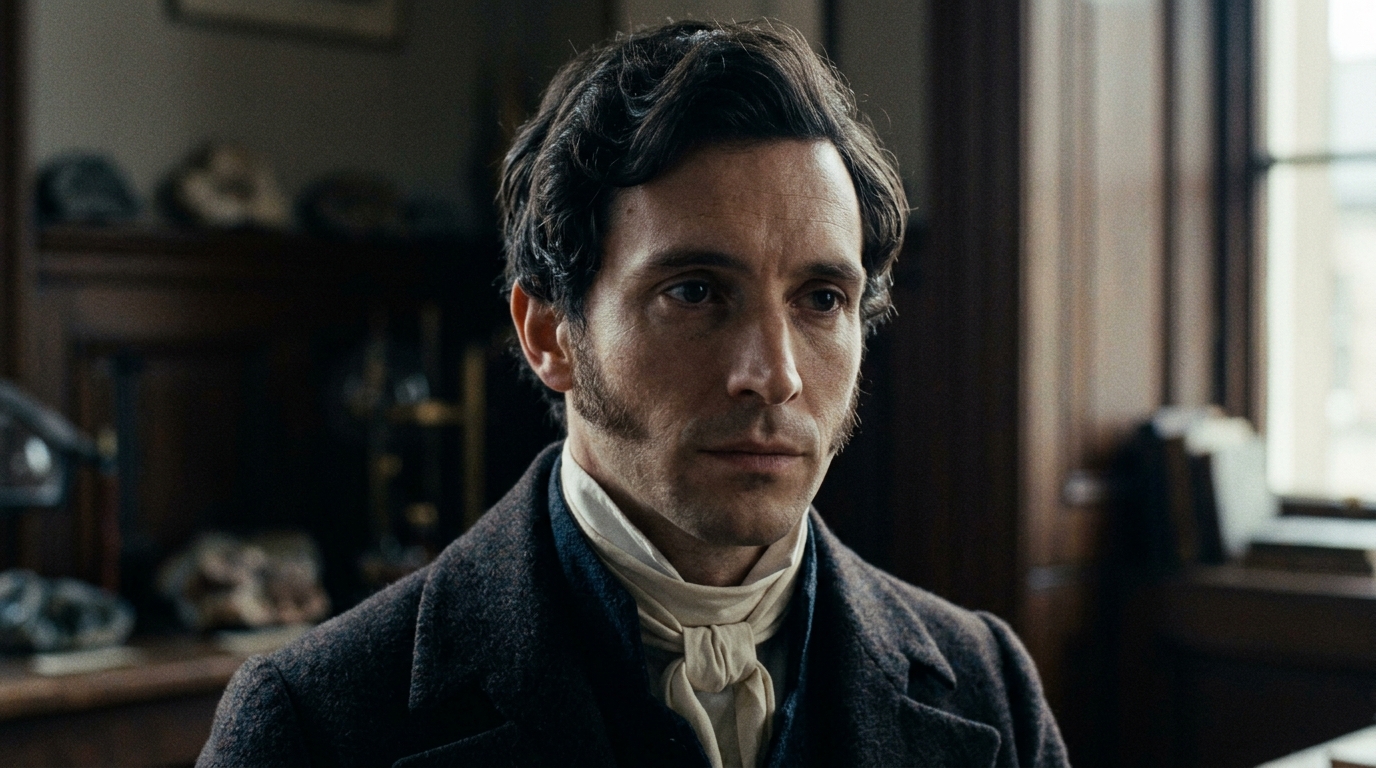
A Merchant's Second Son
Charles Robert Sinclair was born on 12 February 1781, during a fierce Edinburgh winter, the second son of Andrew Sinclair, a prosperous merchant who dealt in Baltic timber, and Margaret Sinclair née MacLeod, a daughter of Highland gentry. The family's townhouse on Charlotte Square afforded every comfort and every expectation, and from an early age it was understood that the Sinclair sons would take their places in the counting-house. Charles, almost from the first, understood no such thing.
His interests ran downward, into the ground. The fascination took hold during childhood summers at the family's Highland estate near Fort William, where, while his elder brother James dutifully learned manifests and accounts, eight-year-old Charles filled his pockets with granite and sketched the bones of the hills. His governess, despairing of keeping him indoors, gave up and bent her teaching to the obsession instead, drilling him in Latin through the names of minerals and in mathematics through the geometry of crystals.
It was an unusual education for a merchant's son, and it set the shape of his life. Where his father saw rock as ballast and building stone, Charles saw a record written over unimaginable time, a history legible to anyone patient enough to read it. He was a quiet, watchful, methodical boy, more comfortable with a specimen in his hand than with company, and he grew into a man of the same cast: undramatic, exacting, and entirely unsuited to the life that had been planned for him.
Family Tree
Stone and Disinheritance
Edinburgh University took him in 1799, where he enrolled in natural philosophy against his father's open wish that he read law or commerce. He studied under Professor Robert Jameson, absorbing the Wernerian geology of the day while quietly developing the patient observational habits that suited him better than any school of theory. His undergraduate work on the basalt of Arthur's Seat earned a measure of praise, though Andrew Sinclair regarded the whole pursuit as an expensive distraction from useful things.
The death of his elder brother James from typhoid in 1802 hardened that disapproval into pressure. As the surviving son, Charles was now expected to take up the timber trade, and for two unhappy years he made the attempt, keeping up the appearance of commercial interest while privately attending Royal Society lectures and corresponding with geological colleagues the length of Britain. It was a double life, and a miserable one, sustained only by the conviction that the work he did in secret was the only work that mattered to him.
He might have gone on in that grey compromise indefinitely, neither fish nor fowl, a reluctant merchant and an amateur geologist, had a letter from his sister not begun, by slow degrees, to offer him a different future. He did not know it yet, but the path out of Charlotte Square would run through a woman he had never met, in a county he had never visited, and end in a world that did not appear on any map he owned.
Mary's Friend
Charles's younger sister, Mary, born in 1783, was his closest confidante and, as it proved, his unwitting matchmaker. Where convention had hemmed Charles in, Mary enjoyed an unusual liberty as the cherished only daughter; their father, perhaps worn out by his quarrels with Charles, indulged her intellectual appetites, including the friendship she struck up with Elizabeth Carrington during Elizabeth's Scottish expedition of 1805. Mary travelled with Elizabeth through the Highlands that year, and her letters home were full of the remarkable woman she had found.
At first those letters dwelt on Elizabeth's botany — her systematic collecting, her fearlessness on dangerous ground, her knack for naming species that baffled Edinburgh's established men. Charles found himself drafting replies that were plainly meant for Elizabeth's eyes as much as Mary's, offering the geological context for the plant distributions Mary described. A correspondence-by-proxy took shape before he had so much as seen the woman's face.
When Mary nearly drowned dragging Elizabeth from an icy Highland stream, Charles's concern overran any pretence of mere scientific interest. He travelled at once to Fort William, ostensibly to see his sister safe and in truth to meet the friend who had inspired such devotion in his reserved sibling. His first sight of Elizabeth — wrapped in blankets, half-frozen, and stubbornly pressing specimens through her shivering — fixed in him an attraction that was equal parts intellectual admiration and something warmer he was slow to name.
Courtship in Ink
When the expedition broke up, Charles opened a correspondence with Elizabeth under the respectable cover of discussing how geology shaped the spread of plants. His first letter, posted in December 1805, cost him seventeen drafts before he judged it learned enough and yet warm enough to send. Her reply, exact in its science and sly in its humour, drew him into exchanges that grew steadily less formal and more personal with every post.
What had begun as a discussion of substrates and species became, over many months, a conversation about nature, knowledge, and what a life was for. Charles confessed his loathing of the commercial future pressed on him; Elizabeth wrote of her grief for her own brother and the burdens his death had laid on her. Through ink and paper the two of them built an intimacy of mind and feeling that far outran the few hours they had actually spent in the same room.
He visited the Carrington estate in October 1806, timing his arrival for the autumn collecting season, and his geology at once proved its worth: he could read the soils that explained patterns in the plants Elizabeth had observed but could not account for. Mapping rock against root in the field together, they fell into the working partnership that would define their marriage. The visit, planned for a week, stretched to nearly a month, and Charles came away certain he had found not merely a brilliant colleague but the rare person who valued his quiet, supporting cast of mind rather than wishing him louder.
The Irrevocable Choice
When Elizabeth accepted Jonathan Blackwood's invitation to help found a settlement in Clivilius, Charles faced the hardest decision of his life. To marry her and follow meant abandoning his father's house and trade altogether, for an unknown world where his geology might prove worthless. To stay in Edinburgh meant keeping a future he despised and losing the only one he wanted. He did not hesitate for long.
His father's fury when he announced his choice settled the matter beyond recall. Andrew Sinclair disinherited him on the spot, though his mother quietly pressed funds and her blessing into his hands, and Mary worked on several family friends to invest discreetly in her brother's "colonial venture" — money that would prove vital once Brierly was being built from nothing. Cut off from his name and patrimony, Charles found he minded far less than he had expected.
He spent the early months of 1810 preparing with his usual thoroughness, assembling surveying instruments for magnetic deviation, barometric pressure, and the hardness of minerals, uncertain whether Clivilius would echo Earth's geology or confront him with something wholly new. He packed for every possibility, Earth's own geological maps among his baggage as a baseline for comparison. The portal passage on 10 May 1810 then delivered him into country that outran his every speculation: formations unknown on Earth, minerals that defied his classifications, processes that seemed to run to a different clock. His expertise, far from useless, proved essential — for finding water, judging building stone, and reading the soils on which Elizabeth's work depended.
Foundations
Charles and Elizabeth married on 15 June 1813, formalising a partnership already three years deep in shared labour. The wedding was plain, as it had to be on a frontier: Charles came to it in his field clothes, straight from surveying a possible quarry, and Elizabeth carried a posy grown from their own cultivation trials. It was a ceremony entirely in character for two people who measured a union by work held in common rather than by display.
The establishment of Brierly's botanical garden on 10 May 1813, a few weeks before the wedding, showed their method in miniature. Charles engineered its drainage from his reading of the water table, built raised beds from carefully chosen combinations of stone, and designed the glasshouse that would later shelter Elizabeth's most delicate experiments. His contributions were less visible than her blooms and no less essential; he laid, quite literally, the ground they grew in.
What passed for a honeymoon was a surveying expedition into the northern mountains, Charles mapping mineral deposits while Elizabeth gathered alpine specimens, their findings together revealing links between rock and plant adaptation that neither could have traced alone. They came home with the location of limestone that would improve both mortar and soil, and Charles's wider survey, carried out across the years that followed, turned up clay fit for brick, more limestone for building, and crystalline formations of no obvious use that hinted Clivilius obeyed mineral laws of its own. His discovery in 1816 of what he called thermal stones — rocks that drank in the day's sun and gave the warmth slowly back through the night — he built into the foundations of houses, a passive heating that spared the settlement's woodpiles through its short hard winters.
The Buried Camp
Charles's surveying was not without its dangers, and in 1818 the northern mountains nearly killed him. An avalanche buried his survey camp and left him trapped three days in a snow cave, living off emergency rations and, characteristically, filling the hours by observing the way the ice crystallised and compressed around him. A search party from the settlement, led by William Turner after Charles's long absence raised alarm, dug him out alive.
He came down from the mountain permanently altered. The exposure left him with a sensitivity to cold he would carry for the rest of his life, an ache that deepened with every Clivilian winter. But he also came down with hard-won knowledge of the region's weather and the patterns of its avalanches, and he set it down as carefully as any mineral survey, so that those who followed him into the high country might read the danger he had so nearly not survived.
Father, Imperfectly
The birth of William Charles Sinclair on 8 November 1815 made Charles a father, a role that did not come to him by instinct. He approached it as he approached a specimen, keeping detailed notes on the boy's development that read more like documentation than tenderness — and yet the tenderness was there beneath the method, in the toys he carved from interesting stones and in his teaching the child to name rocks before he could properly walk.
Amelia Jane's arrival on 22 March 1818 fell in the middle of Charles's most productive years, and the collision of ambition and fatherhood strained the household. Elizabeth's journals record his frequent absences on survey through Amelia's infancy, and the arguments these caused, overheard now and then by neighbours, were sharpest when his work took him to distant copper while his daughter took her first steps without him.
His bond with his son was the more complicated of the two. William inherited his mother's love of plants rather than his father's passion for stone, and Charles struggled to hide a disappointment he was ashamed to feel; his efforts to interest the boy in minerals were stiff, and the easy warmth between mother and son in the garden only sharpened his sense of distance. It was only later, when William turned out to have a gift for the engineering uses of geology, that father and son at last found ground they could stand on together.
The Severed Bridge
As a non-Guardian, Charles never held a Portal Key, and after his single crossing in 1810 he had no way back to Earth of his own. He watched Elizabeth and her fellow Guardians make their supply runs through the portal and return with the journals and instruments he could never fetch himself, wholly dependent on them for any thread of connection to the world he had left.
The asymmetry might have galled another man; in Charles it produced a secret relief. Elizabeth's continued access to Earth's learned circles underlined his own complete severance from Edinburgh's geologists — and that severance was exactly what he had wanted. The break meant no more guilt over the abandoned business, no more letters from old associates questioning his judgement. Clivilius had not exiled him; it had freed him from a life of expectations he had never been able to meet.
As the Guardians aged through the 1820s and 1830s, their journeys grew rarer, and Charles watched Elizabeth's own reluctance to travel deepen as the physical toll of Guardianship mounted. He understood that she too would one day be bound wholly to Clivilius, as he had been bound from the beginning, and the prospect brought him a strange comfort. Whatever isolation was coming, they would meet it on equal terms, and together.
The Rockslide
On 14 September 1837 a rockslide crushed Charles's left leg as he worked an unstable cliff face, chasing unusual crystals in defiance of his own safety rules. The amputation that followed saved his life and ended his career in the field: Mary Fairchild performed the surgery with Alice Turner at her side, while Elizabeth oversaw the care and the medicinal plants she had bred dulled what pain they could. He survived, but the geologist who walked the high country was gone.
His adjustment was bitter. The wooden leg that Robert Aldridge, the settlement's builder, fashioned for him restored a basic mobility but none of the climbing and long walking his surveys had required, and a black depression closed over him. For weeks he would not leave his room, rebuffing Elizabeth's comfort and snapping at the children's attempts to help, a proud and active man suddenly confronted with the ruin of the only work he knew.
What saved him was a change of direction rather than of heart. Unable to survey, Charles became Brierly's geological theorist and teacher. He opened a mineral museum in 1838, laying out decades of specimens with patient explanations of how each had formed, and he taught the settlement's children their geology, finding an unlooked-for joy in their questions. His lectures, delivered from a chair Aldridge had built to take the weight off his ruined leg, became events that drew the adults in alongside the young. His stone bridge, the settlement's first permanent crossing, was completed in 1843, and in 1845 he and Elizabeth together founded Brierly's scientific society, whose monthly meetings in their home gave him at last the community of inquiry he had lost when he left Edinburgh.
Without Her
Elizabeth's death on 12 October 1850 wounded Charles more deeply than the loss of his leg ever had. Her passing, with George Whitmore's in the same year, left Mary Fairchild the last Guardian holding the portal, and Charles understood that the settlement now stood at the edge of a complete isolation he would not live to see closed, though he had lived inside his own version of it since 1810.
He tended her botanical garden afterwards with something near devotion, following her detailed notes on the care of each plant and adding his own mineral amendments to the soil. Visitors found him talking to the plants as though Elizabeth might answer through them, an eccentricity the settlement forgave a man who had given it so much. His own health, fragile since the amputation, slipped without her care and her company to anchor him.
He spent his last years setting down the geological observations he had never properly recorded, assembling a full survey of the region's minerals for those who would come after. His Geological Atlas of the Brierly Region, finished only months before his death, married rigorous science to plain practical guidance for builder and farmer alike — and, in its margins, the private annotations of discoveries made at Elizabeth's side, so that a dry catalogue of rock became, in places, a quiet record of a shared life.
Burial
Charles Robert Sinclair died on 22 March 1858, exactly forty years after his daughter Amelia's birth, collapsing as he tended Elizabeth's grave. He was seventy-seven. His death came less than a year after Mary Fairchild's, whose passing had finally severed Brierly's last bridge to Earth — the very isolation Charles had carried alone since 1810, now settling over the whole settlement at last.
His funeral drew a smaller gathering than Elizabeth's had eight years before, in keeping with the quieter part he had played, but those who came were the people his knowledge had served: the builders who had used the stone he chose, the farmers whose soil he had read, the grown children who had first found wonder in his rock collection. They buried him beside Elizabeth, beneath the oak she had grown from a Sussex acorn, under a single stone he had chosen years earlier for the crystalline veins that caught and scattered the morning light.







