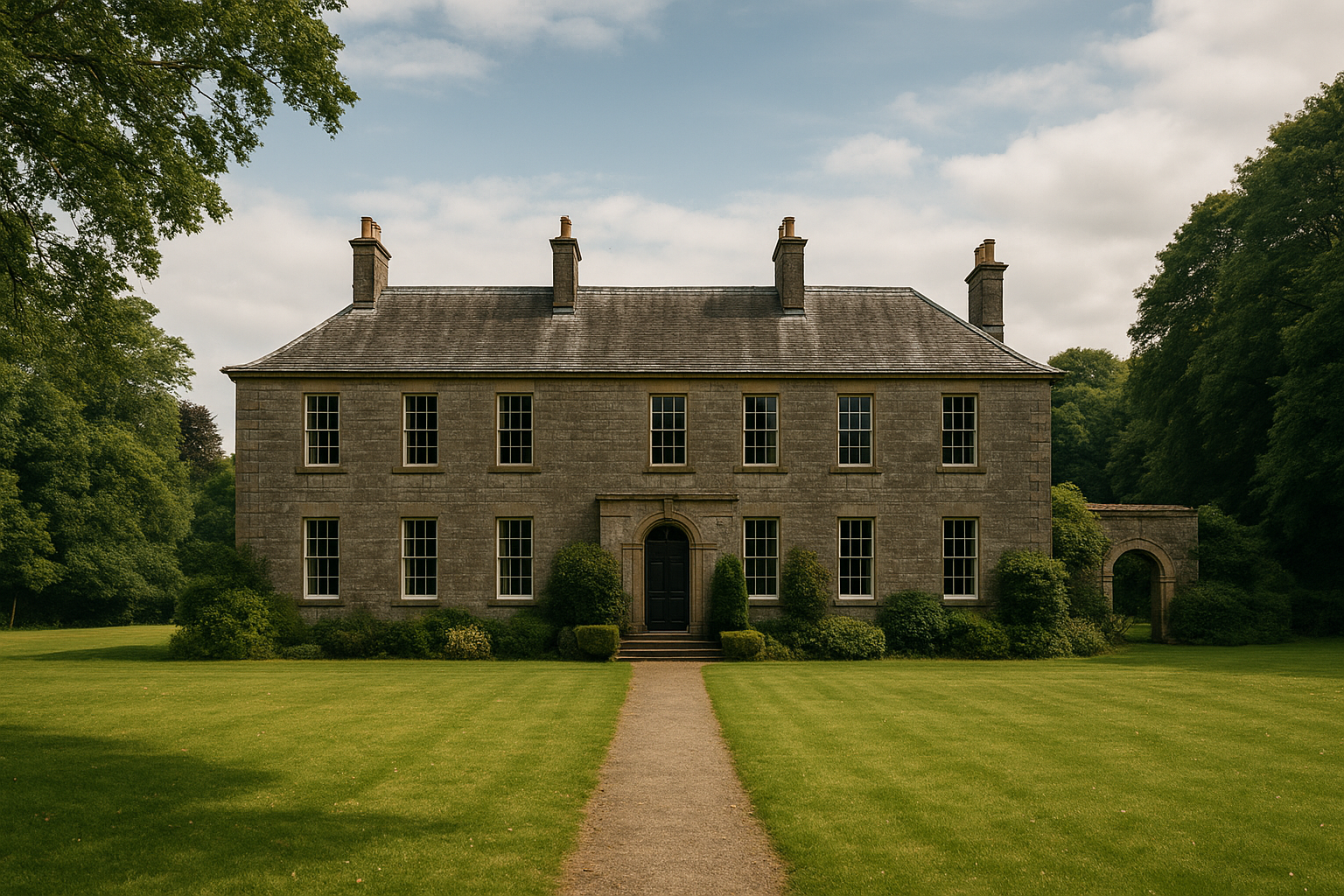
Campbell Estate, Morningside, Scotland
Campbell Estate stood along Braid Hills Drive in Edinburgh's Morningside district, a late-17th-century Georgian manor whose weathered stone concealed underground networks, reinforced greenhouses, and centuries of accumulated secrets. The property's strategic positioning, distinctive architecture, and evolution from modest country house to repository of mysteries reflected generations of quiet adaptation. The catastrophic fire of April 2025 reduced centuries of Campbell legacy to ash and rubble, leaving only a recently built cottage and questions about what might eventually rise from the ruins.
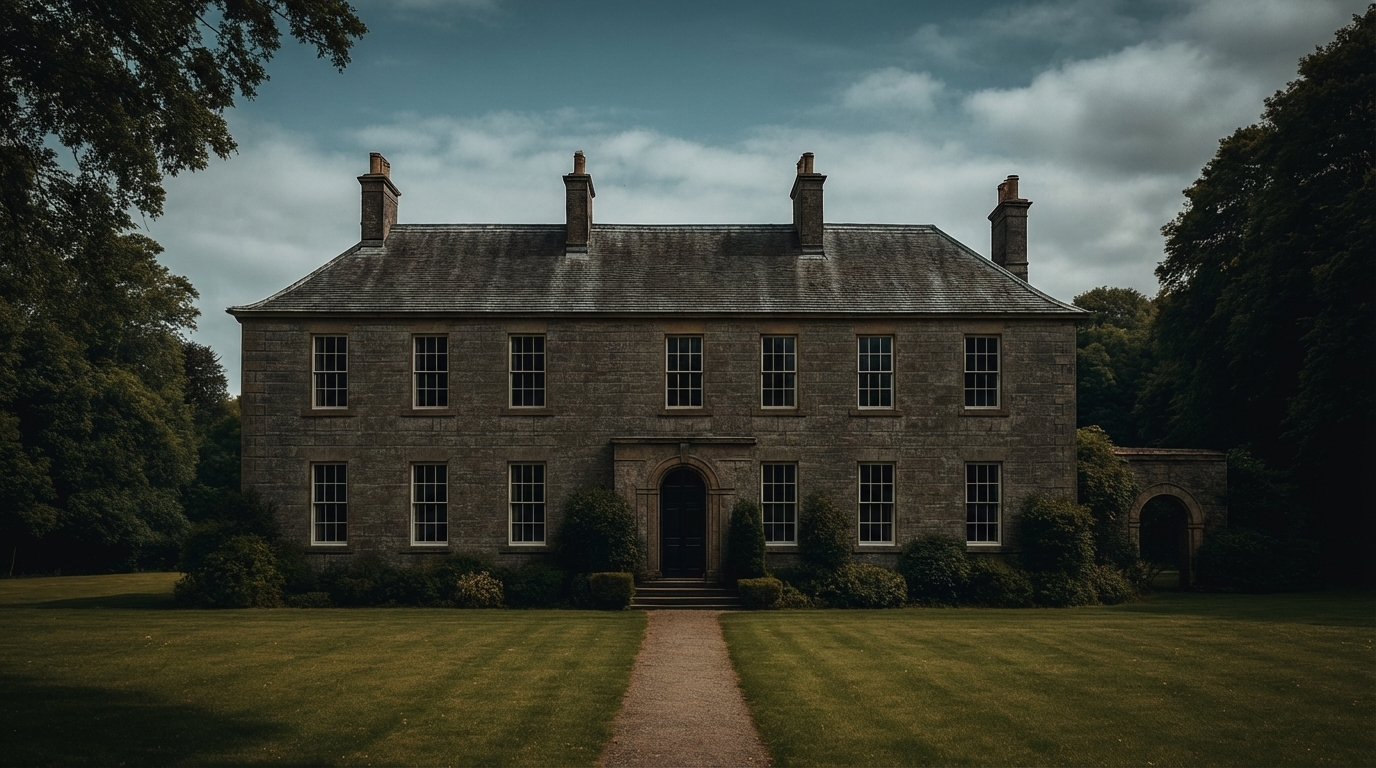
Location and Landscape
Campbell Estate occupied approximately six acres along Braid Hills Drive in Edinburgh's Morningside district, positioned where the city's southern suburbs transition towards the Braid Hills and open countryside beyond. The property's elevated situation on the lower slopes provided commanding views across Edinburgh whilst maintaining the privacy that substantial grounds and mature screening vegetation afforded. The location represented an ideal compromise—close enough to the city centre for convenient access, yet sufficiently removed to create the sense of rural retreat within urban boundaries.
The estate's topography utilised natural slope to create distinct zones across its compact acreage. The main house occupied the highest ground, with gardens descending in gentle terraces towards the lower reaches where the greenhouse complex was situated. Natural springs emerging from the hillside fed water features and irrigation systems, their reliable flow proving particularly valuable for greenhouse operations. The estate's boundaries were defined by weathered stone walls along Braid Hills Drive—approximately eight feet high with iron gates—and combinations of walls, hedging, and strategic tree placement along less visible boundaries with neighbouring properties.
The compactness of the six-acre footprint required careful design to accommodate multiple functions without obvious crowding. Every element served layered purposes—ornamental gardens that also screened sensitive areas, woodland plantings providing both aesthetic value and security buffers, pathways facilitating movement whilst appearing purely decorative. The property's organisation reflected centuries of incremental optimisation, creating landscape that felt larger than its actual dimensions through strategic screening and layered planting that prevented comprehending the entire property at once.
The soil across most of Campbell Estate demonstrated characteristics typical for Edinburgh's southern suburbs—adequate for traditional purposes, supporting conventional gardens without attracting particular attention. The estate's microclimate, influenced by elevation, sheltering from the Braid Hills, and urban heat effects, created growing conditions slightly more favourable than exposed locations whilst avoiding frost pockets. Morning mists occasionally settled in the lower reaches where the greenhouse complex was positioned, creating atmospheric conditions advantageous for operations requiring high humidity.
The Main House
The Campbell manor house, constructed in the 1690s, embodied late-Stuart architectural sensibilities adapted to Scottish conditions. The two-storey rectangular form, built from local sandstone, measured approximately fifty feet wide by forty feet deep—sufficient for comfortable family living without pretentious grandeur. The façade exhibited Georgian symmetry and classical proportions whilst incorporating Scottish traditions of substantial walls and relatively small windows designed for heat retention and security.
The ground floor contained formal reception rooms arranged conventionally. A drawing room occupied the front left, capturing southern light towards Braid Hills Drive. The dining room mirrored this on the right, seating twelve comfortably. Behind these spaces, the library extended across the rear, its floor-to-ceiling shelving holding generations of family documents, maps, and materials whose archival significance exceeded their apparent content. The library functioned as the estate's intellectual heart, with oak tables, reading chairs, and a partner's desk facilitating research and collaborative examination of sensitive materials.
By Daniel Campbell's time, all bedrooms were located on the upper floors. The first floor housed principal chambers—Daniel's bedroom in the front corner with views towards the Braid Hills, and three bedrooms for his daughters along the corridor. The second floor, originally servants' quarters, had been adapted for studies and workspaces where successive Campbells engaged in archival work. One chamber, accessible only through a particular sequence of doors, served as repository for the estate's most sensitive documents.
The kitchen occupied substantial space in the ground floor's rear extension, its evolution from 17th-century hearth cooking to modern appliances creating architectural palimpsest where different eras coexisted functionally. The massive pine table that dominated the centre had witnessed generations of family meals, recipe testing, and casual conversations where significant decisions emerged.
Adjacent to the kitchen lay the estate's most modern addition—a purpose-built testing room that Daniel had designed for developing the coffee blends distinguishing the Leaf and Bean. Measuring approximately twelve feet square, this compact space contained specialised equipment: grinders, precision scales, temperature-controlled kettles, and various brewing devices. A custom tasting bar crafted from pine matched the kitchen table, creating material continuity between related spaces. Here Daniel conducted methodical evaluations, his notebooks recording ratios, temperatures, and sensory observations with scientific precision. Secure storage housed special ingredients under controlled conditions—working amounts for experimental work whilst the main supply remained in the greenhouses.
The house's cellars extended beneath the entire footprint, providing cool storage whilst connecting through passages predating the house itself to the underground network that proved ultimately insufficient when fire consumed everything above.
The Greenhouses
The greenhouse complex occupied approximately half an acre in the property's lower reaches, positioned where natural slope created a sun-trap whilst surrounding trees provided screening from neighbours and the road. The main greenhouse, built in the 1880s, measured approximately forty feet by fifteen feet—substantial for a private estate whilst remaining within bounds of Victorian botanical enthusiasm.
The construction employed reinforced glass considerably thicker than standard specifications, ostensibly for weather resistance but practically obscuring interior observation. The iron framework supported elaborate systems for temperature regulation, humidity control, and light management exceeding conventional ornamental requirements. The structure's positioning meant that anyone viewing from Braid Hills Drive saw primarily the roof, the angle preventing clear interior observation.
The interior divided into zones separated by glass partitions and canvas curtains. The forward third housed recognisable ornamental species providing plausible explanation for the greenhouse's existence. These specimens, whilst legitimately interesting, served primarily as camouflage for operations hidden in the rear sections.
The rear sections, accessible only through locked doors and shielded from observation, contained the hybrid specimens constituting the estate's deepest secret. Here the cultivation medium differed fundamentally from anything found on Earth. The soil sustaining the hybrid plants had been transported from Clivilius, imported through means family records documented with varying precision. This foreign soil, visually indistinguishable from ordinary growing medium but possessing properties conventional analysis could not explain, provided essential foundation for cultivation impossible in terrestrial earth.
The Clivilius soil occupied raised beds constructed specifically to contain it, their lead-lined timber design preventing mixing with the estate's native earth. The beds measured approximately three feet deep—considerably greater than standard cultivation required—accommodating root systems of unusual density suggesting that whatever made the soil distinctive operated beneath the surface where understanding remained theoretical.
Water management followed protocols differing from conventional practice. Natural spring water underwent filtration and treatment before reaching the rear sections, removing compounds that might interfere with processes the Clivilius soil facilitated. A dedicated cistern stored treated water, maintaining consistent temperature. Conditions remained within narrower ranges than forward sections required, creating stability permitting the hybrids to express characteristics fluctuating conditions might suppress.
A smaller auxiliary greenhouse, measuring approximately twenty by twelve feet, served propagation, quarantine, and experimentation requiring isolation. Its timber construction and inconsistent glass gave somewhat ramshackle appearance belying careful environmental controls maintained within.
Both structures benefited from dedicated heating systems representing substantial investment relative to the estate's scale. Originally coal-fired, eventually converted to modern climate control, these systems ensured stable conditions regardless of Scottish weather. The visible costs occasionally raised questions amongst accountants and local tradespeople, but the Campbell family's long standing and the greenhouses' ostensible conservation value generally satisfied curiosity.
The Underground Network
Beneath Campbell Estate's visible architecture lay passages and chambers whose extent seemed disproportionate to the six-acre footprint, suggesting purposes extending beyond the estate's boundaries. The passages existed in multiple layers representing different construction periods gradually integrated into a complex whole connecting to Edinburgh's extensive underground networks despite miles separating Morningside from the city centre.
The deepest passages, carved through bedrock, followed natural geological features—ancient water channels and softer stone layers. These tunnels demonstrated medieval or earlier construction, their original purposes remaining speculative. Their extraordinary aspect was connection to Edinburgh's underground networks through passages extending several miles northward. These routes, probably established when surface travel carried significant dangers, provided access to locations within Edinburgh whilst remaining invisible from above.
Later additions, constructed during the Jacobite period, created more direct routes within the estate and larger chambers suitable for temporary accommodation or material storage. These sections showed sophisticated construction—proper ventilation disguised as natural features, reinforced ceilings, and storage niches behind false walls.
The most recent tunnels, Victorian and early 20th century, connected the main house cellars directly to the greenhouse complex, permitting movement regardless of weather or discretion needs. This passage employed straightforward engineering—relatively straight route with proper drainage, adequate height, and electric lighting added as technology permitted.
Several chambers served specialised purposes. A temperature-stable vault housed documents requiring protection from fluctuating conditions. A smaller room provided emergency accommodation, though its modest size could shelter only a handful. Multiple niches offered secure storage for items warranting burial beneath the estate.
The entrances integrated carefully into the limited acreage. Primary access descended through the cellars via stairs continuing beyond a pivoting wall section. The greenhouse complex connected through what appeared to be drainage but widened into passage beyond the perimeter. Two camouflaged exits emerged in wooded areas where mature trees created blind spots preventing observation from neighbouring properties or the road.
The tunnels' survival during the April 2025 fire demonstrated construction prioritising durability. Stone vaulting and separation from wooden floors preserved passages even as buildings collapsed. Yet survival meant something different for subterranean spaces—the tunnels remained navigable but led nowhere useful once the houses and greenhouses they connected were reduced to ruins.
The Cottage
The cottage surviving the fire represented the estate's most recent architectural addition, constructed during Daniel's lifetime to address family circumstances requiring both proximity and separation. Following Eloise's death in November 2016 and Daniel's return with his three daughters, multi-generational living arrangements demanded thoughtful resolution.
Alasdair and Moira recognised that their son and granddaughters needed space to rebuild family life. The solution emerged through practical consideration and symbolic statement—a purpose-built cottage positioned near the estate's eastern boundary, approximately 150 yards from the main house through woodland, creating sufficient separation that daily routines would not automatically intersect whilst preserving ability to easily gather.
Construction began in 2017, employing traditional Scottish vernacular adapted to contemporary standards. Thick stone walls provided thermal mass and weather resistance. A slate roof would weather to match the main house. The compact footprint—approximately 900 square feet plus attic space—reflected priorities differing from the main house's Georgian proportions.
The single-storey structure contained four principal rooms arranged for maximum functionality. The combined kitchen and living area occupied approximately 300 square feet of open-plan space. Two bedrooms, each approximately 150 square feet, provided private quarters for Alasdair and Moira. A small study gave Alasdair dedicated workspace whilst remaining integrated into the cottage's overall flow. A modest conservatory extending from the rear provided additional space for Moira's botanical work with conventional species.
The cottage's positioning proved significant beyond providing separation. The location offered views through woodland towards the Braid Hills whilst establishing distinct domestic territory. The distance from the greenhouse complex meant Alasdair and Moira's routines would not automatically intersect with more sensitive activities, providing security through both ignorance and separation.
The cottage's completion in 2019 allowed the arrangement to work remarkably well, providing privacy whilst maintaining multi-generational connection through shared meals, casual visits, and comfortable coexistence reflecting genuine affection rather than obligation.
The cottage's survival during the fire resulted from multiple factors—physical separation through woodland providing natural firebreak, its modest nature making it an afterthought for attackers focused on more obvious targets, and recent construction meaning modern fire-resistant materials. Following the fire and the family's eventual departure for Clivilius, the cottage became the estate's only remaining habitable structure, housing trusted associates maintaining minimal security.
Destruction
The fire consuming Campbell Estate on 7 April 2025 destroyed not merely buildings but centuries of accumulated history, knowledge, and material culture irreplaceable by any insurance settlement. The flames engulfing the main house spread with terrifying speed, consuming the upper floors where all bedrooms were located before intervention could prevent total loss.
The ground floor, including the library with irreplaceable archives, the testing room with specialised equipment, and the kitchen serving as domestic heart, suffered complete destruction. The stone cellars survived structurally but filled with debris from collapsed floors above. The main house's relatively compact 2,000-square-foot-per-floor footprint across two levels meant the fire had less distance to spread but more devastating impact per area burned.
The greenhouse complex, targeted specifically during the attack, suffered catastrophic damage combining deliberate destruction with fire effects. The reinforced glass shattered under assault, exposing specimens to smoke, heat, and flame. The iron frameworks, softened by heat, twisted and collapsed. The compact arrangement meant both main and auxiliary buildings succumbed within hours.
The Clivilius soil lay exposed amidst ruins, contaminated by ash, chemicals from fire-suppression, and general chaos. The relatively small quantity—perhaps two dozen cubic yards—meant complete loss remained possible if contamination proved severe. Whether this unique growing medium retained properties after such trauma remained unknown.
The underground network survived largely intact, stone construction and separation from burning structures providing protection wooden floors and plaster walls could not match. Yet the tunnels led nowhere useful once the houses and greenhouses they connected were reduced to ruins.
The gardens bore witness through scorched areas, damaged trees, and trampling beneath boots of attackers, firefighters, and investigators. The formal terraces immediately surrounding the main house suffered most severely from proximity to the burning structure.
The cottage, positioned approximately 150 yards distant through woodland providing natural firebreak, survived through distance, luck, and its status as insufficiently important to warrant attackers' attention. It stood amongst ruins as both loss and continuity—the only Campbell building remaining habitable, yet simultaneously reminder of everything destroyed.
What Remains
Campbell Estate exists in suspended animation, neither abandoned nor actively occupied, awaiting decisions depending on circumstances extending beyond property management. The ruins stand as they fell, blackened stones and collapsed walls creating a landscape of destruction that weather gradually softens but cannot erase. The greenhouse frames remain where they collapsed, monuments to loss.
The cottage sees occasional use by trusted associates maintaining minimal security, ensuring underground entrances remain sealed and boundaries stay respected. The compact property makes oversight more practical than larger holdings would permit. Yet their presence represents watching rather than living.
The gardens, deprived of maintenance, revert towards wilderness though bones of formal design remain visible. Perennials continue blooming according to cycles established over generations, creating strange beauty amidst destruction. The woodland shows fire damage but survives largely, its mature trees continuing to screen boundaries.
The water flows from natural springs, following routes engineering channelled but geological forces created before any Campbell claimed stewardship. Without irrigation systems, springs form pools following natural drainage, creating wetland areas previously maintained as dry ground.
The Clivilius soil, exposed in greenhouse ruins, persists in ways ordinary growing medium would not. Despite contamination, despite Scottish weather, despite absence of controlled conditions, the soil retains properties suggesting it remains fundamentally different.
The underground network continues patient existence, largely forgotten beyond caretakers ensuring entrances stay sealed. The relatively compact system requires minimal maintenance beyond preventing unauthorised access. The tunnels stand ready to resume traditional functions should circumstances warrant.
The estate's legal status remains uncomplicated—the Campbell family retains ownership, property taxes continue, and local authorities recorded destruction without pursuing reconstruction questions. The estate exists in official records as damaged property awaiting decisions about its future, status that can continue indefinitely.
The property's position along Braid Hills Drive means ruins remain visible to passing traffic, though boundary wall and surviving woodland screen detailed observation. Local residents occasionally pause whilst walking past, noting changes as months stretch into years. The cottage, appearing normally maintained, sometimes prompts speculation about whether the Campbells might return. These questions remain unanswered, the estate's future depending on circumstances extending far beyond neighbourhood curiosity.







