Bunnings, Glenorchy
Bunnings Warehouse Glenorchy is a large-format hardware retailer located at 20 Howard Road, Glenorchy, Tasmania. Opened in June 2015 as the replacement for Tasmania's original Moonah warehouse, the $43 million complex spans over 16,000 square metres of retail space. The location assumed unexpected significance on 25 July 2018, when Beatrix Cramer and her sister Gladys visited for supplies—a routine errand that culminated in surveillance by an unidentified observer and a cryptic directive from Leigh Trogaris that would alter their evening's trajectory.
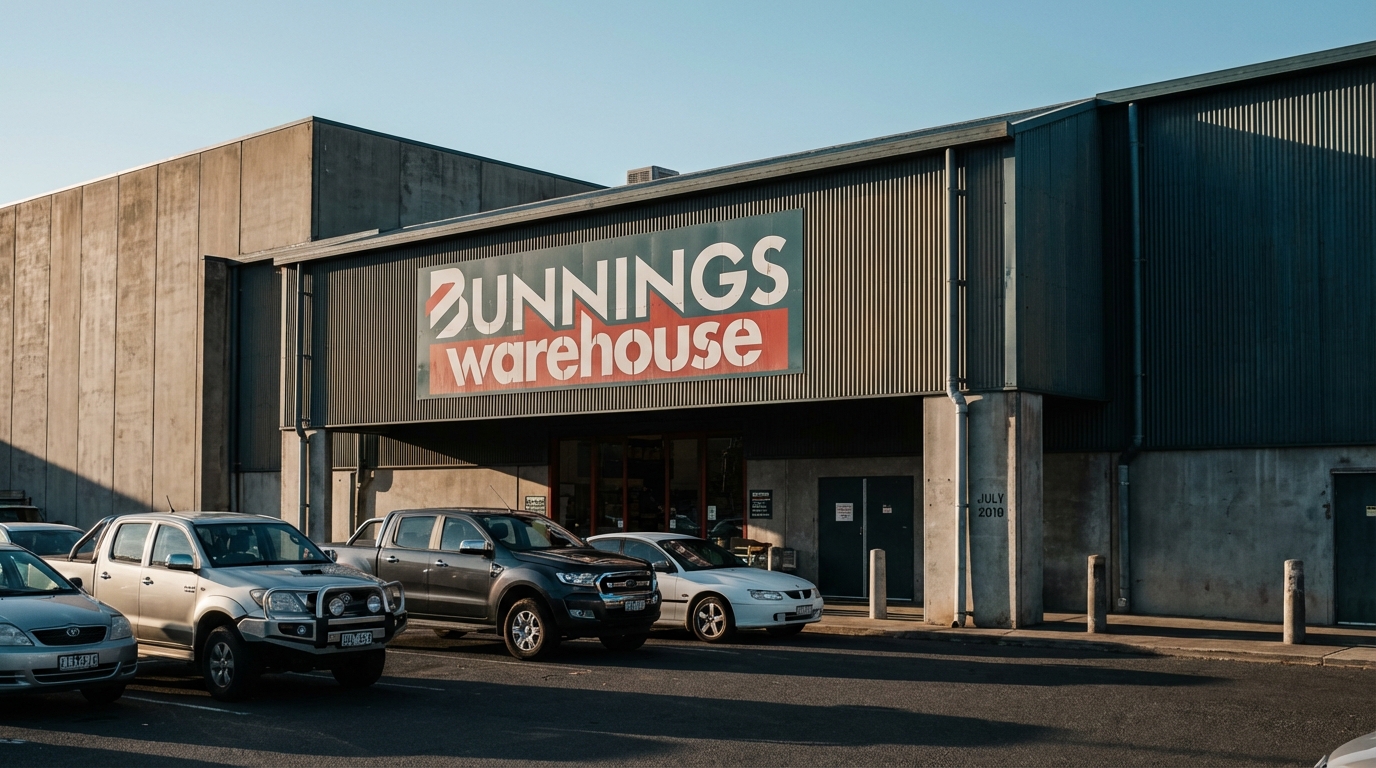
The Warehouse and Its Footprint
The Bunnings Warehouse at 20 Howard Road, Glenorchy, occupies land adjacent to the Hobart Showgrounds—a location chosen for its accessibility from the Brooker Highway and proximity to Glenorchy's expanding residential catchment. The building, completed in mid-2015, replaced Tasmania's original Bunnings Warehouse in nearby Moonah, which had served the greater Hobart area since the chain's early expansion into the island state.
The new facility represented a significant capital investment. At over 16,000 square metres, the warehouse dwarfed its predecessor in both footprint and ambition. The design followed Bunnings' standardised large-format model: soaring ceilings supported by exposed steel trusses, concrete floors polished to an industrial sheen, and aisles arranged in a grid pattern calculated to maximise both browsing time and impulse purchasing. Air conditioning units mounted high in the rafters pushed cool air downward with mechanical efficiency, creating the distinctive chill that characterised the chain's interior climate regardless of season.
The complex opened to considerable local fanfare on 15 June 2015, with several hundred guests attending the formal unveiling. The development had cost approximately $43 million and employed dozens of local workers during construction. For Glenorchy—a suburb still navigating the tensions between its working-class heritage and aspirational gentrification—the warehouse represented both economic promise and the creeping homogenisation of suburban commercial space.
Interior Architecture and Commercial Function
Inside, the Glenorchy warehouse exhibited the calculated abundance that defined the Bunnings retail experience. Twenty-eight kitchen displays lined one section, each presenting an idealised domestic fantasy of granite benchtops and soft-close cabinetry. Twelve bathroom displays occupied adjacent space, their gleaming fixtures and artfully folded towels suggesting lives of effortless cleanliness. A sprawling garden nursery occupied the outdoor section, where seasonal colour punctuated rows of potted natives and exotic ornamentals.
The special service counter—positioned near the front entrance to intercept customers with complex enquiries—operated as a node of transactional interaction. Staff stationed there navigated requests ranging from the straightforward to the arcane: delivery scheduling, special orders, warranty claims, and the occasional demand for printed information from the store's internal database. Company policy prohibited such printing, a regulation that staff enforced with varying degrees of rigidity depending on temperament and workload.
The trade drive-through, accessible from the rear of the building, catered to contractors and tradespeople who valued efficiency over browsing. Here, timber and bulk materials could be loaded directly into vehicles without the inconvenience of navigating retail aisles. The café near the entrance provided sustenance for those who had underestimated the physical demands of hardware shopping, whilst the indoor playground offered containment for children whose patience had exceeded its limits.
A Routine Errand, July 2018
On 25 July 2018, the Glenorchy Bunnings became an incidental setting in events that would assume greater significance only in retrospect. Beatrix Cramer—then navigating a period of profound personal instability following the death of Joel Gorsemann—visited the store with her sister Gladys to obtain information on concrete pouring and to purchase shelving.
The visit itself was mundane in conception: a practical errand undertaken during a day already weighted with emotional complexity. Beatrix approached the special service counter seeking printed documentation on concrete mixing ratios and curing times. The transaction became unexpectedly contentious when the staff member on duty—a woman named Lara—refused to print the requested pages, citing company policy with a flatness that bordered on contempt.
The impasse was resolved by the intervention of a male colleague, whose name tag identified him as Jake. His instruction to simply print the pages cut through bureaucratic resistance with pragmatic directness. Beatrix departed the counter with her documentation, the exchange having cost more emotional energy than either party had anticipated.
Meanwhile, Gladys had independently compiled a substantial shelving order in another section of the store. A staff member named Jarod assisted her in transporting the load to their vehicle in the car park, his helpfulness standing in marked contrast to the friction Beatrix had encountered.
The Watcher in the Shadows
It was in the car park—that transitional zone between the warehouse's fluorescent certainty and the world beyond—that the afternoon took an unsettling turn. As Beatrix crossed the asphalt toward their truck, she noticed a figure standing near the corner of the building. The man was thin and tall, his posture suggesting deliberate stillness rather than casual loitering.
He carried nothing—no trolley, no bag, no evident reason for his presence. His position, half-shrouded in the shadows cast by late afternoon light, seemed calculated for observation rather than commerce. Beatrix felt the weight of his attention with an instinctive certainty that transcended rational assessment.
Before she could act on this awareness, a white van passed between them, temporarily obscuring her line of sight. When the vehicle cleared, the corner stood empty. The man had vanished with a completeness that felt less like departure than erasure. Whether he represented a genuine threat, a coincidental presence, or something connected to forces Beatrix did not yet fully understand remained an open question—though subsequent events suggested that such surveillance was rarely accidental in her orbit.
Leigh's Directive
The drive away from Bunnings brought no relief. As Gladys navigated the truck through the car park, Beatrix's phone delivered a notification that would reshape the remainder of their day. The message was from Leigh Trogaris—a figure whose communications invariably carried operational weight.
"Change in plans. Package on your bed – needs delivery. You'll get address soon."
Seconds later, a follow-up provided the destination: 655 Main Road Berriedale, at 7:15 pm.
The timing and precision of this directive suggested that Leigh had known their location, or at least anticipated their schedule with uncomfortable accuracy. The mention of a "package" awaiting delivery carried implications that neither sister could afford to ignore. Whatever routines they had planned for the evening dissolved in that moment, replaced by the particular urgency that attended Leigh's instructions.
Beatrix ordered Gladys to take them home immediately. The shelving in the truck bed, the printed pages on concrete mixing, the petty grievance with Lara at the service counter—all of it receded into irrelevance. The afternoon's errands had been prologue. The real business of the day awaited.







