Brooke Isabella Pafistis
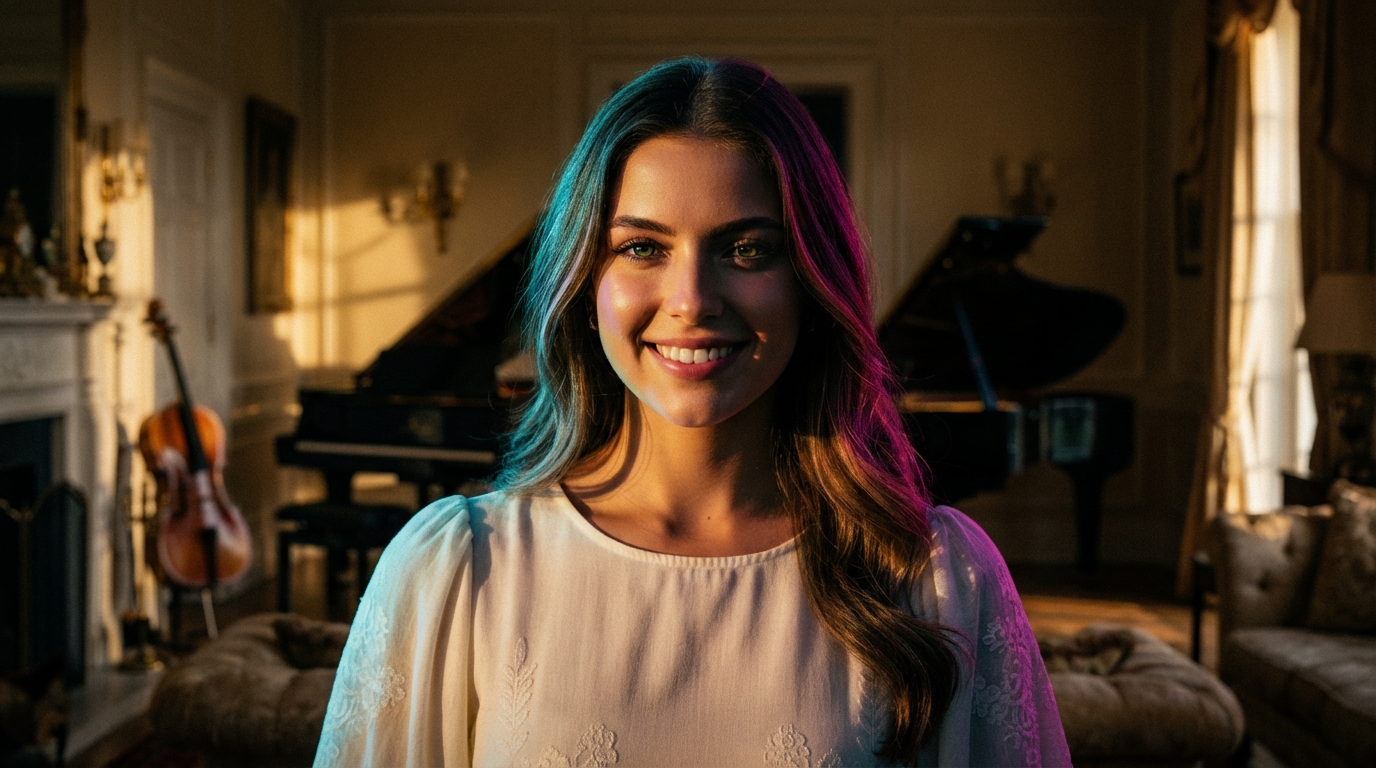
Brooke Isabella Pafistis, born 9 November 2006 in Hobart, Tasmania, is a bright-eyed, musically gifted girl whose infectious energy and boundless enthusiasm define her character. Growing up in the Battery Point mansion surrounded by creative parents and an artistic older sister, Brooke discovered her passion for piano at an early age. When her father Adrian's disappearance in July 2018 fractured her family, eleven-year-old Brooke was brought to Clivilius in August 2018, where her natural optimism and adventurous spirit face new challenges in an alien world.
Born into a House of Creative Harmony
Brooke Isabella Pafistis arrived in the world on 9 November 2006 at Royal Hobart Hospital, the second daughter of Adrian Louis Pafistis and Sharon Louise Pafistis (née Reynolds). Her birth represented the completion of what her parents envisioned as their family—two daughters, four years apart, each inheriting different aspects of their parents' creative legacy. Where Sarah had received her mother's middle name Louise, Brooke's middle name Isabella carried its own significance, chosen for its musical quality and European elegance that reflected the family's bicultural heritage.
The Battery Point mansion where Brooke spent her early childhood was more than a home—it was a three-dimensional expression of her father's architectural philosophy and her mother's aesthetic sensibility. The modern mansion, which Adrian had both designed and constructed, blended contemporary design with classic European elegance. For Brooke, this extraordinary residence was simply normal—the grand entrance with Renaissance-inspired columns, the spacious foyer where her footsteps echoed, the expansive living area with soaring ceilings and floor-to-ceiling windows that framed Tasmania's ever-changing skies. The property's luxurious heated pool became her summer playground, the meticulously landscaped gardens her exploration territory, the built-in barbecue area the stage for family gatherings filled with laughter and music.
Most significantly for Brooke's development, the living room contained a grand piano—a beautiful instrument that would become central to her identity. The piano had been purchased when Sarah began showing musical interest, but it was Brooke who would ultimately claim it as her primary means of self-expression. From her earliest memories, the piano represented possibility, beauty, and the magical capacity of disciplined practice to produce something transcendent.
Brooke's family environment was richly creative. Her father Adrian, the master builder whose hands shaped structures across Tasmania, brought to family life a quiet intensity and commitment to excellence. He taught both daughters to observe the world with critical eye, to understand that quality was never accidental but always the result of careful attention. Her mother Sharon, the talented hairdresser and salon owner, embodied creative entrepreneurship—the understanding that beauty and commerce need not be opposed, that building a business was itself a form of artistic expression.
Her older sister Sarah, already displaying exceptional visual artistic talent by the time Brooke was old enough to understand such things, provided both inspiration and implicit pressure. Sarah's paintings decorated the house, her artistic achievements garnered recognition at school and in the community, her creative sensibility seemed effortless and natural. For Brooke, having an artistically accomplished older sister meant both privilege and challenge—the advantage of growing up surrounded by creativity, the difficulty of finding her own distinctive voice in a household where visual art was already so well represented.
The family also included Zephyr, a mischievous ferret whose playful antics and endless curiosity perfectly matched Brooke's own energetic temperament. Zephyr's darting explorations through the house, his habit of stealing small trinkets to create impromptu treasure hunts, his boundless enthusiasm for investigation—all resonated with Brooke's own approach to life. The ferret became her particular companion, the creature who seemed to understand her restless energy and need for movement and discovery.
The Pafistis household was characterised by bicultural richness. From her father, Brooke inherited Greek-Australian heritage—stories of her grandfather Kostas's calculated poker games, traditions of filoxenia that made hospitality sacred, the particular blend of Mediterranean warmth and Australian pragmatism. From her mother came Cornish heritage—tales of windswept coasts and fishing villages, of her grandmother Iris's seamstress precision, of building beauty from simple materials. This complex ancestry meant Brooke grew up understanding that identity could be multiple, that she belonged simultaneously to several traditions whilst being wholly herself.
Weekend family outings became formative experiences. Hikes on Mount Wellington where her father pointed out natural formations and discussed sustainable building principles, visits to Salamanca Market where her mother examined textiles and colour combinations, beach trips where both girls were encouraged to explore and collect and imagine. These excursions weren't merely recreation but education in observation, appreciation, the capacity to find wonder in everyday encounters.
The Discovery of Musical Voice
Brooke's relationship with the piano began early and intuitively. Unlike Sarah, whose artistic talent emerged through drawing and painting, Brooke was drawn to the piano's particular magic—the way pressing keys could produce sound, the discovery that patterns of notes created melodies, the understanding that disciplined practice could transform hesitant scales into confident music.
Her parents recognised this natural affinity and nurtured it carefully. Piano lessons began when Brooke was five years old, initially with a local teacher who emphasised both technical fundamentals and musical joy. Brooke approached practice with the same boundless enthusiasm she brought to other pursuits—sometimes frustrating in its lack of focus, often delightful in its genuine pleasure. She didn't practice piano because she ought to but because she wanted to, because creating music felt natural and necessary.
By age seven, Brooke was displaying unusual musical sensitivity—the ability to hear complex pieces and reproduce them by ear, the intuitive understanding of rhythm and phrasing that typically required years of instruction. Her teacher noted both her raw talent and her need for discipline, the challenge of harnessing natural ability through structured practice. This tension between spontaneous creativity and necessary discipline would characterise Brooke's musical development, requiring her to learn that genuine artistry demanded both inspiration and perspiration.
The living room piano became Brooke's sanctuary and stage. She would practice for hours, filling the Battery Point mansion with music that ranged from classical études to contemporary pieces to her own improvised compositions. The grand space with its soaring ceilings provided perfect acoustics, the floor-to-ceiling windows creating natural theatre where she could imagine performing for audiences beyond her immediate family. Adrian would sometimes pause his architectural work to listen, Sharon would style clients' hair whilst Brooke's melodies drifted through the house, Sarah would paint to musical accompaniment that made her canvases seem to pulse with rhythm.
Brooke's musical interests were broad and eclectic. She absorbed influences from her parents' diverse musical tastes—classical compositions that Adrian appreciated for their structural sophistication, contemporary pieces that Sharon found in her salon's playlist, jazz improvisations that both parents enjoyed. She was equally comfortable with Chopin and contemporary pop arrangements, finding in each genre something valuable to explore and incorporate into her developing musical identity.
Unlike Sarah, whose introspective nature meant her art sometimes carried weight and shadow, Brooke's musical expression remained characterised by lightness and joy. Her pieces—whether classical repertoire or original compositions—conveyed optimism, energy, movement. This wasn't naivety but genuine temperament, the natural brightness of a child whose early experiences had been predominantly happy, whose family life had provided security and encouragement, whose world still seemed fundamentally good despite its complexities.
Schooling and Social Development
Brooke attended local Hobart schools where her natural confidence and social ease made her popular amongst peers. Unlike Sarah, who had always been somewhat introverted and artistically focused, Brooke possessed extroverted tendencies—she made friends easily, participated enthusiastically in group activities, brought energy and enthusiasm to social situations. Teachers noted her determination and focus alongside her sometimes scattered attention, the way she could be intensely concentrated on musical pursuits whilst struggling to maintain equivalent focus on subjects that interested her less.
Her musical talent brought recognition and opportunity. She performed in school concerts, participated in local youth music programmes, began to understand that her piano abilities set her apart in ways both gratifying and isolating. Being the talented musical student meant receiving encouragement and attention, but it also meant carrying expectations, feeling pressure to perform, experiencing envy from peers who lacked equivalent gifts.
At home, Brooke occupied a particular position in the family constellation. She was the younger daughter, often perceived as the sunny one, the optimistic one, the child who brought lightness whilst Sarah carried more introspective weight. This distinction wasn't entirely fair—Brooke experienced her own complexities, her own doubts and fears—but family dynamics often simplify, assigning each member particular roles that become difficult to transcend.
Her relationship with Sarah was central to her development. Four years' age difference meant Sarah often served as caretaker and role model, protecting Brooke from difficulties, mediating between Brooke and their parents, providing the kind of big-sister guidance that shaped Brooke's understanding of what it meant to be a Pafistis daughter. Sarah's protective instincts, intensified by their mother's demanding career and father's construction business, meant Brooke grew up with unusual security—someone always watching over her, anticipating her needs, smoothing her path.
Yet this protection also created dependency and perhaps forestalled certain kinds of independence. Brooke learned to rely on Sarah's intervention, to expect that difficulties would be managed by others, to trust that the world would generally be kind because Sarah made it so. This wasn't entirely healthy—it meant Brooke didn't always develop the resilience that comes from navigating challenges independently—but it reflected Sarah's genuine love and their parents' unconscious patterns of dividing parental responsibilities.
The Fracture: Adrian's Disappearance
On 30 July 2018, when Brooke was eleven years old and still several months from her twelfth birthday, her father Adrian left for what should have been a routine work meeting. He never returned. For Brooke, this disappearance was simultaneously incomprehensible and devastating. Her father—the quiet, steady presence who had always been there, who had taught her to observe buildings and understand craftsmanship, who had listened to her piano practice with genuine appreciation—was simply gone.
The immediate aftermath was marked by confusion and fear. Adult conversations happened in hushed tones, Sarah became even more protective, their mother Sharon maintained careful composure that suggested enormous effort beneath the surface. Brooke understood that something terrible had happened but couldn't grasp the full enormity. Her world, which had seemed fundamentally secure, had revealed itself to be precarious in ways she had never imagined.
Police came to their Battery Point home, asking questions and taking notes. Detectives Karl Jenkins and Sarah Lahey interviewed family members, their professional concern unable to fully mask the troubling implications of Adrian's disappearance. Brooke was largely shielded from these interactions—sent to stay with friends whilst official investigations proceeded, protected by both Sharon and Sarah from the darkest possibilities.
The weeks following Adrian's disappearance marked Brooke's loss of innocence—not dramatic or sudden but gradual erosion of the belief that the world was safe, that families stayed together, that terrible things happened to other people but not to the Pafistis family. She continued attending school, continued piano practice, continued outward routines that masked internal disruption. But everything had changed in fundamental ways she couldn't articulate.
Her piano playing during this period reflected her emotional state—sometimes frantic and desperate, as if she could somehow play loudly enough to bring her father back, sometimes withdrawn and minimal, barely touching the keys as if music itself had lost meaning. Sarah tried to maintain normalcy, Sharon balanced her own grief with practical necessities of managing household and business, and Brooke found herself navigating trauma without fully understanding what she was experiencing.
The Battery Point mansion, previously a sanctuary of creative expression and family warmth, became haunted by absence. Adrian's empty chair at dinner, his unused workshop, the architectural drawings still spread across his desk—all reminded Brooke constantly that her father was gone and that no one could explain where or why. She would sometimes sit at the piano, playing pieces her father had particularly enjoyed, as if musical invocation could summon him back across whatever distance separated them.
Portal Crossing and Impossible Reunion
On 17 August 2018, weeks after Adrian's disappearance, Brooke's world shifted again in ways that transcended comprehension. The specifics of how she, Sarah, and Sharon came to cross through a Portal into another dimension remain somewhat opaque in family narrative—whether Sharon had discovered the truth through her investigation, whether they were given genuine choice, whether they were somehow manipulated into crossing. What is certain is that on that day, eleven-year-old Brooke left Earth behind and entered Clivilius, the alien world where her father had been taken.
The reunion with Adrian was overwhelming—joy, confusion, relief, strangeness all mixed together in emotional complexity that Brooke couldn't fully process. Her father was alive, which was what mattered most, but he was also somehow different, marked by experiences she couldn't understand, existing in a place that defied everything she thought she knew about reality. For a child who had spent weeks fearing her father was dead, his physical presence—able to hold her, speak to her, confirm that he still existed—represented miracle beyond measure.
Yet the circumstances of their reunion also raised questions Brooke was too young to fully formulate. Why hadn't he come home if he was alive? What was this place they had been brought to? Would they ever return to Hobart, to the Battery Point mansion, to the life she had known? These questions hung unspoken, too large and terrible to voice, existing as background anxiety that would shape her experience of Clivilius even as she tried to adapt.
Musical Adaptation in an Alien World
The settlement of Bixbus, where the Pafistis family found themselves, presented challenges that tested even Brooke's natural optimism. The harsh, arid landscape bore no resemblance to Tasmania's green beauty. The makeshift infrastructure, the constant dust, the cramped living quarters, the absence of familiar comforts—all created environment where simple survival dominated more refined concerns like musical education and artistic development.
Yet Brooke's musical passion persisted even in these unpromising circumstances. Instruments were scarce in early Bixbus—the settlement focused on essential survival needs rather than cultural amenities—but music itself couldn't be regulated or rationed. Brooke sang, created rhythmic compositions using found materials, improvised melodies that filled her family's living space with sound that transcended their circumstances.
As Bixbus developed and stabilised, educational infrastructure began to emerge. The Learning Grove, established in September 2018, represented the settlement's commitment to maintaining childhood development even in alien environment. The Grove's philosophy of experiential learning shaped by individual passions perfectly matched Brooke's needs. When a piano finally arrived in Bixbus—brought through the Portal as part of cultural enrichment efforts—Brooke was among the first to claim it for practice.
The piano in Bixbus was not the grand instrument of the Battery Point mansion—it was smaller, more battered, its tone imperfect from transport and environmental challenges. But it was a piano, which meant it was possibility, connection to the musical identity Brooke had developed on Earth, proof that beauty and artistry could survive even forced displacement and impossible circumstances.
Brooke's piano practice in Bixbus served multiple functions. For her personally, it provided continuity with her previous life, refuge from the alienness of her surroundings, means of processing emotions too complex for words. For her family, her music offered comfort and normalcy, reminder that they remained the Pafistis family despite radical transformation of their circumstances. For the broader Bixbus community, Brooke's playing became a symbol of resilience and hope—proof that human creativity and cultural expression could flourish even in settlements built from necessity rather than choice.
Her relationship with Sarah remained strong though complicated by their circumstances. Sarah, struggling with her own artistic frustrations and resentments about their displacement, sometimes found Brooke's optimism difficult to witness. Brooke's capacity to adapt, to find joy even in challenging circumstances, to maintain enthusiasm when Sarah felt predominantly loss—this could feel like implicit criticism, suggestion that Sarah's more complex emotional responses represented failure rather than legitimate reaction to trauma.
Yet the sisters' bond endured these tensions. Sarah continued to protect Brooke, to support her musical development, to create space for her younger sister's dreams even whilst questioning the meaning of her own artistic work. Brooke, for her part, provided lightness that balanced Sarah's darkness, optimism that countered Sarah's scepticism, living proof that the Pafistis family could survive and perhaps even thrive despite everything they had lost.
Musical Growth and Emerging Identity
As Bixbus evolved from desperate survival camp to functioning settlement, opportunities for cultural development increased. Brooke's musical abilities gained recognition within the community. She performed at settlement gatherings, provided musical accompaniment for community events, began teaching basic piano to younger children who had been brought to or born in Bixbus. These roles transformed her from talented student to emerging artist and educator, requiring her to develop skills beyond mere performance.
Her musical style evolved in response to her circumstances. The classical repertoire she had studied on Earth remained foundational, but she began incorporating elements that reflected her new reality—compositions that suggested both displacement and hope, pieces that acknowledged hardship whilst maintaining belief in beauty's persistence. Her original compositions, which had always been part of her practice, became increasingly sophisticated, reflecting not just technical development but emotional maturation forced by circumstance.
Unlike Sarah, whose artistic work in Bixbus often felt conscripted into community service against her will, Brooke experienced her musical contributions as more naturally aligned with her temperament. She enjoyed performing for others, found satisfaction in teaching, appreciated being recognised for her talents. This wasn't lack of depth but genuine difference in personality—where Sarah needed solitude and autonomous creative expression, Brooke thrived on connection and shared musical experience.
Her relationship with Adrian, disrupted by months of separation and complicated reunion, gradually rebuilt through music. He attended her performances, provided encouragement for her development, recognised in her musical dedication an echo of his own commitment to craftsmanship and excellence. They couldn't recover lost time or fully bridge the gap that trauma had created, but music provided language for connection when words proved inadequate.
Sharon, navigating her own adaptation to Bixbus, found in Brooke's musical development cause for pride and hope. Her youngest daughter's capacity to maintain enthusiasm, to continue pursuing her passion despite radical disruption of every familiar structure, represented resilience that Sharon deeply valued. She supported Brooke's musical education as circumstances allowed, understanding that nurturing her daughter's talents was itself resistance against the forces that had displaced them.







