4338.10 · January 10, 2018 AD
Broken Hill on the Line
A phone call placed from a fourth-floor government office in Hobart reaches a mining company desk in Broken Hill, bridging fifteen hundred kilometres and several years of fraternal drift. Nathan Cowdrey tells his brother Josh everything — the note, the envelope, the portal, the barren world on the other side — and the silence that follows carries the particular quality of a man reorganising his understanding of his brother's sanity before deciding, against all available evidence, to believe him.
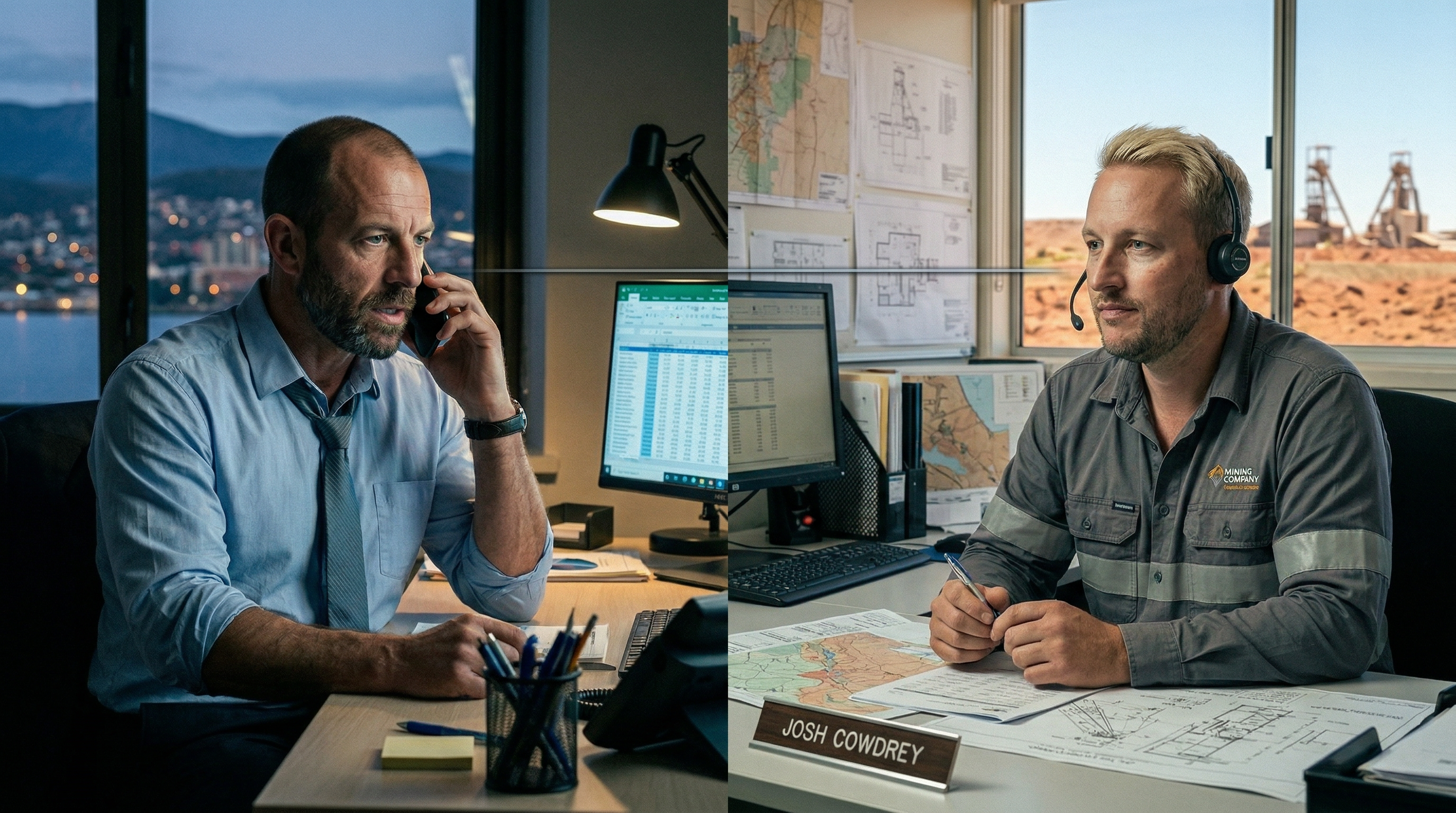
The phone call travelled fifteen hundred kilometres through fibre optic cable and cellular relay, crossing Bass Strait and the breadth of Victoria and the flat, sun-hammered expanse of western New South Wales before arriving at a desk in Broken Hill where Josh Cowdrey was doing what Josh Cowdrey did — working steadily through the afternoon with the methodical attention of a man whose relationship with finance had been built on the principle that numbers did not lie and surprises were to be eliminated rather than embraced.
The brothers had not spoken properly since Christmas, and before that the gaps had been longer — weeks stretching into months, conversations contracting into texts that grew shorter with each exchange until the relationship existed primarily as a standing assumption rather than an active practice. The drift was nobody's fault and both of their faults, the predictable erosion that occurs when siblings settle into separate geographies and separate routines and discover that adulthood does not automatically preserve the intimacy that childhood provided without effort.
Nathan's voice arrived carrying frequencies Josh had learned to read across three decades of brotherhood. There was a register Nathan used when something was genuinely wrong — not the theatrical alarm he deployed for minor crises, not the performative stress he applied to work frustrations, but a tighter, more compressed quality that stripped the habitual warmth from his tone and left something raw beneath. Josh heard it within the first sentence. The chair in Broken Hill shifted forward.
What followed was not a conversation in any conventional sense. Nathan spoke and Josh listened — not the passive listening of someone waiting for their turn, but the active, absorptive listening of a man cataloguing information that refused to fit any framework he possessed. A handwritten note left by a friend who had subsequently vanished. An envelope containing devices constructed from materials that defied identification. A letter describing technology built by an ancient civilisation, a parallel world, an artificial intelligence that administered it. And then the part that should have ended the call — the part where Nathan described pointing one of the devices at a wall in a government meeting room and watching reality open like a door.
The silence from Broken Hill lasted long enough to acquire texture. Through the connection, the faint mechanical thrum of mining equipment provided a bassline of industrial normality — the sound of a world that operated according to established physical laws and had no patience for alternatives. Josh's breathing was audible, measured, the respiration of someone processing information that his analytical training insisted was impossible while his knowledge of his brother insisted was being delivered in earnest.
The assessment that emerged from that silence was characteristic of the man who made it. Not dismissal. Not credulity. Something more precise — an acknowledgment that Nathan believed what he was saying, coupled with a request for evidence that could survive scrutiny more rigorous than fraternal trust. Josh had spent his career in mining finance, where the gap between what people claimed about a deposit and what the assay results confirmed could represent the difference between investment and insolvency. He did not reject the extraordinary on principle. He simply required it to prove itself.
Nathan's promise to send something concrete carried an urgency that the distance between Hobart and Broken Hill could not diminish. The call ended with an agreement that was less a plan than a mutual acknowledgment that something had changed in the space between them — not the drift that had characterised recent years but its opposite, a sudden, gravitational contraction that pulled two brothers back toward each other across the width of a continent.
In Hobart, the office continued its late-afternoon routines around a man whose phone call had just recruited his brother into something neither of them could yet name. In Broken Hill, a finance analyst sat at his desk with the distant hum of mining equipment filling the silence where his brother's voice had been, turning over impossibilities with the same methodical attention he applied to balance sheets, and finding — against every instinct his training had provided — that he could not dismiss what he had heard.







