
Broken Hill Base Hospital, New South Wales
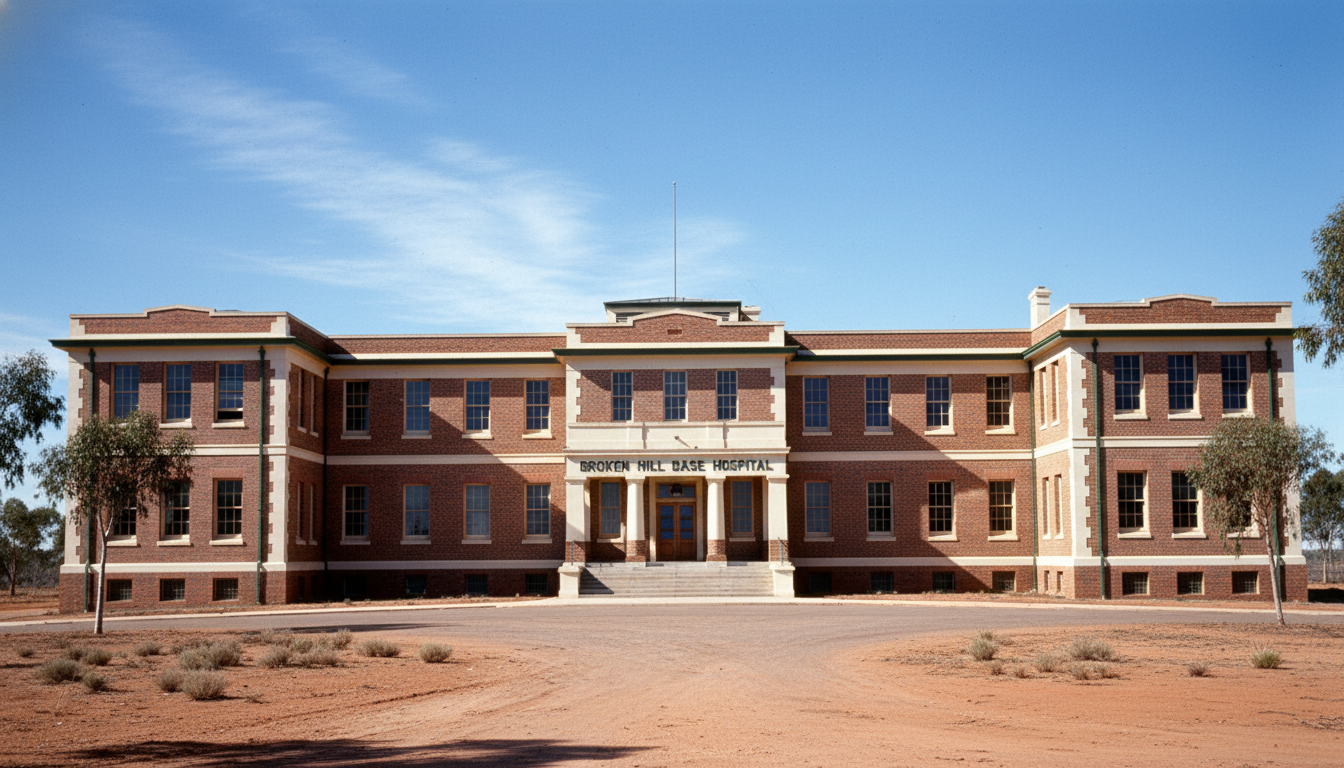
Broken Hill Base Hospital, established 7 September 1924 on foundations laid in 1891, stands as the primary healthcare sanctuary for one of Australia's most isolated mining communities. Born from the brutal necessity of treating industrial accidents in a town built on silver, lead, and zinc, the hospital has evolved into a multi-service facility serving remote outback populations across 350,000 square kilometres. Its story embodies Australian resilience—delivering life, treating tragedy, and enduring against geographical tyranny.
Genesis and Early Development (1883–1905)
The hospital's story begins not with its formal establishment but with the desperate circumstances that made it inevitable. When boundary rider Charles Rasp discovered the broken ridge of mineralised rock in 1883 that would transform empty outback into one of the world's richest deposits, he unknowingly set in motion a sequence that would require medical infrastructure as urgently as it required mining equipment.
The early years of Broken Hill's existence—that explosive transformation from empty scrubland to boomtown—created conditions that were spectacular, profitable, and lethally dangerous. The mines descended rapidly, chasing veins of silver, lead, and zinc through rock that resisted extraction. Men worked in conditions that ranged from merely hazardous to actively murderous: temperatures in the deeper shafts exceeded 100 degrees Fahrenheit, ventilation was primitive at best, safety protocols were rudimentary, and equipment failures occurred with grim regularity.
Medical care in the 1880s consisted primarily of private doctors operating from makeshift clinics, their services available to those who could afford payment. The mining companies maintained medical staff for treating injured workers, but access remained limited to employees, and the quality varied dramatically based on company priorities and individual physician competence. Religious organisations, particularly the Sisters of Mercy, provided charitable care that filled gaps the market economy wouldn't address, treating the indigent and desperate through facilities that were more sanctuary than hospital.
The inadequacy of this patchwork system became undeniable through accumulated tragedy. On 14 March 1888, the rockfall that crushed miner Samuel Hastings three hundred metres underground illuminated the brutal reality: by the time colleagues had fashioned a stretcher from timber and coats, hauled Hastings to the surface, and transported him to the nearest doctor, hours had elapsed during which proper medical intervention might have saved function if not life. The incident, replicated in variations across numerous accidents, created pressure within the mining community for centralised medical facilities accessible to all workers regardless of employment status.
The campaign for a proper hospital united interests that rarely aligned: union representatives advocating for worker welfare, mining company executives recognising that treating injuries promptly reduced compensation costs, civic leaders promoting infrastructure that signalled permanence beyond boom-town temporariness, and religious organisations seeking institutional frameworks for their charitable missions. By 1889, this coalition had achieved sufficient political momentum to force action.
On 22 September 1889, a contentious town hall meeting addressed the fundamental question of location. Mine owners advocated for proximity to the major shaft operations, arguing that emergency response time represented the critical variable in trauma survival. The Sisters of Mercy championed higher ground away from the dust and contamination that characterised areas adjacent to mining operations, arguing for long-term health considerations beyond immediate trauma response. The debate captured a broader tension about the hospital's purpose—would it exist primarily as emergency intervention for industrial accidents, or would it serve as a comprehensive health facility for a permanent community?
The vote narrowly favoured the elevated Thomas Street site, a decision that would prove prescient as the hospital evolved beyond its mining origins. On 3 May 1890, Dr. Edmund Grafton, the town's most respected physician, presided over the foundation stone ceremony attended by approximately three hundred residents. The stone itself contained a time capsule: a miner's pick symbolising the industry that necessitated the hospital, and a patient ledger representing the healing mission the institution would serve. Father Patrick O'Shea delivered a blessing that acknowledged both practical and spiritual dimensions, whilst the assembled crowd represented the diverse population that would depend on the facility—Anglo-Australians, Irish Catholics, Eastern Europeans, Chinese merchants, all united by their shared vulnerability to outback hardship and mining danger.
Construction proceeded through 1890 and early 1891, funded through a combination of government allocation, mining company contributions, and community fundraising that included everything from church bazaars to benefit concerts. The initial structure was modest: two weatherboard buildings connected by a covered walkway, totalling twelve beds, one surgery ward, a dispensary, and residential quarters for a matron. The facilities were spartan but functional, designed with the understanding that expansion would follow as resources permitted.
On 17 October 1891, the hospital treated its first official patient: sixteen-year-old Jimmy Calloway, a blacksmith's apprentice who had suffered a deep laceration to his left leg when molten metal from the forge splashed against his trousers. Dr. Grafton sutured the wound whilst Nurse Margaret Ellis administered antiseptic treatment and recorded the details in the patient ledger that would eventually contain thousands of entries chronicling a century of outback medical practice. Calloway's successful treatment—he recovered fully and would work as a blacksmith in Broken Hill for another forty years—became the hospital's first success story, proof that coordinated medical care could overcome injuries that might otherwise have meant permanent disability or death.
The first decade established patterns that would endure: the constant stream of mining accidents requiring emergency intervention, the gradual recognition that chronic conditions deserved attention alongside acute trauma, the challenges of recruiting and retaining medical professionals willing to work in isolation, and the hospital's evolution into a community institution that marked life's passages as well as treating its crises.
On 4 February 1892, in the pre-dawn hours when the outback cold penetrated even warmed buildings, Alice Jane Thompson became the first baby born within the hospital's walls. Her mother Ellen, who had lost two previous children to complications of home birth, had travelled to the hospital specifically to access the sterile environment and skilled attendants that domestic settings couldn't provide. Dr. Thomas Whitby and Nurse Ellis guided Alice into the world after fourteen hours of labour that would have been significantly more dangerous without hospital facilities. The successful delivery, followed by mother and infant's healthy recovery, demonstrated that the hospital could celebrate life's beginnings as well as fighting death's encroachment.
By 1905, the hospital had expanded to include twenty-four beds, a dedicated surgical theatre with improved lighting and ventilation, and—most significantly for the community—a maternity ward. The six-bed maternity unit, opened on 12 June 1905, represented a profound evolution in the institution's purpose. The impetus came from women who had experienced the terror of labour complications in isolated homes, from doctors who had witnessed preventable deaths, and from community leaders who recognised that a town claiming permanence needed infrastructure supporting reproduction as well as production.
The maternity ward's opening drew a crowd that filled the hospital's grounds—mothers who had lost children, fathers who had buried wives, midwives whose skilled hands couldn't compensate for lack of emergency surgical capacity. The ceremony was brief but emotional, with Sister Mary Catherine of the Sisters of Mercy offering prayers for all the babies who might have survived with hospital care, and for all the mothers whose lives would be protected by access to obstetric facilities. Within the first year, fifty births occurred in the maternity ward, a number that spoke to the community's eager embrace of the service.
Expansion and Professionalisation (1905–1950)
The early twentieth century brought systematic expansion that transformed the modest facility into a regional medical centre. The hospital's growth reflected Broken Hill's evolution from frontier mining camp into established city, from speculative boom to sustained industrial operation, from transient population to settled community with schools, churches, and civic institutions that signalled permanence.
World War I created particular demands. When the conflict began in 1914, many of Broken Hill's young men volunteered for military service, but mining's designation as essential industry meant others remained to maintain production of metals critical for munitions manufacturing. The hospital treated both the casualties of continued mining operations and, occasionally, returned servicemen whose injuries required ongoing care that military facilities couldn't provide. The influenza pandemic of 1918-1919 overwhelmed the hospital's capacity, requiring the transformation of community halls into auxiliary wards where nurses and volunteers fought an invisible enemy that killed with terrifying efficiency.
The interwar period brought modernisation driven by both technological advancement and accumulated experience. The installation of X-ray equipment in 1923 represented a quantum leap in diagnostic capability, allowing doctors to visualise fractures and foreign objects without exploratory surgery. The acquisition of an ambulance in 1927 improved emergency response times, though the vast distances of the outback meant many patients still arrived hours after their injuries. The establishment of a nurse training programme in 1931 addressed chronic staffing shortages by developing local talent rather than depending entirely on recruitment from coastal cities.
The Great Depression tested the hospital as it tested all institutions. Government funding contracted, private charity diminished as families struggled to meet basic needs, and patient numbers increased as economic desperation created health crises. The hospital maintained operations through a combination of reduced staff salaries, deferred maintenance, and the extraordinary commitment of personnel who understood that closing was not an option when the nearest alternative facility was hundreds of kilometres distant.
World War II brought renewed demands. The hospital treated mining accidents that increased in frequency as production pressures intensified and experienced workers departed for military service. The arrival of Italian prisoners of war, held in Broken Hill camps and working in mining operations under guard, added complexity as the hospital's ethical obligation to treat all patients encountered the wartime hostility towards enemy nationals. Doctors and nurses navigated these tensions with varying degrees of grace, but the institution's commitment to treating medical conditions regardless of patient nationality remained fundamentally intact.
The post-war period saw expansion accelerate. The hospital's bed capacity increased to sixty by 1948, then to eighty-five by 1952. New buildings replaced the original weatherboard structures, incorporating modern materials and design principles that improved both functionality and patient comfort. The establishment of specialist clinics—ophthalmology for treating the trachoma common in outback communities, orthopaedics for addressing mining injuries, and paediatrics for serving a town whose baby boom mirrored the national phenomenon—transformed the hospital from general facility into comprehensive medical centre.
Modern Era and Contemporary Challenges (1950–Present)
On 7 September 1924—the date that would eventually be recognised as the hospital's official establishment date, though operations had begun decades earlier—a formal dedication ceremony brought together civic leaders, medical professionals, and community members to celebrate the institution's evolution from emergency necessity into permanent fixture of outback life. The ceremony included unveiling of a commemorative plaque that honoured both the Sisters of Mercy whose early charitable work had sustained vulnerable populations, and the mining families whose collective advocacy had made the hospital's establishment possible.
Through the latter twentieth century, the hospital navigated challenges that reflected both national healthcare trends and the specific constraints of remote service delivery. The introduction of universal health care under the Medibank system in 1975 (later refined as Medicare in 1984) transformed accessibility, ensuring that financial barriers no longer prevented treatment. Yet geographical barriers remained intractable—the hospital served populations scattered across 350,000 square kilometres, connected by roads that could become impassable during weather events, relying on communication infrastructure that improved only gradually.
The partnership with the Royal Flying Doctor Service became increasingly integral. When medical emergencies exceeded the hospital's capacity—major trauma requiring specialist surgical intervention, cardiac events demanding facilities the hospital couldn't provide, complicated obstetric cases needing neonatal intensive care—the RFDS provided aerial evacuation to Adelaide or Sydney. The relationship exemplified the pragmatic cooperation necessary for delivering healthcare in Australia's interior, where no single institution could address all needs but coordinated networks could approximate the service levels available in metropolitan areas.
Within the hospital's maternity ward, generations of Broken Hill families drew their first breaths. William "Bill" Clift, born 28 July 1952, followed by Gregory Alan Clift on 17 March 1956. Kathleen "Kathy" Rose Clift on 22 November 1959. Michael James Clift on 15 August 1963. Each birth represented both individual joy and community continuity, proof that outback life could sustain families across generations despite the hardships. The maternity ward staff—doctors and midwives who witnessed thousands of deliveries—became keepers of intimate knowledge about which families welcomed children with celebration and which with resignation, which fathers paced anxiously and which disappeared to hotels until the messy business concluded.
The hospital's emergency department maintained constant readiness for the mining accidents that, despite improved safety protocols, remained grimly regular. On 16 March 1971, when the partial tunnel collapse at the South Mine crushed Albert John Clift's left leg, the emergency response demonstrated both the hospital's capabilities and its limitations. Dr. James Mitchell, the orthopaedic surgeon who spent seven hours reconstructing Clift's shattered limb, possessed the technical skill to save the leg from amputation—a feat that would have been impossible decades earlier. Yet he couldn't restore full function, couldn't reverse the permanent disability that would end Clift's mining career and transform his family's economic circumstances.
Throughout the 1970s and 1980s, the hospital witnessed the slow transformation of Broken Hill itself. Mining declined from dominant employer into significant but not singular industry. Tourism emerged as economic diversification strategy, bringing visitors drawn by outback landscapes and heritage architecture. The population aged as young people departed for opportunities unavailable in a remote mining town. The hospital adapted to these demographic shifts, increasing geriatric services whilst the maternity ward's activity levels gradually decreased.
The institution also found itself, unknowingly, entangled in events darker than industrial accidents or natural deaths. In September 1988, when fifteen-year-old Violet Dallow confronted her history teacher about his involvement in predatory networks, when her subsequent murder became one of two killings that year attributed to the figure known as the Silverton Strangler, the hospital existed at the periphery of events it couldn't influence. The investigation brought Detective Barry Glasson through the hospital's corridors, interviewing staff, seeking medical records, pursuing leads that would ultimately prove insufficient.
The hospital had no way of knowing that it existed within a geography marked by crimes spanning decades, that the Silverton Strangler's activities extended from 1988 through to at least 2018, or that these crimes involved not just earthly predation but dimensional crossings through Portal technology. The institution continued its daily mission—delivering babies, treating injuries, comforting the dying—whilst unseen networks operated within the very community it served.
By the early twenty-first century, the hospital faced challenges that reflected both progress and persistent constraints. Medical technology advanced at rates that outpaced regional facilities' ability to acquire and maintain equipment. Specialist recruitment remained difficult despite improved telecommunications allowing consultation with metropolitan expertise. Funding models designed for concentrated urban populations struggled to address the realities of serving scattered rural communities where per-patient costs were necessarily higher than in dense city settings.
The hospital's response involved creative adaptation. Telehealth consultations connected Broken Hill patients with specialists in Adelaide and Sydney, allowing expert assessment without the expense and difficulty of travel. Visiting specialist programmes brought surgeons, oncologists, and other experts to Broken Hill for concentrated periods treating accumulated caseloads. Partnerships with rural health organisations created career pathways that attracted medical professionals interested in outback service without committing to permanent isolation.
On 5 October 1986, Amelia Violet Clift entered the world in the hospital's maternity ward, her birth representing the ongoing generational renewal that justified the institution's existence. Amelia's grandmother Eileen, herself born in Broken Hill in 1928, could reflect on a lifetime during which the hospital had transformed from basic facility into comprehensive medical centre whilst maintaining its fundamental mission of protecting life in an unforgiving environment.
The hospital continued treating the patients who presented: mining injuries less frequent but still occurring, heat exhaustion from tourists underestimating outback conditions, chronic diseases requiring ongoing management, births and deaths marking the inevitable rhythm of human existence.
Infrastructure and Services (Contemporary)
The modern Broken Hill Base Hospital comprises multiple buildings spanning several acres on the original Thomas Street site. The main hospital building, constructed in stages between 1968 and 1985, presents a three-storey brick structure designed for function rather than architectural distinction. The maternity ward occupies the entire second floor of the eastern wing—twelve private birthing suites, a neonatal care unit capable of supporting premature infants until transfer to specialist facilities, and the nurses' station where decades of birth records document the town's demographic story.
The emergency department operates twenty-four hours daily, staffed by a rotating roster of doctors and nurses trained specifically for trauma response. The facility includes four treatment bays equipped for resuscitation and emergency surgery, an ambulance bay designed for rapid patient transfer, and direct communication links with the Royal Flying Doctor Service for coordinating evacuations when injuries exceed local treatment capacity.
The surgical theatre, upgraded substantially in 1998, handles routine procedures and moderate complexity operations. General surgery, orthopaedics, and obstetric surgery constitute the primary activities, though visiting specialists conduct scheduled operations during their periodic visits. The operating theatre's equipment represents ongoing investment battles—balancing the expense of maintaining current-generation technology against budget constraints that reflect regional facility designation rather than metropolitan major hospital status.
Medical imaging services—X-ray, ultrasound, and CT scanning—provide diagnostic capabilities that would have seemed miraculous to the facility's founders. The CT scanner, acquired in 2003, reduced the number of patients requiring evacuation for diagnostic purposes, though MRI services remain unavailable, necessitating transfers when that imaging modality is required.
The hospital's pharmacy maintains inventory calculated to serve immediate needs whilst avoiding the waste inherent in stockpiling medications with limited shelf life. The balance is delicate—insufficient stock creates delays when urgent prescriptions arise, excessive stock creates financial waste and storage challenges. The pharmacist's experience becomes crucial for predicting seasonal patterns, anticipating likely demands, and maintaining relationships with suppliers who understand outback logistics.
Laboratory services provide basic pathology testing, though complex analyses require samples sent to Adelaide, creating delays that can complicate diagnosis and treatment planning. The microbiologist and pathology technicians operate equipment that allows immediate assessment of common conditions—blood counts, metabolic panels, urinalysis—whilst recognising their limitations for specialised testing that metropolitan facilities handle routinely.
The hospital's relationship with general practitioners in Broken Hill creates a network where the facility serves as referral destination and emergency backstop for the primary care physicians managing the majority of medical conditions in the community. This partnership distributes healthcare delivery efficiently, directing resources towards acute needs whilst supporting chronic disease management through outpatient services and GP collaboration.
Mental health services, long the weakest component of outback healthcare, receive attention through visiting psychiatrists and psychologists operating from the hospital's outpatient clinics. The services remain inadequate to community needs—suicide rates in regional Australia significantly exceed metropolitan averages, social isolation creates vulnerability to depression and anxiety, and substance abuse issues require sustained intervention that episodic specialist visits cannot provide. Yet the hospital's efforts, combined with community mental health nurses and telehealth consultations, represent improvement over historical neglect.
Workforce and Organisational Culture
The hospital employs approximately 250 staff across all functions—doctors, nurses, allied health professionals, administrative personnel, maintenance workers, food service employees, and the various specialists whose labour makes institutional operation possible. Recruitment and retention represent ongoing challenges that shape organisational culture and operational strategies.
Attracting medical professionals to remote practice requires acknowledging both genuine appeals and undeniable difficulties. Some doctors are drawn specifically to outback service—valuing the breadth of practice that comes from working without immediate specialist backup, appreciating the community integration impossible in metropolitan anonymity, or seeking lifestyle factors that small-town living provides. Others accept Broken Hill positions as career stepping stones, completing obligatory rural service required for specialist training pathways or accumulating experience before pursuing urban opportunities.
The nursing staff demonstrates remarkable stability, with many pursuing decades-long careers at the hospital. The nurses become community fixtures, recognised at the supermarket and the hardware store, privy to intimate family knowledge through years of treating multiple generations. Their institutional memory provides continuity that transcends individual doctor rotations, ensuring that knowledge about local health patterns, family medical histories, and community resources persists despite turnover in medical staff.
The hospital's culture reflects its frontier heritage—pragmatic resourcefulness, collective problem-solving, and humour that acknowledges difficulties without succumbing to them. The emergency department staff maintain dark comedy as psychological defence against regular exposure to trauma. The maternity ward celebrates births with enthusiasm undimmed by routine, each delivery remaining miraculous despite the thousands witnessed. The administrative offices navigate bureaucratic requirements with strategies honed through decades of extracting resources from funding models designed for different circumstances.
Training programmes for medical students and nursing students bring temporary influxes of young professionals experiencing rural practice, some discovering unexpected affinity for outback medicine, others confirming their preference for metropolitan careers. The teaching function benefits both trainees and permanent staff, introducing current knowledge whilst forcing experienced practitioners to articulate expertise they've accumulated through years of practice.
Legacy and Continuing Mission
The Broken Hill Base Hospital has delivered an estimated 50,000 babies since that first birth in 1892, treated countless mining accidents, nursed generations through illness, and provided comfort to the dying when cure proved impossible. The institution embodies Australian commitment to healthcare equity—the principle that geographical remoteness shouldn't determine access to medical services, that outback residents deserve treatment comparable to what metropolitan populations receive.
Yet the hospital also illustrates the persistent gaps between principle and practice. Specialist services remain limited, forcing patients with complex conditions to travel hundreds of kilometres or thousands if specialty centres are required. Emergency responses are constrained by distance that can't be compressed—when accidents occur in pastoral properties 200 kilometres from town, medical intervention arrives later than would be acceptable in urban settings. Mental health services, whilst improved, remain inadequate to community needs shaped by isolation, economic uncertainty, and social factors that create vulnerability.
The hospital's future balances opposing forces: technological advancement that allows sophisticated treatment in remote settings, versus funding pressures that question the expense of maintaining regional facilities. Telehealth promises improved access to specialist expertise, but relies on telecommunications infrastructure still developing across much of outback Australia. Medical workforce strategies attempt to address recruitment challenges, but cannot eliminate the fundamental reality that many professionals prefer urban practice.
For Broken Hill's residents, the hospital represents security against the uncertainties of outback existence—the knowledge that when accidents occur, when babies arrive, when illness strikes, skilled practitioners and modern facilities stand ready to respond. The institution has witnessed the town's entire modern history, from mining boom through tourist reinvention, from frontier settlement through established community, from Imperial optimism through post-colonial reckoning with Australia's complicated identity.







