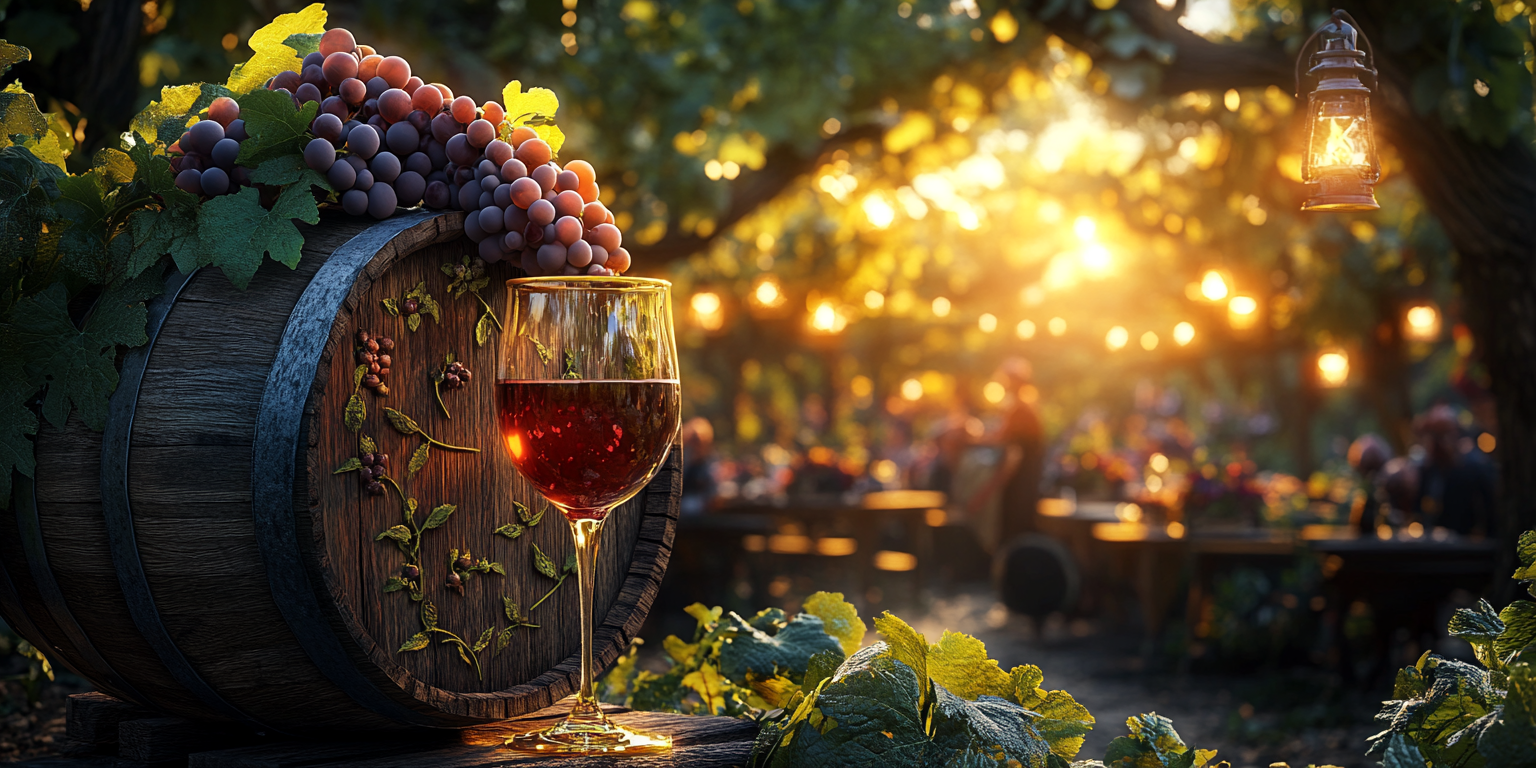
Brierly Harvest Festival
The Brierly Harvest Festival was the great annual celebration that closed the grape harvest in Brierly, held in the last days of September since 1820 and centred on the ceremonial First Pour, when the season's first cask was broached in Whitmore Square. Across two centuries of near-total isolation it served as the settlement's calendar, memory, and binding — its procession, Grape Stomp, Cask Race, and nightfall Festival Fire passed from one generation to the next. After contact with Bixbus in 2018 it became the meeting point of two worlds.
The Last Days of September
The Brierly Harvest Festival was the great fixed point of the settlement's year, the celebration that closed the grape harvest and gathered the whole town into a single night of feasting, ritual, and noise. It fell in the last days of September, when the fruit was in and the presses had done their work, and for the better part of two centuries it was the one occasion on which every family in Brierly — vintners and grain-growers, builders and healers, the old and the newly born — stood in the same square at the same hour.
It was, above all, a festival of continuity. The same procession wound through the same streets, the same cask was broached on the same platform, and the same songs were sung as the fire burned down, year upon year, until the doing of it mattered as much as anything it commemorated. For a community of some two hundred and fifty souls who, for most of their history, had no one to celebrate with but themselves, the festival was less a party than a yearly act of self-definition — a way of saying, once more, who they were and what they had made of the land.
What it commemorated was simple enough: the harvest, the wine, and the people who raised both. What it became, over the generations, was the keeping-place of Brierly's memory, where the town's triumphs and disasters were folded into ritual and carried forward. The good years and the ruinous ones alike were remembered by the festival that marked them, and the names the people gave those festivals — the Golden Vintage, the Year of Fire and Fortune, the Festival That Almost Wasn't — became the chapter-headings of the settlement's own account of itself.
The First Barrel
The festival began with a single barrel. In 1820, after five years of toil and uncertainty since the first vines were planted, George Henry Whitmore — founding Guardian and the maker of Brierly's wine — completed the settlement's first full-scale harvest and produced a vintage made entirely from Brierly-grown grapes. To honour the land's bounty and the people who had worked it, he called the town together in the square on the last evening of September and ceremoniously tapped the cask.
That act became the First Pour, the defining ritual around which everything else would grow. Under the glow of lanterns and the warmth of a communal feast, the settlers drank, danced, and celebrated late into the night, unaware that they had founded a tradition that would outlast every one of them. It was not merely a celebration of the harvest. It was the night Brierly stopped being an experiment and became a place — the moment the settlement, in its own telling, truly came into its own.
From that year the festival was kept each September to mark the close of the harvest, and the First Pour remained its solemn centre. The honour of breaking the seal and drawing the first cup was reserved for a senior vintner, most often a descendant of one of the founding families, and the wine was then carried through the crowd and shared from hand to hand until the whole town had tasted the year. Only then did the celebration proper begin.
Procession, Pour, and Fire
In its settled form the festival followed an order that scarcely changed in two hundred years. As September drew to its close, the day opened with a procession through Brierly's streets, led by representatives of each vineyard carrying baskets of the last grapes picked from their rows. They wound down from the slopes and through the town to Whitmore Square, the broad town square at the settlement's heart that had taken the founder's name, where a great wooden platform was raised for the occasion.
There the First Pour was made, the senior vintner breaking the seal before the assembled town and drawing the first cup into a worn pewter vessel that had, by tradition, been George Whitmore's own. The wine went out among the crowd, and the square gave way to the feast. Long wooden tables were laid the length of it, heaped with roasted meats, fresh bread, cheese, and fruit, and set with the year's finest wines and the dark beer the Bennetts had brewed in Brierly since the founding. Families and friends gathered along the boards, drinking and arguing and telling the same stories they told every year, deep into the night.
The games gave the day its riot. Best loved was the Grape Stomp, in which competitors crushed grapes underfoot in great wooden vats, shrieking and slipping, dyed to the knee in purple — a celebratory mess that also bound each new generation to the bodily, ancient labour of their craft. Beside it ran the Cask Race, where teams rolled heavy barrels through the streets at a reckless pace, and the whole town turned out to cheer or to wager. There were tasting contests for the older heads, dancing for everyone, and games enough to keep the children running until they dropped. It was at the tasting that the new vintage got its name, the elders arguing over the year's wine until a word stuck to it that would follow it onto every cask and down into every cellar.
Music ran under all of it. Local players took up violins, flutes, and tambourines, and the folk songs and ballads the founders had carried from England surfaced again as they did every year, passed down from grandmother to grandchild almost unchanged. The night traditionally closed with the old tune the town simply called the Vintners' Farewell, sung by the whole square together as the embers settled.
For as night fell, the festivities gathered at last around the Festival Fire — a towering bonfire built in the square and lit when the feasting was done. The fire was said to ward off misfortune and to call a good harvest for the year to come, and the people of Brierly gathered close to it to sing, to dance, and to raise the last toasts of the evening. When the fire burned low and the songs ran out, the festival was over for another year, and the long work of the vines began again.
Years That Entered the Telling
Most festivals passed and were forgotten, indistinguishable in memory from the ones before and after. A handful did not, and these the town carried down by name.
The fifteenth, in 1834, was remembered as the Year of Fire and Fortune. A summer of relentless dry winds had left the vineyards brittle, and in late August a lightning storm set the Whitmore estate ablaze, threatening to take the whole year's harvest with it. Samuel Whitmore, the founder's grandson, led a desperate effort to save what he could, hauling water from the river through the night, and by the time the fire was beaten back much of the vineyard was gone. The town braced for the first festival without a First Pour.
But Samuel had salvaged a small, scorched batch of grapes, and from them pressed a wine unlike any before it — a bold, smoky red that the fire itself had shaped. That September, before a crowd that had steeled itself for disappointment, he raised the cup and told them, "From fire comes strength. From struggle comes fortune. Tonight, we drink not to what we lost, but to what we saved." The smallest First Pour in Brierly's history became its most remembered, and the 1834 Harvest Reserve passed into legend as the finest vintage the settlement ever made.
The festival lapsed only once in all its history, and that was in 1850. Within that single year the settlement lost two of its founders — George Whitmore, who had planted Brierly's first vineyard, founded the festival, and poured its very first cup, and Elizabeth Carrington, whose work had coaxed the dead ground into life at all. With the town in mourning and the heart gone out of any thought of celebration, the people of Brierly let that autumn's festival pass unkept. It was the single year, in two centuries, that no cup was poured. When the festival returned the following September the town took up its count where it had broken off, so that from then on the number of festivals ran always a year behind the calendar. Brierly never corrected the discrepancy. It kept the gap deliberately, a small permanent absence in the record, in memory of the year it had lost the man who gave the festival its beginning.
So it was that the fiftieth festival fell in 1870, half a century after the first, and was kept as the Golden Vintage. By then Brierly had grown from a struggling outpost into a winemaking region in miniature, its vineyards spread far across the Plains, and to mark the anniversary every vineyard contributed a cask of its finest wine to a single blended First Pour — fifty years of craft and perseverance poured gold into one cup. The festival was extended to three days of stomping and racing and feasting, and on the final midnight the town built the largest Festival Fire anyone had seen, its glow carrying for miles across the dark grassland. It was less a celebration than a declaration: that Brierly endured, and meant to go on enduring.
The Shared Pour
The festival's hardest test came in 1938, the year remembered as the Festival That Almost Wasn't. The Great Drought had dropped the Whitmore River to its lowest recorded level, and the vineyards, starved of water, gave only a fraction of their usual yield — barely grapes enough to feed the town, let alone to press into wine. For the second time in its history, and the first since the year of mourning, Brierly faced a September with no First Pour to give.
It was Eleanor Fairchild, of the founding healer's line and a respected vintner in her own right, who refused to let the tradition die. If there was no new wine to broach, she argued, then let the town make one of its own: each household would bring a single cup from its private reserve, and the cups would be blended together in the square into one communal cask. That night the people of Brierly drank not to abundance but to perseverance, each tasting a wine made of everyone's small sacrifice.
The Shared Pour entered the festival's traditions as its second sacred rite, the dark twin of the First Pour — never performed in good years, kept only for times of true hardship, a reminder that the community could outlast scarcity by pooling what little it had. In all the long centuries it was called upon only rarely, and each time it was, the town remembered Eleanor Fairchild and the drought that had taught them how.
Between such years the festival did its quieter, steadier work. Through the hundred and sixty years that Brierly lived alone, cut off from the wider world after the last of its Guardians died in 1857, the Harvest Festival was the settlement's calendar and its memory both — the fixed point around which the agrarian year turned and the occasion on which the town took stock of itself. Courtships began at the festival and were sealed there a year later; feuds were made up or hardened over the cups; the dead of the year were toasted and the newly born were shown off.
The settlement's long tradition of inquiry, its habit of asking what kind of world it lived in, surfaced in the festival's late hours as readily as in its library, when the wine had loosened the talk and the fire had burned low. Whatever else changed, September brought everyone back to the square.
A Meeting of Two Worlds
For one hundred and ninety-eight festivals the celebration belonged to Brierly alone. The hundred-and-ninety-eighth, in 2018, did not.
Only weeks earlier, on the thirteenth of September that year, an exploration party from the young settlement of Bixbus had found Brierly along the river and ended a silence of over a century and a half. When the festival came round at the end of the month, it became the first the town had ever shared with outsiders. Elias Bradbury and Sophie McMonagle of Bixbus came at the invitation of Samuel Fletcher, Brierly's leader, and were met with the whole tangle of feeling such a thing deserved — curiosity, caution, and a quiet, fearful excitement at the change they so plainly heralded.
The unease did not survive the evening. The two visitors were swept into the festival's rituals, watching the First Pour with the seriousness it demanded, throwing themselves into the Cask Race, and failing so spectacularly at the Grape Stomp that the whole square laughed with them rather than at them.
But it was a single moment that fixed the night in memory. Late in the evening Sophie McMonagle took out a guitar and played a folk ballad from Earth — a melody at once foreign and uncannily familiar, so close to the town's own harvest songs that many of the people of Brierly fell silent to hear it. For two centuries they had kept their version of those tunes without knowing another world still sang them. By the night's end Brierly and Bixbus raised their cups together, and the festival that had marked the close of every Brierly year now marked the opening of its borders.
The years that followed changed the festival more than any since its founding. When the railway between Bixbus and Brierly opened at the end of 2020, the wine that had been made for a single town began, for the first time, to travel; and each September the same iron road carried visitors the other way, into a celebration that had never before had to make room for strangers. The intimate harvest rite of two hundred and fifty people became, slowly, a destination, with Bixbus faces in the crowd and Bixbus coin changing hands among the casks.
Not all of Brierly welcomed it. To the traditionalists, the sight of the First Pour performed before an audience of outsiders, the sacred cup raised for people who did not know what it cost, came close to sacrilege; they feared the festival would curdle into a spectacle and lose the thing that had made it worth keeping. Others argued that a festival shared was not a festival diminished, and that a town which had survived by holding fast had also survived by knowing, occasionally, when to open the gate.
Through the argument the festival held. The procession still wound down from the vineyards to Whitmore Square; the senior vintner still broke the seal and drew the first cup; the Grape Stomp still ran purple and the Cask Race still ran reckless, and the Festival Fire still climbed into the September dark. Whatever the wider world made of Brierly, and whatever Brierly was still deciding to make of the wider world, the last days of September brought the whole town back to the square, to the wine, and to the long account of itself that the festival had kept, year upon year, for more than two hundred years.







