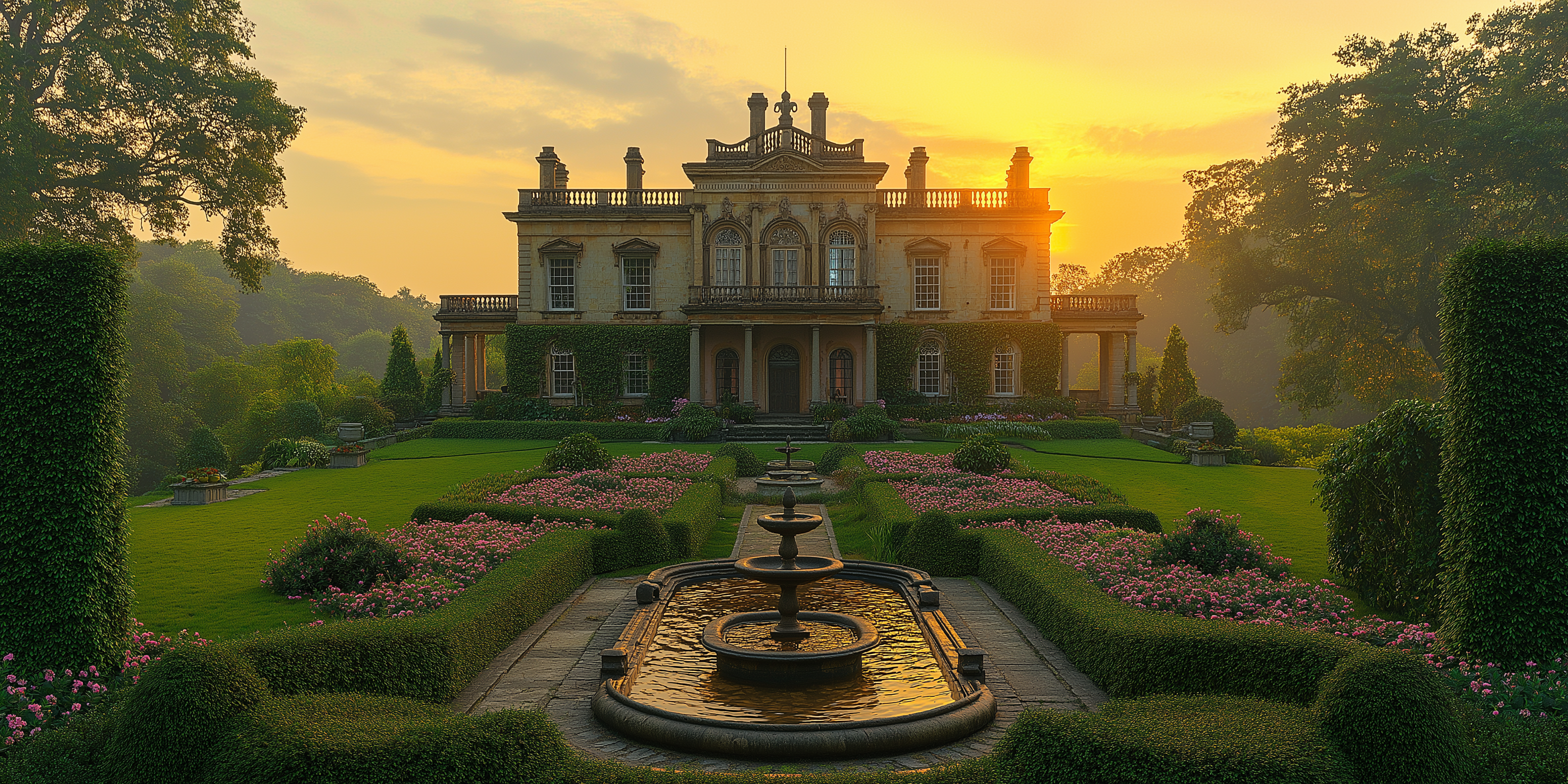
Bradley James Collins
Bradley James Collins, born on 12 November 1968 in London, transformed his childhood fascination with Britain's architectural heritage into a pioneering hospitality empire. The son of distinguished historian Dr. James Collins and barrister Elizabeth Collins, Bradley founded Collins Heritage Properties in 2001, revolutionising heritage tourism through adaptive reuse. His 2006 marriage to Jasmine Dallow merged their companies into Collins Boutique Hotels, creating a legacy where preservation meets innovation across continents.

Birth and the Georgian Inheritance
Bradley James Collins was born on 12 November 1968 at the Portland Hospital in London, arriving into a world where intellectual pursuit and cultural appreciation formed the very foundation of daily life. His father, Dr. James Edward Collins, had by this time established himself as one of Britain's most respected historians, specialising in Victorian social history and the evolution of British architectural heritage. His mother, Elizabeth Clara Collins (née Bennett), practised as a prominent barrister in family law at Lincoln's Inn, bringing to the household a fierce commitment to justice and advocacy that would subtly shape Bradley's own sense of responsibility towards cultural stewardship.
The Collins family home, a meticulously maintained Georgian townhouse in Bloomsbury, provided Bradley's first and most enduring lessons in the power of architectural heritage. Built in 1785, the house retained its original features—high ceilings with delicate cornicing, tall sash windows that flooded rooms with natural light, and graceful proportions that embodied the mathematical harmony of Georgian design. From his earliest years, Bradley absorbed the understanding that walls hold stories, that spaces carry memory, and that preservation is not about freezing time in amber but about honouring continuity whilst serving contemporary life.
The Bloomsbury neighbourhood of Bradley's childhood existed as a living palimpsest of London's intellectual history. The British Museum stood just streets away, the Bloomsbury Group's former haunts dotted the area, and centuries of scholarly endeavour seemed to emanate from the very pavements. Growing up amidst this concentration of cultural heritage, Bradley developed an almost instinctive understanding that buildings were not merely shelter but vessels for human aspiration, creativity, and memory.
London in the late 1960s and early 1970s was a city still grappling with post-war reconstruction, where fierce debates raged about modernisation versus preservation. The controversial demolition of the Euston Arch in 1962 remained fresh in architectural memory, serving as cautionary tale about what happens when progress tramples heritage. Bradley's childhood unfolded against this backdrop of architectural tension, his parents' dinner table conversations often touching on planning controversies, heritage listing disputes, and the delicate balance between development and protection. These discussions, conducted with the intellectual rigour characteristic of both historian and barrister, planted seeds that would eventually flower into Bradley's life's work.
Childhood Education Through Experiential Learning
Dr. James Collins believed passionately in experiential education, rejecting the notion that history could be adequately taught through textbooks alone. Weekends often found father and son exploring Britain's architectural treasures, from the windswept ruins of Hadrian's Wall to the perfectly preserved elegance of Bath's Royal Crescent. Bradley's first visit to the British Museum at age six, on a drizzly June morning in 1975, proved transformative. Walking through galleries filled with fragments of Egyptian, Greek, and Roman civilisations, he grasped for the first time that preservation was humanity's hedge against oblivion, that without conscious effort to protect cultural artefacts, entire worlds could vanish into silence.
These regular pilgrimages became Bradley's informal curriculum in reading the language of stone and story. At Canterbury Cathedral, his father explained how Norman Romanesque evolved into Gothic soaring verticality. At Windsor Castle, they traced centuries of royal building campaigns, each monarch's additions revealing changing tastes and technologies. At Ironbridge, Bradley witnessed where the Industrial Revolution had been born, understanding viscerally how architecture embodies social transformation. Dr. James possessed the rare gift of making history tangible, helping his son see beyond mortar and masonry to the human stories embedded within.
His mother's influence, whilst less overt than his father's architectural tutorials, proved equally formative. Elizabeth's courtroom advocacy taught Bradley that buildings, like vulnerable individuals, deserved champions—that heritage required not merely appreciation but active defence against those who would demolish for expedience or profit. Her dedication to protecting families in crisis found echo in his later commitment to protecting buildings threatened by neglect or demolition. She taught him that passion must be married to pragmatism, that effective advocacy required understanding legal frameworks and economic realities, and that preservation battles were won through persuasion rather than mere moral indignation.
The combination of his father's scholarly devotion and his mother's principled pragmatism created in Bradley a rare synthesis: the intellectual depth to understand heritage's cultural significance combined with the practical determination to preserve it through viable business models. He learnt early that sentiment alone wouldn't save buildings—that preservation required demonstrating economic sustainability alongside cultural value.
Harrow School and the Development of Leadership
At thirteen, Bradley entered Harrow School, following in the footsteps of Churchill, Byron, and Peel through Tudor corridors that had witnessed centuries of British education. The school's architectural grandeur—from the Old Schools building to the Fourth Form Room where Churchill had carved his name into wooden desks—provided constant reminder that buildings serve as vessels for institutional memory. Harrow's physical fabric told stories of continuity and change, of traditions maintained whilst adapting to contemporary needs, embodying precisely the adaptive reuse philosophy that would later define Bradley's career.
Bradley excelled particularly in History and English Literature, his essays demonstrating not merely academic ability but genuine passion for understanding how societies express themselves through built environments. His History teachers recognised in him an unusual capacity to synthesise broad cultural movements with specific architectural manifestations, to see buildings not as isolated objects but as physical embodiments of social forces. In English Literature, he gravitated towards writers who engaged with place and space—Hardy's Wessex, Dickens's London, the Brontës' moors—understanding literature and architecture as complementary languages for expressing human experience.
As a member of Harrow's debating society, Bradley developed the eloquence and persuasive capacity that would later serve him well in advocating for heritage causes. He learnt to construct arguments that appealed to both emotion and reason, to anticipate objections and address them pre-emptively, and to speak with authority whilst remaining open to counter-arguments. His election as prefect in his final year reflected natural leadership abilities, yet Bradley remained more interested in ideas than authority, more fascinated by the stories embedded in Harrow's ancient stones than by the social prestige of attending such an institution.
In July 1984, he won the Harrow School History Prize for an essay examining the Industrial Revolution's impact on British architecture. The piece, which his mentor Professor Hugo Walters praised as demonstrating "remarkable maturity and insight," already revealed Bradley's central preoccupation: how technological and social transformations manifest in built environments, and how architecture both reflects and shapes cultural change. The essay argued that Victorian railway stations, factory warehouses, and workers' housing represented not merely utilitarian construction but a society wrestling with unprecedented transformation, creating new architectural languages to express new social realities.
Cambridge: The Forging of Scholarly Expertise
Bradley matriculated at the University of Cambridge in October 1985, entering an institution whose very fabric embodied centuries of accumulated architectural heritage. Pursuing a Bachelor of Arts in History with specialisation in British Architectural History, he found himself immersed in an environment where medieval chapels stood beside Renaissance courts, where Victorian additions nestled against Tudor gates, and where each generation had left its mark whilst preserving continuity. Cambridge itself became his laboratory for studying adaptive reuse, demonstrating how institutions could continuously repurpose spaces—chapels becoming libraries, refectories transforming into examination halls—whilst maintaining essential character and purpose.
Under the mentorship of distinguished professors, Bradley developed rigorous methodology for analysing architectural heritage that combined aesthetic appreciation with social history, technical understanding with cultural interpretation. He spent long hours in the Cambridge University Library, poring over architectural drawings, building contracts, and contemporary accounts that revealed how structures were conceived, constructed, and received. His vacation periods involved field research, measuring and sketching historic buildings, interviewing conservation architects, and gradually building the practical knowledge that would complement his academic training.
His undergraduate dissertation on Victorian architecture's social impact demonstrated the synthetic thinking that would characterise his best work. Rather than treating buildings as isolated aesthetic objects, Bradley examined how Victorian society's anxieties about industrialisation, urbanisation, and class conflict manifested in architectural form. He analysed how Gothic Revival expressed nostalgia for imagined medieval harmony, how railway station design negotiated between functionality and grandeur, and how workers' housing embodied competing visions of social order. The dissertation earned him the Cambridge Historical Society Prize and First Class Honours, with examiners praising its "sophisticated integration of architectural analysis with broader cultural history."
Graduation in June 1988 brought the predictable moment of parental pride—Dr. James and Elizabeth watching their son receive his degree at the Senate House, recognising how their own values and interests had taken root and flourished. Yet Bradley had no intention of stopping at undergraduate level. He immediately commenced a Master of Philosophy in Historical Studies, focusing his research with laser precision on the question that would define his career: how could historic buildings be adapted for contemporary use whilst preserving their essential character and cultural significance?
His MPhil thesis, completed in 1989, examined case studies of successful and unsuccessful adaptive reuse projects across Britain. He analysed converted warehouses, repurposed churches, transformed industrial buildings, identifying patterns that distinguished preservation from destruction, genuine respect from superficial pastiche. The research led him to several key conclusions that would guide his later work: that successful adaptive reuse required understanding a building's essential character rather than merely preserving decorative features, that new interventions could enhance rather than compromise historic fabric when executed with sensitivity and skill, and that buildings breathed best when serving genuine human needs rather than existing as museumified relics.
The thesis argued passionately against what Bradley termed "preservation as taxidermy"—the approach that treated historic buildings as dead things to be stuffed and mounted for display. Instead, he advocated for "preservation as continuity," viewing buildings as living entities whose histories continued to unfold through thoughtful adaptation. This philosophical foundation would underpin everything he later built, both literally and figuratively.
Professional Apprenticeship: Learning the Craft
In September 1989, Bradley joined Historic England as a Graduate Trainee in the Heritage Protection Department, beginning the vital transition from academic theorist to practical preservationist. The position involved assessing historic buildings for statutory listing, advising local authorities on conservation matters, and navigating the complex intersection of preservation law, property rights, and planning policy. Bradley discovered that effective heritage conservation required skills beyond architectural knowledge—it demanded diplomacy, economic understanding, legal literacy, and psychological insight into what motivated property owners and developers.
His three years at Historic England provided invaluable grounding in the regulatory framework governing heritage conservation. He learnt how to conduct thorough building surveys, identifying architectural features worthy of protection and distinguishing between original fabric and later alterations. He mastered the bureaucratic processes through which buildings received listing designations, and the legal mechanisms that protected them from inappropriate alteration. Perhaps most importantly, he developed skill in persuading sceptical property owners that conservation needn't mean constraint, that heritage could represent economic asset rather than regulatory burden, and that preserving historic character often enhanced rather than diminished property value.
Yet Bradley increasingly felt that working within the regulatory framework, whilst essential, represented only one dimension of heritage conservation. Listing buildings and enforcing regulations could prevent destruction, but they couldn't ensure vibrant continued use. He became convinced that the most effective preservation emerged not from legal compulsion but from demonstrating economic viability—showing that historic buildings could serve contemporary purposes whilst maintaining integrity.
This conviction led to his August 1992 move to Heritage Developments Ltd. as Project Manager, a position that involved the commercial side of conservation: acquiring historic properties, securing planning permissions and listed building consents, managing restoration works, and ultimately creating economically sustainable uses. His first solo project, The Old Schoolhouse Conversion in Bristol (completed March 1993), transformed a derelict Victorian schoolhouse into luxury apartments, demonstrating precisely the principle he had explored in his Cambridge thesis—that historic buildings could be adapted for new purposes whilst preserving the architectural features that gave them distinction and character.
The Bristol project taught Bradley practical lessons no academic course could provide. He learnt how to work with conservation officers who sometimes prioritised regulatory compliance over practical outcomes, how to manage contractors unfamiliar with traditional building techniques, how to source appropriate materials when original specifications were no longer manufactured, and how to navigate the inevitable tensions between preservation ideals and budget realities. The successful completion earned him recognition within the heritage property sector and established his reputation as someone who could marry respect for history with commercial viability.
His June 1997 promotion to Senior Project Manager at Landmark Heritage Properties represented another significant step, involving oversight of high-profile projects including the conversion of Carlisle Castle, a medieval fortress, into a unique heritage hotel. The project required managing large, multi-disciplinary teams including archaeologists, historians, conservation architects, structural engineers, and craftspeople specialising in traditional building techniques. Bradley excelled at the diplomatic challenge of keeping diverse stakeholders aligned around shared vision whilst respecting each discipline's concerns and expertise.
The Carlisle project also crystallised Bradley's thinking about heritage hospitality specifically. As he watched the castle transformation unfold, he recognised that hotels represented perhaps the ideal adaptive reuse for many historic buildings. Unlike residential conversion, which typically created private spaces inaccessible to the public, hotels allowed visitors to experience heritage firsthand. Unlike museums, which treated buildings as exhibits rather than active spaces, hotels enabled people to actually inhabit history, sleeping within ancient walls, walking through corridors that had witnessed centuries of human drama. This insight—that hospitality could be a vehicle for heritage preservation rather than merely commercial exploitation—would become the foundation of his entrepreneurial venture.
The Entrepreneurial Vision Takes Shape
By his early thirties, Bradley had accumulated a decade of practical experience across the full spectrum of heritage conservation, from regulatory protection to commercial development. Yet he felt increasingly constrained by working within others' visions and organisational frameworks. His ideas about heritage hospitality—creating immersive, culturally enriching experiences where guests didn't merely view history but inhabited it—demanded entrepreneurial freedom to realise fully.
Recognising that business acumen would be essential for translating vision into viable enterprise, Bradley enrolled in London Business School's Executive Education Programme in Entrepreneurship and Innovation in 1995, studying part-time whilst continuing his work at Landmark Heritage Properties. The programme provided frameworks for strategic planning, financial management, marketing, and organisational development that complemented his heritage expertise. He studied successful hospitality entrepreneurs, analysed boutique hotel business models, and developed the strategic plan that would eventually become Collins Heritage Properties.
The decision to launch his own company required not merely courage but substantial financial investment. Bradley leveraged personal savings, secured loans, and attracted initial investors impressed by his track record and detailed business plan. On 1 January 2001, at age thirty-two, Collins Heritage Properties formally came into existence, its stated mission to "acquire, restore, and manage historic properties that offer guests authentic heritage experiences whilst ensuring the long-term preservation of Britain's architectural legacy."
The Georgian Rose and Early Success
Bradley's inaugural project, The Georgian Rose in Bath, embodied everything he envisioned for his heritage hospitality concept. In March 2001, he acquired a Georgian townhouse in one of Bath's most prestigious crescents—a building that had fallen into disrepair but retained magnificent original features including intact cornicing, working shutters, and a stunning central staircase. The property's deterioration meant Bradley could purchase at below-market rate, but restoration required meticulous attention and significant investment.
He assembled a team of specialist craftspeople, including a master plasterer to restore the ornamental cornicing, a joiner skilled in repairing Georgian sash windows using traditional techniques, and a stone mason to address structural issues in the Bath stone facade. Bradley insisted on using appropriate materials and methods—lime mortar rather than cement, natural pigments for decorative painting, and painstaking repair rather than wholesale replacement wherever possible. This approach cost more and took longer than conventional renovation, but the results justified the investment.
The Georgian Rose opened in September 2001 to immediate acclaim. The eight-room boutique hotel offered guests the experience of inhabiting authentic Georgian elegance—sleeping in rooms with original shutters and cornicing, descending that magnificent staircase for breakfast in the morning room, relaxing in the garden that had been restored according to period planting schemes. Yet Bradley had incorporated modern comforts with sensitivity—discreet climate control, contemporary bathrooms concealed within period-appropriate enclosures, and wifi that didn't require visible technological infrastructure.
More importantly, The Georgian Rose demonstrated Bradley's philosophy that heritage hospitality should educate as well as accommodate. Rooms contained carefully curated libraries on Georgian Bath, Regency society, and the architecture of the period. Staff received extensive training in the building's history and could answer guests' questions about architectural features. Bradley developed partnerships with local tour guides specialising in Georgian Bath, offering guests walking tours that contextualised the hotel within the broader cityscape.
The success exceeded projections. Within six months, The Georgian Rose was operating at ninety per cent occupancy, attracting heritage enthusiasts, architecture buffs, and discerning travellers who valued authenticity over generic luxury. Early reviews praised the hotel's "impeccable attention to historical detail without sacrificing comfort" and Bradley's "revolutionary approach to heritage preservation through active use rather than museum-style conservation."
Expansion and the Heritage Stays Programme
The Georgian Rose's success provided both capital and confidence for expansion. In June 2002, Bradley opened The Bloomsbury Literary Retreat in London, a project that demonstrated his evolution beyond mere architectural preservation towards cultural curation. The Georgian townhouse, located near the British Museum in a neighbourhood once home to Virginia Woolf and the Bloomsbury Group, didn't simply occupy a historic building but actively celebrated the area's intellectual heritage.
Bradley developed programming that brought literary culture to life: monthly writing workshops led by published authors, literary salon evenings where guests discussed classic and contemporary works, and a library curated in collaboration with rare book dealers to include first editions and literary curiosities. Each room was named after a Bloomsbury Group member and decorated with period-appropriate furnishings and artwork that evoked that writer's aesthetic. The hotel became a destination not just for overnight stays but for day visitors attending events, creating community around shared literary interests whilst generating additional revenue streams.
The Manchester Millworks (opened October 2003) showcased Bradley's ability to adapt his heritage hospitality concept to industrial architecture. The converted textile factory celebrated Manchester's role in the Industrial Revolution, preserving exposed brick walls, original cast-iron columns, and vintage machinery as decorative elements. The hotel's restaurant emphasised locally-sourced Northern cuisine, and Bradley commissioned a small museum displaying the building's industrial history.
The Edinburgh Whisky Distillery Hotel (opened April 2004) represented perhaps Bradley's most ambitious project to date. The former distillery, with its distinctive pagoda roof and copper stills, offered immersive whisky experiences: private tastings of rare single malts, distillery tours explaining the production process, and a bar featuring hundreds of Scottish whiskies arranged regionally. The hotel attracted not just tourists but whisky connoisseurs who appreciated the authenticity and depth of the experience.
In June 2004, Bradley formalised the approach he had been developing by launching the Heritage Stays programme. The initiative provided structured framework for offering guests immersive experiences related to each building's historical significance, with different programming for each property reflecting its unique heritage. The programme transformed Collins Heritage Properties from a boutique hotel company into a network of heritage experiences that educated guests about British history, architecture, and culture whilst generating revenue that funded ongoing preservation.
Industry Recognition and Meeting Jasmine
By 2004, Bradley had established himself as a significant figure in British heritage hospitality. "Boutique Hotelier" magazine's September feature highlighted his innovative approach. When The Georgian Rose hosted the Annual Heritage Hospitality Conference that November, Bradley delivered the keynote address articulating a vision that would influence the sector: that heritage tourism must balance preservation with accessibility, that buildings serve humanity best when serving human needs, and that the past deserves protection precisely because it enriches the present.
In January 2005, Bradley launched a mentorship programme pairing aspiring heritage hospitality entrepreneurs with experienced industry professionals, reflecting his commitment to cultivating the next generation of preservationists. His July 2005 collaboration with the National Trust created symbiotic relationships where Collins properties offered guests exclusive behind-the-scenes access whilst the Trust received revenue share and exposure to heritage enthusiasts.
On a June morning in 2005, Bradley attended a London antique furniture auction seeking period-appropriate pieces for his properties. He found himself competing for a Georgian sideboard against Jasmine Dallow, an Australian entrepreneur with her own boutique hotel portfolio. After winning the piece, Bradley approached to commiserate and discovered someone who spoke his language of heritage and hospitality with equal fluency.
Their first date at The Lanesborough that evening revealed profound compatibility—two minds attuned to history's whispers, two hearts devoted to creating meaningful spaces, two entrepreneurs who understood that business could embody values beyond profit. Over subsequent months, their relationship deepened through shared explorations: Bradley guiding Jasmine through Bath's honey-coloured crescents, orchestrating a Scottish Highlands getaway at The Edinburgh Whisky Distillery Hotel, introducing her to his parents at an intimate London dinner where past and future converged in conversation.
Bradley's Valentine's Day 2006 proposal atop Tower Bridge captured his romantic sensibility perfectly—choosing a Victorian engineering marvel that symbolised the marriage of functionality and beauty, arranging private closure to transform public monument into intimate sanctuary. When Jasmine accepted, Bradley gained not merely a wife but a true partner who understood that their professional merger would amplify rather than compromise individual visions.
Marriage, Merger, and Shared Purpose
The April 2006 merger of Collins Heritage Properties and Dallow Hotels Group created Collins Boutique Hotels—a company combining Bradley's expertise in British heritage with Jasmine's innovative hospitality approach and sustainable design principles. As Chief Operating Officer, Bradley continued overseeing acquisitions and restorations, expanding the portfolio across the United Kingdom and into Continental Europe.
Their wedding on 9 September 2006 at Sudeley Castle in Gloucestershire embodied everything they valued: a historic venue steeped in royal history, intimate celebration amongst family and professional colleagues, and the symbolic union of two lives devoted to heritage preservation. Bradley's parents, Dr. James and Elizabeth, witnessed their son's happiness with pride, recognising in Jasmine someone worthy of the values they had instilled. The ceremony itself, conducted in Sudeley's chapel, represented Bradley's ideal marriage of past and present: historic setting, contemporary commitment, ancient stones bearing witness to new beginning.
The launch of the Violet Rose Suite in Adelaide on 30 September 2006 revealed Bradley's capacity for empathy. Understanding the depth of Jasmine's continuing grief over her sister's murder, he helped create a sanctuary where personal tragedy transformed into public purpose—a room offering free lodging to families enduring similar anguish. Bradley's heritage expertise guided the delicate balance between memorial and functionality, proving that buildings could honour memory whilst serving practical needs.
Guardian of Harmony Haven and Lasting Legacy
Bradley's 2007 acquisition of the Adelaide waterfront property demonstrated willingness to apply heritage philosophy beyond Britain, working with Australian architects to honour local context whilst maintaining the company's commitment to sustainable luxury and cultural preservation. Under Bradley's operational leadership, Collins Boutique Hotels grew strategically, each property acquisition reflecting his discerning eye for buildings possessing both architectural merit and narrative potential.
In 2018, Bradley's life took an extraordinary turn when he became a Guardian of Harmony Haven, a settlement within the bio-virtual dimension Clivilius. This role represented the ultimate evolution of his preservation instincts—from rescuing Georgian townhouses to safeguarding Earth's entire cultural legacy across dimensional boundaries. His decades of expertise in adaptive reuse and heritage conservation became vital for nurturing a settlement where humanity's displaced found refuge. The position demanded extraordinary discretion, requiring Bradley to maintain his Earth-based business operations whilst secretly supporting an interdimensional community.







