
Blake Alexander Karger
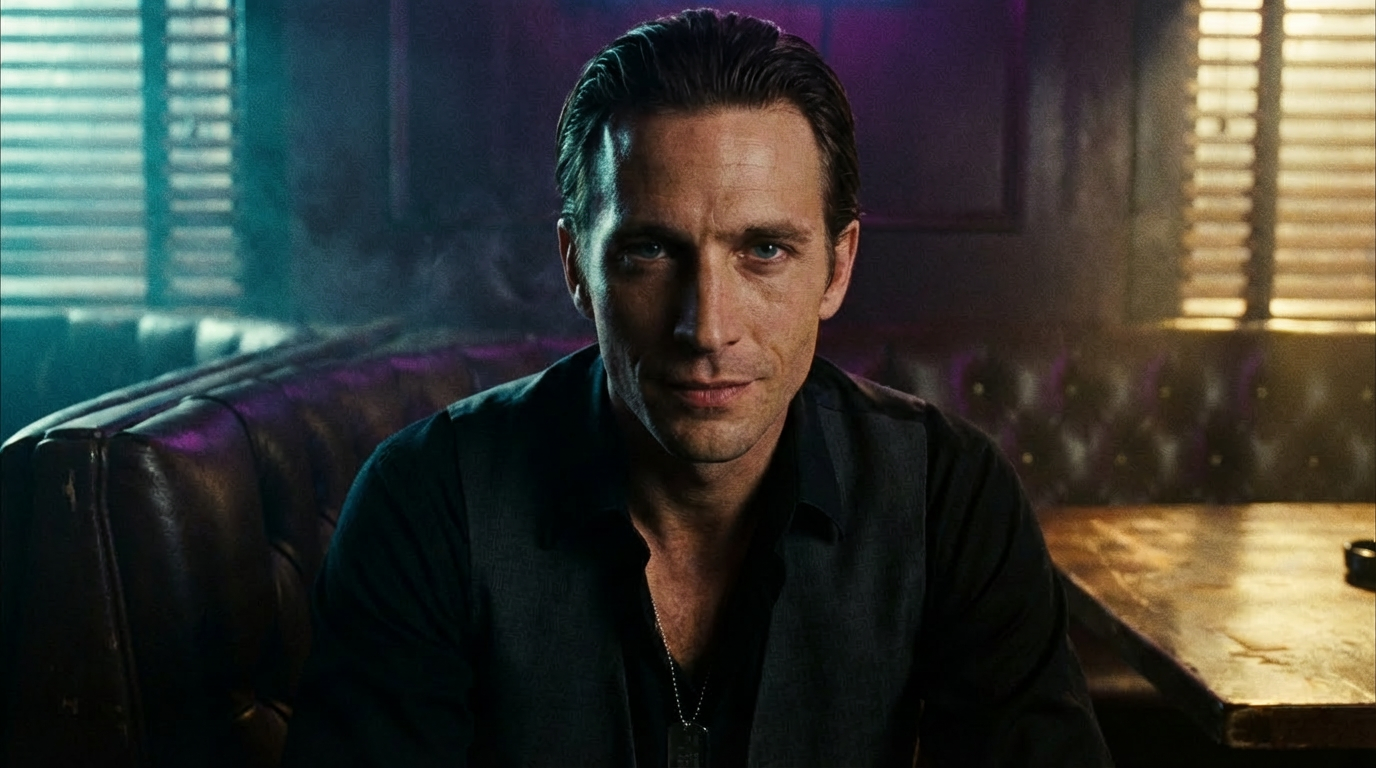
Blake Alexander Karger, born 8th June 1982 in Sydney, New South Wales, is a contract enforcer who has spent his adult life perfecting the art of being exactly as dangerous as he looks whilst ensuring nobody can prove it. Raised in a household where violence was ambient rather than exceptional, he drifted into Sydney's criminal underworld with something approaching relief — and arrived in Hobart, eventually, as a man with a day job, a reputation, and a smile that never quite reaches his eyes.
The Making of a Particular Kind of Person
Blake Alexander Karger was born on 8th June 1982 at Westmead Hospital, the only child of Roger Colin Karger and Linda Karger (née Devereux). The family home was in Blacktown, in Sydney's western suburbs — a neighbourhood that was not without its merits and was not without its problems, and which Roger Karger embodied both qualities simultaneously. Roger was a mechanic by trade, running a workshop out of a leased bay in a light industrial strip, and he was competent at the work in the specific way of a man who understood machines and had no patience for anything he did not understand. He was also volatile in the specific way of a man who treated volatility as an entitlement — not constantly, not predictably, but with the particular unpredictability that was in some ways worse than either. The household's atmosphere was organised around his moods. Linda managed this with the efficiency of long practice: she clerked for a local government office, she maintained the house, she absorbed what needed absorbing, and she did not discuss any of it.
Blake learned early the domestic lesson that violence was not an emergency but a weather pattern — something that arrived, passed through, and left a residue. What he did not learn, because there was no one to teach him, was that this was unusual. For a significant portion of his childhood he assumed that the calibration of his household was more or less standard, and it was only the incremental accumulation of contradictory evidence — other families, other houses, other textures of noise from behind other front doors — that eventually revised this understanding. By the time it was revised, the initial lesson had already done its foundational work.
He was not a miserable child, which was important and which people who encountered him later occasionally found surprising. He was watchful and self-contained, with a particular intelligence that expressed itself less in academic performance than in social acuity. He could read a room with the accuracy of someone who had been required to do so since early childhood. He understood power dynamics — who held them, how they shifted, what they cost — in a way that most children his age did not have the vocabulary for and he had no vocabulary for either, but which he understood in his body as naturally as balance. He was physically large for his age from around ten or eleven — broad through the shoulders, unhurried in movement, with the settled quality of someone who had made a private decision never to look startled. He was not a bully in the schoolyard sense. He simply understood that he did not need to be.
School and the Absence of Trajectory
Blake attended primary school in Blacktown and secondary school at a state comprehensive nearby, and his school record was a document of managed friction rather than outright failure. He was expelled twice — once in Year 8 for an altercation with a teacher that left the teacher with a split lip and a version of events that was never entirely challenged, and once in Year 10 for circumstances officially recorded as "repeated conduct unbecoming" that covered a considerably more specific incident involving a locker, a younger boy, and a sustained campaign of intimidation that had been running for months before anyone noticed. He finished his schooling at a third institution without further formal incident, which was less a sign of improvement than of a person who had learned that formal incidents left records.
He was not stupid. Several teachers, across several schools, noted the gap between his performance and what his attentiveness in certain subjects suggested was possible. He absorbed information selectively — history interested him in the way that power struggles and the mechanics of control interested him, and he retained detail from these lessons with an accuracy that surprised people who assumed he was not listening. Mathematics was fine. English was a transaction. He had no interest in being assessed and considerable interest in acquiring knowledge that seemed directly useful, and these two orientations did not map neatly onto formal education.
He left school at seventeen with results that closed most doors and no particular anxiety about that fact. The doors he intended to open were not the ones his results were relevant to.
The Sydney Apprenticeship
What followed was not, from the outside, dramatic. Blake drifted into the outer orbit of several interconnected criminal networks operating across Sydney's western and south-western suburbs — not by active recruitment so much as by gradual, mutual recognition. He was useful. He was physically capable, he was discreet in the specific way of someone who understood that talking was a liability, and he had a quality that was difficult to name but immediately recognisable to the people who valued it: he did not hesitate in the way that most people hesitated. The microsecond of moral processing that most people experienced before doing something genuinely harmful — Blake either did not experience it, or had learned so early to dismiss it that the distinction was academic.
He began with debt collection work in his late teens, the entry-level role for someone with his particular profile. The work suited him. It was procedural in its way — you arrived, you communicated a consequence, you waited for compliance, you escalated if compliance did not arrive. He was good at the communication step in a way that often made the escalation unnecessary, which made him economical to employ. He had a quality of stillness in confrontational situations that read as controlled menace to the people on the receiving end — not rage, not excitement, just a calm, patient, evaluative presence that made it very clear the person in front of him had already lost and had not yet been told.
Through his early twenties he moved up the informal hierarchy of available work: from debt collection to enforcement, from enforcement to more specific tasks that required more specific qualities. He was reliable. He was clean, in the professional sense — no arrests that stuck, no paper trail that connected him to outcomes, a consistent ability to be somewhere else when documentation was generated. He maintained this not through luck but through methodical attention to the mechanics of accountability: who saw what, what could be corroborated, what a camera did and did not capture, and how a statement could be technically accurate and entirely misleading simultaneously.
He did not form close friendships. He maintained professional relationships with precision and social relationships with the minimum necessary investment. He was not a man without personality — he had a dry, controlled wit that emerged in the right company and a genuine appreciation for competence in others, regardless of field — but he kept these qualities on a short leash. Likeability was a tool, and tools were for use.
The Move to Hobart
Blake relocated to Hobart in 2010, at an age when most people were consolidating rather than relocating. The reasons were both practical and strategic. Sydney had become, for someone with his profile, a geography of known quantities and monitored relationships. Hobart offered the inverse: a smaller city with a less surveilled criminal ecology, a concentration of wealth and power in a relatively compact social network, and the particular opportunity that came from being an outsider with skills that the local market had not yet fully supplied.
He arrived with a reputation that preceded him via a handful of shared contacts and established himself incrementally, working contract roles for several interconnected syndicates with interests across Hobart's hospitality, property, and gaming sectors. He was not visible in Hobart's underworld in the way that some figures were visible — he did not socialise in the places that got raided, did not associate with people who talked, and did not allow the financial transactions of his professional life to touch anything with his name on it. He lived in a rented flat in the northern suburbs that was unremarkable in every direction.
In August 2014, Blake was contracted to recover money and send a message on behalf of a syndicate-connected client whose ego had been bruised at Wrest Point Casino. The target was Beatrix Cramer, a small-time operator whose chip-skimming operation had graduated to a mistake. Blake's approach to Beatrix was characteristic — direct, unhurried, and given its full gravity without theatrics. He delivered an ultimatum. Return the money, or her partner would face the consequences. He was not bluffing. He was never bluffing. This was not a moral position but a professional one: a threat that could not be followed through was not a threat, it was a request, and Blake did not make requests.
Beatrix did not return the money.
On 14th August 2014, Brody Taylor — Beatrix's partner, a man who almost certainly did not fully understand the specifics of the situation that had led to this outcome — was found dead in a rented storage unit in Moonah. The coroner's report cited accidental injury with cardiac irregularity. The investigation lasted approximately as long as it took to write the report. Blake was not interviewed. He was, at that point, reliably established elsewhere.
Whether Blake experienced anything in the vicinity of regret about the Brody Taylor contract was not a question he engaged with. It was a professional outcome. The work had been commissioned, the terms had been clear, the consequences had been foreseeable by everyone involved. That Beatrix had chosen to test whether the terms were real was her error. That Brody had been the instrument of the consequence rather than the target was incidental — the architecture of the threat had made it so from the start.
The Day Job at Wrest Point
Blake joined the security staff at Wrest Point Casino in 2017, a development that was not as unlikely as it might appear. Casino security was, structurally, an excellent fit for someone with his background: it required physical presence, situational awareness, the management of confrontation, and an instinct for identifying persons of interest and tracking their movement through a controlled environment. He was competent at all of these. He was also, by 2017, a man with a strategically maintained absence of criminal record, references that could not be easily discredited, and the specific quality of seeming like exactly what he presented himself as being — which was the quality that had served him most consistently throughout his career.
The role also provided access. Wrest Point was not merely a casino; it was a nexus — a place where Hobart's legitimate wealth, its criminal economy, and its grey area intersected under soft lighting and a noise ordinance. The clientele included property developers, politicians, syndicate affiliates, and the merely desperate, all operating within fifty metres of each other with varying degrees of awareness of their company. For someone who traded in information and leverage as much as in physical enforcement, a position that gave him both a floor pass and a legitimate reason to watch everyone on it was worth considerably more than the wage.
When Beatrix Cramer walked into Wrest Point on the evening of 27th July 2018, Blake knew her within seconds. The recognition was not particularly emotional — four years had passed, she was a solved problem, her partner was dead and the matter was closed from his perspective. But she was also, clearly, working. The red dress, the way she moved, the calibrated performance of casualness — Blake had spent too long watching people perform to miss the architecture beneath the surface. He pulled the camera feeds, identified Jarod James, and settled in to let the evening proceed until it provided something useful.
When it did, he moved with the efficiency of someone who had been waiting for exactly this development. The cuffing of Beatrix Cramer at the end of that evening — her wrists extended, his voice unhurried, the smile that Beatrix later described as something she expected to see in her nightmares — was not triumphant in the way of a man winning a personal contest. It was professional. A problem from four years ago had walked back into his workplace and handed him a clean resolution. The smile was simply because it had been easy.
The Hobart Network
Beyond the casino, Blake's Hobart years had built him a network that was useful precisely because it was not visible as a network. His connection to Inspector Sam Woolley of the Hobart Police was the most structurally significant — a relationship of mutual, unstated benefit in which each party maintained the fiction that the arrangement was transactional and temporary. Woolley appreciated having a reliable source of information about activities that official channels were too slow, too public, or too accountable to pursue directly. Blake appreciated having a well-positioned contact whose instinct, when something threatened to become an investigation, was to call first and ask whether an investigation was really necessary.
His involvement with Thomas Jeffries — a figure whose interests in Tasmania's resources sector carried the weight and the connections of someone accustomed to things being arranged — added a different register to Blake's Hobart operations. The work Thomas Jeffries required was not the crude enforcement of debt collection. It was the subtler work of ensuring that certain information did not travel, that certain problems resolved themselves quietly, and that the people involved understood the consequences of the alternative. It suited Blake's skills and his preference for operating at a remove from mess.
He was, across these years, a man who did not feature in anyone's conversations. He was spoken of with the particular brevity of someone whose name was a signal rather than a topic — mentioned to communicate a category of possibility rather than to invite discussion. In Hobart's criminal and semi-criminal circles, this was its own form of reputation: not celebrity, not infamy, just a name that caused a change in the quality of someone's attention and the pace of their thinking.
The Person Beneath the Profile
Blake Karger at forty-three was not, by external appearances, remarkable. He was methodical about his physical condition in the way of someone who treated it as professional equipment rather than personal vanity — he ran early in the mornings, ate without particular enthusiasm or indulgence, slept efficiently, and maintained the kind of fitness that was not visible as an effort. He rented a flat in New Town that he had occupied for six years, which was the longest he had lived anywhere, and which contained furniture that was functional and impersonal in a way that suggested either someone who travelled frequently or someone who had no particular relationship with the concept of home. The former was no longer true.
He read — this was the detail that occasionally surprised people who formed an opinion of him before knowing it. He had a genuine, if unsystematic, interest in history, particularly military history and the history of crime and policing, and he read broadly and retained detail well. His bookshelves were the most populated surface in the flat, and they were not for display. He had no strong opinions about alcohol, drank without sentiment, and found the social performance of drinking — the rounds, the toasts, the warmth it was supposed to generate — mildly tedious. He attended no religious or community institutions. He had, in Hobart, two acquaintances he might have called friends if asked to identify someone in that category, neither of whom knew the full shape of his professional life, and neither of whom pushed.
He was not without internal life. He understood cause and effect with great clarity. He understood that the people who had hired him to threaten Beatrix Cramer had understood the likely outcome, and that Brody Taylor's death was a consequence of a chain of decisions in which he was one link among several. Whether this constituted moral responsibility or merely professional participation was a question he had considered and set aside, not because it was unimportant but because the answer did not change anything he intended to do. He had made his accommodations with the shape of his own life some years ago. He was not tortured by it. He was not proud of it. He had simply looked at what he was, decided it was the most honest version of himself available, and proceeded accordingly.
This was, in its way, the most unsettling thing about him — not the violence, not the reach, not the smile at the end of an evening when the cuffs went on. But the clarity. The complete, unhurried clarity with which Blake Alexander Karger understood himself and the world he moved through, and found neither one particularly surprising.







