Blackwood & Co
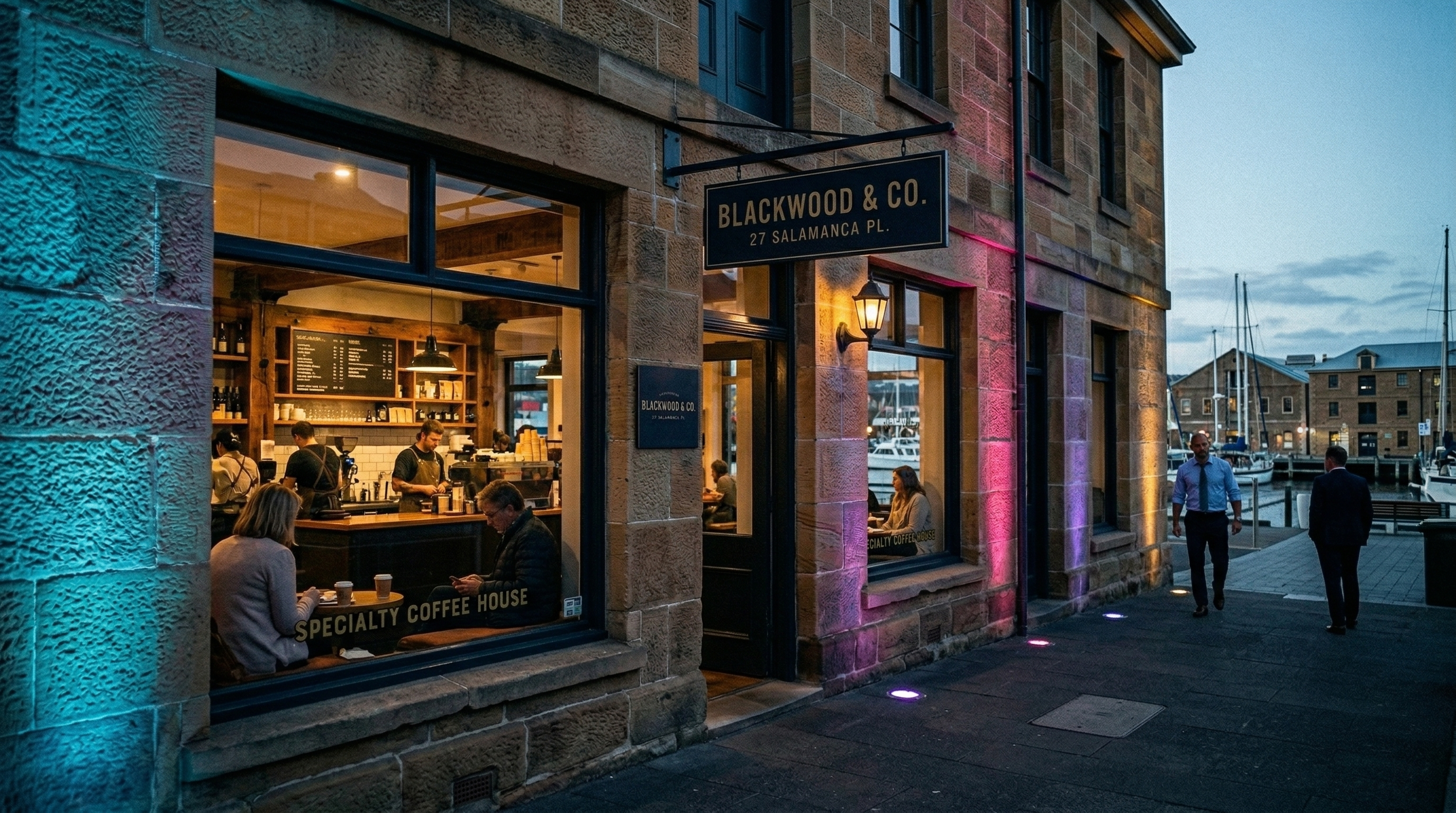
Blackwood & Co is an independent specialty coffee house located at 27 Salamanca Place, Hobart. Established in 2015, the café occupies a converted sandstone warehouse dating from the 1830s, blending heritage architecture with contemporary industrial design. Known for its single-origin beans roasted locally in New Town and its carefully curated aesthetic, Blackwood & Co has become a fixture of Hobart's waterfront coffee culture, attracting professionals, students, and tourists drawn to its harbour views and artisan approach.
Heritage and Establishment
The building at 27 Salamanca Place began its existence in 1836 as a bonded warehouse, one of dozens constructed along the Hobart waterfront to service the colony's burgeoning maritime trade. For over a century, its sandstone walls stored goods arriving from across the British Empire—wool bales, whale oil, imported machinery, and the countless commodities that sustained Van Diemen's Land's colonial economy.
Like many Salamanca warehouses, the building transitioned through various commercial purposes as Hobart's economy evolved. By the late twentieth century, it had been subdivided and converted for retail and hospitality use, its heritage façade preserved while its interior spaces were adapted to contemporary commercial requirements.
Blackwood & Co opened in October 2015, founded by Melbourne expatriates seeking to establish a specialty coffee presence on the Hobart waterfront. The name references the Tasmanian blackwood tree (Acacia melanoxylon), a native timber prized for furniture-making and boat-building—a subtle nod to the maritime heritage of the building's original purpose and the founders' commitment to Tasmanian provenance.
Design and Aesthetic
The café's interior deliberately juxtaposes heritage elements with industrial contemporary design. The original sandstone walls remain exposed, their convict-hewn blocks providing texture and historical weight that no modern construction could replicate. Against this backdrop, the fitout introduces black steel fixtures, Edison-style pendant lighting, and polished concrete floors—the visual vocabulary of Melbourne's laneway coffee culture transplanted to Hobart's colonial waterfront.
Tasmanian native plants in handcrafted ceramic pots line the harbour-facing windows, their organic forms softening the industrial aesthetic while reinforcing the local provenance theme. The ceramics are sourced from Salamanca Market artisans, creating a commercial relationship that embeds the café within the broader creative economy of the precinct.
Seating accommodates approximately forty patrons across a mix of communal tables, individual workstations with power outlets catering to the laptop crowd, and window-facing stools offering views across Constitution Dock. The layout encourages both lingering and efficiency—regulars can occupy their preferred positions for hours, while takeaway customers move through the space with minimal friction.
Coffee Programme
Blackwood & Co's coffee programme centres on single-origin beans roasted by a small-batch roaster operating from New Town, approximately five kilometres from the café. This relationship—developed over several years and maintained through weekly deliveries—ensures freshness whilst supporting the local specialty coffee supply chain that has developed in Hobart since the early 2010s.
The espresso menu follows contemporary Australian conventions: flat whites, long blacks, and lattes prepared on a La Marzocco Linea PB, with batch brew and pour-over options available for those seeking alternative extraction methods. Baristas are trained to produce consistent latte art, with the rosetta pattern serving as the house standard—a small signature of craft that regular customers come to expect and appreciate.
Milk options reflect evolving dietary preferences, with oat, almond, and soy alternatives available alongside full-cream dairy sourced from a Tasmanian producer. The pricing sits at the upper end of Hobart's café market, positioning Blackwood & Co as a premium offering without reaching the exclusivity that might alienate the working professionals who constitute its weekday core demographic.
Clientele and Character
The café's customer base reflects its Salamanca Place location: a mixture of suited professionals from nearby government and commercial offices, university students taking advantage of the early-morning quiet for study, and tourists consulting phones and guidebooks en route to MONA or the Salamanca Market. The demographic shifts throughout the day and week—businesslike and purposeful on weekday mornings, more leisurely and tourist-heavy on weekends.
Regular customers develop relationships with particular staff members, their orders anticipated and prepared without explicit request. These wordless transactions, repeated across months and years, create a social texture that distinguishes neighbourhood cafés from anonymous chains. For some patrons, the daily coffee ritual becomes freighted with significance beyond the caffeine itself—a moment of recognition and connection that anchors the day's beginning.
The staff skew young, predominantly in their twenties, drawn from the cohort of hospitality workers who circulate through Hobart's café and restaurant scene. Turnover is moderate; the working conditions and tips are sufficient to retain skilled baristas for longer than industry averages, creating continuity that regular customers notice and appreciate.
Significance
Blackwood & Co represents a particular moment in Hobart's culinary evolution—the period following MONA's 2011 opening when the city's hospitality sector began aspiring to Melbourne standards whilst retaining distinctly Tasmanian character. The café exists at the intersection of heritage tourism, specialty coffee culture, and the quiet daily rituals that make urban life navigable.
For those who pass through its doors each morning, Blackwood & Co offers more than beverages. It provides consistency in an inconsistent world, recognition in an anonymous city, and the small human exchanges that accumulate into something resembling belonging.






