Berkshire, England
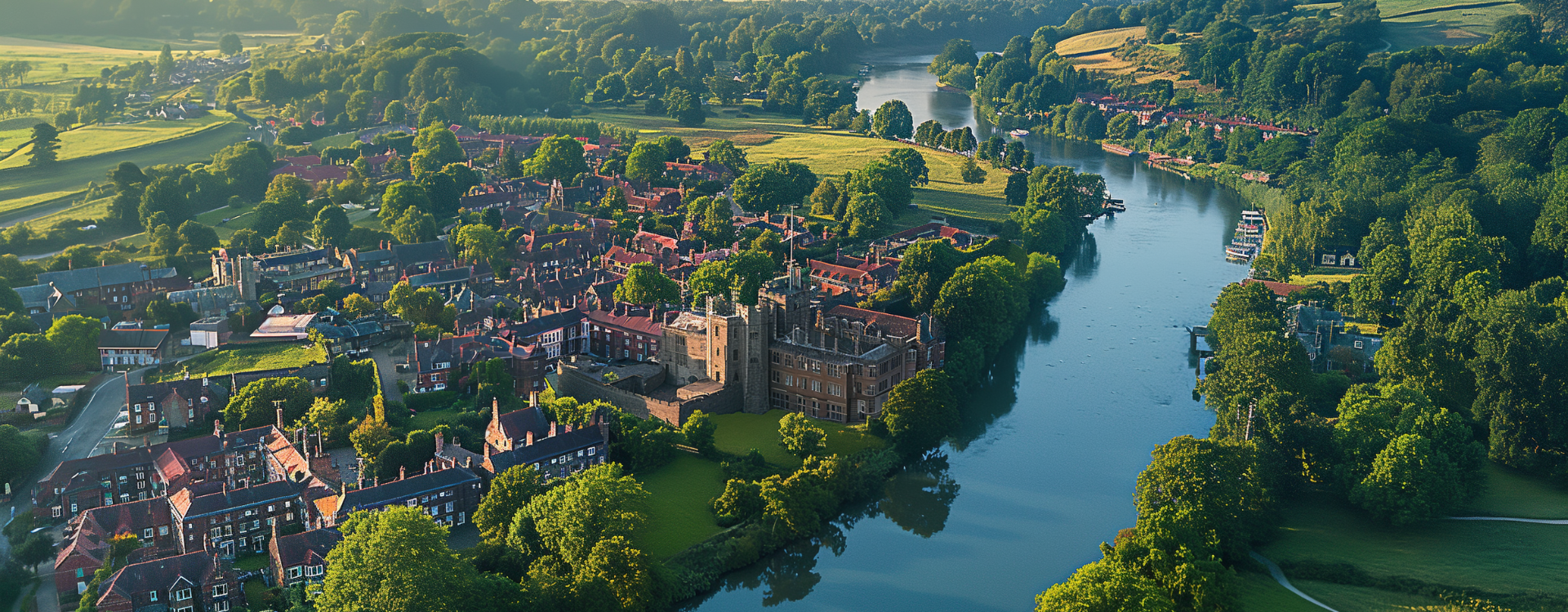
Berkshire, the Royal County, takes its name from a Celtic word for a forest of box trees that once grew near Newbury. The Thames forms its historic northern boundary across one hundred and three miles from Buscot to Old Windsor, and the presence of Windsor Castle — built by William the Conqueror and continuously occupied by the Crown for nearly a thousand years — earned the county its royal designation, confirmed by Queen Elizabeth II in 1957. Eton College, founded by Henry VI in 1440, stands within its borders.
Bearroc: The Name and the Land
The name Berkshire derives from Bearroc, a Celtic word meaning hilly, which according to Asser's ninth-century biography of King Alfred referred to a forest of box trees that once stood west of Frilsham, near Newbury. The Anglo-Saxon form Bearrocscir first appears in the chronicle for the year 860, making Berkshire one of the oldest shires in England — it may date from the 840s, when the districts of Sunningum in the east and Ashdown in the west were unified into a single administrative county. Its historic northern boundary is the River Thames, which the county follows uninterruptedly for one hundred and three miles from Buscot in the west to Old Windsor in the east. To the south lie Hampshire and Surrey; to the west, Wiltshire; and in the far north-western corner, a five-mile stretch of boundary touches Gloucestershire.
The landscape divides into two distinct regions. In the west, the Berkshire Downs — a chalk downland and designated Area of Outstanding Natural Beauty — rise to Walbury Hill, at two hundred and ninety-seven metres the highest chalk hill in England. These downs are the source of the River Kennet, which flows eastward through Newbury before meeting the Thames at Reading. In the east, the land is lower, more wooded, and increasingly urban, shaped by the proximity of London. The county covers 1,263 square kilometres and had a population of 911,403 at the last census.
Before the Saxons: The Atrebates and Calleva
The Berkshire Downs supported numerous prehistoric settlements linked by ridgeways that led to the great ritual centres of Wiltshire. The major archaeological monument within the historic county is the Uffington White Horse, an Iron Age chalk figure 110 metres long carved into the hillside above the Vale of White Horse — though since 1974 it has fallen within the administrative boundaries of Oxfordshire. In the river valleys and eastern lowlands, settlements from the Iron Age give evidence of the Atrebates, a Belgic people who occupied the territory between the Thames, the Test, and the Sussex coast from around the first century before Christ. Their principal town, Calleva Atrebatum — the Roman Silchester, southwest of Reading — became one of the most significant urban centres of Roman Britain, with a forum-basilica, temples, an amphitheatre, a network of metalled roads, and a town plan that remains one of the best-preserved in the country, its walls still visible in the Hampshire countryside.
Wessex, Mercia, and the Danes
During the Anglo-Saxon period, the territory that would become Berkshire was contested by the rival kingdoms of Wessex and Mercia, with Mercia gaining the upper hand in the mid-seventh century before Wessex reasserted dominance in the early ninth. Alfred the Great was born at Wantage in 848, and much of his campaign against the Danish invasions was fought on Berkshire soil. In 871, the Danes seized Reading but were defeated at the Battle of Englefield and again at the Battle of Ashdown, where Alfred and his brother Æthelred led the forces of Wessex. The county suffered further devastation in 1006, when Danish raiders laid waste to its principal towns.
The early history of Berkshire is inseparable from Abingdon Abbey, which by the time of the Domesday survey in 1086 was second only to the Crown in the extent of its possessions. The abbot exercised considerable judicial and administrative powers, his court endowed with the privileges of a hundred court and freed from interference by the sheriff. Berkshire and Oxfordshire shared a common sheriff until the reign of Elizabeth I, and the county's assizes were held at Abingdon — which served as county town — until 1867, when they were transferred to Reading.
The Castle, the Abbey, and the Meadow
The Norman Conquest transformed Berkshire. At the time of the invasion, the county formed part of the Earldom of Harold and supported him at Hastings, a loyalty punished by sweeping confiscations that left no estates of importance in English hands by the time of the Domesday survey. William the Conqueror recognised the strategic significance of the Thames Valley and built Windsor Castle on the chalk ridge above the river, establishing what would become the principal royal residence outside London and the oldest continuously occupied castle in the world. Its presence earned Berkshire the prefix Royal — a designation that dates to at least the nineteenth century, formally confirmed by Queen Elizabeth II in 1957.
In 1121, Henry I founded Reading Abbey, which became one of the richest and most powerful monastic houses in England, its scriptorium producing manuscripts of national importance. Henry himself was buried before the high altar in 1136. The abbey's dissolution under Henry VIII in 1539 reduced it to ruins, but the surviving fragments — together with the Victorian replica of the Bayeux Tapestry housed in the Reading Museum — continue to draw visitors. Downstream from Windsor, the meadow at Runnymede witnessed the sealing of Magna Carta in June 1215, when King John met his rebellious barons on ground roughly halfway between the royal fortress and the baronial camp at Staines.
Cloth, War, and Revolution
The wool trade made Berkshire prosperous from the twelfth century, and the reign of Edward III saw the introduction of cloth manufacture, for which the county became famous. Market towns such as Newbury flourished on the proceeds, and the rivers Thames and Kennet provided vital transport routes for the movement of goods. The cloth trade began to decline in the seventeenth century, but not before the county had been drawn into the bloodiest conflict of the age. During the English Civil War, Reading endured a ten-day siege by Parliamentary forces in 1643, and Wallingford — garrisoned for the Crown — did not surrender until 1646. Newbury was the site of two pitched battles: the First Battle of Newbury at Wash Common on 20 September 1643, and the Second Battle of Newbury at Speen on 27 October 1644. Donnington Castle, besieged and battered during the second engagement, was reduced to the ruin that still stands above the Lambourn Valley.
The Glorious Revolution of 1688 produced its only substantial military action on English soil at Reading, where forces loyal to William of Orange defeated a Jacobite garrison on 9 December in what became known as the Battle of Broad Street — an engagement celebrated in the town for centuries afterward.
Canal, Railway, and the Growth of Reading
The Kennet and Avon Canal, opened in 1810, gave a modest stimulus to trade through the southern part of the county, but it was the arrival of Brunel's Great Western Railway — reaching Didcot in 1839 and extended through Hungerford and Newbury by 1847 — that transformed Berkshire's economy and geography. Reading, already the largest town in the county by virtue of its position at the confluence of the Thames and the Kennet, grew rapidly during the Victorian era. Huntley and Palmers, founded in 1822, became by mid-century the most famous biscuit manufacturer in the world, and the town's brick and seed industries expanded alongside it. In 1867, the summer assizes were moved from Abingdon to Reading, effectively transferring the county town. Berkshire County Council was established under the Local Government Act 1888.
The nineteenth century also gave Berkshire two of its most enduring cultural associations. Ascot Racecourse, closely linked with the Crown Estate and situated six miles from Windsor Castle, became one of the leading venues for thoroughbred racing in Britain. And Oscar Wilde, sentenced in 1895, served his imprisonment in Reading Gaol — an experience that produced one of the most celebrated poems in the English language.
Boundaries, Losses, and the Six Authorities
The Local Government Act 1972, effective 1 April 1974, redrew Berkshire's boundaries in ways that would have been unthinkable to its medieval inhabitants. The county gained Slough and Eton from Buckinghamshire but lost the Vale of White Horse to Oxfordshire — surrendering Abingdon, Wantage, Faringdon, Didcot, and Wallingford, together with the Uffington White Horse and the birthplace of Alfred the Great. The transfer recognised the administrative logic of the Thames as a boundary on its northern bank, but it severed Berkshire from some of its most ancient associations. In 1998, a further reorganisation abolished Berkshire County Council entirely, replacing it with six unitary authorities: Bracknell Forest, Reading, Slough, West Berkshire, Windsor and Maidenhead, and Wokingham. Berkshire remains a ceremonial county, with a lord lieutenant appointed by the Crown, but it has no county council and no single administrative centre.
Eton and the College
Among the places that came to Berkshire in the 1974 boundary changes was the small town of Eton, which had lain within Buckinghamshire for the whole of its recorded history. Eton's significance rests almost entirely on the institution that Henry VI founded there in 1440: The King's College of Our Lady of Eton beside Windsor, the most famous school in the English-speaking world. Twenty of Britain's prime ministers were educated within its medieval courts, and the town of fewer than five thousand people that surrounds it has been shaped — commercially, socially, and physically — by the college's presence for nearly six centuries. Eton College, the town of Eton, and the castle at Windsor that prompted Henry VI to choose this stretch of the Thames for his foundation together form a cluster of royal, educational, and architectural significance that is unmatched anywhere else in the county.







