Beatrix Evelyn Cramer
Beatrix Evelyn Cramer, born 12 February 1985 in Hobart, Tasmania, is an enigmatic figure whose life trajectory moved from troubled youth to antique dealer to Guardian of Bixbus. Raised in Claremont, her fascination with hidden things and boundary-pushing behaviour defined her from childhood. After co-founding Timeless Treasures Antique Emporium with partner Brody Taylor, his 2014 murder and the shop's collapse precipitated years of grief. Her 2018 arrest and dimensional escape to Clivilius transformed her resourcefulness and cunning into essential Guardian capabilities.

Early Life and the Weight of Being Second
Born on 12 February 1985 at Royal Hobart Hospital, Hobart, Tasmania, Beatrix Evelyn Cramer arrived as the second daughter of Brett Wayne Cramer, a master carpenter and senior consultant at Premier Construction Group, and Wendy Elizabeth Cramer (née Cradock), an esteemed primary school teacher who would later become an advocate for children's literacy and creative education. The family home in the northern Hobart suburb of Claremont—a brick veneer house lovingly renovated by Brett—provided the physical framework for Beatrix's childhood, though her interior life would resist all such careful construction.
From the beginning, Beatrix existed in deliberate opposition to the careful order her parents had established. Where her older sister Gladys Cramer (born 17 August 1981) thrived on precision, academic excellence, and methodical achievement, Beatrix operated according to an entirely different logic—one rooted in intuition, impulse, and an irrepressible fascination with the hidden and forbidden. If Gladys represented the family's public-facing success story, Beatrix was its secret drawer, its locked cabinet, its question mark.
The dynamic between the sisters shaped both their lives profoundly. Gladys, nearly four years Beatrix's senior, approached childhood with earnest diligence: colour-coded homework folders, carefully maintained friendships, predictable routines. Beatrix, by contrast, seemed constitutionally incapable of staying within established boundaries. She stole not from necessity but from compulsion—buttons from her mother's sewing box, coins from her father's workshop, trinkets from visiting relatives. When caught at age ten with a neighbour's vintage brooch, her only explanation was chillingly precise: "People only hide what matters."
Brett Cramer, whose mastery of carpentry extended to building display cabinets for his daughter's growing collection of stolen treasures, approached Beatrix's peculiarities with pragmatic containment rather than punishment. He constructed elaborate shelving for her assemblage of insect husks, antique buttons, weathered keys, and fragments of broken pottery—creating physical structures that acknowledged her impulses whilst attempting to impose order upon them. It was a gesture both generous and symbolic: containment without censure, acceptance without approval.
Wendy Cramer, whose educational philosophy centred on nurturing curiosity and creative expression, struggled more visibly with Beatrix's particular brand of independence. She provided structured reading lists, organised craft projects, and engineered supervised adventures to antique markets and plant nurseries—attempting to channel her younger daughter's fascination with hidden things into socially acceptable frameworks. The results were mixed. Beatrix absorbed everything—the histories, the aesthetics, the stories embedded in objects—but remained fundamentally ungovernable.
Family outings revealed the contrasts sharply. Gladys would return from weekend trips with detailed notes, photographs, and educational materials carefully filed. Beatrix would return with pockets full of "found" items: fragments of depression glass lifted from op shops, vintage postcards separated from their collections, coins that had somehow migrated from display cases to her possession. The family learned not to ask too many questions about provenance.
Education and the Art of Selective Compliance
Beatrix attended St Mary's College, a private Catholic school in Hobart, from 1991 to 2003. Her academic record throughout these years followed a consistent pattern: mediocrity in subjects that required conformity, excellence in domains that permitted independent expression. She performed adequately in Mathematics and Science—achieving marks sufficient to avoid remediation but never suggesting particular aptitude or interest. In subjects allowing creative or subjective interpretation, however, she came alive.
Visual Arts became her primary domain of legitimate achievement. Teachers noted her unusual eye for composition, her facility with unconventional materials, and her tendency to incorporate found objects into her work—assemblages that combined orthodox technique with materials that raised questions about their origins. A Year 10 project on "Domestic Archaeology" featured fragments of porcelain, rusted keys, and what appeared to be genuine Victorian mourning jewellery, prompting uncomfortable staff conversations about whether the work constituted brilliant conceptual art or inadvertent evidence of theft.
Drama provided another outlet for her particular talents. Beatrix excelled at improvisation, character work, and the careful study of human behaviour—skills that would later prove invaluable in contexts far removed from the school stage. She displayed an uncanny ability to read people, to intuit what they wanted to hear, and to deliver performances calibrated to specific audiences. Her drama teacher, Sister Margaret O'Donnell, once remarked that Beatrix had "the most naturally convincing stage presence I've seen in thirty years of teaching, which is either a tremendous gift or a terrible warning."
Physical Education revealed yet another dimension of Beatrix's character: competitive intensity paired with tactical cunning. She excelled not through natural athleticism but through strategic thinking and psychological warfare. In team sports, she read opponents with the same forensic attention she applied to antique furniture, identifying weaknesses and exploiting them without hesitation. Her coaches found her simultaneously valuable and unsettling.
The infamous examination incident of Year 11 encapsulated Beatrix's relationship with institutional authority. Accused of obtaining advance access to examination questions—allegedly through a combination of social engineering, careful observation of staff patterns, and possibly direct theft of documents from a locked desk drawer—Beatrix mounted a defence of such plausibility and injured innocence that formal charges were never pursued. Whether she had actually committed the alleged offence remained ambiguous; that she was capable of it remained beyond doubt.
Throughout these years, Gladys watched her younger sister with a mixture of exasperation, concern, and reluctant admiration. The sisters maintained close connection despite their differences—Gladys often covering for Beatrix's transgressions whilst simultaneously lecturing her about consequences and responsibility. Their relationship, whilst occasionally fraught, remained rooted in unspoken loyalty and the shared understanding that they were, in crucial ways, each other's interpreters in a family that didn't quite know how to read either of them.
Post-School Wandering and the Discovery of Purpose
Graduating from St Mary's College in December 2003, Beatrix declined all suggestions of tertiary education. The idea of three years in lecture halls, following prescribed curricula, submitting to institutional assessment—it held no appeal. Instead, she embarked on what her parents euphemistically called a "gap year" and what Gladys more accurately described as "Beatrix doing exactly what Beatrix wants."
Between 2004 and early 2005, Beatrix moved through regional Tasmania like water finding its level, taking up short-term employment in plant nurseries, market stalls, and rural bed-and-breakfasts across Deloraine, Bicheno, and Geeveston. These positions rarely lasted more than a few months—not because of incompetence but because of Beatrix's fundamental resistance to routine and her tendency to reorganise systems without asking permission. She left each position with excellent references (her charm and competence were never in question) and vague explanations about "pursuing other opportunities."
During this period of apparent drift, however, Beatrix was actually engaged in intensive self-education. She spent weekends haunting antique markets, estate sales, and regional auctions, developing an increasingly sophisticated eye for object authentication, material analysis, and the subtle tells that distinguished genuine articles from clever reproductions. She cultivated relationships with dealers, collectors, and the various eccentrics who populated Tasmania's antiques subculture, learning through observation and careful questioning.
Her particular genius emerged in her ability to read objects the way most people read faces—discerning age, authenticity, and emotional significance through touch, weight, and minute visual details. She could distinguish a faux lockplate by the colouration in its brass screws, trace the age of an oil lamp by the weight of its burner, identify the region of a pressed tin ceiling rose by touch alone. These weren't skills acquired through formal training but through thousands of hours of hands-on investigation and an almost forensic attention to detail.
By late 2004, Beatrix had begun supplementing her official employment with unofficial activities: acquiring items from estate clearances before official listings, identifying undervalued pieces at auctions and reselling them privately, occasionally "rescuing" items from skips and abandoned properties. She operated in the grey spaces between legal salvage and opportunistic theft, guided by her own ethical framework that prioritised object preservation over property law.
Brody Taylor and the Creation of Something Real
In February 2005, at a riverside flea market in Launceston, Beatrix encountered Brody Alastair Taylor—a 27-year-old archival consultant and antiquarian whose meticulous approach to historical objects provided perfect counterpoint to Beatrix's intuitive boldness. Their meeting, sparked by a disagreement over the authenticity of a convict-carved box, evolved rapidly from argument to collaboration to something neither could quite name but both recognised as significant.
Brody, still married to cultural anthropologist Lauren Keenan but increasingly estranged from both the marriage and the institutional academic world, found in Beatrix a kindred spirit who shared his passion for material history whilst bringing complementary skills. Where Brody approached objects with scholarly reverence and archival precision, Beatrix brought street-smart cunning, aesthetic instinct, and practical sourcing expertise. Where Brody catalogued and contextualised, Beatrix acquired and arranged. Where Brody preserved memory, Beatrix created theatre.
Their relationship developed through long evenings examining estate clearances, weekends driving to remote properties chasing rumours of undiscovered collections, and countless hours discussing provenance, restoration ethics, and the emotional archaeology of abandoned objects. By mid-2006, Brody had formally separated from Lauren and relocated to New Norfolk, where he and Beatrix began planning what would become Timeless Treasures Antique Emporium.
The shop itself—a repurposed 19th-century sandstone church wedged between a florist and a funeral director—became the physical manifestation of their partnership. Beatrix selected the building, negotiated the lease, and designed the theatrical presentation of the collection. Brody established the cataloguing system, authenticated acquisitions, and maintained the meticulous ledgers that documented every item's history. Together they created something that transcended conventional antiques retail: part museum, part memorial, part carefully curated experience of tactile nostalgia.
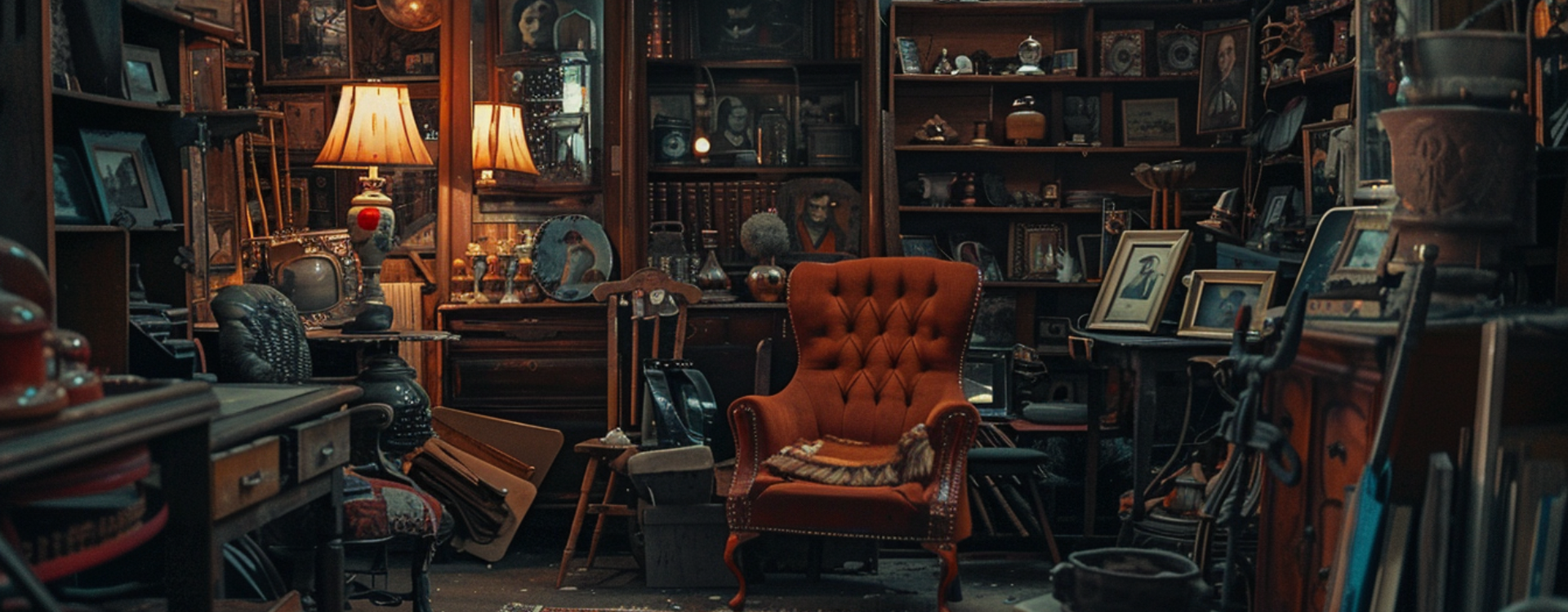
Timeless Treasures opened in early 2006 and quickly developed reputation within Tasmania's heritage community. The inventory reflected both Brody's scholarly interests and Beatrix's eclectic acquisitions: colonial-era apothecary jars alongside taxidermied wildlife, pressed tin ceiling roses beside mismatched teaspoons stamped with cryptic initials, shattered porcelain dolls sharing shelf space with convict-manufactured nails. The shop felt simultaneously curated and chaotic, scholarly and theatrical—much like the partnership that sustained it.
Customers often commented on the palpable tension between Brody's methodical explanations and Beatrix's dramatic presentations. She would stage objects as though directing a play; he would then provide the historical footnotes. She would acquire items through methods that didn't always bear close scrutiny; he would subsequently legitimise them through careful provenance research. The dynamic worked precisely because each supplied what the other lacked.
Their personal relationship remained complex throughout these years. Never quite conventionally domestic, never fully resolved, it existed in the liminal space between business partnership and romantic entanglement. They maintained separate residences but shared keys. They argued about pricing and attribution but moved through the shop's crowded aisles with unconscious choreography. Friends described them as "completing each other's sentences whilst disagreeing about every word."
Tragedy, Ruin, and the Long Collapse
On 14 August 2014, Brody Taylor was found dead in a private storage unit in Moonah, Tasmania. The official ruling cited accidental death; those close to the situation recognised immediately that the explanation satisfied no one. Gladys Cramer, who discovered the body, carried knowledge about the circumstances that she would not fully disclose for years. The lack of proper investigation, the sealed reports, the subtle pressure to accept the official narrative—all pointed to something deliberately obscured.
For Beatrix, Brody's death represented catastrophic rupture. The shop that had been their shared creation became unbearable space she could neither abandon nor properly inhabit. She continued operating Timeless Treasures through 2015, maintaining routines that no longer meant anything, serving customers whose sympathetic glances felt like violations. The financial pressures that Brody had quietly managed whilst alive became overwhelming in his absence. Legal complications with his estranged family, unresolved questions about inventory ownership, mounting debts—each problem compounded the last.
By late 2015, the bank had initiated foreclosure proceedings. The New Norfolk police presided over the formal seizure. Officer Karl Jenkins—whose complex relationship with Beatrix spanned years and involved numerous small favours, overlooked infractions, and unspoken understandings—passed her the spare key as the locks were changed. It was simultaneously a compassionate gesture and ethical violation, typical of the complicated position Beatrix occupied in many people's lives.
The shop remained boarded and padlocked for nearly three years. Beatrix visited occasionally, standing on the footpath outside, unable to cross the threshold into what remained. In July 2018, however, she returned in the pre-dawn hours—barefoot, wrapped in grief and determination—to confront what she had lost.
Jarod James and the Complications of Kindred Spirits
Beatrix's relationship with Jarod Michael James, born the same day she was (12 February 1985), represented one of the most enduring and complicated connections of her life. They had known each other since adolescence in Hobart, recognising in each other a similar relationship to risk, rules, and the spaces between legal and illegal activity. Their friendship deepened during their late teens at Wrest Point Casino, where both discovered aptitudes for reading people, calculating odds, and dancing along edges of acceptable behaviour.
Where Beatrix played casino games for the aesthetic of danger—the performance of risk-taking, the theatre of chance—Jarod approached them with strategic calculation. He played to win, or more precisely, to read. He studied opponents with the same attention Beatrix devoted to antique furniture, identifying tells and exploiting psychological vulnerabilities. Their approaches complemented without quite aligning: both fascinated by risk, but for different reasons.
Throughout the 2000s and early 2010s, Beatrix and Jarod occasionally collaborated on ventures that operated in legal grey areas: sourcing exotic animals for private collections, facilitating discreet sales of items with questionable provenance, providing "consultation" services that involved more research into security systems than was strictly necessary for legitimate business. These projects often dissolved under weight of conflicting priorities—Jarod's preference for careful planning versus Beatrix's impulse toward immediate action—but the connection endured.
Their relationship defied simple categorisation. Not quite romantic, not purely platonic, it existed in territory defined by mutual recognition and comfortable complexity. They could go months without contact, then pick up mid-conversation as though no time had passed. They kept each other's secrets without discussion, covered for each other without being asked, and maintained loyalty that transcended conventional friendship precisely because it acknowledged each other's fundamental unreliability.
Transition to Clivilius and the Birth of the Guardian
Cornered and facing charges for theft and assault, Beatrix activated a Portal Key that Leigh Trogaris had give her. The transition was neither planned nor fully understood—an act of desperate escape rather than considered choice. She emerged in Clivilius through a portal near what would become Bixbus.
The early days in Clivilius represented profound disorientation. Beatrix had to reconcile the impossible reality of inter-dimensional travel with the immediate practical challenges of survival in frontier settlement. She encountered Jamie Greyson—the friend who had vanished from Earth weeks earlier—and discovered that several other people from her Tasmania social network had also transitioned, creating a strange echo of familiar relationships in an utterly alien context.
The designation as Guardian of Bixbus came not through formal appointment but through demonstrated capability. Beatrix's skills—reading situations, acquiring resources through unconventional means, operating effectively in ambiguous moral territory—proved immediately valuable. Her role within the Guardianship became fluid but essential: she worked the margins, using knowledge of human psychology and subterfuge to secure resources, negotiate with Earth-side contacts, and handle operations requiring deniability or moral flexibility.
The Guardian Who Doesn't Believe in Guardianship
Beatrix's relationship with her Guardian role remains fundamentally ambivalent. Unlike many who embrace Clivilius as a second chance or higher calling, Beatrix serves Bixbus not from an ideological commitment but because the settlement offers something she has always craved: a world where adaptability, instinct, and cunning matter more than conventional morality or institutional approval.
She does not subscribe to romantic notions of destiny or divine purpose. She serves because Bixbus needs her particular skills, because the work keeps her engaged, and because the alternative—passivity, boredom, or irrelevance—holds no appeal. Her contributions are pragmatic rather than idealistic: acquiring resources, solving problems, handling situations that require either technical expertise or moral flexibility.




