4075.104 · April 14, 1755 AD
Battlefields in Brocade
Elspeth is entrusted with helping to alter an extraordinary gown of colour-shifting Venetian silk for a grieving noblewoman, but when Agnes reveals that a previous apprentice vanished after asking too many questions, she begins to understand that the Emporium's true currency isn't fabric at all. The dresses, it seems, are merely wrapping paper for secrets worth more than all the silk in Christendom.
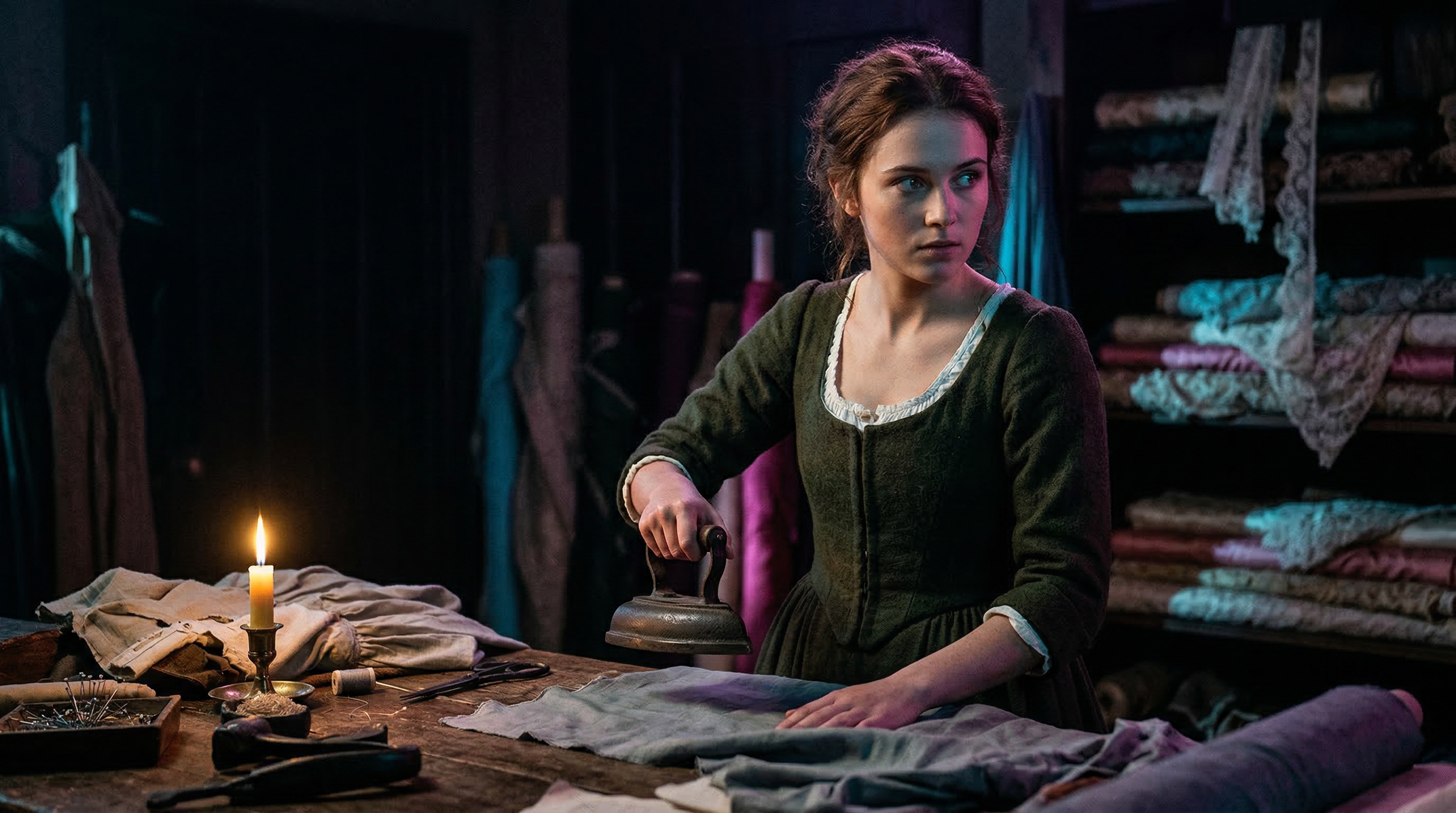
"They told me a girl had vanished for asking too many questions. Naturally, my next thought was to ask what questions she'd been asking."
The afternoon had settled into a rhythm of pressing and folding, the iron growing familiar in my grip, when the bell above the front door chimed again. Its delicate tinkle carried through to the workroom like a whisper on the wind, and I found myself pausing, the heavy iron suspended above a length of dove-grey muslin as I strained my ears to catch the voices from the main shop.
Agnes and Martha had returned from their attendance upon Lady Drummond some time ago, both women settling back into their work with the kind of studied silence that suggested the appointment had not been entirely straightforward. Neither had spoken of what had transpired in the fitting room, and I had not asked. The warning still echoed in my ears: Not a word of what you may have heard or seen today. To anyone.
But this new arrival was different. I could hear it in the quality of the voice that drifted back to us—the smooth, cultured tones of the city's upper class, the vowels stretched and rounded in a way that spoke of finishing schools and private tutors, of privilege worn as comfortably as a favourite cloak.
"...absolutely vital that it be ready by tomorrow evening, Moira." The words were clipped and precise as the snip of embroidery scissors. There was an edge to the voice, a hint of desperation that piqued my curiosity like a loose thread begging to be pulled. "You understand the importance, I trust?"
I held the iron motionless, barely breathing lest I miss the exchange. Across the table, Jane's indigo-stained fingers had stilled over the waistcoat she was finishing. Even Elizabeth's humming had ceased, the workroom falling into a listening silence.
"Of course, Lady Aberfoyle." Moira's voice was smooth as the silk I had been pressing all morning. There was a note of something in her tone—not quite deference, but a careful respect tinged with... was that amusement? A subtle undercurrent that suggested she held more power in this exchange than was immediately apparent. "You can rest assured that your gown will be ready in time for the soirée. I give you my personal guarantee."
The name struck me with the force of recognition. Lady Aberfoyle—wife to Lord James Aberfoyle, a man whose influence in Edinburgh was said to reach from the merchant guilds to the very halls of government. Rumours of his dealings had reached even our modest household in Canongate, whispers of political machinations and questionable business ventures that my mother had quickly hushed whenever they fell upon young ears. "That's not talk for decent folk," she would say, her lips pressed thin with disapproval. "Lord Aberfoyle moves in circles we'd do well to stay clear of."
A pause followed, pregnant with unspoken meaning. The silence stretched, taut as a bowstring, and in it I could almost hear the rapid beating of my own heart.
"See that it is." Lady Aberfoyle's tone carried a weight of finality, of command accustomed to being obeyed without question. Yet beneath the aristocratic assurance lurked something that sounded remarkably like fear. "There is much riding on this evening, Moira. For both of us."
For both of us. The words carried an implication of shared risk, of a partnership that extended beyond the usual transaction between dressmaker and client. What could a lady of such standing possibly share with a shopkeeper, however successful? What mutual interest could bind them together in such a way?
I was so lost in thought, turning these questions over in my mind, that I nearly missed Agnes's approach. The older woman moved with surprising quietness for someone of her years, and when she spoke, her voice was low but not unkind.
"Eavesdropping already, are we?"
I felt my cheeks flush with embarrassment, the heat rising to the very tips of my ears. "I didn't mean to listen in," I said quickly, the words tumbling out in a rush. "I was just—"
"Curious." Agnes finished for me, a hint of a smile tugging at the corners of her mouth. "Aye, that's natural enough. The wanting to know is as much a part of human nature as breathing, especially for a lass with a quick mind." The smile faded, replaced by a gravity that transformed her weathered face into something altogether more serious. "But curiosity can be a dangerous thing in a place like this, Elspeth. It's led more than one person down paths from which there's no return."
"What do you mean?" The question escaped before I could stop it.
Agnes regarded me for a long moment, her honey-coloured eyes searching my face as if weighing how much to reveal. "There was a girl here, oh, three years past now. Bright thing, not unlike yourself. Quick hands, quicker mind." She paused, her gaze drifting to the velvet curtain that separated us from the shop. "She got too curious. Asked too many questions about the wrong people. Started piecing things together that weren't meant to be pieced."
"What happened to her?"
"She left." Agnes's voice was flat, final. "One day she was here, the next she wasn't. Moira said she'd found a position elsewhere, somewhere in the Highlands. But..." She shook her head slowly. "Best to keep your head down and your ears closed, especially when it comes to the comings and goings of the nobility. They play games with stakes higher than you or I could ever afford."
Before I could press further—before I could ask what manner of games, what had this girl discovered, where in the Highlands had she truly gone—the velvet curtain parted with a whisper of fabric, and Moira swept into the workroom.
Her presence commanded immediate attention. The air seemed to crackle with energy, as if the very atmosphere recognised the power she wielded. Her grey eyes scanned the room, taking in every detail—a loose thread here, a misplaced pin there—before settling on Agnes and me with the intensity of a falcon spotting prey.
"Ladies." Her voice was crisp as freshly ironed linen. "We have an urgent commission. Lady Aberfoyle's gown for tomorrow evening's soirée requires significant alterations. The bodice must be taken in, the hemline raised, and the sleeves reworked entirely." She spoke with the precision of a general outlining a battle strategy. "Miss Stewart, you'll assist Agnes with this task. I trust you're up to the challenge?"
I straightened, pushing down the flutter of nervousness that beat against my ribs like a caged bird. This was my chance to prove myself, to demonstrate that my hands were skilled enough to work on a garment destined for one of Edinburgh's most prominent women. "Yes, madam," I replied, proud of how steady my voice sounded. "I'll do my best."
"Your best had better be exceptional." Moira's gaze held mine, unblinking. "This gown is of utmost importance. The fabric is a special order—silk brocade from Venice, dyed with a pigment that changes colour in different lights, from deepest midnight to the first blush of dawn." She paused, letting the words settle. "Handle it with the greatest care. A single yard costs more than you would earn in a year."
The words were delivered not as a boast but as a simple statement of fact, a reminder of the gulf that existed between my world and the one inhabited by the Emporium's clientele. It was a gulf I had crossed when I stepped through the shop's door, but one I could never fully bridge, no matter how skilled my fingers became.
"Martha, Jane—you'll continue with the work at hand. Elizabeth, I'll need you in the front; Lady Carmichael's daughter is expected within the hour for her final fitting." Moira's commands were delivered with the efficiency of long practice. "And remember, all of you—discretion is paramount. What happens in this workroom stays in this workroom. The conversations you overhear, the garments you handle, the clients you glimpse—these are not topics for gossip over supper or idle chatter with friends."
Her eyes found mine again. "Is that understood, Miss Stewart?"
There was an undercurrent to her words, a subtle emphasis that suggested the consequences of disobedience would be swift and severe. I thought of the girl Agnes had mentioned—the one who had asked too many questions, who had pieced things together that weren't meant to be pieced. The one who had simply... vanished.
"Yes, madam," I said. "Absolutely."
Moira studied me for a moment longer, as if reading the sincerity in my eyes and finding it sufficient. Then she nodded, once, and swept out of the room, leaving behind a wake of tension and unspoken questions.
Agnes sighed, shaking her head. "Well, lass," she said, her voice carrying a mix of resignation and something that might have been excitement, "it seems you'll be getting a baptism by fire. Come on, then. Let's see what you're made of.”
The gown was unlike anything I had ever seen.
Agnes retrieved it from a locked cabinet at the far end of the workroom—a cabinet I had not noticed before, its door cleverly disguised to blend with the shelving around it. She handled the garment with a reverence that bordered on the religious, laying it out upon the worktable with the care one might afford a sleeping infant.
The silk seemed to drink in the light from the high windows and transform it into something else entirely. At first glance, the fabric appeared to be a deep, midnight blue—the colour of the sky just before true darkness falls. But as Agnes spread it across the scarred wood of the table, the colour shifted, rippled, became something closer to violet, then to a blue so pale it was almost silver.
"Venetian silk brocade," Agnes said, her voice hushed. "Dyed with pigments from the Orient—Moira has a contact in the merchant trade who acquires them for her. There's perhaps three bolts of this fabric in all of Europe."
I reached out, then hesitated, my fingers hovering above the surface. "May I?"
"You'll have to touch it if you're to help alter it," Agnes said, but there was approval in her eyes at my caution. "Go on. But gently, mind. The oils from your skin can mark it if you're not careful."
I brushed my fingertips across the fabric, and a small sound escaped my lips—something between a gasp and a sigh. The silk was cool to the touch, impossibly smooth, and it seemed almost to respond to the warmth of my hand, the colour deepening where my fingers made contact before slowly returning to its original shade as I withdrew.
"It's alive," I breathed, then immediately felt foolish for saying such a thing.
But Agnes did not laugh. "Some say the silk remembers," she said quietly. "That it holds onto something of everyone who wears it. Fanciful talk, perhaps. But there are stranger things in this world than fabrics with memories." She reached for her pin cushion, all business once more. "Now, let's see what needs doing. Lady Aberfoyle has lost weight since this was first fitted—grief will do that to a body."
"Grief?"
Agnes glanced at me, then away. "Her son. Took a fever last autumn. Fourteen years old, and gone within a fortnight." She began inserting pins along the bodice seam, marking where the fabric would need to be taken in. "She hasn't worn colour since. This gown—it's the first. For tomorrow's soirée."
I thought of Violet, of the way her small hand felt in mine, of the gap-toothed smile that could brighten even the darkest of days. Fourteen years old. Not so much older than Effie. The thought of losing a sister—of losing any of them—was enough to make my chest constrict painfully.
"That's terrible," I said softly.
"Aye, it is." Agnes's voice was matter-of-fact, but not unkind. "Tragedy doesn't discriminate, lass. Titles and wealth are no protection against death. Lady Aberfoyle lost her boy the same way your father was lost to you—suddenly, without warning, without the chance to say goodbye." She looked up from her pinning. "I'm sorry. I shouldn't have—"
"No." I swallowed hard against the sudden tightness in my throat. "No, you're right. I hadn't thought of it that way. That someone like her could feel the same..." I trailed off, uncertain how to finish.
"The same loss you feel?" Agnes's smile was sad, knowing. "Pain is pain, Elspeth. It cares nothing for rank or station. Remember that, when you're tempted to think of these fine ladies as creatures apart from yourself. They bleed the same red blood we do. They weep the same salt tears."
We worked in silence for a time after that, the only sounds the whisper of silk and the soft snick of scissors. I watched Agnes carefully, learning the way she handled the precious fabric—firm but gentle, confident but never careless. When she handed me a needle threaded with silk the exact shade of the gown, my hands trembled only slightly.
"Small stitches," she instructed. "So small they disappear into the weave. The goal is invisibility—when this gown is worn, no one should be able to tell it was ever altered. Lady Aberfoyle's reputation depends upon appearing as though nothing has changed, as though the grief has not touched her, as though she remains the same woman she was before her world fell apart."
"But it has touched her," I said. "The gown proves it. The alterations—"
"Will be invisible." Agnes's eyes met mine, and I saw something there—a warning, perhaps, or a lesson. "That is what we do here, Elspeth. We make the invisible visible, and the visible invisible. We create armour out of silk and lace, shields out of brocade and ribbon. The women who come to us—they are going into battle. The ballrooms and salons of Edinburgh's society are as dangerous as any battlefield. And our gowns..." She smoothed her hand across the midnight silk. "Our gowns are their weapons."
I bent my head over my work, considering her words. There was poetry in them, a way of seeing this trade that elevated it beyond mere commerce. But there was something else, too—something that connected to what Agnes had hinted at earlier, to the undercurrents I had sensed since my first moments in this place.
"You said earlier," I ventured, keeping my voice low, "that Moira deals in more than silk and lace. That information is her real stock in trade."
Agnes's hands stilled. Across the room, I was acutely aware that Martha had looked up from her work, her spectacles glinting in the afternoon light. Even Jane's fingers had paused their ceaseless motion.
"Did I say that?" Agnes's tone was carefully neutral.
"You implied it. When you were showing me the pressing earlier. Before Lady Drummond arrived."
A long moment passed. I could feel the weight of it, the tension that had suddenly gathered in the room like storm clouds on the horizon. Agnes exchanged a glance with Martha—a silent communication that passed between them too quickly for me to read.
"You've a good memory," Agnes said finally. "That can be useful, or it can be dangerous. It depends entirely on how you choose to use it."
"I'm not asking to cause trouble. I just want to understand."
"Understanding comes with time, lass. And with trust." Agnes resumed her stitching, her needle flashing in and out of the silk with renewed purpose. "Trust that must be earned. You've been here less than a day. Moira took a chance on you—we all did, by extension. Whether that chance pays off remains to be seen."
"I won't betray that trust." The words came out fiercer than I had intended, but I did not regret them. "I need this position. My family needs it. I'm not fool enough to jeopardise that by speaking out of turn."
"Good." Agnes nodded slowly. "Hold onto that. Let it guide you in the days and weeks to come, when you're tempted to ask questions you shouldn't, or speak of things you've seen." She leaned closer, her voice dropping to barely more than a breath. "The dresses are just the wrapping paper, Elspeth. Pretty enough to look at, but it's what's inside that matters. What's stitched between the seams. What's whispered during fittings when a lady thinks no one is listening." Her eyes held mine. "Information, in the right hands, is worth more than all the Venetian silk in Christendom. Remember that."
The words sent a shiver down my spine. This was what I had sensed from the beginning—this undercurrent of secrecy and power that flowed beneath the surface of the Emporium like a hidden river. Moira MacKenzie was not merely a dressmaker to Edinburgh's elite. She was something else entirely. A collector of secrets. A broker of whispered confidences.
And now I was part of it—whatever it truly was.
"The stitching on the hem," Agnes said, her voice returning to its normal volume, the moment of confidence passed as though it had never been. "Watch how I do this part. It requires a particular technique, or the fabric will bunch."
I bent my head and watched, my mind churning beneath the surface even as my hands learned the motion. The afternoon light slanted through the high windows, painting golden rectangles across the worktable, and the silk brocade shimmered beneath our fingers like captured starlight.
Somewhere in the shop, the bell chimed again—another customer, another secret walking through the door. The sound seemed very far away, belonging to a world I was no longer entirely part of.
I kept my eyes on the needle and did not look up.







