4338.213 · August 1, 2018 AD
Battle of Wills
Charles Smith had expected a quiet pre-dawn raid on last night's lasagne. What he got was his mother in the kitchen doorway, already past cross, and a standoff he thought he was winning right up until the moment he wasn't. In the small, petty theatre of a suburban kitchen at five-forty-three in the morning, Charles discovers that being quicker than his mum is not the same thing as being her equal.
"You can be quicker than your mum at a lot of things. Being right is not one of them."
The tiles in the hallway were cold enough to notice through my socks, and my socks had the beginnings of a hole I'd been meaning to tell Mum about for three weeks. My stomach made a noise I'd have been embarrassed about if there were anyone around to hear it. Which there wasn't, except for the low murmur of voices coming from the spare room, which meant the computer was on, and the computer being on at this hour of the morning meant one thing.
Lisa.
I slowed a little as I passed the doorway. Lisa's voice came through the speakers with that slight delay that always made her sound like she was talking from underwater, which she sort of was, in the sense that she was on the other side of the planet. Will was saying something behind her, a quiet American rumble, and Mum was laughing the loud bright laugh she kept for video calls with her daughter.
I thought, as I had been thinking quite a lot lately, that Salt Lake looked like an excellent place to be. Eli was there. Eli had been there for weeks. Eli, in the version of the story I was quietly working on in my head, was not coming back. I had another year of school and then nothing in particular lined up, and Salt Lake had started to look less like Eli's trip and more like Eli's exit.
I kept walking.
The clock showed 5:43 as I passed the living room, which was five minutes later than I'd hoped and seventeen minutes before I needed to be in a car. I pushed the kitchen door open with a shoulder and the overhead light hit me like a slap.
The pantry door stuck the way it always stuck, and my hand found the cereal box on autopilot. Same box. Same shape. Same taste I could already predict, sitting in the same bowl I would rinse out later because nobody else in the house ate cereal at this hour. My stomach made its opinion known about the cereal, which was an opinion I was inclined to agree with.
I put the box back.
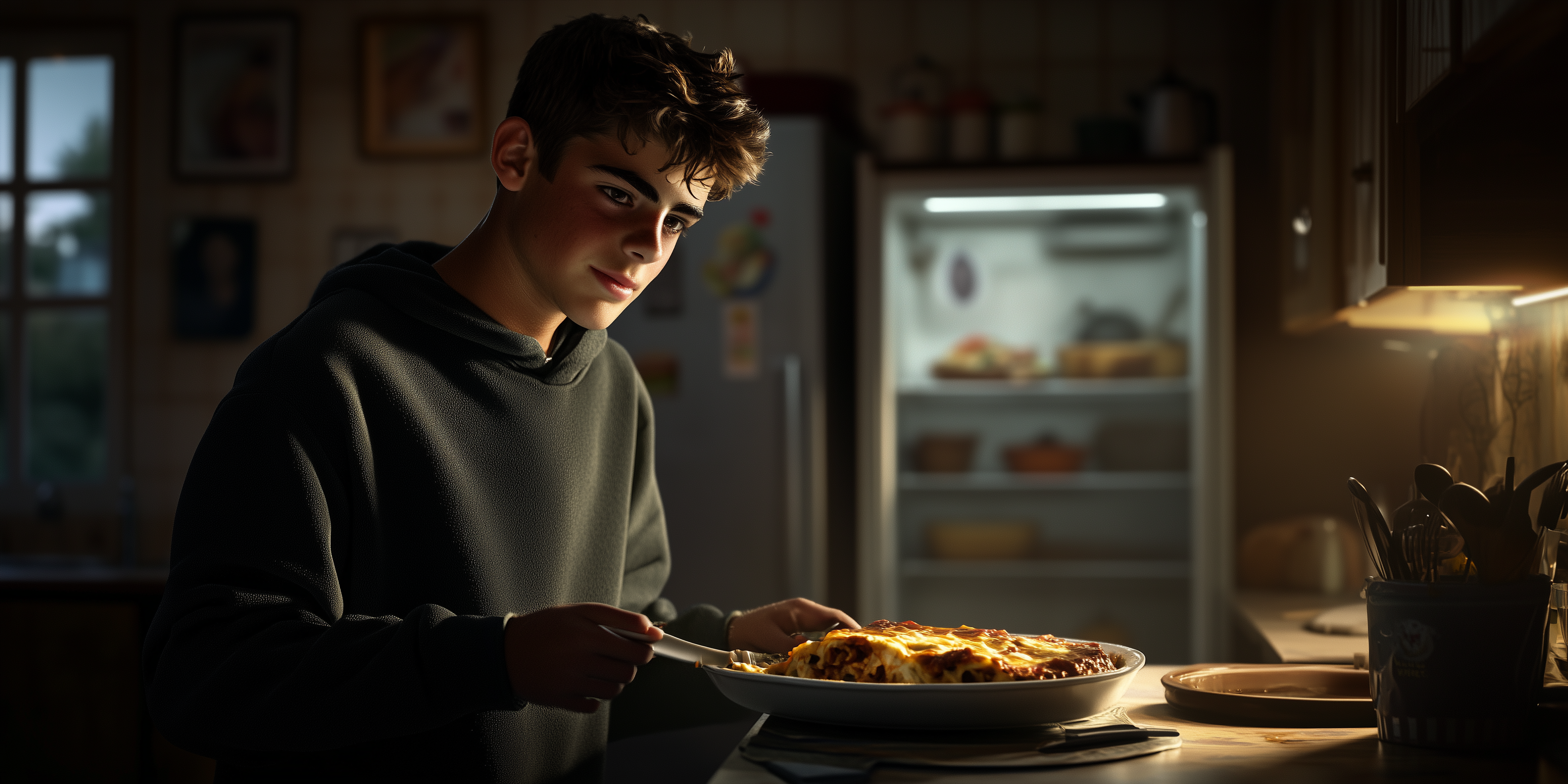
The fridge was a better proposition. I opened it and the cold air came out in a slow sigh, carrying the particular smell of a fridge full of things Mum had organised — containers with their lids on properly, leftovers labelled on the ones she cared about, a row of cucumber and capsicum at the front because she believed in a fridge that led with vegetables. I stood there in my socks and looked past all of it.
Second shelf, behind the yoghurt.
Last night's lasagne.
I had been fine with last night's lasagne at the time, and I was better than fine with it now. Cold lasagne was one of the small, genuinely excellent things about Mum's cooking that she would never admit to, because in her head food existed to be eaten hot at a table with a prayer over it. What she didn't know was that the flavour did a second round of work overnight — the sauce went denser, the cheese set into the pasta, and the whole thing became, in my view, objectively better than it had been at dinner.
I lifted the container out of the fridge with both hands. Heavier than I remembered. I held it in front of me, the fridge door still open, the cold air working its way around my socks, and I peeled back the lid.
"Charles!"
I hadn't heard her come down the hall. Mum moved quietly when she wanted to, which was a thing I had noticed years ago and filed away as useful intelligence, and now here she was in the kitchen doorway with the sharp edge of her voice already out. I turned with the container still in my hands. The fridge door drifted shut behind me with a soft thunk and the kitchen felt suddenly a lot smaller than it had a second ago.
She was in her pyjamas. The ones with the little smiling Jesus faces on them, which Lisa had given her one Christmas as a joke that Mum had taken entirely seriously and now wore in what I assumed was close to a weekly rotation. Her hair was doing the thing it did first thing in the morning, and she had both hands on her hips in the way that meant she had decided on a position before she'd walked in.
"I was just…" I started, which was a line I'd used enough times to know it wouldn't save me, but the opening was there and I took it.
She didn't say anything. She just stood there and waited for me to finish a sentence I hadn't worked out how to finish.
The thing was, I could feel it already — she was wound tighter than the situation called for. A container of lasagne did not justify the face she was pulling. Something had been building in her since Sunday, maybe earlier, and I'd spent the week clocking it the way you clock weather. You don't need to know what's coming to know that something is. But this wasn't the morning to ask about it, and I wasn't, at five-forty-three in the morning with cold lasagne in my hands, the person who was going to ask.
So I did what I always did when Mum was wound up and I was on the wrong side of the decision. I got ready to make her laugh.
"It's all part of my healthy, balanced, breakfast regimen," I said.
I gave it the full delivery. Chin up, shoulders back, the voice I used when I wanted a line to sound like it had been written by someone more important than me. I held the container out slightly as evidence, like a barrister presenting his exhibit. I could feel the corners of my mouth wanting to go, and I didn't let them, because half the game was keeping a straight face while the other person worked out whether you were joking.
Mum's eyes narrowed.
Normally this was where she broke. Not a full laugh — Mum didn't hand out full laughs at five-forty-three in the morning — but the small thing her mouth did when she was trying not to give me the satisfaction, the tiny compression at one corner that meant I'd landed it. I watched for it. I watched for it the way I always watched for it.
It didn't come.
Her jaw set instead, and her hands stayed on her hips, and I had the brief unsettling experience of a bit not working. Which was fine. I had backup.
"Just a little bit," I said, and before she could answer I reached into the container with two fingers and liberated a single meatball from its bed of pasta, and held it up between us like I had won something.
She moved fast.
Her hands came for the container and I wasn't expecting it — Mum didn't usually go physical in the kitchen, that wasn't her register — and for a second I thought she was actually going to get it off me. But I had the advantage of being sixteen and stupid and awake on adrenaline now, and I sidestepped. A proper sidestep, quick enough that my socks slid half a foot on the tiles. The container stayed in my hands. The meatball stayed in my other hand. I laughed before I'd decided to laugh. It came out loud in the quiet kitchen and I heard it sound wrong almost immediately.
Mum's face had gone somewhere I hadn't seen it go in a while.
Not cross. Cross was the usual weather. This was past cross.
"Charles, this is important."
Dad's voice came from the doorway behind Mum, low and measured, and I looked past her to find him filling the frame with the kind of presence he brought to every room he entered — which was to say, not much presence at all until he spoke, and then all of it. He was in his garments and his dressing gown was hanging loose at his sides, the cord trailing, like he had put it on as an afterthought on the way down the hall. His hair had a pillow-crease through it. He looked, in fact, like a man who had been sleeping peacefully until recently and had come to see what the noise was about.
"You can't be silly about your meals," he went on. "Put the food back and have a proper breakfast."
That was the full speech. Dad didn't do speeches. He said what he needed to say in as few words as the situation would tolerate and then he stopped, and in our house that was enough, because Dad speaking at all was a kind of weight in itself. I'd watched Lisa and Eli get the same three sentences delivered in the same flat register when I was a kid, and I'd watched them obey it, which had surprised me at the time and made more sense to me now.
I put the lid back on the container. I did it slowly, the way you'd do anything you were trying to make look dignified after being caught holding it at arm's length from your mother.
"As if this little bit of lasagne would feed us all," I said, and I slotted the container back into the fridge, up on the second shelf where I'd found it.
I turned back and caught Mum mid-breath, gathering herself for the next round, and I realised with a small sinking feeling that Dad's intervention had not finished the argument. It had only paused it. She was waiting for him to be done so she could keep going.
Dad, for his part, looked like he'd done his bit. He stood in the doorway a beat longer, long enough to register that the lasagne was back in the fridge, and then he turned and walked off down the hall.
I was, as it turned out, on my own.
"That's not the point," Mum said, and her voice had gone lower, which in Mum's register was a worse sign than loud. "I was going to put it with something else."
I rolled my eyes.
I did it properly. A full commitment — head tilted a fraction, the whole ceiling of the kitchen involved — because if I was going to lose this I was at least going to land a point or two on the way down. I wanted her to see it. I wanted her to know I'd seen the "something else" for what it was, which was a justification invented on the spot to back up a position she'd already taken.
"And besides that, you didn't ask!"
It came out sharp enough that I actually looked at her properly for the first time since she'd walked in. Her cheeks had gone pink. Not the pink of someone worked up in a fun way — the pink of a person who was down to her last few inches of patience and had just watched me spend them for her.
Which should have made me back off.
It did not make me back off.
Because I had, stored away in a sealed compartment of my memory where I kept things for exactly this kind of moment, a grievance from about a week ago. I had bought a block of Cadbury from the service station on the way home from school. I had eaten most of it that evening and I had put the last two rows in the pantry, folded the wrapper down, and left it there for tomorrow. Tomorrow had come. The chocolate had not been there. Mum had been at the kitchen bench with a suspiciously contented expression, and when I'd asked her about it she had said she'd assumed it was community chocolate and had pretty much confessed to the whole thing before I'd finished the question.
I had let it go at the time, because the argument hadn't been worth it.
I was not letting it go now.
"And you didn't ask to eat my last piece of chocolate either," I said.
I shut the fridge door on the way out of the sentence. I hadn't meant to slam it. I just hadn't fully calibrated my arm to the weight of what I was feeling, and it came off harder than it should have, and the magnets on the fridge rattled, and Mum's face did something I wasn't expecting.
She went still.
Just for a second. Just long enough for me to register that I'd crossed some line I hadn't known was there. And then she was back, and she was louder than before, and I knew before she opened her mouth that she had found something to say that was going to cost me.
"You know it gives you eczema, anyway."
She said it flat.
Not shouted. Not even particularly pointed. She said it the way you'd mention the weather forecast to someone who was about to walk out in a shirt, and that was what made it land, because the flatness was the move. She wasn't arguing. She was stating a fact we both already knew, and she was stating it now, because I had been losing the fight anyway and she had decided to end it.
And she had ended it.
My face went hot before my head caught up. I could feel it in my cheeks and in my ears — the particular full-body flush of being reminded that my mother kept a full medical file on me and would open it in a pinch. The eczema was real. It was on the inside of my elbows and behind my knees, mostly, and it flared when I ate too much dairy, which meant it flared roughly once a week, because I was sixteen and I was not going to stop eating dairy. She knew all of this. I knew she knew all of this. The fact that we both knew was the whole basis of our family's ongoing low-grade dairy politics, and she had just dragged it out of the cupboard and slapped it on the kitchen bench in the middle of a fight about lasagne.
Clever.
I hated that it was clever.
I was, on a day-to-day basis, quite proud of my mother's sharpness. I had grown up inside it. I had watched her run it on my father, who would lose four out of every five arguments and walk away not quite knowing how, and I had watched her run it on my siblings, who had all, at various points, given up trying to out-argue her. I had thought, in a quiet sixteen-year-old way, that I might be the one who'd caught up with her. That I might be running at her speed now, or close to it, and that the sparring we did in the kitchen and the car and the hallway was the beginning of something like an even match.
It was not, as it turned out, an even match.
Not this morning, anyway.
I put the anger where I could find it again later and I opened my mouth to say something clever back, and nothing came. Which was the second worst part. The worst part was the way her face had already settled into the expression of a woman who knew she had won and was waiting for me to work out what to do about it.
What I did about it was leave.
I brushed past her on my way out of the kitchen. Not gently. My shoulder caught hers as I went through the doorway and I felt her give a little under the contact, and I didn't apologise, because apologising would have conceded the whole fight and I had already conceded enough of it.
"Where are you going?"
Her voice came after me into the hallway, still sharp, and for a second I nearly didn't answer. I was halfway to the bathroom already and I had the door in my sightline. But not answering would have been a round she could come after me for later, and I was done giving her rounds.
"I've got seminary, remember?"
I threw it over my shoulder without turning around, because turning around would have meant looking at her and I wasn't ready to do that yet. I said it the way you say something you want the other person to hear but not reply to — quick, flat, already walking. She was the one who got up at five-thirty every morning to make sure I was up. She was the reminder. I didn't need to be reminded. That was, in fact, the joke.
I kept walking.
The hallway felt longer than it usually did, which I recognised as a thing your brain does when you want a corridor to be over with. My face was still hot. My ears were still hot. The lasagne container was behind me in the fridge, and my mother was behind me in the kitchen doorway, and the whole morning was already receding into the category of things that will have blown over by this afternoon.
Mum and I did this.
We did this and it was fine.
We would be fine by dinner. She would be fine by dinner. I would apologise in the small sideways way I apologised, which involved setting the table without being asked or making her a cup of herbal tea, and she would accept it in the small sideways way she accepted things, which involved not mentioning it again, and the lasagne would go into whatever she was planning to build around it, and the eczema would quietly clear up on my elbows the way it always did, and the whole thing would be filed away.
I reached the bathroom door.
I went in.
I closed it behind me, and I leaned against it for a second, and I let out a breath I hadn't realised I'd been holding. My hands were shaking slightly, which surprised me, because I hadn't thought the fight had cost me that much.
It was, I thought, going to be one of those days.
And then I got on with getting ready for seminary.







