
Battery Point, Tasmania, Australia
Battery Point is a historic peninsula suburb of Hobart, Tasmania, situated on Muwinina country where the Derwent River meets the harbour. Named for the artillery battery established in 1818 to defend the colonial settlement, it preserves some of Australia's finest Georgian architecture in cobblestoned streetscapes built by convict labour. Home to prestigious addresses including St Georges Terrace, the suburb balances heritage preservation with contemporary living, its character shaped by maritime history, community vigilance, and the unsettling events of 2018.
Ancient Shores and First Custodians
Long before European colonisation imposed its grid of streets and definitions upon this peninsula, the lands now known as Battery Point belonged to the Muwinina people of the South East nation. The promontory that juts into the Derwent River, offering commanding views across the harbour and toward the mountain the colonisers would name Wellington, held significance within Aboriginal patterns of movement and resource gathering. The shoreline provided access to marine resources—shellfish, fish, and the materials for tools and adornment—whilst the elevated ground offered vantage points from which to observe the river's changing moods and the seasonal rhythms that governed traditional life.
The Muwinina understood this place as part of a living landscape, connected through songlines and kinship obligations to the broader territories of south-eastern Tasmania. Their knowledge of country encompassed not merely the physical terrain but the spiritual dimensions that animated rock and water, tree and creature. The arrival of British colonists in the early nineteenth century disrupted these ancient connections with catastrophic thoroughness, yet the Muwinina relationship to this peninsula endures in ways that colonial naming conventions cannot entirely obscure. The very shape of the land—its curves and contours, its orientation to water and mountain—remains as it was when Aboriginal feet alone walked these shores.
The Battery and Colonial Foundation
The suburb takes its name from the artillery battery established on the promontory in 1818 to defend the young settlement of Hobart Town against potential naval attack. The battery, positioned to command the approaches to Sullivan's Cove, represented both practical military necessity and symbolic assertion of British sovereignty over Van Diemen's Land. The guns that once pointed seaward have long since been removed, yet the name persists as reminder of the settlement's precarious early years, when the possibility of French or American incursion seemed genuine threat rather than historical curiosity.
The establishment of the battery coincided with the broader development of Hobart Town's waterfront infrastructure. The deep-water harbour of the Derwent River had attracted Lieutenant-Governor David Collins to this site in 1804, and by the 1810s the settlement had begun expanding beyond its initial footprint around Sullivan's Cove. The elevated ground of the peninsula offered desirable building sites—close enough to the commercial waterfront to be convenient, yet sufficiently elevated to escape the rough character of the dockside streets. Colonial officials and successful merchants began constructing residences that reflected their aspirations to respectability and permanence.
The convict system that defined early Van Diemen's Land left its mark upon Battery Point as thoroughly as upon any part of the colony. Transported labour quarried the sandstone that became the signature material of the suburb's architecture, cut the timber for framing and joinery, and laid the foundations of buildings intended to house their social superiors. The irony was not lost on contemporary observers: men and women condemned to servitude built homes of elegance and refinement for those who had condemned them. The warm honey tones of colonial sandstone, visible throughout Battery Point's heritage streetscapes, carry within them the labour of those whose names history has largely forgotten.
Georgian Elegance and Maritime Character
The decades following the establishment of the battery witnessed Battery Point's transformation from military outpost to residential enclave. Georgian architectural principles—symmetry, proportion, classical detailing—found expression in the cottages and terraces that lined the suburb's emerging streets. Local builders, some of them skilled convict artisans, adapted metropolitan styles to colonial conditions, creating a distinctive architectural vernacular that married British precedent with Tasmanian materials and climate considerations.
The maritime character of early Battery Point cannot be overstated. Sailors, shipwrights, and waterfront workers lived alongside merchants and professionals in a social geography more fluid than the rigid class distinctions of the mother country might have suggested. The proximity to Salamanca's wharves and warehouses meant that the sounds and smells of maritime commerce penetrated daily life—the creaking of rigging, the shouts of stevedores, the pungent aroma of whale oil that sustained much of the colony's early economy. Public houses catered to seafaring clientele, whilst chandlers and provisioners established businesses supplying vessels bound for distant ports.
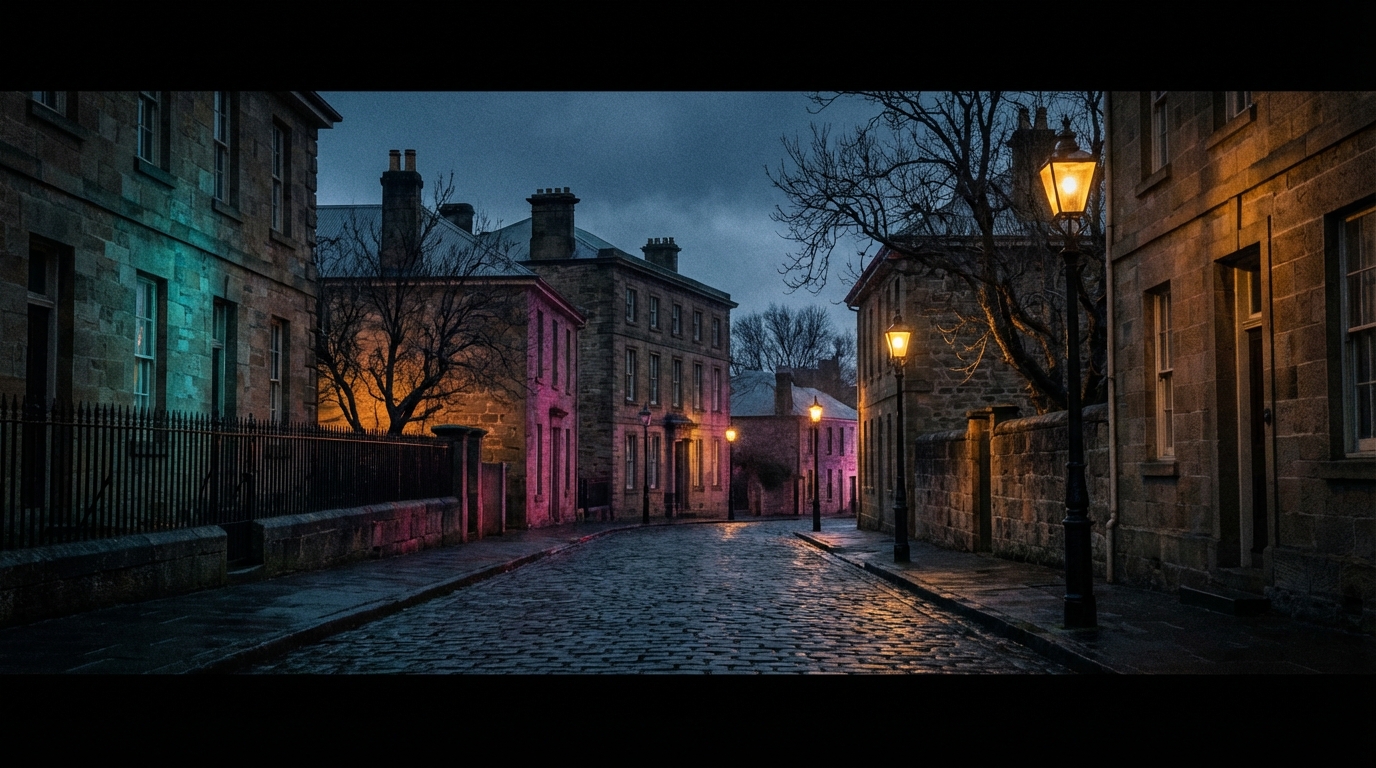
The cobblestone streets that survive in parts of Battery Point date from this era, their uneven surfaces designed to provide purchase for horse-drawn vehicles navigating the suburb's sometimes steep gradients. These streets, narrow by modern standards, reflect an urban scale conceived for pedestrian movement and horse traffic rather than the automobile. Walking Battery Point today, one encounters spatial relationships—the proximity of buildings to roadway, the intimacy of laneway connections—that preserve the feel of early colonial settlement in ways that broader thoroughfares cannot replicate.
Victorian Prosperity and Consolidation
The mid-nineteenth century brought both challenges and opportunities to Battery Point. The end of convict transportation to Van Diemen's Land in 1853 removed the labour system that had built the suburb, whilst the colony's renaming as Tasmania in 1856 signalled aspirations to shed the penal taint that had defined its first half-century. The discovery of mineral wealth in Tasmania's interior generated prosperity that flowed through Hobart as the island's commercial and administrative capital, and Battery Point's established residents benefited accordingly.
The architectural character of the suburb evolved during the Victorian era, with new construction reflecting the ornamental elaboration and material confidence of the period. Where Georgian buildings had emphasised restraint and proportion, Victorian additions introduced decorative ironwork, elaborate verandahs, and the eclectic mixing of historical references that characterised the era's aesthetic sensibility. Yet Battery Point's relatively compact geography and established street patterns constrained development, preserving much of the Georgian fabric even as Victorian embellishments were added.
The suburb's social composition shifted subtly during this period. As Hobart expanded and new suburbs emerged on its periphery, Battery Point consolidated its reputation as a desirable residential address for the professional and mercantile classes. Lawyers, doctors, successful merchants, and colonial administrators established households in the suburb's substantial residences, whilst artisans and maritime workers continued to occupy the more modest cottages and terraces. This social layering—grand homes neighbouring workers' dwellings—created the textured streetscapes that heritage advocates would later celebrate as evidence of authentic historical development rather than planned uniformity.
Twentieth-Century Transitions
The twentieth century brought significant challenges to Battery Point's heritage character. The decline of maritime industry reduced the suburb's economic rationale, whilst changing residential preferences drew families to newer suburbs offering larger blocks and modern amenities. By mid-century, Battery Point had acquired a somewhat neglected aspect, its Georgian cottages seen by many as outdated inconveniences rather than architectural treasures. Some buildings were demolished; others were subdivided into cramped rental accommodation or allowed to deteriorate through deferred maintenance.
The heritage conservation movement that emerged in the 1960s and 1970s transformed attitudes toward Battery Point's historic fabric. Advocates argued that the suburb's Georgian and Victorian buildings represented irreplaceable cultural assets deserving protection and celebration rather than demolition and replacement. The establishment of heritage listing provisions and the growing tourism industry created new economic incentives for preservation, whilst a generation of residents committed to restoration rather than modernisation invested considerable effort in returning neglected buildings to something approaching their original condition.
The transformation was remarkable. Buildings that had seemed destined for the wrecking ball were instead carefully restored, their sandstone façades cleaned, their original features uncovered from beneath layers of inappropriate modification. Battery Point became recognised as one of Australia's best-preserved colonial precincts, drawing visitors interested in architectural history and heritage tourism. The suburb's narrow streets and intimate scale, once viewed as disadvantages, became celebrated attributes that distinguished Battery Point from the automobile-oriented suburbs surrounding it.
St Georges Terrace and Prestigious Addresses
Among Battery Point's most distinguished addresses, St Georges Terrace occupies a particular position in the suburb's geography of prestige. The terrace, positioned to capture harbour views whilst maintaining the privacy that substantial success demanded, has attracted residents whose accomplishments span generations. The generous block sizes available on St Georges Terrace permitted architectural ambitions beyond what the suburb's more compact streets could accommodate, and the resulting residences reflected both the wealth of their owners and the skills of the architects and builders who realised their visions.
The Pafistis residence at 29 St Georges Terrace exemplified the possibilities of contemporary architectural expression within Battery Point's heritage context. Designed by the renowned Hobart architect Dr Veronica Clark and constructed by Adrian Pafistis's own company in the early 2000s, the residence occupied the site of the former Carmichael House, a nineteenth-century mansion demolished in the late 1990s after structural deterioration rendered restoration economically impossible. The new building honoured Battery Point's architectural traditions through its use of Tasmanian sandstone for the Renaissance-inspired entrance columns, whilst its contemporary spatial organisation and sustainable building features announced thoroughly modern sensibilities.
The residence became something of a local landmark, featured in Tasmanian lifestyle magazines and praised for its seamless integration of European aesthetic sensibility with Tasmanian coastal environment. Yet in August 2018, the grand house at 29 St Georges Terrace became the site of one of Battery Point's most unsettling mysteries—the inexplicable disappearance of the Pafistis family and the systematic stripping of every removable item from the residence, as though someone had attempted to erase all trace of their occupation.
The Summer of 2018
The events of 2018 brought Battery Point unwelcome notoriety that disrupted the suburb's carefully cultivated image of heritage tranquillity. On 30 July, Adrian Louis Pafistis, founder of Pafistis Construction Co. and resident of St Georges Terrace, departed his home for what he believed was a routine client consultation. He never returned. Sharon Pafistis reported her husband missing when he failed to appear by the following morning, initiating an investigation that would draw Detectives Karl Jenkins and Sarah Lahey to the suburb's prestigious streets.
The detectives conducted their initial interviews at the Pafistis residence, sitting in the formal living room surrounded by the architectural details Adrian had specified, questioning Sharon about her husband's habits, his business dealings, his recent behaviour. The investigation revealed troubling connections to other disappearances whilst uncovering few concrete answers. Sharon maintained composure throughout, though detectives noted the subtle grammatical shifts in her speech—references to their marriage sliding between present and past tense—that suggested awareness, perhaps unconscious, that something fundamental had already changed.
Three weeks later, on 17 August 2018, the Battery Point residence became the site of an even stranger event. Sharon and daughters Sarah and Brooke vanished without apparent warning, their absence discovered when a concerned business associate arrived to find the property abandoned. More disturbing still was what investigators encountered: the house had been stripped completely bare. Every piece of furniture, every curtain, every appliance—removed with systematic thoroughness that seemed almost surgical. The walls bore rectangular shadows where artwork had hung; the floors showed indentations where furniture had stood; but the items themselves had vanished as completely as the family who had owned them.
Detective Sergeant Alexander Stout, who assumed leadership of the investigation following Detective Lahey's tragic death on 4 August, examined the property extensively with forensic teams. They found no signs of forced entry, no evidence of struggle, no explanation for how an entire household's contents could be removed without neighbours noticing. The residence's subsequent sale in 2019—completed through paperwork bearing Adrian and Sharon Pafistis's authenticated signatures despite neither appearing physically—added another layer of impossibility to a case that defied conventional explanation.
Notable Residents and Community Character
Battery Point has attracted residents whose contributions extend well beyond the suburb's boundaries. Graeme Ephraim Cribthorpe, born in the suburb on 17 September 1993, embodied the area's tradition of public service. Growing up amongst heritage buildings and harbour views, Cribthorpe developed the sense of vigilance and community responsibility that would later define his career with Tasmania Police. His progression from Battery Point childhood to Senior Constable specialising in casino crime investigations represented the suburb's capacity to nurture individuals committed to serving the broader community.
Detective Sergeant Charlie Edward Claiborne established his family home in Battery Point following his transfer to Hobart's Criminal Investigation Branch in 1999. The cottage he shared with wife Sandra, an artist whose work explored movement and stillness, became a living artwork—each room painted in colours that shifted with the light, creating what Sandra described as emotional weather. For Claiborne, Battery Point offered refuge from the operational demands of major crime investigation, a place where he could decompress from cases that exposed him to the darkest aspects of human behaviour. The narrow streets and heritage architecture provided counterpoint to the chaos of crime scenes, reminding him that order and beauty remained possible despite evidence to the contrary.
The suburb's community character reflects this mixture of professional achievement and artistic sensibility. Lawyers and architects, writers and academics, medical specialists and business owners live alongside one another in proximity that encourages casual acquaintance if not deep friendship. The heritage requirements that govern building modifications create shared stake in preservation, whilst the suburb's walkable scale promotes encounters that larger, car-dependent neighbourhoods cannot generate. Battery Point residents tend to know one another by sight if not by name, recognising faces from Salamanca Market visits or evening walks along the waterfront.
Heritage Preservation and Architectural Significance
Battery Point's heritage significance extends beyond individual buildings to encompass the suburb's urban fabric as a whole—the relationship between public and private space, the rhythm of building and garden, the materials and techniques that give the precinct its distinctive character. Heritage listings protect individual structures of particular importance, but the suburb's value lies equally in the ensemble effect, the accumulated visual coherence that results from two centuries of development within consistent parameters of scale and material.
The sandstone that defines Battery Point's architectural character was quarried locally, much of it from deposits near Oatlands that supplied stone for many of Hobart's historic buildings. The material's warm colouration—ranging from cream through honey to deeper ochre depending on iron content and weathering—creates visual continuity across buildings of different eras and functions. Georgian cottages and Victorian terraces, modest workers' dwellings and substantial merchant residences, all share this common material vocabulary that distinguishes Battery Point from suburbs constructed in brick or timber.
Conservation practice in Battery Point has evolved considerably since the heritage movement's early advocacy. Contemporary approaches recognise that preservation requires ongoing maintenance and adaptation rather than static museum-piece treatment. Buildings must accommodate contemporary living requirements—modern kitchens, updated bathrooms, improved insulation—without compromising heritage values. The best restoration work in Battery Point achieves this balance, respecting original fabric whilst ensuring that historic buildings remain viable homes rather than picturesque but impractical relics.
Geography and Situation
Battery Point occupies a distinctive geographic position within greater Hobart, its peninsula form creating spatial relationships unavailable to suburbs with more conventional boundaries. Water defines the suburb on multiple sides—the Derwent River to the east, the harbour approaches to the north, the inlet that separates Battery Point from Sandy Bay to the south. This marine embrace shapes both microclimate and outlook, moderating temperature extremes whilst providing the harbour views that have always attracted residents of means.
Coordinates -42.88995 latitude and 147.33324 longitude place Battery Point just south of the Hobart CBD, close enough for easy access to the commercial centre yet sufficiently distinct to maintain its own character. The proximity to Salamanca Place—with its Saturday market, renovated warehouses, galleries, and restaurants—adds cultural amenity without overwhelming the suburb's residential tranquillity. Residents can walk to Salamanca's attractions in minutes, participating in the precinct's vitality whilst retreating to Battery Point's quieter streets when the crowds become oppressive.
Mount Wellington dominates Battery Point's western outlook, the mountain's presence a constant reminder of Tasmania's natural grandeur. The peak's changing aspects—snow-capped in winter, wreathed in cloud during weather changes, catching alpenglow at sunset—provide visual drama that varies with season and time of day. This relationship between urban settlement and wilderness mountain, between the human scale of heritage streetscapes and the geological scale of Wellington's bulk, characterises Battery Point's visual experience in ways that distinguish it from comparable heritage precincts elsewhere in Australia.
Contemporary Character and Tensions
Modern Battery Point exists in productive tension between preservation and development, heritage values and contemporary aspirations, community tradition and newcomer ambition. Property values have risen dramatically since the heritage movement's early victories, transforming what had been relatively affordable accommodation into some of Hobart's most expensive real estate. Young families who might once have found their first homes in Battery Point's modest cottages now compete against investors and downsizers whose purchasing power exceeds their own.
The suburb's tourism significance creates its own pressures. Visitors attracted by heritage architecture and colonial atmosphere bring economic benefit but also generate traffic, parking demands, and commercial pressures that some residents find unwelcome. The boundary between residential neighbourhood and tourist attraction remains contested, with debates about short-term rental accommodation, commercial uses in residential zones, and the appropriate balance between preservation and liveability continuing to engage community attention.
Yet Battery Point retains qualities that resist commodification. The narrow streets discourage through-traffic; the heritage requirements limit the transformations that capital might otherwise impose; the established community maintains social norms that newcomers must navigate. Walking the suburb's laneways at dusk, past cottages whose windows glow with evening light, hearing fragments of conversation drift from gardens where residents tend vegetables or share wine with neighbours, one encounters a way of living that persists despite the pressures of contemporary urban development.







