Barrier Police District
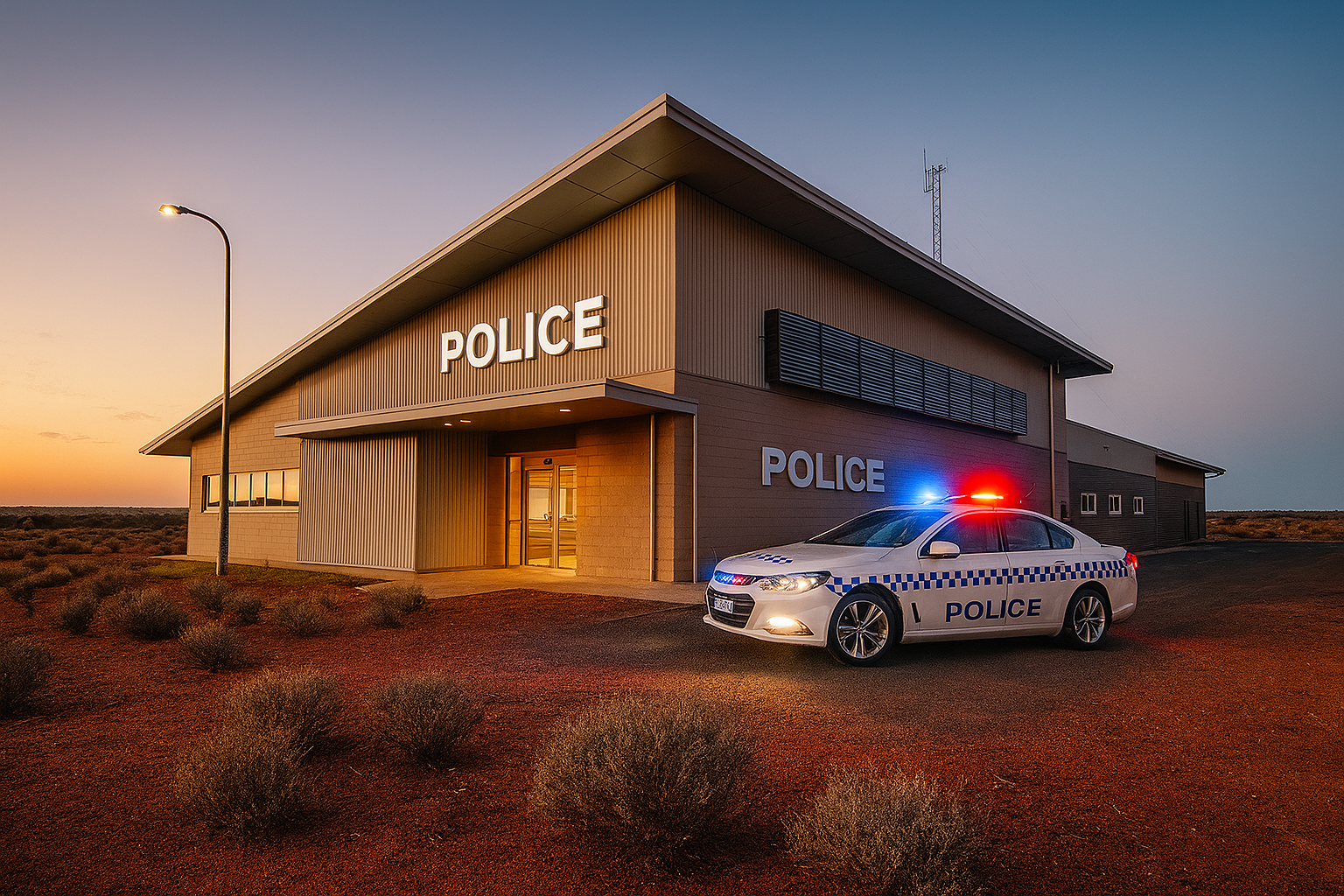
The Barrier Police District represents one of the New South Wales Police Force's most challenging commands—a vast jurisdiction spanning the arid expanses of far western New South Wales where distance is measured in days and isolation breeds its own particular pathologies. Established informally in 1884 to manage the chaos of Charles Rasp's silver rush, the district formalised in 1888 as Broken Hill transformed from tent city to industrial powerhouse. Across nearly one hundred and forty years, the district's officers have adapted to extraordinary demands: quelling violent mining disputes, safeguarding wartime resources, navigating complex relationships with displaced Aboriginal communities, and pursuing investigations across landscapes that swallow the unprepared without mercy. The Silverton Strangler case of 1988—two women murdered, no arrest, no conviction—remains the district's most haunting failure, a wound that time has not healed and that continues to shape its institutional culture to this day.
Origins and the Silver Rush (1884–1900)
Before the Barrier Police District existed as a formal entity, the land that would become its jurisdiction knew law only as an abstract concept whispered by men who had fled it. The far western reaches of New South Wales in the early 1880s constituted a lawless expanse where pastoralists enforced their own codes, Aboriginal communities navigated the violent encroachment of European settlement, and the occasional mounted trooper passed through on circuits that might span months between visits.
Everything changed on 5 September 1883, when boundary rider Charles Rasp pegged his claim on a rocky outcropping that would prove to be one of the world's richest deposits of silver, lead, and zinc. Within months, prospectors and fortune-seekers descended upon the site in numbers that overwhelmed any pretence of order. The tent city that sprouted around the Line of Lode operated by its own brutal logic: disputes settled by fists or firearms, property rights enforced through intimidation, and the vulnerable—particularly women, children, and Aboriginal people—left to whatever protection they could find for themselves.
The Colonial Secretary's office in Sydney, confronted with alarming reports of violence and lawlessness, dispatched Sergeant Thomas Brennan and two constables to establish police presence in early 1884. Their arrival on 17 March of that year marks the unofficial beginning of what would become the Barrier Police District, though formal designation would wait another four years. Brennan, a veteran of the gold rush chaos at Hill End and Gulgong, understood immediately that conventional policing methods would prove inadequate. The nearest substantial reinforcement lay in Wilcannia, over two hundred kilometres distant. Communication required days rather than hours. And the population he was meant to control already numbered in the thousands, with more arriving weekly.
The first police "station" consisted of a canvas tent pitched on what would become Argent Street, its authority symbolised by nothing more than a handwritten notice and the revolvers on the officers' belts. Brennan's approach combined pragmatism with selective enforcement: serious crimes—murder, major theft, violence against women—received immediate attention, whilst the petty disputes and minor infractions that constituted daily life in the mining camps were largely left to sort themselves. This triage mentality, born of necessity, would characterise the district's operations for decades to come.
The formal establishment of the Barrier Police District in 1888 coincided with Broken Hill's transition from chaotic mining camp to structured township. The population had stabilised somewhat, permanent buildings were replacing tents, and the Broken Hill Proprietary Company had emerged as the dominant commercial force. The new district's boundaries encompassed an area larger than many European nations—from the South Australian border in the west to the pastoral runs beyond Menindee in the east, from the Queensland boundary in the north to the Mundi Mundi Plains stretching southward into seemingly infinite red expanse.
A permanent police station, constructed of local stone and brick, opened at 357 Argent Street in 1892. The building's clock tower, added in 1895, became a landmark visible from much of the town—a deliberate symbol of ordered time in a place where the desert's rhythms had previously governed all activity. Senior Sergeant William McPherson, appointed as the district's first formal commander, oversaw a complement of twelve officers responsible for a jurisdiction that would have required fifty to patrol adequately.
The challenges of these early years shaped institutional practices that persisted for generations. Officers learned to ride for days across featureless landscape, navigating by sun and stars. They developed relationships with station owners and publicans who served as informal intelligence networks, reporting unusual activities or strangers whose presence might indicate trouble. They confronted the particular lawlessness of mining towns: claim-jumping disputes that erupted into violence, sly-grog operations that poisoned their customers, gambling dens where fortunes changed hands and sometimes so did lives.
Most controversially, early district officers participated in the broader colonial project of Aboriginal dispossession. The Wilyakali, Barkindji, and Ngiyampaa peoples whose traditional lands encompassed the district's jurisdiction found themselves subjected to policies ranging from forced relocation to punitive expeditions. Records from this period, where they survive, document a troubling legacy that subsequent generations would struggle to address: arrests for "vagrancy" that served to clear Aboriginal camps from valuable land, "protective custody" that separated families, and violent confrontations that went uninvestigated when the victims were Indigenous.
Industrial Tensions and the Great War (1900–1920)
The twentieth century's arrival brought new challenges that tested the district's capacity for adaptation. Broken Hill's mining workforce, increasingly organised through powerful unions, viewed police with suspicion born of bitter experience. Officers found themselves positioned between corporate interests demanding protection of property and workers demanding recognition of rights, a tension that would explode repeatedly over the following decades.
The 1892 miners' strike had established patterns of confrontation that intensified as the labour movement strengthened. District officers were regularly deployed to protect scab labour, escort managers through picket lines, and arrest union organisers under legislation that criminalised industrial action. Inspector Arthur Williamson, commanding the district from 1903 to 1911, walked this tightrope with considerable political skill, maintaining relationships with both company officials and union leaders whilst enforcing laws he privately considered unjust. His personal papers, donated to the Broken Hill Historical Society after his death, reveal a man deeply conflicted about his role in suppressing legitimate worker grievances.
The 1909 lockout tested these conflicts to breaking point. When the Broken Hill Proprietary Company closed its mines rather than negotiate with the Amalgamated Miners' Association, the district found itself managing a civilian population sliding toward starvation. Officers distributed emergency rations, mediated disputes between locked-out families and landlords demanding rent, and attempted to prevent the violence that desperation breeds. Constable Harold Jenkins' personal diary from this period documents scenes of "women weeping for bread whilst we had none to give" and children "so thin their ribs showed through tattered shirts." The experience radicalised several young officers, at least two of whom later resigned to join the labour movement they had previously policed.
The outbreak of war in 1914 transformed the district's responsibilities dramatically. Broken Hill's mineral wealth—lead and zinc essential for munitions—made it strategically vital. Officers suddenly found themselves guarding mines and processing facilities against sabotage, monitoring the large German and Austrian immigrant population for signs of disloyalty, and enforcing regulations that treated longtime residents as enemy aliens based solely on their birthplaces.
The Battle of Broken Hill on 1 January 1915 shattered any remaining sense that the war was a distant concern. When two men—Gool Mahomed and Mullah Abdullah, both claiming allegiance to the Ottoman Empire—opened fire on a picnic train near the Silverton tramline, killing four civilians and wounding seven others, the district confronted terrorism decades before the term entered common usage. The response, coordinated by Senior Sergeant James Sullivan with support from military personnel stationed in town, resulted in both attackers being killed. But the aftermath revealed troubling tendencies: reprisal attacks against innocent members of the Muslim and Afghan communities, summary detention of individuals based on ethnic appearance, and a climate of suspicion that lingered for years.
The war years also brought increased responsibility for the district's vast pastoral hinterland. With young men departing for military service, stations operated with skeleton crews, creating opportunities for cattle duffing and property crime that stretched police resources impossibly thin. Officers conducted circuits lasting weeks, travelling by horse and later by early motor vehicles whose unreliability in outback conditions became legendary. Constable Leonard Glasson—father of the future Detective Inspector Barry Glasson—joined the force in 1937 but heard stories from veterans of these circuits: nights spent beneath stars with only a horse for company, confrontations with desperate men hundreds of kilometres from backup, the particular loneliness of enforcing law in landscapes that seemed to mock human pretensions to order.
Depression, War, and Modernisation (1920–1970)
The interwar period brought both consolidation and crisis to the Barrier Police District. The 1920s saw gradual professionalisation: standardised training requirements, improved communications through telephone and radio, motor vehicles that shrank (somewhat) the vast distances officers patrolled. Senior Sergeant Marcus Webb, commanding from 1923 to 1934, implemented reforms that his predecessors had only imagined: regular shift rotations, formal evidence-handling procedures, and documentation requirements that created the archival records future investigators would depend upon.
The Great Depression struck Broken Hill with particular severity. As metal prices collapsed, mines closed or reduced operations, throwing thousands out of work. The district's officers, many of whom came from the same working-class families now facing destitution, found themselves enforcing eviction orders and managing bread lines. Constable William O'Brien's resignation letter from 1932 captured the moral tension: "I did not join the Force to turn children from their homes whilst their fathers search for work that does not exist."
Yet crime statistics from this period reveal surprising patterns. Major property crime decreased as communities developed mutual support networks; petty theft increased as desperation mounted. Domestic violence escalated—a predictable consequence of economic stress and cramped living conditions—though reporting remained sporadic given prevailing attitudes toward family privacy. The district established its first dedicated domestic violence response in 1935, a single female constable whose role was to interview victims in settings less intimidating than the station's front desk. Constable Edith Marjorie Thornton served in this capacity until 1942, documenting patterns of abuse that official statistics would not acknowledge for decades.
World War II renewed the strategic significance that had marked the previous conflict. Mining operations intensified to meet military demand, whilst security concerns prompted enhanced surveillance of the district's diverse population. German and Italian residents faced restrictions and suspicion, though the community's response proved more measured than in 1915—hard lessons, perhaps, having been learned. The district coordinated with military intelligence to monitor potential sabotage threats, though no significant incidents occurred.
Post-war modernisation accelerated changes that had been building for decades. Radio communication, initially limited to the Broken Hill station, expanded to include patrol vehicles and remote posts. Forensic capabilities improved through collaboration with Adelaide laboratories, though the tyranny of distance meant that evidence often degraded during the days required for transport. Officer training incorporated developments in interview technique, crime scene management, and investigative methodology, gradually replacing the intuitive approach that had characterised earlier generations.
The district's relationship with Aboriginal communities entered a new phase as assimilationist policies gave way, slowly and unevenly, to recognition of Indigenous rights. Officers who had enforced child removal and vagrancy laws found themselves, by the 1960s, working alongside Aboriginal liaison officers and navigating land rights claims that challenged the legal foundations of pastoral leases throughout the district. The transition was neither smooth nor complete; racist attitudes persisted within the force, and Aboriginal people remained drastically overrepresented in arrest and incarceration statistics. But the seeds of reconciliation, however tentatively, were being planted.
The Modern Era and the Silverton Strangler (1970–2000)
The 1970s brought technological and social transformations that reshaped policing throughout New South Wales, with particular implications for remote districts like the Barrier. Computer systems, initially centralised in Sydney, gradually extended to regional commands, enabling record-keeping and information-sharing that previous generations could only have imagined. Vehicle fleets modernised, communications infrastructure improved, and training programmes incorporated advances in forensic science, psychology, and management theory.
Yet these improvements could not prevent the tragedy that would define the district for decades to come.
The Silverton Strangler case began on 13 September 1988, when Sally Louise Harlow failed to return to the Silverton Hotel where she had been staying whilst conducting historical research. The thirty-one-year-old historian from Newcastle had spent weeks investigating patterns of unexplained disappearances in the region—research that would prove grimly prescient. Her belongings were discovered on 17 September near an abandoned mining shack; her body was found on 22 September, strangled and posed with theatrical deliberation in bushland northwest of Silverton.
Detective Sergeant Barry Glasson led the investigation with an intensity that colleagues found both admirable and alarming. The son of a district officer and himself a veteran of nineteen years' service, Glasson brought deep local knowledge and methodical investigative technique to a case that would ultimately defeat both. The absence of forensic evidence—no fingerprints, no fibres, no witnesses—created a void that theories could not fill. Glasson pursued leads across three states, interviewed hundreds of potential witnesses, and constructed elaborate timelines that mapped Sally Harlow's final days in minute detail. None of it produced a viable suspect.
When sixteen-year-old Violet Dallow vanished from a Girl Guides camp near Silverton on the night of 30 September, the investigation acquired personal dimensions that tested Glasson's professional detachment. Violet was his daughter Mandy's closest friend, a girl he had known since childhood. Her body, discovered on 5 October, bore the same signature as Sally Harlow's murder: strangulation, careful positioning, minimal physical evidence. The Silverton Strangler—a media appellation the district despised but could not escape—had claimed a second victim.
The investigation consumed resources on a scale unprecedented in the district's history. Officers worked double shifts for months. Specialists from Sydney supplemented local personnel. Interstate agencies shared information about similar cases. Yet the killer remained phantom-like, leaving traces so minimal that forensic analysis produced nothing actionable. By 1990, the active investigation had effectively stalled, though the case remained officially open.
The professional and personal toll defied easy measurement. Glasson's marriage fractured under the strain, temporarily separating before reconciliation. Several junior officers requested transfers, unable to continue working cases that reminded them daily of failure. The community's trust in police protection—always complicated in a town where memory stretched long—eroded further as months became years without resolution.
A cold case review in 1995, led by Detective Inspector William Thornton from Sydney, acknowledged the investigation's thoroughness whilst criticising what he termed "tunnel vision" and "excessive emotional investment." The review recommended reassignment of the case, though Glasson remained nominally involved until his promotion to Senior Sergeant removed him from direct investigative duties. The Silverton Strangler file, by then occupying an entire shelf in the station's archives, continued to grow—but primarily through periodic updates confirming the absence of new leads.
Contemporary Challenges (2000–Present)
The twenty-first century has brought both continuity and change to the Barrier Police District. The challenges that defined earlier eras—vast distances, sparse population, limited resources—persist in modified form. Officers still patrol landscapes where mobile phone coverage remains sporadic and backup may be hours distant. They still navigate complex relationships between mining interests, environmental concerns, and community wellbeing. They still confront the particular pathologies that isolation breeds: domestic violence rates that exceed metropolitan averages, substance abuse that offers escape from limited horizons, youth suicide that claims too many promising lives.
Yet the tools available have transformed dramatically. DNA analysis, unknown when Sally Harlow died, now offers hope for cold cases that seemed permanently frozen. Digital forensics can extract evidence from devices that earlier investigators could not have imagined. Interstate and international databases enable pattern recognition across jurisdictions that once operated in isolation. The district's officers, trained in technologies their predecessors would find miraculous, bring capabilities to investigations that might finally unlock mysteries decades old.
Inspector Barry Glasson retired on 30 November 2011, his forty-four-year career culminating in a ceremony that drew hundreds of colleagues, community members, and former officers. His speech avoided mention of unsolved cases, focusing instead on partnerships and progress. Yet everyone present understood what remained unspoken: the Silverton Strangler had escaped justice, and likely would continue to escape as witnesses died and memories faded.
The murder of Naomi Simmons on 13 January 2023 reopened wounds that time had not healed. Found amongst the sculptural installations near Silverton, her death bore similarities to the 1988 cases that investigators could not ignore. Detective Inspector Jeremy Harding, leading the investigation, consulted extensively with retired officers including Glasson, seeking institutional memory that formal records could not capture. Senior Constable Brock Polden, assigned to the district's cold case review unit, began systematic re-examination of the Harlow and Dallow files using modern forensic techniques.
The investigations continue as of this writing, their outcomes uncertain but their implications profound. If DNA or other evidence can finally link the 1988 murders to an identifiable perpetrator—whether still living or long deceased—the district will have achieved a closure that eluded Glasson's generation. If the Silverton Strangler proves to be the same individual responsible for Naomi Simmons' death, the implications extend further still: a killer operating across decades, patient and methodical, claiming lives in the red country that has always kept its secrets close.
The Barrier Police District endures as it has for nearly one hundred and forty years: adapting to challenges its founders could not have anticipated, maintaining order in landscapes that resist human pretensions to control, and pursuing justice even when justice seems impossibly distant. The red brick station on Argent Street—expanded and modernised but still recognisable from nineteenth-century photographs—continues to anchor the district's operations. The clock tower still marks ordered time against the desert's indifferent rhythms. And the officers who serve there still carry the accumulated weight of their predecessors' triumphs and failures, knowing that some cases close and others simply wait, patient as the country itself, for answers that may never come.







