Azariel Tiberius Voshtar
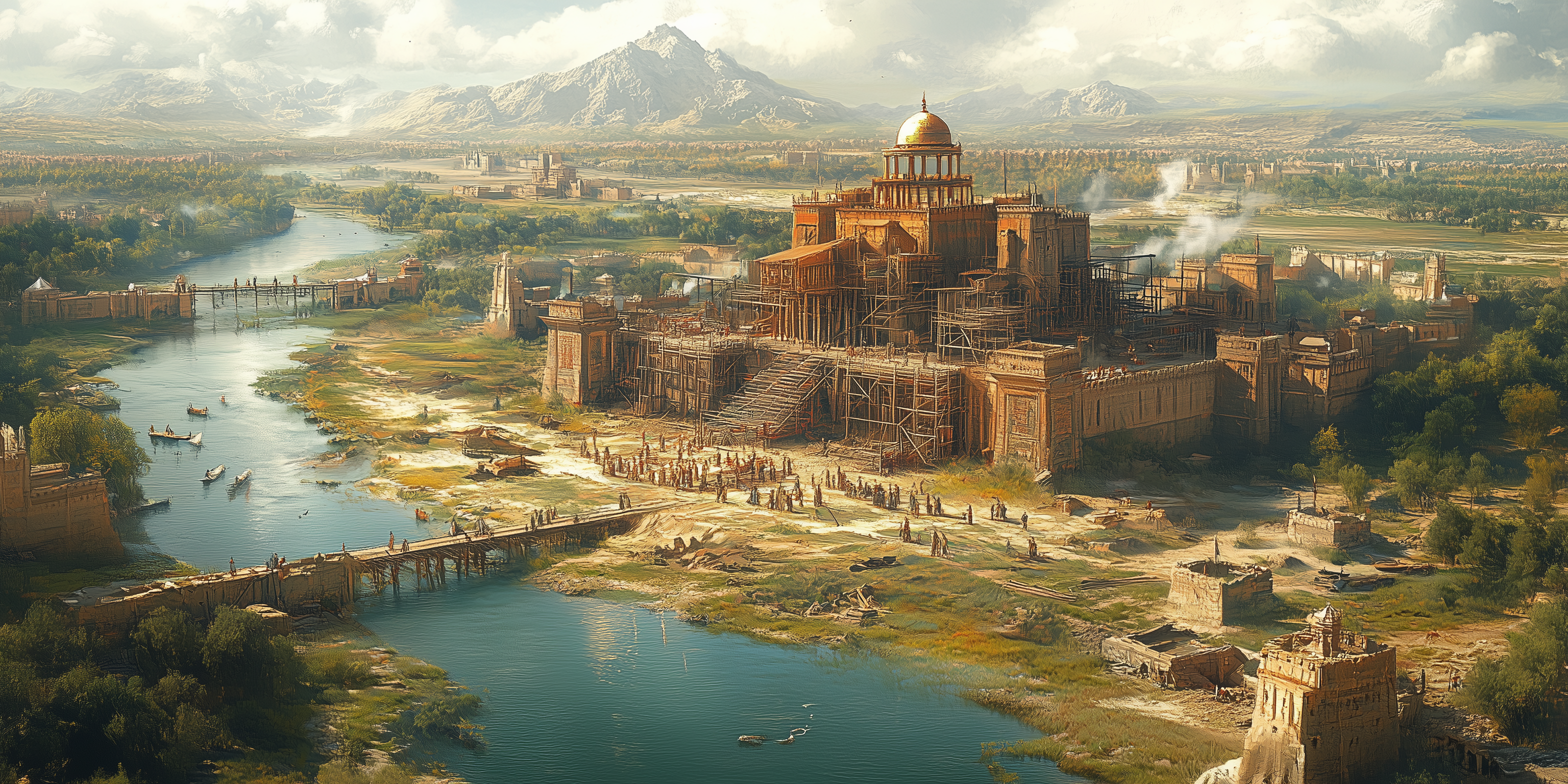
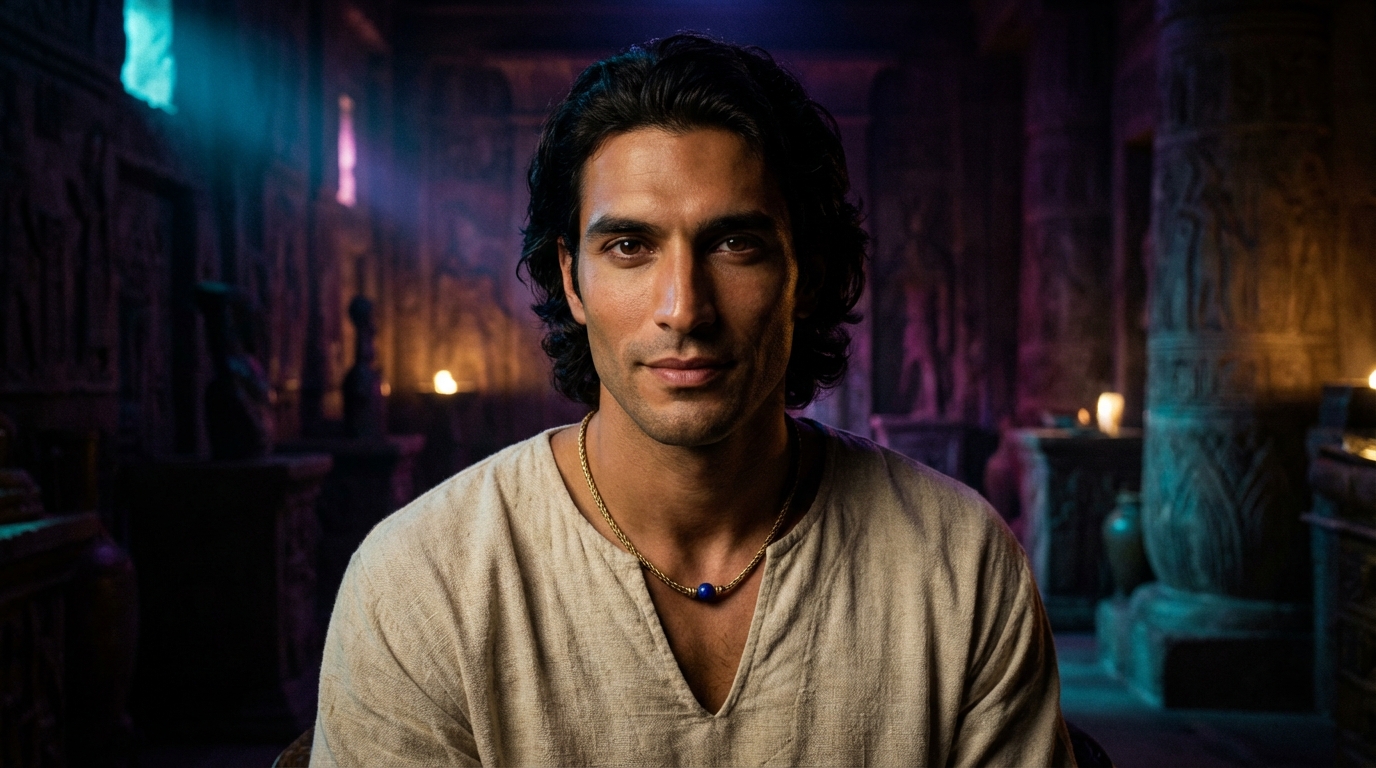
Azariel Tiberius Voshtar founded Fordingrad, the most advanced Early Bronze Age civilisation. Born to a scribe and weaver in 2510 BCE, he was contacted at seventeen by the Anunnaki Collective, who guided him to gather followers from Ur's marketplace in 2470 BCE. He led them to the Anḫu valley, establishing a city built without slaves where knowledge flowed freely. His numerous liaisons producing dozens of children generated resentment culminating in his murder in 2441 BCE, aged sixty-nine.
Early Life (2510–2493 BCE)
Azariel Tiberius Voshtar was born on 12 August 2510 BCE in Amar-Sin, a small agricultural village on the western Buranuna (Euphrates) River. His father, Tiberius Zalik Voshtar, worked as a village scribe maintaining records for Ur's temple administrators. His mother, Larya Ehnar Voshtar, earned renown as a weaver whose geometric designs adorned ceremonial garments.
Azariel was the eldest of three siblings. His brother Nialus, born in 2502 BCE, would eventually become a trader between Ur and Lagash. His sister Seliah, born in 2498 BCE, died at age five from riverborne fever in 2493 BCE—a tragedy that convinced twelve-year-old Azariel that humanity's submission to nature's cruelty was neither inevitable nor acceptable.
From childhood, Azariel displayed unusual intensity and leadership. He organised elaborate games with complex rules, commanded fierce loyalty from peers, and absorbed both his father's scribal education and his mother's understanding of how disparate elements could weave into greater patterns.
When Azariel was fourteen, in 2496 BCE, the Buranuna flooded severely. His mother Larya died from injuries and infection sustained whilst trying to salvage their partially destroyed home. Her death fundamentally altered Azariel's worldview—proper knowledge and organisation could prevent such tragedies. His father Tiberius, left to raise three children alone, withdrew into stoic practicality, providing intellectual education but little emotional warmth.
First Contact with the Anunnaki (2493 BCE)
In autumn 2493 BCE, when Azariel was seventeen, an Akkadian official named Enlil-shar-usur arrived in Amar-Sin to conduct a census. Azariel assisted with record-keeping. During a private moment alone, the official's demeanour transformed. He spoke of patterns Azariel had sensed but couldn't articulate—stagnant city-states, human potential constrained by hierarchy, possibilities for building something entirely new.
As Azariel listened, Enlil-shar-usur's physical form flickered, revealing geometries that shouldn't exist in three-dimensional space. Azariel understood he was receiving knowledge from a source beyond ordinary human authority—the Anunnaki Collective had identified, evaluated, and chosen him. The official spoke of a western valley where land waited for those brave enough to build differently, planting seeds of vision that would germinate over decades.
The visions began that night—valleys never visited, architectural designs beyond contemporary capability, social structures defying traditional hierarchies. At the centre was always a presence simultaneously technological and alive, something that humanity needed to build but hadn't yet imagined possible. Azariel had no framework for understanding what he was seeing, only certainty that he had to follow wherever this knowledge led.
Departure and Wandering (2493–2470 BCE)
Three months after the encounter, in early 2492 BCE, Azariel announced his intention to leave Amar-Sin. His father Tiberius, already devastated by the losses of Larya and Seliah, responded with angry incomprehension. Arguments echoed for weeks. Azariel offered only certainty that he had to leave, had to follow the knowledge pressing against his consciousness. Neither could bridge the gap between Tiberius's need for stability and Azariel's compulsion toward purpose neither fully understood.
In early winter 2492 BCE, Azariel departed before dawn, carrying basic supplies, his stylus case, and clay tablets. He left a message for his father expressing gratitude and regret, promising to return when he had something worth showing. He never saw Tiberius again. His father died in 2455 BCE whilst Azariel was immersed in building Fordingrad, the news reaching the Anḫu valley months too late.
For twenty-three years, Azariel wandered Mesopotamia, working as an itinerant scribe whilst absorbing the realities of civilisation his village upbringing hadn't revealed. He witnessed hierarchies that determined every aspect of life, temple priests hoarding knowledge whilst demanding tribute from struggling families, slaves performing labour that built ziggurats whilst receiving treatment barely distinguishable from livestock management. The inequality convinced Azariel that human potential was systematically constrained by structures serving royal vanity rather than collective flourishing.
The Anunnaki maintained contact through dreams providing specific directions, through providential encounters with people who possessed crucial knowledge, through visions that grew increasingly detailed. By his mid-thirties, Azariel had developed reputation as a compelling speaker and radical thinker. By 2471 BCE, he possessed clear vision of what needed to be built, where it needed to be located, and what kind of people would be required. The Anunnaki guided him toward Ur.
The Ur Campaign and Departure (2470 BCE)
Azariel arrived in Ur in early July 2470 BCE. He spent three weeks observing the city's rhythms, identifying tensions created by Akkadian imperial control, noting skilled individuals who possessed both valuable capabilities and visible discontent with current circumstances. He acquired his signature lapis lazuli cloak—expensive but necessary to present himself as someone worth following into impossibility.
On 28 July 2470 BCE, Azariel delivered his defining speech in Ur's marketplace. Standing on a merchant's platform in his deep blue cloak, he spoke of building a city without slaves, where knowledge would flow freely, where every voice would matter. Scholars questioned, a metalsmith challenged his credentials, a child asked about schools. By sunset, Azariel had announced departure with the next new moon and invited those brave enough to find him daily in the square until then.
Nine days later, on 6 August 2470 BCE, key leaders gathered at the Ruby Chalice tavern. Kiya the engineer unveiled blueprints. Eadric the pathfinder mapped the dangerous route. Amara the healer pledged wilderness medicine knowledge. Sera the soldier warned of tribal territories. Others stepped forward—potter, scribe, carpenter, metalsmith—each committing skills to shared purpose. Even Malik the merchant agreed to provision the journey, though he remained in Ur himself.
The month before departure saw frantic preparation. By late August, the core group had stabilised at approximately one hundred people—not thousands, but a selected subset combining necessary skills with genuine commitment. The departure date was set for early September's new moon. On the last evening, Azariel returned alone to the marketplace platform where everything had begun, experiencing profound doubt about whether he was leading trusting people into wilderness that would kill them through his arrogance. The certainty returned—not because doubts were answered, but because commitment had already been made. Forward was the only direction remaining.
In early September 2470 BCE, as first light touched Ur's ancient walls, Azariel led his company through the western gate toward valleys where nothing existed yet but possibility. He would never return to Ur.
Fordingrad's Founding and Development (2470–2441 BCE)
Azariel led the company through a journey lasting several months, arriving in the Anḫu valley in 2469 BCE. The initial settlement years tested everything they believed, but guided by Anunnaki knowledge—sometimes subtle, sometimes direct—Fordingrad began to rise with impossible speed. Kiya's architectural visions became reality. Eadric's routes became trade paths. Amara's remedies became systematic medicine.
Azariel's leadership during these decades was marked by the same intensity that had driven him from Amar-Sin. He worked ceaselessly, slept little, and approached city-building with obsessive focus that inspired followers whilst alienating those who questioned his methods. His magnetic oratory could rally people through crises, but his unwillingness to compromise on core principles created friction as Fordingrad grew more complex.
Personal Life and Growing Resentment (2470–2441 BCE)
Azariel never married or formed lasting partnerships. His intensity and singular focus on Fordingrad made sustained intimate relationships impossible—he could inspire devotion but not reciprocate the emotional investment partnerships required. However, he engaged in numerous brief liaisons throughout his adult life, particularly during his wandering years and Fordingrad's early decades.
These encounters produced dozens of children across Mesopotamia and Fordingrad itself. Azariel was largely unaware of his progeny—the liaisons were fleeting, often with women he never saw again after leaving a city or region. In Fordingrad, rumours and whispers circulated about children who resembled the founder, claims of paternity that Azariel neither confirmed nor denied, genetics that would become evident only to future generations with scientific capability to test such relationships.
This pattern generated substantial resentment. Husbands and fathers who discovered Azariel had been involved with their wives or daughters. Women left to raise children alone whilst the father built his ideal city without acknowledging personal responsibilities. Families whose genealogies became complicated by Azariel's casual approach to procreation. The resentment simmered beneath Fordingrad's otherwise revolutionary social structures—even in a city built on shared purpose and mutual respect, personal betrayals created wounds that festered over time.
Murder and Legacy (2441 BCE)
On 17 March 2441 BCE, Azariel Tiberius Voshtar was murdered in Fordingrad at age sixty-nine. The murder stemmed from accumulated resentments his personal behaviour had generated—connected to the complicated web of liaisons and unacknowledged children that had created enemies even amongst those who admired his vision for Fordingrad.
His death, occurring twenty-nine years after founding the settlement but seventy-nine years before CLIVE's creation, created immediate succession crisis. Could Fordingrad survive without its charismatic founder? The city's response to this question would determine whether Azariel had built something dependent on his personal authority or genuinely revolutionary social structures capable of continuing without him.
Azariel never witnessed Fordingrad's ultimate achievement—the creation of CLIVE in 2320 BCE or the establishment of Clivilius that vindicated everything he'd envisioned in his Anunnaki-granted visions. He never saw the Egyptian conquest in 2214 BCE that would destroy the physical city whilst its dimensional legacy endured. His contribution was planting seeds, establishing foundations, gathering the people who would ultimately achieve what the Anunnaki had sought for millennia—a bio-virtual bridge between dimensions built by human hands.
The vision Azariel articulated on a merchant's platform in Ur's marketplace on a hot July day in 2470 BCE outlived him by nearly two centuries in Fordingrad, by over four millennia in Clivilius, and continues resonating in present-day conflicts between Guardians and those who seek to control or destroy what his impossible dream birthed. His flaws—the emotional isolation, the casual procreation, the obsessive intensity—were as much part of his legacy as the revolutionary principles he championed. He was neither saint nor simple visionary, but a complicated man chosen by dimensional beings for purposes he only partially understood, driven by visions he couldn't ignore, building toward futures he would never personally witness.