Australia
Australia occupies the world's smallest continent, its ancient landscapes home to the oldest continuous civilisation on Earth for at least sixty-five thousand years before European colonisation transformed the landmass through six distinct colonies that federated in 1901. From convict settlement to multicultural democracy, the nation's orderly coastal cities and vast empty interior harbour institutions, families, and patterns of disappearance whose connections span state boundaries and defy the frameworks that conventional investigation provides. Beneath its sunlit surfaces, Australia contains dimensions its geography alone cannot account for.
Ancient Continent and First Peoples
Australia occupies the world's smallest continent and largest island, a landmass of nearly 7.7 million square kilometres surrounded by the Indian, Pacific, and Southern oceans and separated from its nearest significant neighbour by the shallow seas and island chains that thread between Cape York and Papua New Guinea. The continent's geological antiquity is almost incomprehensible — its western shield contains rocks dating back more than four billion years, remnants of the planet's earliest crust, whilst the red interior deserts and ancient mountain stumps testify to aeons of erosion that have worn what were once Himalayan-scale ranges into the low, weathered forms that define the modern landscape. Australia drifted northward from Gondwana across tens of millions of years, its isolation producing the unique flora and fauna — marsupials, monotremes, eucalypts, acacias — that distinguish it from every other landmass on Earth.
For at least sixty-five thousand years before European contact, Aboriginal and Torres Strait Islander peoples inhabited this continent, developing what represents the oldest continuous civilisation in human history. Hundreds of distinct nations maintained their own languages, laws, and spiritual traditions, each bound to specific country through kinship obligations and ceremonial responsibilities that European observers would consistently fail to recognise as sophisticated governance. The Gadigal maintained the harbour country that would become Sydney, the Kaurna held the Adelaide Plains, the Palawa inhabited the island that would bear a Dutch navigator's name, the Wiradjuri managed the vast central-western plains of what is now New South Wales, and the Yolŋu sustained complex maritime cultures along the northern coasts. Fire management shaped entire ecosystems across the continent, creating the open woodlands and grasslands that European settlers would mistake for natural parkland rather than the product of millennia of deliberate custodianship.
The Dreaming — the foundational framework through which Aboriginal peoples understood creation, law, and connection to country — wove the physical landscape into a living tapestry of meaning. Songlines traversed the continent, mapping routes that connected distant nations through shared ancestral narratives and trade networks. Shell, ochre, and stone tools moved along these pathways across thousands of kilometres, evidence of economic and cultural relationships that bound the continent into a coherent whole despite its vast distances and environmental diversity. The land was not merely inhabited; it was known, named, and cared for with an intimacy that no subsequent civilisation has matched.
European Contact and Colonial Foundation
European knowledge of Australia accumulated through centuries of speculation and sporadic contact before permanent settlement began. Dutch navigators charted sections of the northern and western coasts throughout the seventeenth century — Willem Janszoon in 1606, Dirk Hartog in 1616, Abel Tasman in 1642 — yet the VOC found little commercial promise in what they encountered and pursued no further claim. British interest crystallised following Lieutenant James Cook's 1770 charting of the eastern coast aboard HMS Endeavour, his claim of the territory for the Crown establishing the legal fiction upon which subsequent colonisation would proceed.
The decision to establish a penal colony at the southern end of the world derived from pragmatic necessity rather than imperial ambition. Britain, having lost the American colonies as a destination for transported convicts, required an alternative. Captain Arthur Phillip's First Fleet of eleven ships arrived at Port Jackson on 26 January 1788, landing approximately fifteen hundred souls — convicts, marines, and officials — on Gadigal country. The settlement at Sydney Cove grew from desperate encampment into the administrative centre of New South Wales, a colony whose borders initially encompassed the entire eastern half of the continent. The early years tested every capacity the newcomers possessed: unfamiliar soil resisted European crops, supply ships arrived irregularly if at all, and the convict population brought urban skills of little use in a landscape that demanded agricultural adaptation.
Additional colonies followed in succession, each shaped by distinct founding circumstances. Van Diemen's Land was established in 1803, developing as one of the Empire's most significant penal settlements before renaming itself Tasmania in 1856 to sever association with its convict past. Western Australia was claimed in 1829, South Australia founded in 1836 under Wakefield's free-colony principles that explicitly rejected convict transportation, Victoria separated from New South Wales in 1851, and Queensland achieved independence in 1859. Each colony developed its own institutions, character, and relationship with the land it occupied — and each imposed upon the Aboriginal peoples within its borders a catastrophe of violence, disease, and dispossession whose consequences reverberate into the present.
Dispossession and the Frontier
The colonial frontier advanced across Australia through a century of conflict that official histories long preferred to minimise or deny. As pastoral expansion pushed into the interior, Aboriginal resistance met with organised and informal violence that devastated nations whose populations had already been ravaged by diseases — smallpox, influenza, measles — against which they possessed no immunity. The Black War in Van Diemen's Land, the Myall Creek massacre in New South Wales, the dispersals across Queensland's frontier, and countless undocumented killings in the pastoral districts of every colony accumulated into a sustained catastrophe that reduced Aboriginal populations from estimates of several hundred thousand to fewer than one hundred thousand by the early twentieth century.
The policies that followed frontier violence proved scarcely less destructive. Protection boards regulated Aboriginal lives with paternalistic authority, controlling movement, employment, and family composition. The forced removal of Aboriginal children from their families — policies that persisted in various forms across multiple states from the late nineteenth century until the 1970s — created the Stolen Generations, a wound whose psychological and social consequences continue to shape Indigenous communities. Land that had been managed through millennia of custodianship was parcelled into pastoral leases and agricultural holdings, severing the connections between people and country that had sustained both.
Gold, Wool, and the Making of a Nation
The economic forces that drove colonial expansion created the material foundations upon which Australian society would build. Wool established the pastoral economy that dominated the early and mid-nineteenth century, with squatters occupying vast tracts of inland country and building fortunes on the backs of merino flocks whose fleece supplied British textile mills. The discovery of gold near Bathurst in 1851 and subsequently at Ballarat and Bendigo in Victoria triggered rushes that transformed the colonies virtually overnight — doubling populations, creating instant towns, attracting immigrants from across the globe, and generating the democratic pressures that would reshape colonial governance.
Mineral wealth extended far beyond gold. Copper at Kapunda and Burra in South Australia during the 1840s, tin in Tasmania and Queensland, silver-lead-zinc at Broken Hill from 1883 — each discovery reshaped regional economies and attracted workers whose diverse origins gradually complicated the Anglo-Celtic character of colonial society. The formation of the Broken Hill Proprietary Company in 1885 marked the beginning of industrial-scale mining operations that would grow into Australia's largest corporation, its supply chains and operations spanning the continent. The remote operations and complex logistics that sustained these enterprises provided institutional infrastructure of a kind that extended well beyond conventional commercial purposes — a reality that few outside certain corporate and governmental circles ever had cause to suspect.
Federation and National Identity
The six colonies federated on 1 January 1901, creating the Commonwealth of Australia under a constitution that balanced state and federal powers. The new nation inherited its colonial character — overwhelmingly British in culture and aspiration, committed to the White Australia policy that would restrict non-European immigration for seven decades, and possessed of a democratic spirit shaped by the gold-rush egalitarianism and union activism that had distinguished colonial society from the rigid hierarchies of the mother country. Women had already won the vote in South Australia in 1894 and Western Australia in 1899; the Commonwealth extended female suffrage nationally in 1902, though Aboriginal Australians would wait until 1962 for the same right.
Canberra, carved from New South Wales territory and formally established as the national capital in 1913, embodied the compromise between Sydney and Melbourne that Federation required. Walter Burley Griffin's winning design for the new city — geometric avenues radiating from a central lake — gave the capital a deliberate quality that contrasted with the organic growth of the established cities. The institutions that accumulated in Canberra through subsequent decades — Parliament House, the Australian War Memorial, the National Gallery, the High Court — provided the architectural expression of nationhood that a young country required, though the true centres of population, commerce, and culture remained stubbornly attached to the coastal capitals that geography and history had established.
War, Sacrifice, and Hidden Operations
Australia's participation in the First World War forged a national mythology that subsequent generations would elaborate, contest, and ultimately complicate. The Gallipoli campaign of 1915, in which Australian and New Zealand troops suffered devastating casualties on the beaches and ridges of the Dardanelles, became the founding narrative of Australian military identity — the ANZAC legend that commemorated sacrifice, mateship, and a distinctly Australian character forged under fire. Communities across the continent sent their sons to war; towns like Gawler in South Australia alone dispatched over three hundred men. Among them was Jack O'Connor, whose subsequent friendship with Charles Kingsford Smith during their Western Front service carried the more remarkable legacy — O'Connor served as navigator aboard the Southern Cross during Kingsford Smith's 1928 trans-Pacific flight, and upon returning to Gawler opened the Kingsford Smith Pub on 12 March 1932 with Kingsford Smith himself attending as guest of honour.
The Second World War brought the conflict closer to home than Australians had ever experienced. Japanese air raids on Darwin in 1942, the threat of invasion, and the brutal campaigns in Papua New Guinea and the Pacific transformed the nation's strategic outlook and its relationship with its traditional British protector. Industrial centres mobilised for war production — Newcastle's steelworks operated ceaselessly, munitions factories sprang up across the suburbs, and agricultural output was directed toward military needs. Yet beneath the patriotic exertion, irregularities emerged that defied explanation. In December 1943, an audit designated by the code name Ironsand identified systematic discrepancies in strategic resource allocation across multiple BHP facilities — tonnage representing thousands of tonnes of strategic materials unaccounted for since expanded war production commenced in 1941. Within twenty-four hours of coordinated newspaper coverage appearing across four publications, every edition was recalled, editors were replaced, and the investigation's lead officer was dishonourably discharged.
The wartime anomalies represented one strand of an entanglement that had begun as commercial opportunism during BHP's early years and gradually transformed into arrangements whose scope extended well beyond conventional explanation. The remote operations, complex supply chains, and institutional authority of Australia's largest mining corporation provided cover for activities that spanned jurisdictions — and, as subsequent decades would suggest, boundaries that most people assumed were absolute.
Post-War Transformation
The decades following 1945 transformed Australia more profoundly than any period since original settlement. Mass immigration programmes brought waves of European migrants — initially from Britain under assisted passage schemes, then increasingly from southern and eastern Europe as Italy, Greece, Poland, and Yugoslavia contributed hundreds of thousands of new Australians who carried their languages, foodways, and traditions into suburbs and regional towns that had previously known only Anglo-Celtic homogeneity. Elizabeth, established north of Adelaide in 1955 as a planned satellite city around the General Motors-Holden plant, exemplified the post-war suburban vision — rows of modest homes housing migrant families whose children would grow up Australian in accent if not always in cultural memory.
Economic prosperity fuelled suburban expansion that reshaped every capital city. The quarter-acre block became the spatial expression of Australian aspiration — a detached house with front lawn, back garden, and Hills Hoist clothesline, connected to the city centre by roads whose congestion grew in proportion to the population they served. Manufacturing sustained the post-war economy through decades of tariff protection, with automotive plants, textile factories, and heavy industry providing the employment that funded mortgages, school fees, and annual holidays. This prosperity was genuine but geographically concentrated; regional communities dependent on agriculture and mining experienced the slow leaking of population toward the coast that would accelerate through every subsequent decade.
Healthcare institutions expanded to serve the growing population, their facilities ranging from metropolitan teaching hospitals to regional centres that addressed the particular challenges of distance and isolation. The Obsidian Healthcare Group, which acquired Grimshaw General Hospital in Adelaide in 1980, represented one element of the corporate consolidation that reshaped Australian healthcare during this period. The transaction appeared unremarkable — a private corporation modernising an ageing public asset. Yet Obsidian's operations extended beyond conventional medical services, connecting the hospital to networks whose activities spanned industries, jurisdictions, and boundaries that most citizens never had cause to question.
Geography, Environment, and the Interior
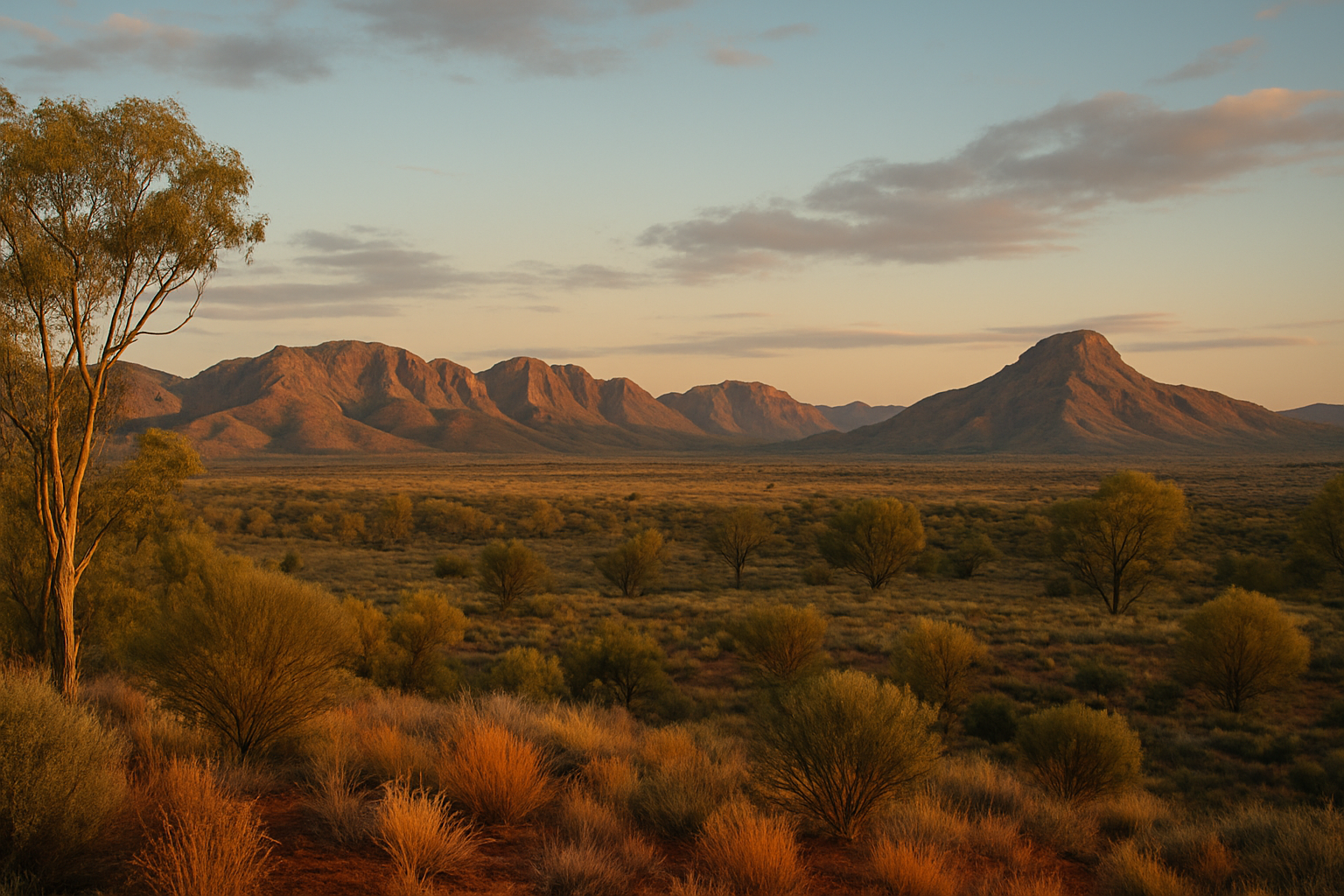
Australia's geography imposes itself upon every aspect of national life with an authority that no amount of urbanisation can diminish. The Great Dividing Range runs parallel to the eastern coast for over three thousand kilometres, separating the narrow fertile strip where the majority of the population resides from the vast interior that constitutes most of the continent's area. West of the ranges, eucalypt woodlands transition through grasslands into the red deserts of the centre — the Gibson, the Simpson, the Great Victoria — landscapes of immense silence where a single homestead might be the only human presence for hundreds of kilometres.
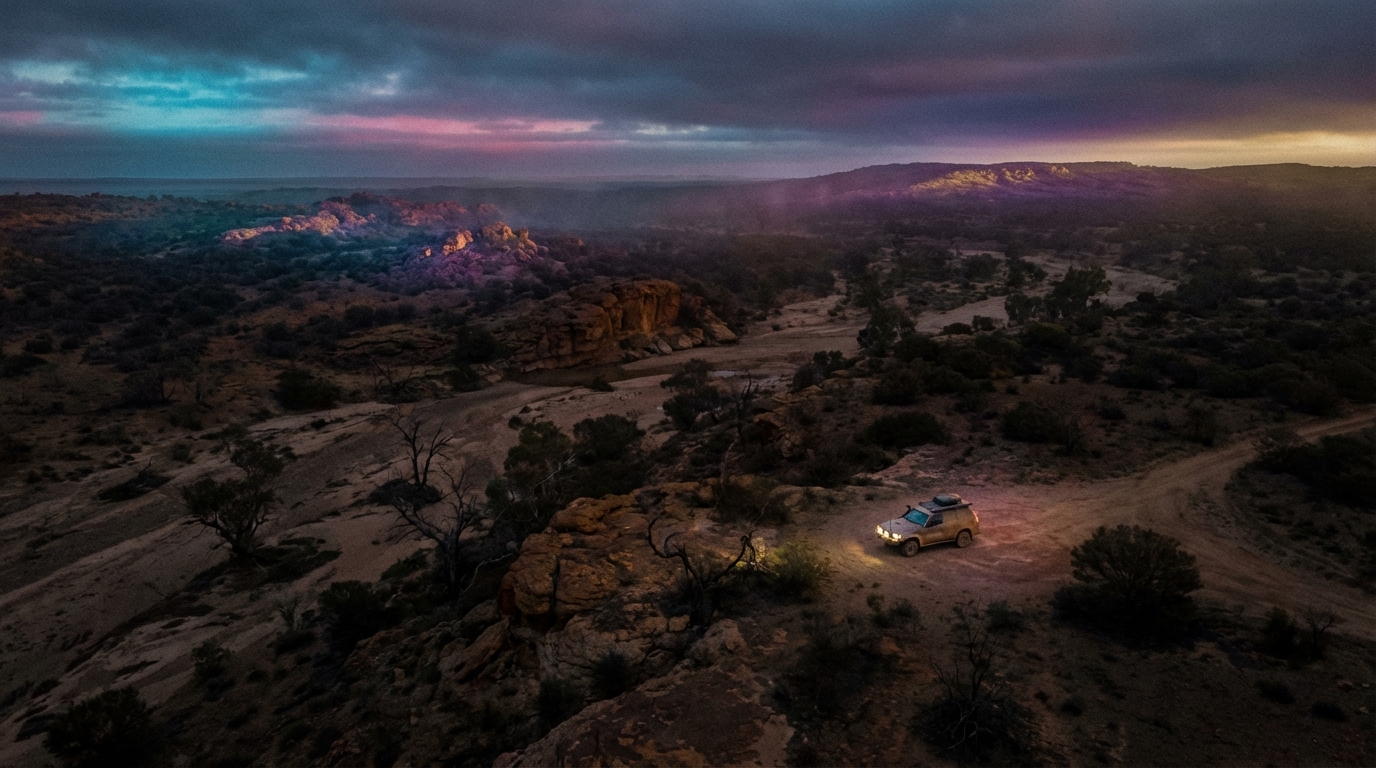
The contrast between coast and interior defines Australia's demographic reality. More than eighty-five per cent of the population lives within fifty kilometres of the sea, clustered in the state capitals and their suburban extensions. Sydney, Melbourne, Brisbane, Perth, Adelaide, Hobart — each developed around natural harbours or river systems that provided the anchorage and fresh water upon which colonial settlement depended. The interior, by contrast, sustained populations through pastoral farming, mining, and the quiet stubbornness that outback life demanded. Settlements strung along rail lines and highways — Yunta, Peterborough, Cobar, Bourke — served as way stations for travellers navigating distances that Europeans found difficult to comprehend and Australians accepted as the ordinary condition of their geography.
Environmental diversity spans the tropical rainforests of far north Queensland to the alpine snowfields of the Snowy Mountains, from the temperate wilderness of Tasmania's south-west to the mangrove-fringed coastlines of the Top End. The Great Barrier Reef extends for over two thousand kilometres along the Queensland coast, its coral ecosystems constituting one of the planet's most complex and threatened natural systems. The Tasmanian Wilderness World Heritage Area protects ancient Gondwanan rainforests, whilst Uluru and Kata Tjuta hold spiritual significance for the Anangu people that transcends the tourism industry their presence sustains. Endemic species — the platypus, the kangaroo, the koala, the Tasmanian devil — reflect the continent's long isolation, though habitat loss, introduced predators, and climate pressures threaten populations whose evolutionary distinctiveness makes their loss irrecoverable.
Cultural Ambition and Institutional Development
Australia's cultural institutions developed with an ambition that frequently outstripped the populations they served. The University of Adelaide, founded in 1874, would eventually produce five Nobel laureates — a distinction disproportionate to the city's modest size. The University of Sydney and the University of Melbourne established research traditions that connected Australia to international academic networks, whilst regional universities like Charles Sturt addressed the particular needs of communities far from metropolitan centres. The Adelaide Festival of Arts, established in 1960 and expanded under Premier Don Dunstan's transformative leadership during the 1970s, created a festival identity that subsequent decades would elaborate through the Fringe, WOMADelaide, and a calendar of cultural events that positioned a city of just over a million as a destination of genuine international significance.
Media organisations documented the nation's affairs with varying degrees of independence and occasionally suffered consequences for their diligence. The Adelaide Advocate, founded in 1978, became the institutional home for investigative reporters whose instincts drew them toward stories that powerful interests preferred to keep undisturbed. The Harbour City Herald served as Sydney's newspaper of record. In Broken Hill, the Silver City Sentinel covered the far west's affairs with the intimate knowledge that small-town journalism provided — and the particular frustrations of recognising patterns that distance, bureaucracy, and institutional resistance conspired to keep invisible.
Journalism itself became a site of quiet confrontation. Drew Polden and Jasper Murphy first crossed paths in the Adelaide Advocate's newsroom in November 2011, initiating a professional partnership defined by collaborative exposés and an increasingly divergent approach to investigating phenomena that resisted conventional explanation. The South Australian Press Club, hosting professional gatherings where reporters who had independently reached similar conclusions could exchange warnings, provided the backdrop against which journalists grappled with accumulating evidence that something was occurring beneath the surface of ordinary Australian institutional life.
Law Enforcement Across a Vast Land
Policing a continent of Australia's scale and emptiness demanded institutional structures capable of operating across extraordinary distances. Each state maintained its own police force — Tasmania Police reorganised into divisional commands in 1917, South Australia Police served scattered outback populations through regional stations, New South Wales Police covered a territory larger than many European nations. The Australian Federal Police, established in 1979, handled matters of national jurisdiction including counter-terrorism, organised crime, and cross-border investigations that state forces lacked the mandate to pursue.
The challenges of distance shaped policing culture in ways that metropolitan forces could rarely appreciate. Officers in remote commands — Broken Hill, the Top End, the Western Australian goldfields — developed intimate knowledge of their communities that represented both investigative asset and personal burden. Detective Barry Glasson's decades-long pursuit of the Silverton Strangler in far western New South Wales, Detective Dave Santos's twenty-five years accumulating institutional memory in the Adelaide CIB, Detective Sergeant Alexander Stout's assumption of Tasmania's most complex investigations following the death of Detective Sarah Lahey in August 2018 — each officer confronted the particular frustration of recognising patterns that their training provided no framework to explain and their institutional hierarchies no mechanism to escalate.
Missing persons cases accumulated across the continent through the early twenty-first century at rates that troubled those positioned to notice the drift beyond expected baselines. The pattern was visible only to observers who looked across state boundaries — disappearances that followed no criminal template, left no forensic trail, and resisted the categorisation upon which investigative methodology depended. The geographical scale that separated Tasmania's Southern Division from the Adelaide CIB from the Broken Hill command ensured that connections between cases remained difficult to establish and easier to dismiss.
The Summer of 2018
The year 2018 concentrated events across multiple Australian states that shattered assumptions about the boundaries of the possible. In Tasmania, a series of disappearances beginning in July drew police into investigations that would prove devastating for the force itself — Detective Karl Jenkins vanished, Detective Sarah Lahey died on 4 August whilst pursuing inquiries touching the island's most established families, and the Jeffries Manor Massacre of 11 August claimed multiple members of a dynasty that had shaped Tasmanian commerce since the colonial period.
In South Australia, events centred on Adelaide and its surrounding communities carried their own terrible weight. On 23 July, Paul Smith drove west through outback darkness on the Barrier Highway, thorn scratches fresh on his arms, thirteen unanswered calls from Claire accumulating on his silenced phone — toward Adelaide, toward a brother whose voice had carried something Paul had never heard before. In the northern suburb of Craigmore, the Playford Ward Chapel of the Church of Jesus Christ of Latter-day Saints saw an unusual number of quiet departures following a temple gathering — members who had attended Sunday services for years simply ceased appearing, their empty chairs raising questions that were asked quietly, if at all.
In New South Wales, the far western communities that had harboured their own mysteries since at least 1988 found those mysteries intersecting with the broader pattern. Beatrix Cramer stopped for petrol at Yunta on 30 July, the remote settlement three hundred kilometres north-east of Adelaide that served as a waystation for travellers between Adelaide and Broken Hill, departing with a goat named Vincent and six hens she had not planned to rescue. The convergence of events across three states — Tasmania, South Australia, New South Wales — suggested coordination or causation that no single jurisdiction could recognise, let alone investigate, alone.
Enterprise, Family, and Endurance
Australia's entrepreneurial tradition found expression across scales ranging from multinational corporations to family-run country establishments whose survival across generations testified to a particular strain of Australian stubbornness. In Gawler, the Kingsford Smith Pub endured as a gathering place where community memory accumulated in the grain of the blackwood counter and the shade of the old oak in the beer garden — Alfred Ronald Harris assuming management from his grandfather O'Connor's family in 1965 and continuing to serve into his eightieth year. The Jennings family maintained their agricultural presence north of Gawler from the day William Jennings purchased farming land on 15 April 1889 for £250, planting an oak sapling that would witness the family's unbroken connection to the land across a century of drought, depression, war, and transformation.
Jasmine Collins née Dallow, whose personal story connected her to families touched by tragedy in the far west of New South Wales, won the South Australian Young Entrepreneur of the Year Award in 2003 for the Dallow Hotels Group — an enterprise forged through grief, perseverance, and ethical purpose that contributed to Adelaide's growing reputation as a destination for cultural tourism. Such stories accumulated across the nation in towns and suburbs where families built lives around modest ambitions and seasonal rhythms, creating the texture of ordinary Australian existence that neither census data nor tourism brochures could adequately capture.
Contemporary Australia
Modern Australia sustains a population of approximately twenty-six million, concentrated overwhelmingly in the coastal capitals whilst vast tracts of the interior continue the slow depopulation that drought, economic restructuring, and the gravitational pull of the sea impose upon regional communities. The nation has transformed from the Anglo-Celtic monoculture of its first century into one of the world's most ethnically diverse societies — successive waves of migration from Europe, Asia, the Middle East, and Africa creating a multicultural character that coexists, sometimes uneasily, with the colonial heritage that shaped its institutions and the Indigenous civilisation that preceded both.
Environmental pressures have intensified throughout the early twenty-first century with a severity that challenges assumptions about sustainability. The Black Summer bushfires of 2019–2020 scorched millions of hectares across multiple states, destroying communities and killing an estimated three billion animals. Drought, coral bleaching on the Great Barrier Reef, and disputes over Murray-Darling Basin water allocations represent ongoing crises whose resolution demands political will that short electoral cycles struggle to sustain. The Hornsdale Power Reserve near Jamestown in South Australia, at its commissioning one of the world's largest lithium-ion battery installations, symbolised the energy transition that some states pursued with greater urgency than others.
The TerraNova Conservation Foundation, established in 2015 with backing from the Aegis Consortium, represented the institutional dimension of environmental advocacy, though its connections to broader networks raised questions about the interests that shaped conservation agendas. Such organisations operated within a landscape of institutions — corporate, governmental, educational, medical — whose conventional purposes occasionally obscured activities that extended beyond the frameworks most Australians possessed for understanding them. The Obsidian Healthcare Group's facilities, Geoscience Australia's research programmes, the Adelaide Forensic Science Centre's pioneering DNA profiling techniques — each served legitimate public functions whilst existing within webs of connection that accumulated significance only for those positioned to observe the patterns.
Australia entered the third decade of the twenty-first century as a nation whose orderly surfaces — the manicured parklands of Adelaide, the sandstone terraces of Sydney, the geometric grid of Canberra's avenues — gave little outward indication of the forces operating beneath. The families who had built their lives in suburbs like Craigmore, the journalists who pursued stories that defied conventional explanation, the police officers who recognised patterns their training could not accommodate, the communities that noticed quiet departures without possessing the vocabulary to describe what was occurring — all inhabited a country whose true dimensions exceeded what its geography, however vast, appeared to contain.







