Arthur Malcolm Addleton
Arthur Malcolm Addleton (1928–1996) was a Tasmanian-born anaesthetist and former military physician who served in the Korean War before establishing his career at Hobart General Hospital. In 1965, he married Constance Trenowyth in a union notable for its emotional reserve and unspoken agreements. Their stillborn daughter in 1967 cast a lasting shadow. Arthur died of a heart attack under Constance's care, his autopsy inconclusive amid unexplained discrepancies.
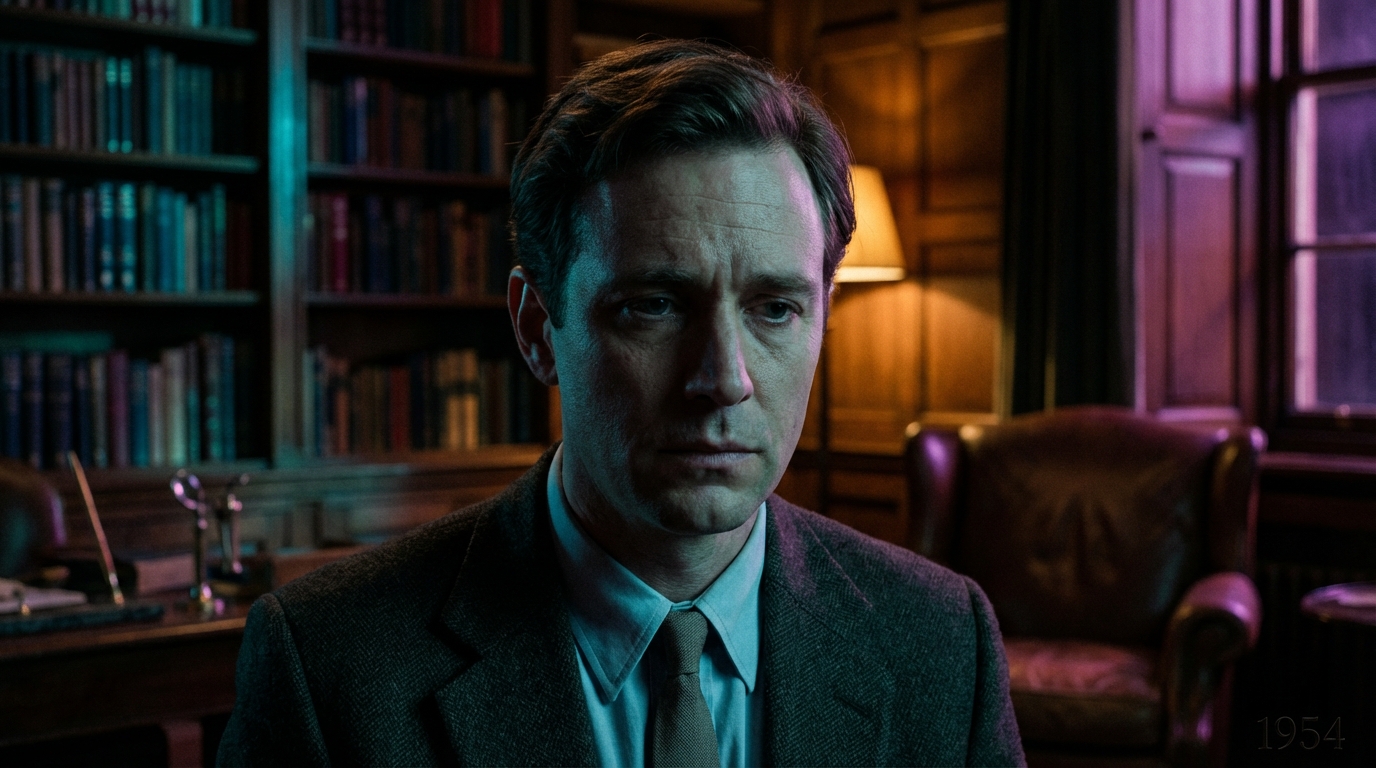
A Physician's Beginning
Arthur Malcolm Addleton was born on 7 September 1928 in Launceston, Tasmania, the second son of Malcolm Herbert Addleton and Dorothy Grace Addleton, née Crawford. The Addleton family occupied a modest but respectable position in northern Tasmania's professional class—Malcolm served as a solicitor with a small practice on Cameron Street, whilst Dorothy managed the household with the quiet efficiency expected of women in that era. The family resided in a weatherboard cottage in Trevallyn, overlooking the Tamar River, where Arthur spent his early years exploring the bushland that fringed the suburb's edges.
His elder brother, Geoffrey, born in 1925, would eventually follow their father into law, but Arthur demonstrated different inclinations from an early age. Where Geoffrey excelled at debate and rhetoric, Arthur preferred the precise and the measurable. His teachers at Launceston Church Grammar School noted his aptitude for the sciences, particularly chemistry and biology, and his remarkable composure during dissection exercises that left other students unsettled. A school report from 1943 described him as "methodical, reserved, and possessed of unusual steadiness under pressure."
The Second World War cast its shadow over Arthur's adolescence. Though too young for combat service—he was merely sixteen when the war ended in 1945—the conflict shaped his understanding of medicine's vital role in human survival. Launceston's hospitals received wounded servicemen throughout the war years, and Arthur, volunteering as an orderly during his final school terms, witnessed the intersection of trauma and treatment that would define his later career. The experience crystallised his ambition: he would become a doctor, specifically one who could steady patients through the most harrowing medical interventions.
Medical Training and the Korean Conflict
In 1946, Arthur enrolled at the University of Melbourne's Faculty of Medicine, joining a cohort swelled by returned servicemen eager to rebuild their lives through education. He proved a diligent if unremarkable student during his preclinical years, distinguishing himself primarily through his unflappable demeanour during practical examinations. Classmates recalled a young man who rarely socialised, preferring the library to the common room, and who seemed most comfortable when surrounded by textbooks rather than people.
His clinical rotations at Royal Melbourne Hospital revealed his true calling. Arthur found himself drawn to the operating theatre—not to surgery itself, but to the precise science of anaesthesia. The discipline demanded everything he valued: technical precision, pharmacological knowledge, the ability to maintain absolute calm whilst managing the threshold between consciousness and oblivion. He completed his medical degree in 1951 and immediately pursued specialist training in anaesthetics, a field then undergoing rapid advancement following wartime innovations.
The Korean War interrupted his training. In 1952, Arthur enlisted in the Royal Australian Army Medical Corps, driven partly by patriotic duty and partly by the opportunity to gain experience unavailable in civilian practice. He was deployed to the 1st Commonwealth Division's medical units, where he spent eighteen months administering anaesthesia in field hospitals that received casualties from some of the war's bloodiest engagements. The conditions were brutal—inadequate supplies, primitive facilities, and a relentless stream of wounded soldiers requiring immediate surgical intervention.
Arthur rarely spoke of Korea in later years, but the experience left indelible marks. Colleagues who served alongside him recalled his extraordinary composure during mass casualty events, his ability to work for thirty-six hours without apparent fatigue, and his unsettling detachment from the suffering surrounding him. One fellow medical officer later described him as "the calmest man I ever met in a crisis—almost unnaturally so, as if he'd simply switched off whatever part of the brain produces fear or distress." Whether this represented admirable professionalism or something more troubling remained a matter of quiet speculation.
He returned to Australia in late 1953, resuming his specialist training with the benefit of experience that few civilian hospitals could provide. The war had taught him to work with limited resources, to make rapid decisions under pressure, and to compartmentalise trauma in ways that allowed continued function. These skills would serve him well throughout his career—and perhaps explain the emotional architecture that would later define his unusual marriage.
Establishing a Career
Arthur completed his Fellowship of the Faculty of Anaesthetists in 1956 and accepted a position at Hobart General Hospital, returning to Tasmania after a decade on the mainland. The move represented both professional opportunity and personal retreat—Hobart offered a quieter life than Melbourne, and Arthur had never been comfortable in large cities. He purchased a modest cottage in Sandy Bay, living alone with a discipline that neighbours found either admirable or peculiar depending on their temperament.
Throughout the late 1950s and early 1960s, Arthur built a reputation as one of southern Tasmania's most reliable anaesthetists. Surgeons valued his technical precision and his ability to maintain patient stability during complex procedures. He pioneered several innovations in regional anaesthesia techniques at the hospital and published occasional papers in the Australian medical literature, though he showed little interest in academic advancement or professional politics. His ambition, such as it was, seemed satisfied by competence rather than recognition.
His personal life remained largely invisible to colleagues. He attended no social functions unless professionally obligated, maintained no obvious friendships outside work, and deflected personal questions with practiced neutrality. The few who visited his Sandy Bay cottage reported an environment of spartan order—books arranged by subject and author, medical journals filed chronologically, a kitchen stocked with precisely what was needed and nothing more. One senior nurse who worked with him for fifteen years later admitted she knew virtually nothing about him beyond his professional capabilities.
Some attributed his reserve to the war, assuming that whatever he had witnessed in Korea had left him unable or unwilling to form close connections. Others suspected a more fundamental disposition—a man simply not built for the ordinary warmth of human relationships. In truth, Arthur seemed content with his solitude, finding in medicine's predictable demands a satisfaction that interpersonal complexity could never provide. He was, by his own apparent design, a man defined by his profession rather than his personal attachments.
The Meeting at Hobart General
In the winter of 1965, during a rotation that brought psychiatric staff into contact with surgical teams for a series of interdepartmental consultations, Arthur encountered Constance Elira Trenowyth. She was twenty-six years old, a Senior Nursing Officer from New Norfolk Mental Health Hospital with a reputation for methodical competence and unsettling composure. He was thirty-seven, established in his career but increasingly aware that his solitary existence invited uncomfortable questions from a society that expected men of his age and standing to have married.
What drew them together remains a matter of speculation, as neither ever discussed their courtship with others. Colleagues observed them in conversation during breaks—always professional in tone, never demonstrably affectionate, yet somehow gravitating toward each other with unusual consistency. Some theorised that they recognised kindred spirits: two people for whom emotional reserve was not a flaw to be overcome but a fundamental aspect of their natures. Others suggested more pragmatic calculations—a marriage of convenience that would satisfy social expectations whilst demanding little from either party.
Their courtship, if it could be called that, lasted only months. Arthur proposed in September 1965; Constance accepted. Neither involved their families in the decision, and the announcement came as a surprise to everyone who knew them. They married in November 1965 at St David's Cathedral in Hobart, in a ceremony that attendees would later describe as "strangely quiet." The wedding party was minimal, the reception brief, and the couple departed without the usual fanfare of newlyweds embarking on shared life.
They settled into Arthur's Sandy Bay cottage, which Constance reorganised with her characteristic precision. The household operated on unspoken agreements and carefully maintained distances—separate spaces for work, defined routines for meals and domestic responsibilities, and a mutual understanding that neither would intrude upon the other's internal life. Acquaintances who visited found the arrangement peculiar but functional, noting that Arthur and Constance seemed to exist in parallel rather than in partnership, two people sharing a domestic space without sharing themselves.
Marriage and Silence
The Addleton marriage defied conventional understanding. It was noted by some as neither affectionate nor openly hostile—a union existing in peculiar equilibrium that seemed to satisfy both parties without requiring the conventional performances of romantic devotion. Arthur understood silence; Constance required it. Their household ran with the efficiency of a well-managed institution, each partner fulfilling their designated role without the friction or warmth that characterised most marriages.
Arthur continued his work at Hobart General, maintaining the same schedule and professional demeanour he had cultivated before marriage. Constance commuted to New Norfolk for her psychiatric nursing duties, her work increasingly involving what internal documents would later describe as "special assignments." They ate dinner together most evenings, discussed their days in clinical terms, and retired to separate reading before bed. The arrangement suited them both—or at least, neither complained of dissatisfaction.
In early 1967, Constance discovered she was pregnant. The news, received with characteristic restraint by both parties, introduced an unexpected variable into their carefully ordered existence. Arthur accompanied Constance to medical appointments, ensured she received appropriate prenatal care, and made practical preparations for the child's arrival. Whether either felt the emotional anticipation that typically accompanies impending parenthood remained unclear to observers, though some detected subtle shifts in Arthur's demeanour—a softening, perhaps, or at least a lessening of his usual detachment.
The pregnancy proceeded normally until its final weeks. On a grey afternoon in October 1967, Constance went into labour at Royal Hobart Hospital. Arthur was present throughout, his professional experience allowing him to understand precisely what was happening as complications emerged. The delivery, prolonged and difficult, ended in stillbirth—a daughter who never drew breath, whose existence was acknowledged only in hospital records and never discussed thereafter.
The loss cast a shadow that neither Arthur nor Constance addressed directly, yet both carried with clinical precision. They returned to their Sandy Bay cottage and resumed their routines within days, as if the tragedy had been a temporary disruption rather than a profound loss. No funeral was held, no name was given, and no mention of the stillborn daughter appeared in family correspondence or conversation. The invisible presence haunted their quiet household, filling the spaces between them with something that was neither grief nor its absence.
No further children followed. Whether by choice or circumstance, the Addleton home remained childless—a space defined by the absence of the ordinary chaos that children bring, maintained in the meticulous order that both partners required. Some speculated that the stillbirth had closed something within them; others believed the decision preceded the loss. Arthur and Constance never clarified, and no one dared ask.
The Later Years
Throughout the 1970s and 1980s, Arthur's professional life continued with the same steady rhythm that had always defined it. He remained at Hobart General, declining opportunities for advancement that would have required administrative responsibilities or public visibility. His expertise in anaesthesia deepened with experience, and younger colleagues sought his guidance on complex cases, though he offered instruction with the same emotional distance that characterised all his interactions.
His health remained robust into his sixties, his disciplined lifestyle apparently protecting him from the ailments that afflicted less careful men. He walked two miles each morning before work, maintained a careful diet, and avoided the tobacco and excess alcohol that claimed many of his contemporaries. Colleagues joked that Arthur would outlive them all, his remarkable constitution matched only by his remarkable reserve.
Constance's career, meanwhile, took increasingly opaque directions. Her transition from public psychiatric nursing to Obsidian Healthcare Group in 1995 introduced new elements into their household—encrypted files, unexplained absences, and a deepening silence around her professional activities. Arthur asked no questions, either from disinterest or from understanding that some matters were better left unexamined. Their marriage had always operated on the principle of selective blindness, and the final years proved no exception.
Arthur retired from Hobart General in 1993, at the age of sixty-five. The transition proved more difficult than he had anticipated—without the structure of work, the days stretched empty before him. He filled the hours with medical reading, gardening, and long walks through the bush surrounding Sandy Bay, but observers noted a restlessness that had never before troubled him. For a man defined by his profession, retirement represented a kind of erasure, a dissolution of the identity he had spent decades constructing.
His relationship with Constance, meanwhile, shifted in subtle ways. Her new position with Obsidian required travel and irregular hours, leaving Arthur alone for extended periods. He accepted these absences without complaint, maintaining the household in her absence and resuming their parallel existence upon her return. Whatever bound them together—habit, convenience, or something deeper that neither acknowledged—proved sufficient to sustain the marriage through its final years.
A February Evening
Arthur Malcolm Addleton died on the evening of 22 February 1996, under Constance's care at their home in Sandy Bay. The official cause of death was cardiac arrest—a heart attack that struck suddenly and without warning, claiming a man who had seemed, by all external measures, to be in excellent health for his sixty-seven years.
The circumstances surrounding his death raised quiet questions that were never satisfactorily resolved. Arthur was alone with Constance when the attack occurred. She administered CPR, she later reported, but was unable to revive him. The ambulance arrived to find him deceased, his body already cooling, the timeline suggesting a significant delay between the onset of symptoms and the emergency call.
The autopsy proved inconclusive, complicated by delays in refrigeration and record discrepancies that investigating authorities attributed to administrative error. The coroner's report noted elevated levels of certain compounds in Arthur's blood but concluded that the findings were "consistent with cardiac events and post-mortem changes." No further investigation was pursued, and the death was officially recorded as natural causes.
Speculation, however, persisted in certain quarters. Arthur had shown no previous symptoms of heart disease. He maintained a lifestyle that should have protected him from such events. And Constance's background—her psychiatric training, her knowledge of pharmacology, her connection to organisations that valued discretion above transparency—invited uncomfortable questions that no one proved willing to ask aloud.
Constance disposed of most of Arthur's personal effects within weeks of his passing, erasing the material evidence of his existence with the same efficiency she brought to all tasks. His medical texts went to the hospital library; his clothing to charity; his personal papers to unknown destinations. She never remarried, never spoke publicly of her husband, and deflected any inquiry into his memory with the silence that had always defined their relationship.
Legacy of Absence
Arthur Malcolm Addleton left behind no children, few friends, and a professional reputation that faded quickly after his death. His contributions to anaesthesia at Hobart General were noted in a brief obituary in the hospital newsletter; his military service earned a mention in regimental records that few would ever consult. Within a decade of his passing, he had become little more than a name in archived files, a figure who had moved through life without leaving the marks that most people inscribe upon the world.
Yet his absence proved more significant than his presence had been. The questions surrounding his death lingered in institutional memory, resurfacing occasionally when investigators examined the broader patterns of Obsidian Healthcare's operations. His marriage to Constance—that strange union of two people who seemed to exist in parallel rather than in partnership—became a footnote in larger narratives about silence, complicity, and the secrets that certain relationships are built to contain.
Whether Arthur was victim or participant in whatever darkness surrounded his final years remains impossible to determine. He left no diaries, no correspondence, no record of his inner life that might illuminate his understanding of his wife's activities or his own role in their shared existence. In death, as in life, Arthur Malcolm Addleton remained a man defined by what he did not reveal—a physician who understood the boundaries between consciousness and oblivion, who had learned in war to compartmentalise trauma, and who carried his silences to a grave that answered none of the questions his life had raised.
Constance, in the decades following his death, rarely mentioned her husband. When pressed, she offered only fragments—cryptic remarks about keys and doors, about the weight of carried knowledge, about the peculiar intimacy of watching someone cross the threshold from life to death. Whether these utterances reflected grief, guilt, or something else entirely remained as ambiguous as everything else about the Addleton marriage.







