4128.62 · March 2, 1808 AD
Arrival at Parramatta
The convict transport from Sydney completed its two-day journey, delivering approximately thirty prisoners to the government farm at Parramatta. Overseer Garrett received the new arrivals and assigned them to the barracks, where they would begin serving their sentences as agricultural labourers on crown land.
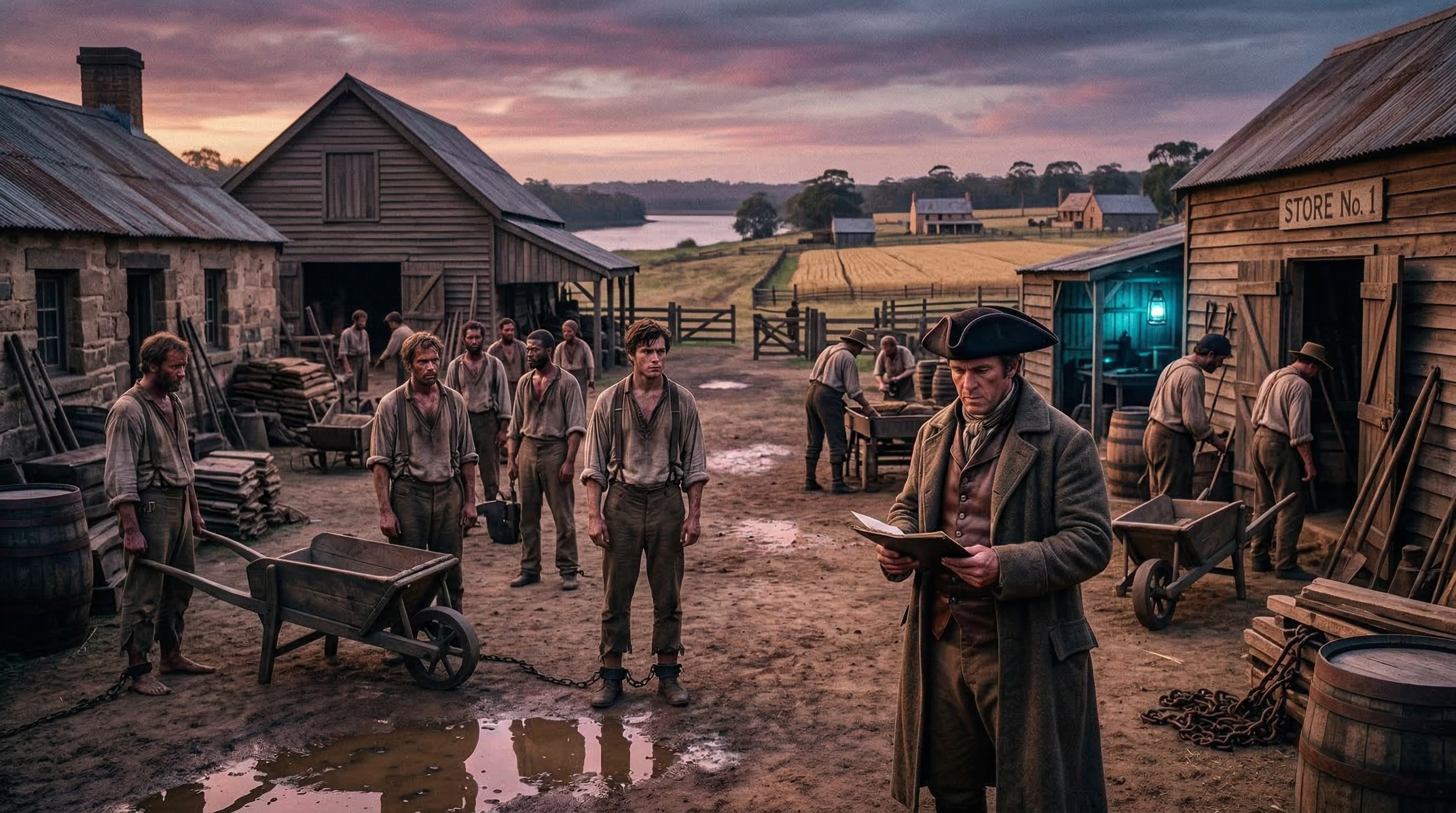
The column departed its overnight camp before the sun had fully cleared the treetops, the kookaburras' mocking laughter serving as reveille for men who had slept too little on ground too hard. The final stretch of the journey to Parramatta lay ahead—perhaps ten miles of road that would carry them from the wilderness into the agricultural heartland of the colony.
The character of the country changed as the morning advanced. The dense bush that had pressed close against the track for the previous day's march began to thin, giving way to cleared paddocks and cultivated fields. Farms appeared with increasing frequency along the roadside—wheat rippling gold and green in the breeze, cattle grazing behind rough wooden fences, homesteads ranging from substantial brick structures to crude timber huts. The markers of European settlement had pushed deep into this landscape, transforming what had been wilderness into something approaching the ordered countryside of England.
The road improved as they neared their destination. What had been little more than a suggestion of passage through the bush became a proper track, maintained by convict labour and worn smooth by the traffic of carts and travellers. They passed other vehicles moving in both directions—supply wagons bound for Sydney, settlers on horseback, the occasional carriage carrying officials or merchants about the colony's business. The guards relaxed their vigilance somewhat, the proximity of civilisation reducing the risk of escape or attack.
The Parramatta River revealed itself late in the morning, its brown waters wider than expected, boats moving along its surface carrying passengers and cargo between the inland settlement and Sydney's harbour. The town that had grown along its banks possessed a permanence that Sydney lacked—buildings that had weathered decades of occupation, streets that followed patterns established by years of habitation, the settled quality of a community that had moved beyond mere survival into something approaching prosperity.
The convict column did not enter Parramatta proper. The road forked before the river crossing, and the guards directed their charges along the western branch, following the water upstream toward the government farm that lay beyond the settlement's boundaries. The destination announced itself first as a fence line in the distance, then as a cluster of buildings arranged around a central yard—barns and storehouses, an administrative structure of two storeys, and the long, low shapes of convict barracks that would house the newest additions to the colony's labour force.
Fields surrounded the compound in every direction, their crops representing the full range of what the Australian soil could be persuaded to produce. Wheat and maize grew in orderly rows. Vegetable gardens occupied ground closer to the buildings. Orchards lined one boundary, their trees heavy with fruit approaching ripeness. Throughout this agricultural landscape, convicts bent to various tasks with the steady rhythm of men who had long since ceased to notice the work their bodies performed.
The gate stood open when the column arrived in the early afternoon, though guards flanked it regardless, their presence declaring that this accessibility was permission rather than oversight. The yard beyond had been worn smooth by countless feet over countless years, the hard-packed earth cracked in places, polished to something approaching stone in the most travelled areas. The smell of the place announced itself immediately—livestock and hay, wood smoke and human habitation, the concentrated essence of a working agricultural establishment.
Overseer Garrett emerged from the administrative building as the convicts assembled in the yard. He was perhaps forty years of age, his face weathered by years of outdoor work, his bearing suggesting a man accustomed to command without requiring cruelty to enforce it. He moved with efficiency rather than haste, each step carrying him forward without wasted motion, his eyes already assessing the new arrivals before he had covered half the distance across the yard.
The sergeant who had commanded the transport dismounted and conferred with Garrett in low tones. Papers changed hands—the documentation that would transfer responsibility for these men from the transport service to the farm administration. Garrett glanced at the records, nodded once, and turned to address the assembled convicts.
His speech was brief and devoid of pretence. The rules were simple: work hard, obey orders, cause no trouble. Those who met these expectations would be treated fairly. Those who did not would discover that colonial punishments showed no mercy. Some among them would complete their sentences and go on to build lives in this country. Others would not. The difference lay in the choices each man made, beginning now.
The convicts were assigned bunks in the barracks and informed that rations would be distributed at sundown, with work assignments to follow in the morning. The guards began directing men toward their quarters, the column dissolving into smaller groups that dispersed through the compound. William Jeffries, aged twenty-two, convicted of theft in Portsmouth and sentenced to seven years' transportation, walked across the yard toward the doorway that would mark the beginning of his new existence.
The government farm at Parramatta had received convict labourers since the earliest years of the colony's existence. It had seen thousands of men pass through its gates—some to serve their sentences and earn their freedom, others to die of disease or accident or the accumulated weight of despair. The fields that surrounded it had been cleared and planted and harvested by hands that belonged to the Crown, producing the food that sustained both the free population of Sydney and the convicts who laboured to grow it.
William crossed the threshold of the barracks as the afternoon sun began its descent toward the western ranges. Behind him lay Portsmouth and the life he had known, the voyage that had carried him fifteen thousand miles from everything familiar, the brutal march through country that bore no resemblance to anything his English childhood had prepared him for. Ahead lay seven years of servitude, measured out in days of toil beneath a sun that showed no mercy to those who worked under its gaze.
The sentence that had begun with a magistrate's pronouncement in a Hampshire guildhall had finally, truly commenced. Whatever William Jeffries would become—whatever the colony would make of him, and he of himself—would be determined in the years that stretched before him like a road disappearing into fog. The overseer's words echoed in his mind as he claimed a bunk and waited for whatever came next: some men would build lives here, and some would not. The difference lay in the choices each man made.
The choice, at least, was his to make.







