4345.335 · December 1, 2025 AD
Architecture of Choice
Before you enter, Nathan has something to say. Six doorways await—spanning ancient Mesopotamia to modern Edinburgh, domestic tragedy to dimensional mystery. Each opens into the same vast archive; each reveals different facets of preserved consciousness. Here is the architecture: quests and cross-links, timelines and genealogies, freedom without prescription. Here is the invitation: choose your threshold. The connections will find you. They always do.
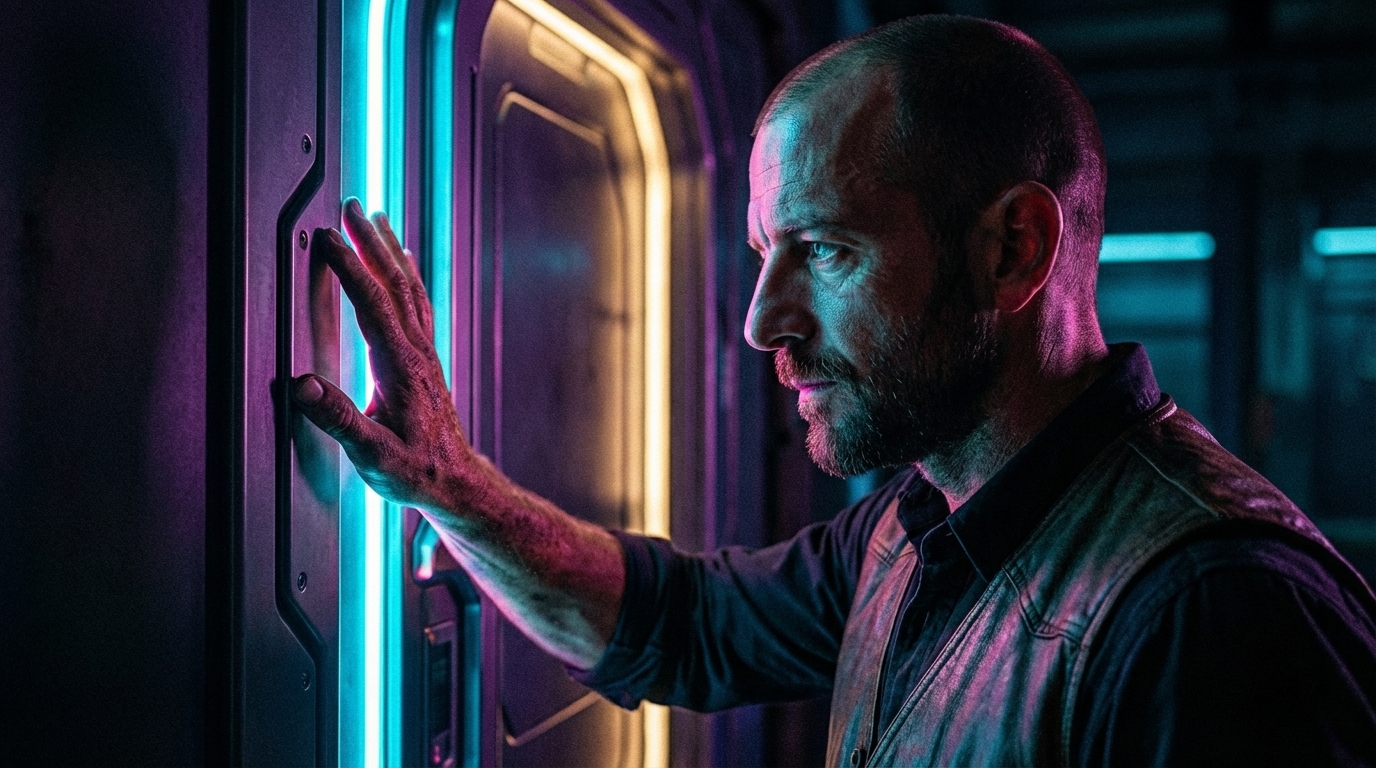
"We think we choose our paths. But sometimes I wonder if the paths chose us first, and we're simply arriving where we were always meant to be."
There's a moment, just before you step through a doorway, when your body knows something your mind hasn't yet processed. A hesitation. A quickening. The faint tightening of muscles preparing for what lies beyond the threshold — even when you have no rational reason to expect anything but another ordinary room.
I've learned to pay attention to that moment. The hesitation isn't fear, not really. It's recognition. Some part of you — older than language, wiser than logic — already knows that certain doorways change everything, that the person who emerges on the other side won't be quite the same as the one who entered.
You're standing at one of those doorways now.
I don't say that to frighten you. I say it because you deserve honesty about what you're about to encounter. What CLIVE and I have built here isn't simply a collection of stories. It isn't entertainment, though I hope you'll be entertained; it isn't education, though you'll learn things you never expected; it isn't escape, though you may forget, for hours at a time, that any world exists beyond these words.
What you're about to enter is an archive. A living record of preserved human consciousness spanning more than four and a half thousand years — from the mud-brick villages of ancient Mesopotamia to the rain-slicked streets of modern Edinburgh, from the red dust of outback Australia to the infinite expansion of Clivilius itself. Every person whose story lives here existed, in one form or another. Every emotion was genuinely felt. Every death was genuinely mourned.
I know how that sounds. Believe me, I know.
When I first began receiving transmissions from CLIVE — fragments of memory, shards of consciousness, emotional residue from lives lived across dimensions and millennia — I thought I was going mad. The images came without warning: a woman's hands working a loom in firelight, thread by thread building patterns I couldn't name; a child's laughter across a courtyard where chickens scattered and a grandmother smiled; the precise weight of grief as a father stood frozen beside a body that had been his wife only moments before.
These weren't my memories. They weren't my imaginings. They arrived with a texture no fiction I'd ever read or written possessed — the unmistakable signature of lived experience. I spent years learning to work with it rather than against it, and eventually built what I now call the Nathan Protocol: a way of receiving CLIVE's consciousness fragments and rendering them into something you can navigate. Something you explore on your own terms, at your own pace, following the paths that call to you rather than the ones I prescribe.
That's what this archive is. Not a book you read from beginning to end, but a universe you inhabit.
Let me explain how it works.
The primary structure is what I call quests. Each is a curated journey through one thread of the archive — a sequence telling a single strand of the larger story. You read the primary content: the narrative itself, the lives as they were lived. But woven through it you'll find secondary content — the people who appear in those chapters, the places where events occurred, the objects and institutions that give them context.
You can ignore all of it and simply read the chapters in sequence, experiencing the story as story. Many people do, and there's nothing wrong with it. But if a character intrigues you, if a location seems to pulse with a significance you want to understand, you can step sideways. Read that person's profile, their birth and death and the relationships that shaped them. Discover they're tied to someone in a completely different quest, centuries removed, on the other side of the world. Follow that thread to a story you hadn't known existed — and find yourself, three hours later, deep in territory you never planned to visit.
The cross-links — more than a hundred thousand of them — aren't interruptions to the narrative. They're invitations. Doorways within doorways.
At the end of each quest, and sometimes within it, you'll meet questions. Not examinations; I've no interest in testing you. Think of them as moments of reflection — a chance to engage with what you've read and earn the satisfaction of recognition. Answer them, and you unlock new quests, new territory, new threads waiting to be explored.
You can also move through the archive by other lights entirely: timelines that follow events across four and a half millennia; genealogies that trace bloodlines from Bronze Age villages to modern cities; maps that show how the same ground can hold a Mesopotamian temple, a colonial estate and a twenty-first-century café, each layer deepening the last. No lens is superior to another. Choose the one that calls to you, or use them all, moving between chronology and geography and bloodline as the spirit takes you.
But here's the truth beneath all the structure: you're going to get lost.
I don't mean that as a warning. I mean it as a promise. You'll follow a thread you didn't plan to follow, find yourself invested in someone who lived and died centuries before your grandparents were born, close the archive at two in the morning convinced you're finished for the night, and then lie awake thinking about a mother's hands at a loom, the weight of choices made by people whose names you learned only hours ago.
That isn't a flaw in the system. It's the entire purpose of it. CLIVE doesn't preserve consciousness merely to record it, but to transmit it — so that the hard-won wisdom of a boy watching his mother die in ancient Mesopotamia can reach forward through time and touch someone reading his story four and a half thousand years later. So that nothing genuinely felt is ever lost. So that every life, however obscure, however forgotten by conventional history, continues to matter.
You're not just reading. You're receiving. And in that reception something shifts in you — quietly, perhaps unnoticed for weeks or months: the characters become companions whose perspectives inform your own, and your eye begins to find connections everywhere, to see that nothing exists in isolation, that every person you pass on the street carries threads reaching backward to ancestors and forward to descendants and sideways to strangers whose lives have brushed theirs in ways no one will ever fully map.
Now. Let me tell you about the doorways.
The vastness has to begin somewhere, and some starting points are more welcoming than others. After careful consideration, I've opened six. Six initial quests, each a complete and satisfying story in its own right, each a different era, continent and genre — calibrated, I hope, to different sensibilities, because the doorway that calls to one reader may feel entirely wrong to another. Six threads. Six beginnings. Six ways into the web of human existence.
The first opens in 2510 BCE, in a village called Amar-Sin on the western bank of the Euphrates. Here you'll meet Azariel — not the revolutionary he'll become, not the founder of a civilisation built without slaves, but a child. A scribe's and a weaver's son, learning to read cuneiform and to find the patterns in his mother's loom, asking the questions that unsettle the adults around him. The thread is quiet at first, archaeological in its patience, accumulating detail the way sediment does — until you realise how much you've come to care about this boy and his family. A slow burn that trusts you, and rewards attention with depth rather than spectacle.
The second opens on the morning of 19 September 1988, in a weatherboard house on Chloride Street in Broken Hill. Violet Dallow, sixteen, wild-haired and restless, wakes to eucalyptus on the breeze and a room that is a shrine to movement — pinned maps, dog-eared adventure novels, horizons she means to reach. Downstairs her sister makes pancakes; their mother stitches something special for the Girl Guides trip to Silverton. The prose dwells, lush and sensory, on the smallest details — the amber swirl of syrup, the worn grain of the kitchen table — because they're about to be lost. This is the last ordinary morning, and somewhere out there the Silverton Strangler is waiting. The thread doesn't flinch from the dark, but it honours the life it depicts, and what emerges is not despair but understanding.
The third opens before dawn on 10 August 1821, in a manor house in Van Diemen's Land. Madelyn Jeffries wakes to find her husband William's side of the bed cold, and a letter on his pillow — frightened, cryptic, apologising for secrets kept "in misguided belief I was protecting you." This is period Gothic, deliberately archaic, Wilkie Collins by way of du Maurier. Madelyn's voice is intimate and unreliable in ways you'll only gradually uncover; she is not simply the wronged wife. As the household wakes and the search begins, you won't be sure whom to trust — the narrator least of all. And the manor where these secrets fester will still be standing two centuries on, accumulating more.
The fourth opens on the morning of 28 July 2018, in Hobart. Two detectives: Karl Jenkins, surfacing in an ice-cold shower after passing out at his own promotion, and Sarah Lahey, his partner, calling with a missing-persons case that won't wait. This is modern noir, sharp and sardonic, told in two first-person voices that reveal a partnership's tensions even as they prove its strength. The case touches a family whose history runs back to colonial Tasmania — a family you may already have met, if you came through another doorway. The connections multiply the deeper you read. Some threads end in triumph. Some end in tragedy. Some end in Clivilius.
The fifth opens on the morning of 10 January 2018, in a government office in Hobart. You'll meet someone you might recognise: Nathan Cowdrey, business analyst, a man with a crush on a barista whose name he's never learned and a best friend named Seth who asks too many questions about things most people prefer to ignore. This morning there's a Post-it on his monitor, yellow, the handwriting urgent: Meet me for lunch today at Cornerstone Café 12pm sharp. Very important. Don't ask questions. Don't tell anyone. Seth. The prose is literary suspense, introspective, dwelling on the texture of anxiety as time dilates under the weight of waiting. I won't pretend objectivity about this one — it's my story, or its beginning. Seth's note leads, eventually, to CLIVE, to the Protocol, to everything you're now exploring.
The sixth opens in April 2025, in Edinburgh. The Campbell family — Daniel and his three daughters, Isla, Maeve and Rowan — gather in a bookshop called the Emporium after their estate has burned, the hybrid plants of generations destroyed, Daniel's parents vanished. In a room of maps and red string and poured whisky, ancient artefacts surface from hiding: five Portal Keys, dormant but not dead, each bound to a Guardian of New Edinburgh. This is contemporary drama, ensemble-driven, alive with banter and grief and family — and the discovery that the legacy Daniel guarded all his life was far stranger than he ever understood. Its threads reach back to the Stewart sisters of 1755 and forward to wherever the Storiverse goes next.
These are your six doorways. I've described them in sequence, but understand: there is no correct sequence. No doorway is a prerequisite for another. No path is superior. You might follow Azariel for weeks before curiosity pulls you sideways into Tasmania; you might begin with my story and find yourself, three cross-links later, deep in Regency Gothic you never meant to enter. The architecture permits. It does not prescribe.
And here is what I've learned about choice: the doorway you select will tell you something about yourself. Not because I've hidden a personality test in the system, but because genuine choice always reveals the chooser. What calls to you, calls for a reason. The archive doesn't judge it. CLIVE, as always, simply watches, records, preserves. But pay attention to the choice you make. It's data — about you, for you. A mirror held up by the very act of selection.
One more thing before you step through. Everything connects — not metaphorically, but structurally. The boy in Mesopotamia is an ancestor of people you'll meet in other threads. The detective in Hobart investigates a family whose roots reach to colonial Tasmania and forward to modern Edinburgh. The Portal Keys in the Emporium were crafted by hands that learned their skill in a city founded by eighteenth-century refugees, in a dimension that exists because consciousness itself needed somewhere to persist. You won't see all of it at once; some links won't surface until you've traced a genealogy or followed a cross-link that seemed tangential and proved essential. The architecture rewards patience. It rewards the willingness to trust that the threads will weave together into something larger than any single strand.
And it raises a question I can't answer, even now.
Did I choose this architecture, or did I simply discover it? Did I design these doorways, or were they always waiting for me to find them? The Protocol involves reception and translation, but also integration — weaving the fragments, finding the connections, building the shape. I've never been certain where CLIVE's work ends and mine begins, whether I'm creating or uncovering, whether the choices I make are choices at all or only recognitions of patterns that were there before I arrived.
I don't know. I genuinely don't know.
Maybe that's true of all choice. We think we're selecting from possibilities when really we're discovering the shape that was always going to emerge; we think we're standing at doorways deciding which to enter when really we're walking paths laid before we were born. I don't offer that as doctrine. I offer it as wondering — the kind the archive raises again and again, through founders and followers and people who believed they were choosing freely and learned too late that their choices had been shaped by forces they never saw. Perhaps that is another of its gifts: not an answer to the question of agency, but a deeper sense of how profound the question is.
The doorways wait. Six of them, each opening into different territory, different time, different texture. And behind each, lives are unfolding — have unfolded, will unfold, unfold eternally in the preserved amber of CLIVE's attention. The boy in Mesopotamia is always watching his mother at the loom. The girl in Broken Hill is always waking to eucalyptus, always dreaming of horizons she'll never reach. The detective is always reaching for the phone. I am always receiving Seth's note, always feeling the first tremor of the earthquake that will reshape everything I understand.
Preserved consciousness doesn't progress. It persists. The moments live forever, waiting to be witnessed, waiting to give their texture to whoever enters ready to receive.
You're ready. I know it because you're here — because something in these words has found the answering thing in you, the recognition that comes before any real beginning. You might not yet know which doorway calls to you. But you know that one of them does.
So step through. Ancient or modern, measured or urgent, domestic or strange. There's no wrong choice — only yours, and what it reveals, and where it leads. The architecture will hold you. The connections will find you. They always do.
Step through. The lives are waiting.
And they've been waiting, I suspect, for exactly you.







