Angus Thomas Whitehall
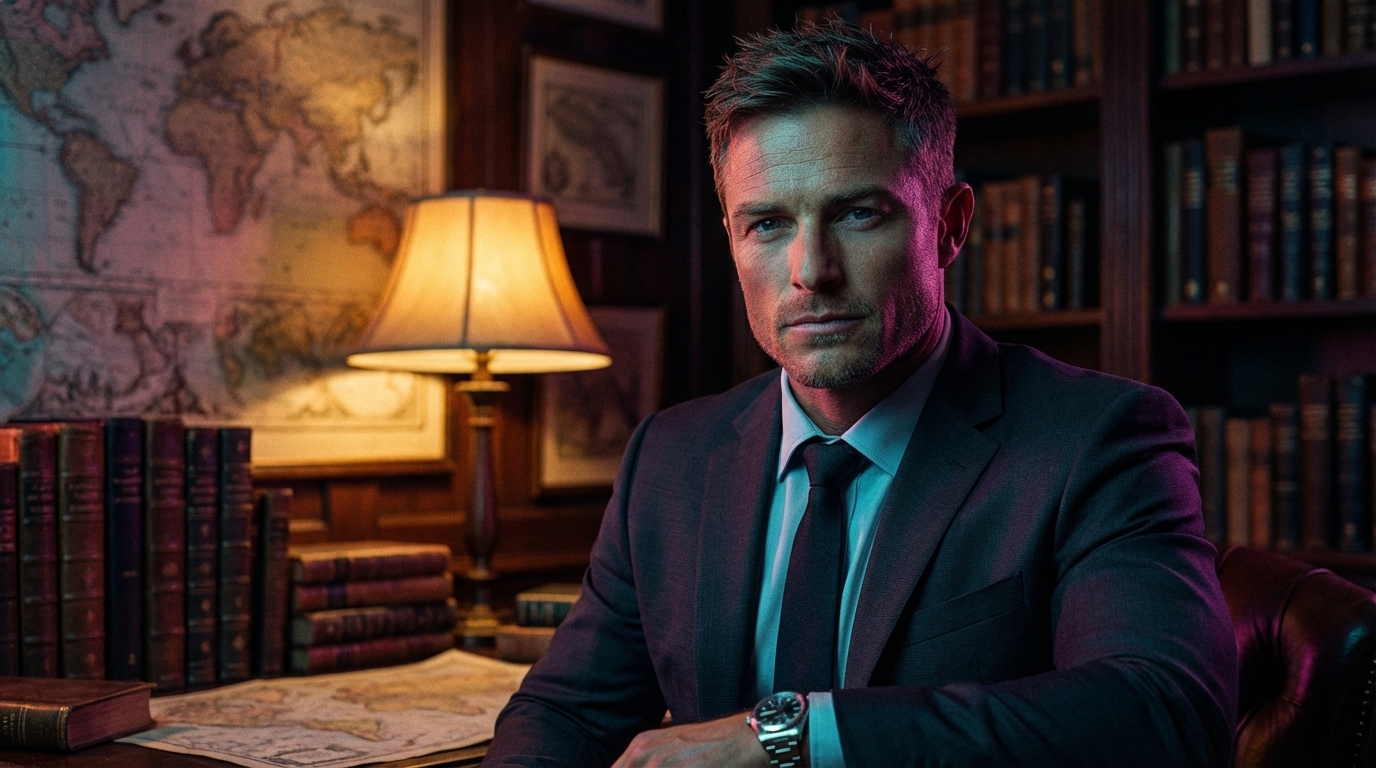
Angus Whitehall, born on 15th June 1989 in Hobart, Tasmania, is a Detective Constable with the Hobart Criminal Investigation Branch of Tasmania Police. Raised in Battery Point by a nurse mother and historian father, his path from a curious, community-minded childhood to the CIB was deliberate and methodical. He came of age professionally during the most devastating crisis in the division's recent history, and carried its weight with the quiet persistence that defines him.
Battery Point and the Making of a Curious Mind
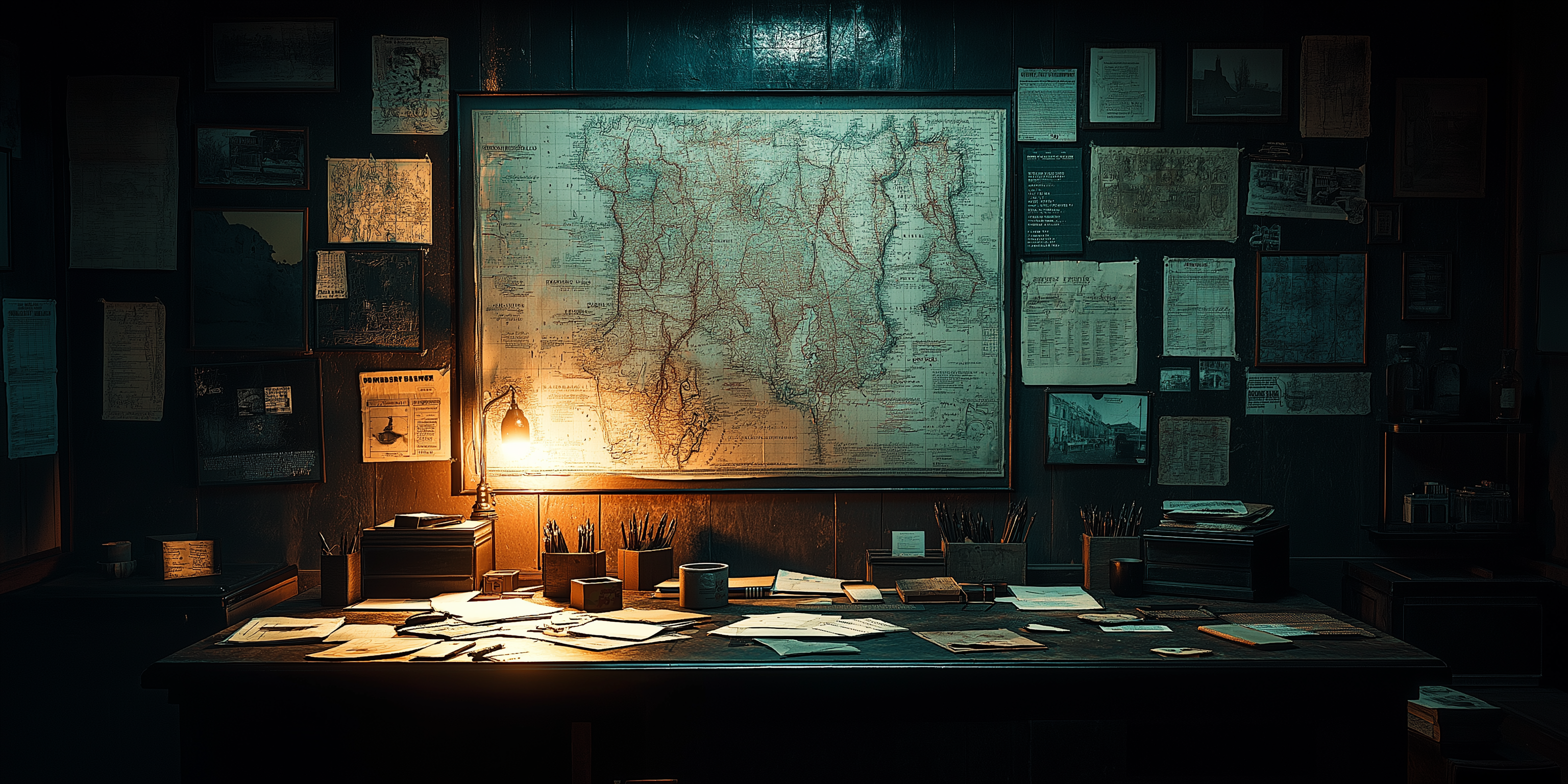
Angus Thomas Whitehall was born on 15th June 1989 at the Royal Hobart Hospital, the first child of William James Whitehall and Margaret Ruth Whitehall (née Coleman). The family settled in Battery Point, one of Hobart's oldest and most characterful precincts, where sandstone cottages and steep laneways descend towards the waterfront and the surrounding streets carry the quiet authority of deep history. It was an unusual neighbourhood in which to raise a child — more museum than suburb in some respects — and its effect on Angus was pronounced.
William was a local historian employed part-time by the Tasmanian Museum and Art Gallery and part-time through his own research commissions. His work filled the house with maps, bound ledgers, and conversation about the city's past, and he had an academic's habit of treating questions — even a child's questions — as things deserving of careful answers. Margaret worked as a registered nurse at the Royal Hobart Hospital's medical ward, and brought home from her shifts a different kind of rigour: an attentiveness to the physical world, a calm under pressure, a tendency to assess situations before acting. Between them, William and Margaret produced a household where curiosity was assumed and thoroughness was expected, without either quality being particularly enforced.
Angus's sister, Emily Ruth Whitehall, arrived in 1993, when Angus was three. The four-year gap between siblings meant that their childhood paths diverged in practical ways — different school cohorts, different social circles — but the house was small enough that they were rarely isolated from one another. Emily, who would later pursue marine biology at the University of Tasmania, was a quieter, more inward child than her brother, and the two complemented each other in the way that siblings sometimes do when their temperaments happen to balance rather than collide.
Angus grew up walking to the waterfront, exploring the lanes of Battery Point on his bicycle, and listening to his father describe what had happened in the buildings they passed. History was not abstract to him in the way it is for many children — it was the texture of the streets he moved through every day, and William's narrations gave Angus an early habit of looking at visible things and asking what lay underneath them. That instinct — the awareness that surfaces conceal stories — would take him, eventually, into detective work.
Mount Stuart and the Scouting Years
Angus attended Mount Stuart Primary School from 1995, the local state school at the top of a hill that commanded views across Hobart's southern suburbs towards the Derwent. He was a reliable student — diligent without being exceptional, well-liked without being the kind of child who required constant social attention. His teachers noted strong reading comprehension and an unusual capacity for sustained concentration, qualities that served him well in subjects requiring careful analysis but occasionally frustrated him in the looser, more creative aspects of the curriculum.
He joined the local Scouts group at the age of eight, in 1997, and remained an active member through to his mid-teens. The Scouts provided structure that suited him — clear tasks, measurable outcomes, the satisfaction of working towards something verifiable. He earned his badges methodically, without rush, and developed leadership habits early: the ability to organise a small group around a specific task, to manage disagreement without escalating it, to ensure that quieter members contributed rather than being talked over. His Scout leader, a retired electrician named Russell Grady, later recalled Angus as one of the most dependable patrol leaders he had known — not because he was commanding or charismatic, but because he could be relied upon absolutely.
Outside of school and Scouts, Angus was a physically active child. Battery Point's proximity to the waterfront meant that sailing was available, and William introduced both children to the sport through the Derwent Sailing Squadron, though Angus's enthusiasm was more sustained than his father's. He also discovered rugby during his primary years through a junior club at a nearby oval, a sport to which he would remain committed well into adulthood.
Hobart College and the Sharpening of Direction
Angus enrolled at Hobart College in 2002, beginning Years 11 and 12 alongside the standard cohort of fifteen and sixteen-year-olds navigating the shift from the looser structure of secondary school to the subject-specific rigour of senior secondary education. The college, situated in the southern suburbs, offered a wider range of elective subjects than most secondary schools, and Angus used this breadth deliberately, choosing Legal Studies, Modern History, and Physical Education alongside compulsory subjects.
He participated in the college debate team, where his habit of methodical, evidence-based argument translated more effectively than he had expected. He was not a naturally performative debater — he lacked the theatrical instinct that drew audiences to certain speakers — but he was hard to defeat on the substance of a case, and experienced debaters found his preparation disarming. His Physical Education cohort overlapped substantially with the college rugby team, and he played as a flanker throughout both years, developing the spatial awareness and capacity for strategic repositioning that the position requires.
By his final year, Angus had settled on criminology as a field of study with the quiet decisiveness that characterised most of his significant choices. The decision was not dramatic — there was no single moment that crystallised it, no particular incident that directed him towards law enforcement — but the convergence of his interest in history, his preference for evidence-based reasoning, and his awareness that societies required people willing to investigate their own worst events pointed consistently in one direction.
He graduated from Hobart College in December 2007 with strong results in Legal Studies and History, his performance reflecting the combination of careful preparation and genuine interest that produced the best outcomes he was capable of.
University of Tasmania (2007–2010)
Angus enrolled at the University of Tasmania in early 2008, undertaking a Bachelor of Arts in Criminology across the Sandy Bay campus. The programme suited him in ways that reinforced both his strengths and the gaps in his education he hadn't yet identified. He excelled in subjects requiring the systematic analysis of evidence — forensic methodology, criminal psychology, patterns of offending behaviour — and found the rigour of academic assessment more engaging than he had expected.
He was not a social isolate at university, but neither was he the kind of student who dissolved into the social life of campus. He played rugby for one of the university club teams, drank the occasional beer at the pub on Friday evenings, and shared a house in Sandy Bay with two other criminology students during his second and third years. He was a reliable, considered flatmate — paying bills on time, managing shared spaces without creating friction, cooking competently if not enthusiastically.
His Honours dissertation, submitted in 2010, examined patterns of recidivism in property crime across Tasmania's regional population centres, comparing rates in communities with different levels of police visibility. It was a methodical, well-sourced piece of work that his supervisor, Associate Professor Gavin Hartley, described as demonstrating a clear investigative instinct — an ability to identify relevant variables and trace their effects across complex data. The observation was accurate, and it reflected what Angus had been developing since childhood: the habit of not stopping at the obvious explanation.
He graduated in 2010 with strong enough results to pursue the policing pathway he'd been planning since Hobart College.
Tasmania Police Academy (2010–2011)
Angus entered the Tasmania Police Academy in Rokeby in late 2010, commencing the recruit training programme and working towards the Certificate IV in Government (Investigations). The Academy's structured environment — the long days, the physical demands, the procedural depth — proved a natural fit for someone who had been building towards it since his mid-teens.
His cohort was a mixed group: recent graduates like himself, career-changers in their thirties, a few recruits from interstate seeking the particular character of Tasmanian policing. Angus fitted in without standing out. He was not the fastest in fitness assessments, nor the highest-scoring in written examinations, but he was consistently strong across all components, and his scenario performances drew particular notice — the instructors observed that he read developing situations with an accuracy that exceeded most recruits at equivalent training stages.
The interview technique modules were where Angus demonstrated what would later become one of his professional signatures: patience. Where other recruits rushed towards conclusions in witness interviews, applying pressure when cooperation stalled, Angus let silences run. He had learnt — from where, exactly, he could not have said; perhaps from watching his father listen to people at museum functions, perhaps simply from disposition — that people filled silences with things they hadn't intended to say, and that this was often more useful than direct questioning. His instructors noted it. His peers found it quietly unnerving.
He graduated from the Academy in 2011 and received his initial posting as a Probationary Constable attached to Hobart Division.
Probationary Constable and Early Career (2011–2015)
Angus's probationary placement exposed him to the full range of frontline policing that general duties in a mid-sized Australian capital city produces: domestic incidents, vehicle collisions, minor assaults, public order management, welfare checks on individuals reported missing or distressed. He responded to each category with the same methodical competence — never spectacular, never negligent, consistent in the way that makes an officer genuinely useful rather than merely present.
He was confirmed as a permanent Constable in 2012 and continued in general duties, developing the practical knowledge of Hobart's geography and social texture that would serve him well when he later moved into investigative work. He knew which suburbs generated which patterns of offending, which licensed premises reliably produced late-night incidents, which parts of the waterfront required attention on long summer evenings. This accumulated local knowledge was not something any university course provided, and Angus gathered it with the same unhurried thoroughness he applied to everything else.
His promotion to Senior Constable in 2015 brought additional responsibilities, primarily in property crime investigations and minor assault cases where the volume was high and the investigative complexity modest but real. He also took on the informal mentoring role that senior constables in general duties often acquire — the new recruits needed someone to interpret the gap between Academy training and street reality, and Angus's combination of patience and directness made him effective in this. He did not glamorise police work or inflate his experience. He told new constables what they needed to know, answered questions without condescension, and helped them navigate the institutional culture without either cynicism or false enthusiasm.
Criminal Investigation Branch (2018–Present)
Angus earned the rank of Detective Constable and joined the Hobart Criminal Investigation Branch in early 2018, the goal he had been building towards across seven years of general duties. The placement brought him under the supervision of Detective Inspector Sienna Alice Blackwood, who had led the CIB since 2016 and whose combination of analytical rigour and interpersonal intelligence he came to respect quickly. He was assigned to a portfolio of serious crimes — property offences with organised elements, aggravated assaults, complex fraud — and began building the investigative case files that were distinct from the volume-driven work of general duties.
He had been in the role for only a matter of months when the events of July and August 2018 restructured the division's world entirely.
The Jennings Investigations (August 2018)
On 2nd August 2018, the remains of Cody Brian Jennings — a man who had been missing from South Australia since 1997 — were discovered at a residential property in Berriedale belonging to Luke Smith. The scene was unlike anything in Angus's training or experience: evidence of extreme violence, animal wounds that defied easy identification, blood traces belonging to a serving detective, and a badly injured man whose account of what he had seen and done was conspicuously incomplete. Within twenty-four hours, the property had burnt to the ground.
Angus was assigned to the investigation as Detective Constable Whitehall under Sienna Blackwood's direct supervision. The work brought him into sustained contact with a body of evidence that resisted conventional frameworks at every turn — witnesses whose stories failed to cohere, forensic findings that suggested phenomena investigators had no protocol for documenting, and a broader pattern linking the Jennings discovery to the simultaneous disappearances of Karl Matthew Jenkins and an individual named Luke Smith under circumstances that no investigation concluded satisfactorily.
The interview Angus conducted with Benny Salter — a man found injured at the Berriedale property and initially resistant to full disclosure — demonstrated his particular strengths. Salter's first account, offered on 8th August, was partial and guarded, confirming the presence of two women subsequently identified as Jenny Triffett and Sharon Pafistis but volunteering nothing further about his own role. Angus did not push. He listened, noted the gaps, and returned with the patience of someone who understood that a reluctant witness revealed more across two careful conversations than under the pressure of one aggressive interrogation. The second interview, conducted on 13th August, produced a disclosure of considerably greater significance: Benny admitted that he had been at the property at the specific request of Detective Sarah Jane Lahey, that his presence related to a broken window she had asked him to repair, and that the connection between Lahey and the Berriedale scene was not incidental.
The revelation was significant. It contributed to the broader picture that Internal Affairs and the CIB were assembling in the days after Lahey's death — a picture of a detective whose judgement had become catastrophically compromised by personal entanglements, and whose actions in the final weeks of her life had created complications that investigation was still working to untangle months later.
The Death of Detective Sarah Lahey
On 8th August 2018, Sarah Jane Lahey died during a confrontation with Gladys Cramer in Myrtle Forest, observed at a distance by a surveillance team led by Detective Sergeant Alexander Stout. Angus and Sienna Blackwood were among the first senior investigators to arrive at the scene, and the experience of walking into that particular forest clearing — a colleague dead, the surveillance team managing their own shock, the procedural machinery of a line-of-duty death initiating around something that felt anything but procedural — settled into Angus in ways he did not immediately articulate.
He had not known Sarah Lahey well. She had been part of the division he was joining rather than someone he had worked alongside in any sustained sense, and their professional contact had been incidental rather than close. But she had been a Detective, his rank within the same unit, a person whose face he had passed in the corridor, and her death in circumstances connected to decisions she had made inside the division he had just joined was a particular kind of reckoning. He filed his reports, processed the scene, and did the work.
The arrest of Gladys Cramer on 8th August 2018 was documented in the arrest report prepared jointly by Sienna Blackwood and Angus Whitehall, detailing Cramer's apprehension at Myrtle Forest, her transport to the Hobart Police Station at 47 Liverpool Street, and the booking procedures that followed. Cramer was charged with manslaughter, obstruction of justice, and involvement in the theft of Cody Jennings' body from the morgue. In the subsequent interview at the station, Angus conducted the initial questioning. Cramer was cooperative but visibly distressed, and Angus brought to the interview the same controlled patience he had developed over seven years — not exploiting her distress, not softening his questions in response to it, but finding the register in which a woman in genuine grief might speak with accuracy about what she had done and why.
Aftermath and the Weight of a Troubled Year
The weeks following August 2018 involved the kind of institutional processing that major investigative failures generate: internal reviews, coronial processes, questions about supervision and oversight, the careful examination of how a detective could have become so comprehensively compromised before the division noticed. Angus participated in these processes as a relatively junior member of the CIB — he was not under scrutiny himself, but he was present in a division that was, and the experience of watching an institution examine itself honestly was formative in ways he could not have predicted.
Karl Matthew Jenkins, whose disappearance from the shed at Jeffries Manor in Granton on 2nd August had set a parallel strand of investigation running alongside everything else, remained a declared missing person throughout this period. Angus had never worked directly with Jenkins, but Jenkins's disappearance was entangled with the Jennings investigation in ways that made it structurally inseparable. The formal declaration of Karl Matthew Jenkins' presumed death in 2023 closed a file without closing the questions that file contained.
For Angus, the second half of 2018 and the years that followed involved building a CIB career under conditions that were, by any measure, extraordinary for a first year in the role. The division was managing the aftermath of Sarah's death and the investigation of its own conduct simultaneously, and there was very little about the institutional atmosphere that resembled the steady accumulation of investigative experience Angus had imagined when he applied for the CIB transfer.
Continuing Career (2019–2026)
The years following the 2018 crisis saw Angus establish himself within the CIB with the methodical, unremarkable consistency that had characterised every stage of his career. He took on complex investigations, contributed to joint operations with other divisions and mainland jurisdictions, and continued developing the interview skills that remained his clearest professional strength. He was promoted to Detective Senior Constable in 2021 — an internal grade progression that reflected sustained performance without the title change that full Detective Sergeant would eventually bring.
He worked under Sienna Blackwood's continued leadership, a supervisory relationship that had been forged in the most difficult possible circumstances and had consequently developed an unusual depth of professional trust. Blackwood's expectations were high and consistently applied; Angus met them without requiring either additional encouragement or significant correction. They were not close in the social sense — Angus respected the boundaries between professional relationships and personal ones — but they functioned well, and that was worth more than warmth.
His interest in organised crime patterns deepened through this period, and he completed specialised training in financial crime investigation in 2022 through the Australian Institute of Police Management, adding a skillset that complemented his existing investigative portfolio. The course appealed to the same analytical instinct that had drawn him to criminology in the first place — the sense that serious criminal activity was never as chaotic as it appeared, that behind the surface disorder there were patterns, and that patterns could be traced.
Personal life ran alongside professional life with the modestly separate quality that Angus had always maintained. His parents, William and Margaret, remained in Battery Point, and Angus visited most Sundays, sitting with his father over the newspaper and with his mother over tea, the conversations ranging across whatever William had been researching and whatever Margaret had encountered on the ward that week. His sister Emily, whose marine biology work had taken her first to the University of Tasmania and then to research positions that divided her time between Hobart and the Southern Ocean research stations, visited when at home with the easy familiarity of siblings who had never made their relationship complicated.
He remained committed to rugby, playing for a Hobart club side into his mid-thirties before the accumulated minor injuries of a flanker's career made him retire from competitive play with the philosophical acceptance of someone who had always understood that physical sports had a timeline. He shifted his energy to hiking — the trails on and around kunanyi/Mount Wellington, primarily — and to the photography habit he had developed during his university years, which had grown from casual documentation into something that required better equipment and genuine compositional thought.







