Angus Callum Stewart
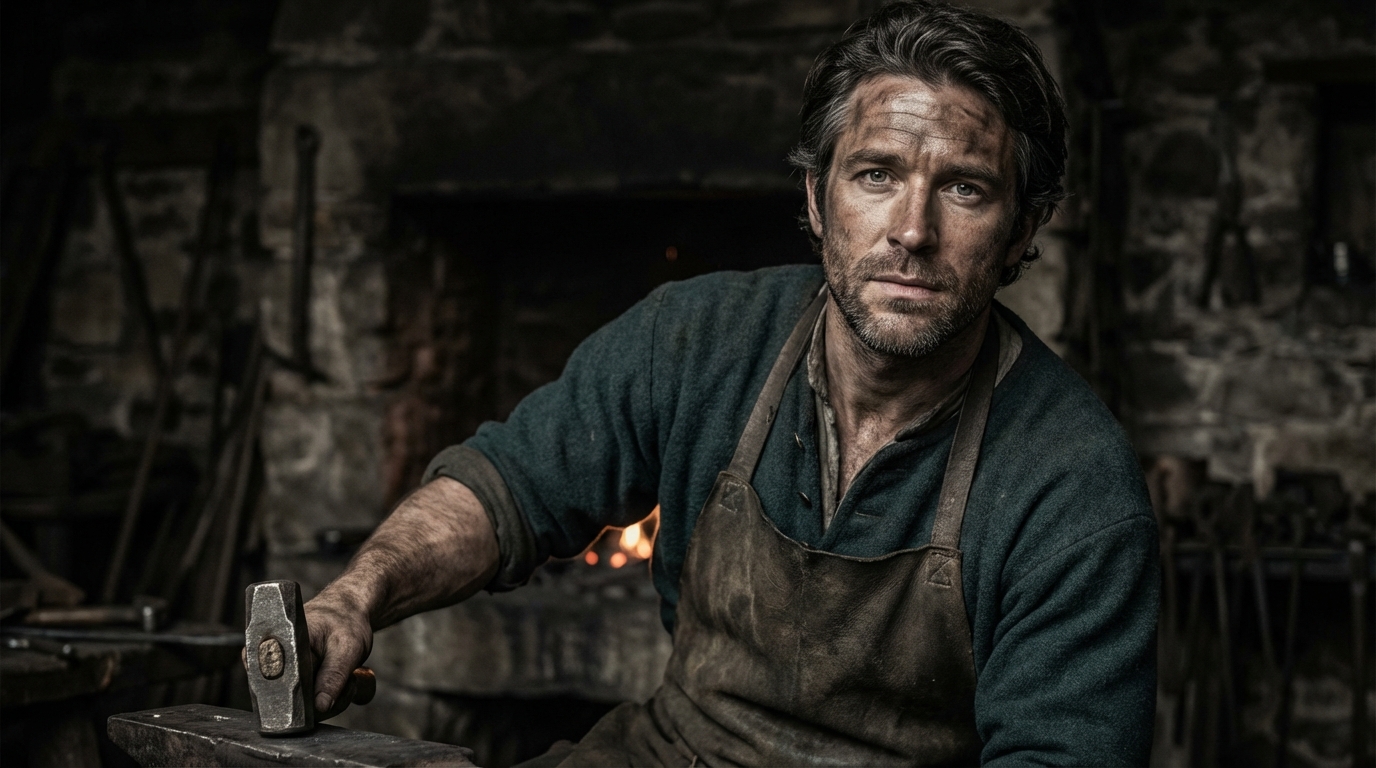
Born in 1714 beneath the shadow of Ben Nevis, Angus Callum Stewart rose from a shepherd's son to become one of Edinburgh's most respected blacksmiths. His marriage to Morag MacKenzie produced four daughters—Elspeth, Effie, Katrina, and Violet—each destined for extraordinary fates beyond the mortal realm. A man of profound integrity and quiet strength, Angus shaped not only iron but the characters of the remarkable women who would carry his values across worlds. His death in a forge accident in June 1754, coupled with undisclosed debts, left his family in precarious circumstances—yet his legacy endured through daughters who became Guardians of New Edinburgh.
Highland Beginnings
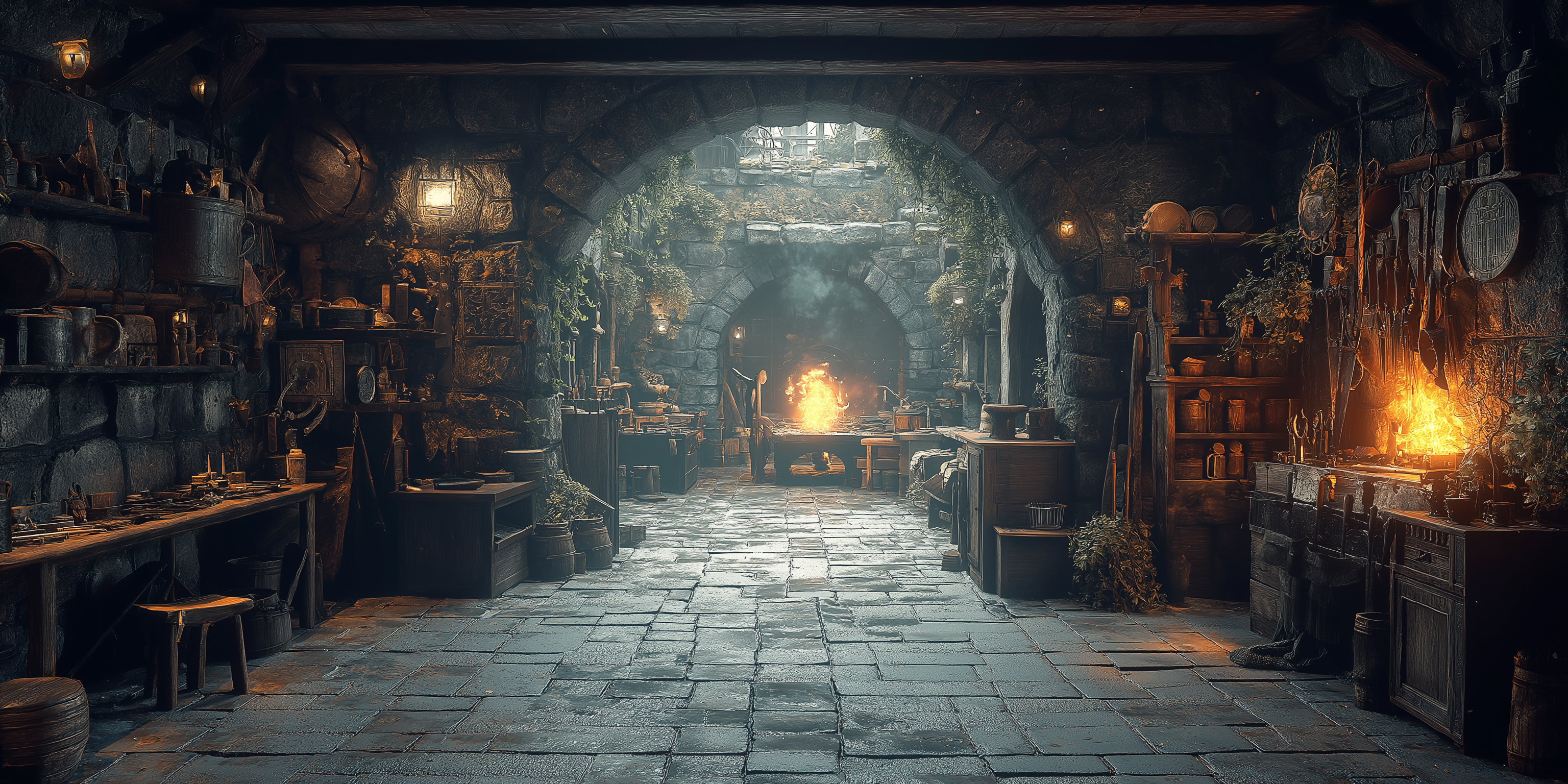
Angus Callum Stewart entered the world on 8 September 1714 in a small blackhouse nestled in Glen Nevis, within sight of the great mountain that would shape his character as surely as any hammer shaped iron. He was the fourth child and second surviving son of Callum Iain Stewart, a shepherd who held grazing rights on Cameron lands, and Mairi Beathag MacNab, a herbalist and midwife whose healing hands had delivered half the children in Fort William and the surrounding glens.
The Stewart household knew both love and loss in equal measure. Before Angus drew his first breath, his parents had already buried two sons—Seumas, stillborn in 1707, and Iain, taken by fever at seven months in 1709. His elder sister Margaret, born in 1711, survived to adulthood, but another sister, also named Morag, lived only five weeks before succumbing to croup in 1720. Between these sorrows came Angus, and after him, Alasdair in 1717—the brother who would later march to Culloden and never return.
Childhood in the Highlands meant learning the rhythms of the land before one could properly read. Angus accompanied his father on long treks through the hills, tending sheep in summer pastures, learning to read weather in the movement of clouds over Ben Nevis. Callum Stewart was a man of few words but absolute integrity—a handshake from him, the locals said, was worth more than any written contract. These values seeped into his second son like water into stone, shaping channels that would define Angus's character for the rest of his days.
Yet it was his mother's influence that first sparked Angus's fascination with transformation. Watching Mairi grind herbs into healing salves, seeing raw plants become medicine through knowledge and careful work, the boy began to understand that the world could be changed by skilled hands guided by patient minds. When he was old enough to venture into the village smithy—drawn by the ring of hammer on anvil and the strange alchemy of fire turning dull ore into gleaming metal—his path became clear.
The Forge's First Lessons
In the autumn of 1728, fourteen-year-old Angus Callum Stewart walked into the workshop of Hamish MacGregor, the master blacksmith of Fort William, and asked to learn the trade. MacGregor, a childless man of forty-two who had relocated from Inverness nearly two decades prior, saw something in the shepherd's son that others might have missed—not merely strong hands and a willing disposition, but a quality of attention, a patience unusual in one so young.
The apprenticeship that followed was rigorous. MacGregor demanded precision in all things, teaching that a blacksmith's work was only as good as his worst piece. Under his tutelage, Angus learned to read the colours of heated metal, to understand the precise moment when iron became malleable enough to shape yet retained its strength. He learned that rushing produced brittle work, that the finest craftsmanship required both force and restraint in careful balance.
Beyond technique, MacGregor imparted philosophy. The forge, he taught, was a place of honest transformation—no amount of skill could make poor iron into good steel, and no shortcuts existed that did not ultimately betray themselves. These lessons extended naturally to character. A craftsman's reputation, once damaged by shoddy work or broken promises, could never be fully restored. Angus absorbed these principles until they became indistinguishable from his own convictions.
The apprenticeship formally concluded around 1735, when Angus was twenty years old. By then, his work had begun to attract notice beyond Fort William. His tools were praised for their balance and durability, his decorative pieces for their understated elegance. MacGregor, watching his finest apprentice surpass him in certain technical refinements, felt not jealousy but the quiet satisfaction of legacy secured.
Morag
In the summer of 1735, Angus travelled to Glenfinnan to deliver commissioned work for a local merchant. The village lay perhaps fifteen miles from Fort William—close enough for trade, far enough for its own distinct character. There, in her father's weaving workshop, he encountered Morag MacKenzie.
She was nineteen years old, possessed of auburn hair and sharp green eyes that seemed to assess everything they observed. The daughter of Hamish MacKenzie, a weaver, and Fiona, a midwife, Morag had inherited her father's understanding of intricate patterns and her mother's practical wisdom. She worked at her loom with the same focused attention Angus brought to his anvil, and when they spoke—first of their respective crafts, then of everything else—each recognised in the other a kindred disposition toward the world.
Their courtship was neither swift nor demonstrative. Angus returned to Glenfinnan when work permitted, finding reasons to deliver goods that might have been entrusted to others. Morag, for her part, began weaving pieces she knew would please the blacksmith's eye—subtle patterns in fabric that echoed the decorative ironwork she had seen in his commissions. By 1736, their intentions were understood by both families, and on 27 June 1737, they married in a simple ceremony in Glenfinnan, surrounded by the rugged beauty of the Highlands and the people who had shaped them.
Edinburgh
The decision to leave the Highlands was not made lightly. Fort William offered security and familiar ground, but Edinburgh offered opportunity. The Scottish capital, in those years between the Jacobite risings, was experiencing a period of commercial and intellectual expansion that would later be called the Scottish Enlightenment. Wealthy merchants, professional men, and the aristocracy all required the services of skilled craftsmen, and a blacksmith of genuine talent could build a reputation impossible to achieve in the rural Highlands.
Through MacGregor's connections, Angus secured a position with Duncan Crawford, an established blacksmith whose forge in the Grassmarket had served Edinburgh's tradesmen and gentry for over two decades. Crawford, approaching sixty and without sons to inherit his business, welcomed the young Highland smith—not as an apprentice, for Angus's skills were already beyond that, but as a journeyman who might one day take the forge as his own.
The transition was not seamless. Highland smithing differed from city work in both scale and expectation. Edinburgh clients demanded not merely function but fashion, wanting decorative elements that reflected current tastes rather than traditional forms. Angus adapted, learning to balance his instinct for honest, durable work with the aesthetic requirements of urban commerce. Within three years, he had established sufficient reputation to set up his own modest forge nearby, still in the Grassmarket district, serving a growing clientele that valued both his craftsmanship and his reliability.
Morag, equally adaptable, found work as a seamstress. Her Highland weaving skills translated readily to the finer needlework Edinburgh's fashionable households required, and her quiet competence earned recommendations that kept steady work flowing to their modest home.
Fatherhood
The early years of their marriage had been marked by sorrow that Morag rarely spoke of in later years. Before Elspeth's birth, there had been losses—pregnancies that ended too soon, hopes that flickered and died before they could properly take hold. When their first daughter arrived on 17 May 1738, her survival felt less like expectation fulfilled than like grace unexpectedly granted.
Angus, whose own childhood had been shadowed by his parents' buried griefs, approached fatherhood with fierce tenderness. He had witnessed what loss could do to a family, how it could hollow out the centre of a household while the exterior remained intact. He was determined that his children would know themselves loved not merely through provision but through presence—through time spent, attention given, and affection openly expressed.
Effie followed on 3 November 1742, then Katrina on 12 February 1744, and finally Violet on 8 August 1746. Four daughters, each distinct in temperament, each cherished for her particular gifts. Elspeth, serious and responsible, inherited her father's sense of duty and her mother's practical intelligence. Effie possessed a natural charm and social grace that would serve her well in years to come. Katrina showed early aptitude for understanding how things worked, forever dismantling and reassembling whatever mechanisms she could find. And Violet, the youngest, combined artistic sensitivity with a dreamer's imagination that her father recognised as something precious requiring protection.
The forge became their second schoolroom. Angus taught his daughters not merely about metalwork—though each learned enough to appreciate the craft—but about the principles underlying it. Patience. Precision. The relationship between intention and outcome. The importance of understanding one's materials before attempting to shape them. These lessons, framed around glowing iron and ringing hammers, would serve the Stewart sisters in contexts their father could never have imagined.
Shadows and Silence
No life proceeds without moral complexity, and Angus Stewart's was no exception.
In 1740, circumstances brought him into contact with Helen Montgomery, a young healer and scholar some six years his junior. Helen, possessed of fierce intelligence and independent spirit, had rejected the conventional path expected of women in her position, choosing instead to pursue knowledge of medicine and natural philosophy. Their connection—intellectual at first, then deeper—developed over the following two years into an affair that Angus would carry as a weight of conscience for the remainder of his days.
The relationship ended in 1742, and in September of that year, Helen gave birth to a son she named Robert Angus Stewart. She never demanded acknowledgment, never sought to disrupt Angus's family, and raised the boy with the help of her own kin. Angus, for his part, ensured what provision he could manage discreetly, though the secret sat heavy in his chest—a betrayal of the very integrity he preached to his daughters. Helen died in 1746, when Robert was four years old, leaving the boy to be raised by her family. Angus's legitimate daughters never knew of their half-brother's existence during their father's lifetime.
Whether Morag knew or suspected, she never said. The marriage continued, outwardly unchanged, but certain silences between husband and wife may have carried more weight than words.
Years of Loss
The mid-1740s brought public calamity to Scotland that intersected painfully with Angus's private world. The Jacobite rising of 1745 swept through the Highlands like fire, drawing young men to the Stuart banner with promises of glory and restoration. Among them was Alasdair Stewart, Angus's younger brother—romantic, idealistic, and utterly convinced of the rightness of the cause.
Angus, from his Edinburgh vantage, watched the rising with mounting dread. His own political sympathies were complicated—he understood the grievances that fuelled Jacobite sentiment whilst recognising the practical impossibility of success against the full weight of the British state. He wrote to Alasdair, urging caution, but his letters either failed to arrive or failed to persuade. On 16 April 1746, at Culloden Moor, the Jacobite army was destroyed. Alasdair Stewart, twenty-eight years old, died with it.
The news reached Fort William before it reached Edinburgh. Callum Stewart, who had quietly discouraged his son's involvement whilst lacking the words or will to forbid it outright, received the report with the silence of a man for whom speech had become impossible. He continued his work—the sheep still needed tending—but something essential had departed. When Angus finally made the journey north to see his parents, he found his father diminished in ways that had nothing to do with age.
Callum died on 3 February 1752, of pneumonia following a harsh winter, though those who knew him understood that his lungs had merely caught up with his broken heart. Angus stood at the graveside in Fort William's old kirkyard, watching his father lowered into ground that already held too many of their family, and felt the full weight of being the surviving son—the one who had chosen safety whilst his brother chose glory and death.
His mother, Mairi, outlived her husband by eleven years, residing with Margaret's family in Fort William. She and Angus maintained correspondence, but the distance between Edinburgh and the Highlands meant their meetings grew infrequent. When news of his own death reached her in 1754, she added another lock of hair to the small wooden box she kept—the one that already held remembrances of the children she had lost before him.
Final Years and Hidden Burdens
By the early 1750s, Angus Stewart had achieved everything a Highland shepherd's son might reasonably hope for. His forge prospered, his reputation was secure, and his four daughters were growing into young women of intelligence and capability. Yet beneath this apparent stability, pressures were building that he concealed from his family with the same stoic silence his father had modelled.
The costs of maintaining their Edinburgh household whilst providing adequately for his daughters' futures had stretched his resources thinner than anyone knew. Investments made on poor advice had failed to return their promise. Commissions occasionally fell through, leaving gaps in income he covered through borrowing rather than reducing their standard of living. Angus, whose pride in providing for his family matched his pride in his craft, could not bring himself to admit that the former was becoming increasingly difficult.
These debts accumulated quietly, documented in papers Morag would only discover after his death.
Death
On 18 June 1754, whilst working on a commission for a merchant—the precise nature of which would be lost to history—a piece of red-hot metal slipped from Angus's tongs. The iron struck his chest, causing severe burns that local healers could not adequately treat. For three days, he lingered, his family keeping vigil in their modest home, the smell of lavender and desperate prayers filling the air.
Angus Callum Stewart died on 21 June 1754, aged thirty-nine years. He was buried in Greyfriars Kirkyard, Edinburgh, in a modest grave that his widow could barely afford.
In the aftermath, the full extent of his debts emerged. The forge and its tools were sold to satisfy creditors. The family's circumstances contracted sharply, leaving Morag a widow with four daughters to feed and clothe, the youngest not yet eight years old. The genteel poverty that followed would shape the next chapter of the Stewart sisters' lives—driving Elspeth, not yet seventeen, to seek employment at Moira MacKenzie's Emporium of Fashion, and setting in motion events that would eventually carry all four daughters far beyond anything their father could have imagined.







