4134.336 · December 2, 1814 AD
An Arrangement Beyond Propriety
During one of her regular visits to the Campbell Cove counting room, Eliza Donnelly proposed that she and William Jeffries meet privately in the Domain, away from the constraints of the dockside setting. Despite understanding the risks such an arrangement posed to both their futures, Jeffries agreed. They settled upon the following Sunday afternoon for their first clandestine meeting.
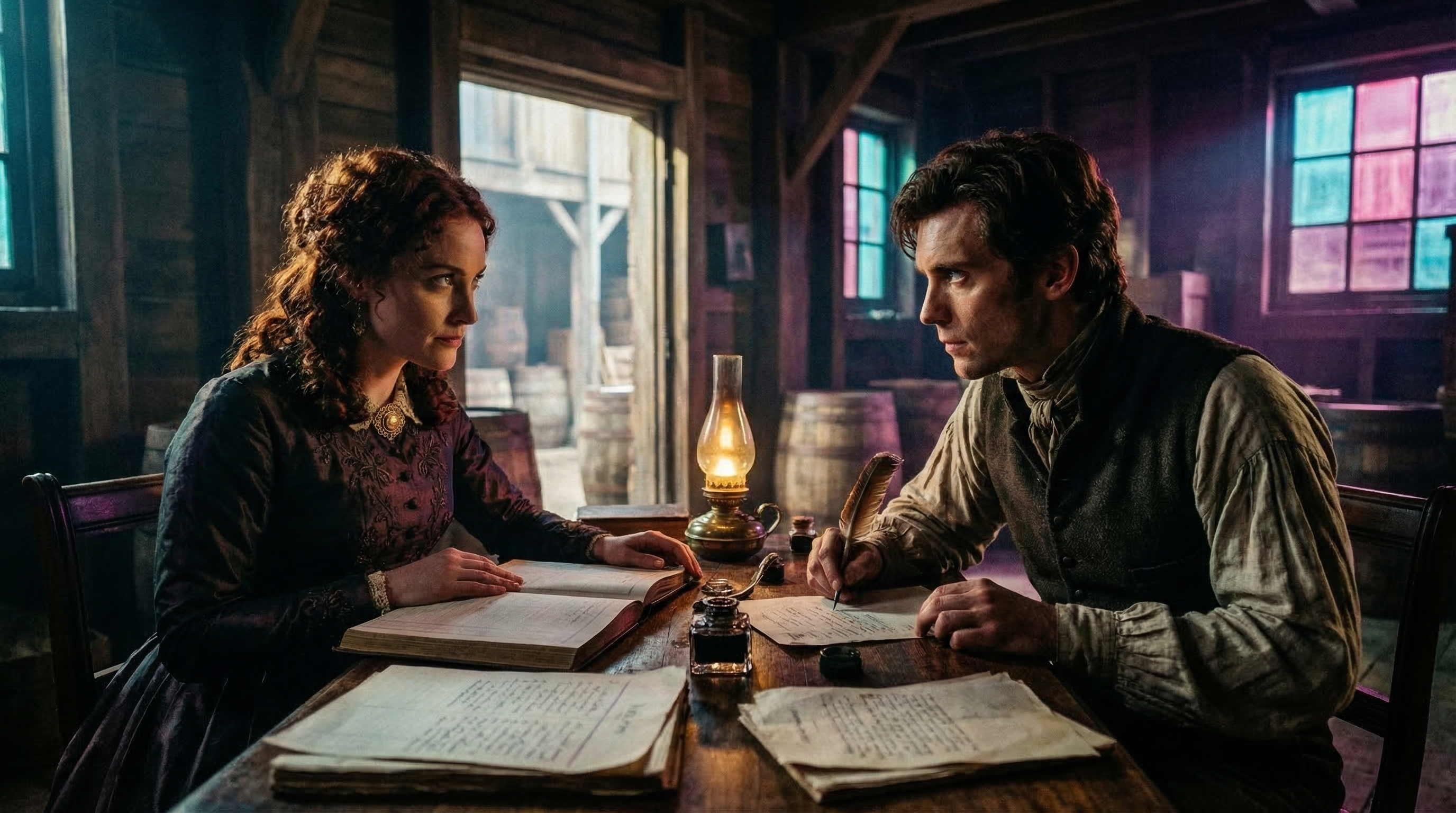
The weeks following their November conversation had established a pattern. Eliza Donnelly visited Campbell Cove at irregular intervals, always with legitimate business to conduct, always requesting William Jeffries's assistance with some aspect of her father's accounts. The counting room at the rear of Warehouse Three became their regular meeting place—a space where a merchant's daughter consulting records with a checker raised no particular comment, where conversations could range beyond the figures inscribed in ledgers without attracting unwanted attention.
During these encounters, Miss Donnelly had undertaken something approaching a commercial education. She explained the mechanics of colonial trade with a command of the subject that would have impressed men twice her age—the flow of goods between Sydney and the wider world, the margins that determined profit and loss, the strategies by which her father had built his fortune from nothing but a letter of credit and a willingness to work. Jeffries absorbed this knowledge with the same thoroughness he brought to cataloguing cargo, recognising its value for whatever future he might eventually construct.
Yet the conversations had begun to strain against the confines of their setting. The counting room offered privacy of a sort, but it remained a working space, subject to interruption, bounded by the rhythms of commerce that demanded attention. Both parties had grown hungry for something more—more time, more freedom, more of each other than the pretence of business consultation could provide.
It was on the second of December that Miss Donnelly proposed a solution. Her voice dropped lower than usual as she spoke, her eyes fixed on the ledger between them as though the words were easier to deliver without meeting his gaze. She described a place she visited sometimes—a grove of eucalyptus in the Domain, near the harbour's edge, where one could sit and watch the ships without being observed. She found it peaceful, she said. She thought he might find it so as well.
The implications of the proposal required no elaboration. A merchant's daughter meeting secretly with a convict was not merely improper; it was potentially catastrophic. Discovery would destroy her reputation and her prospects for advantageous marriage. For Jeffries, the consequences would be equally severe—his ticket of leave revoked, his position terminated, his hopes for advancement crushed beneath the weight of scandal. The colonial hierarchy did not forgive those who forgot their stations, and what Miss Donnelly was suggesting represented a profound forgetting.
Jeffries understood all of this. He had spent years learning to calculate risks, to weigh potential gains against probable costs, to move through the colony's treacherous social landscape without stumbling into the traps it laid for men of his background. Every instinct of self-preservation counselled refusal. He should thank her for her kindness, explain that their friendship had already exceeded what prudence permitted, and retreat to the safety of proper distance.
He did not refuse.
Sunday afternoon, he heard himself say. The docks were quiet then; he could slip away without being noticed. Miss Donnelly looked up from the ledger, and the smile that transformed her features was worth every danger, every impossibility, every rational objection his mind could muster. Sunday afternoon, she agreed. There was a path from the eastern gate that led through the gardens. He should follow it until he reached a clearing with a fallen tree. She would be waiting.
The arrangement was made in a matter of moments—a few quiet sentences exchanged over open ledgers, a time and place agreed upon, a boundary crossed that could not be uncrossed. They parted as they always did, Miss Donnelly departing first whilst Jeffries remained to maintain the appearance of work in progress. The harbour master's clock marked the hour. The docks continued their ceaseless activity. And two people who had no business meeting in secret had agreed to do precisely that.
The intervening days would test Jeffries's capacity for patience. He returned to his duties, tallied cargo, noted discrepancies, performed the role of diligent checker with the same thoroughness he had always displayed. But his thoughts returned constantly to the clearing in the Domain, to the woman who would be waiting there, to the threshold they were about to cross together.
Sunday approached with the inevitability of tide.







