Amelia Grace Mitchell (née Baker)
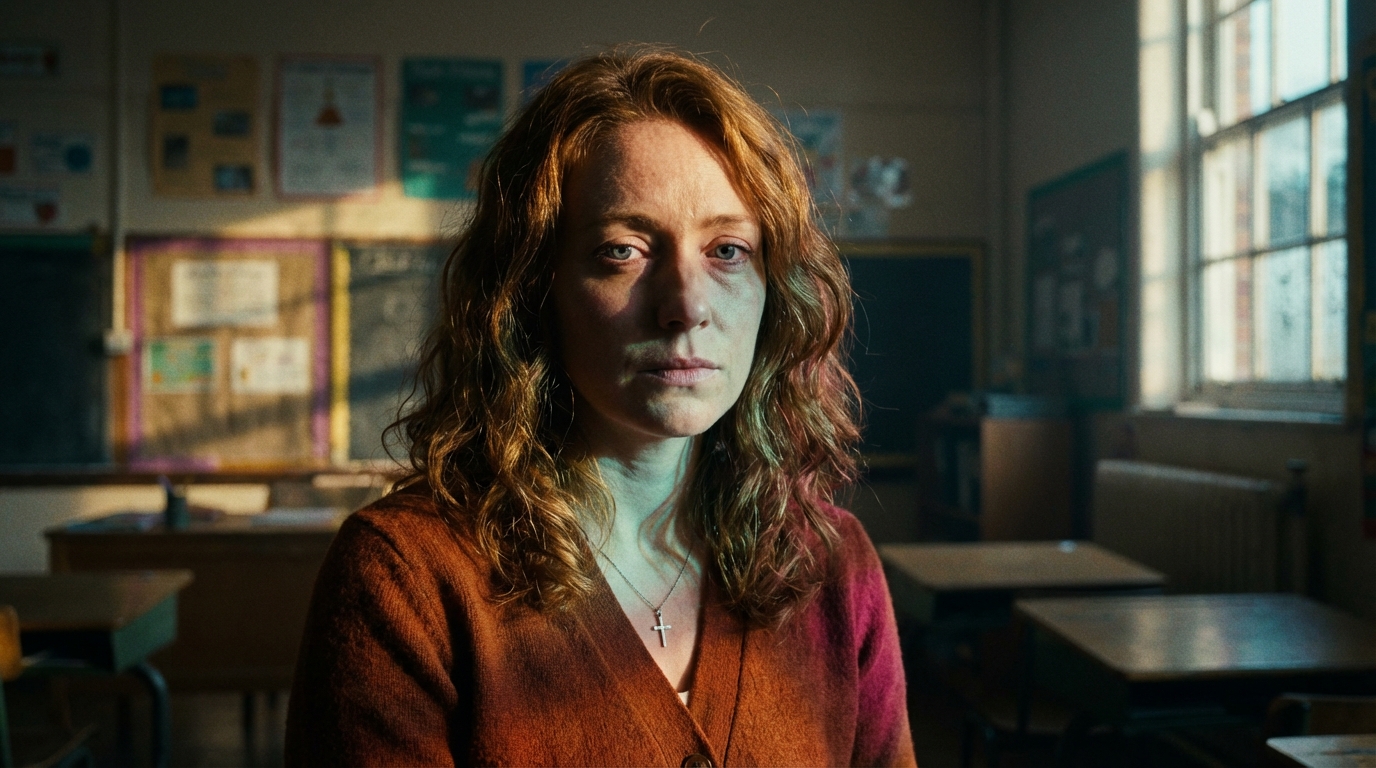
Amelia Grace Baker, born 28 May 1993 in Adelaide, South Australia, is the eldest of seven children in the Baker household of Smithfield. Her childhood was defined by the weight of first-born responsibility in a devout Latter-day Saint family where she served as second mother to six younger siblings. Now a primary school teacher in Mount Barker with a husband and two children of her own, she has built a life of deliberate ordinariness—a choice that carries both satisfaction and quiet grief since her parents and youngest siblings relocated to Clivilius in 2019, leaving Amelia to navigate faith and family from the familiar side of an impossible distance.
Birth and Early Childhood
Amelia Grace Baker was born on 28 May 1993 at the Lyell McEwin Hospital in Elizabeth, the first child of Jonathan Edward Baker and Evelyn Margaret Dawson Baker. Her arrival transformed two individuals into parents and established the template for a household that would eventually encompass seven children across eight years. For Jonathan and Evelyn, married barely two years, Amelia represented both the fulfilment of covenant promises and the beginning of responsibilities neither fully understood until they held her.
The family home in Smithfield, a northern Adelaide suburb characterised by modest brick houses and young families establishing themselves, provided the setting for Amelia's earliest memories. She would later recall fragments: the scent of sawdust from her father's workshop, her mother's voice singing Primary songs whilst folding laundry, the particular quality of afternoon light through the kitchen window. These images carried the golden haze of early childhood, before the household filled with siblings who would reshape her role from cherished only child to responsible eldest.
Benjamin's arrival in September 1994, when Amelia was barely sixteen months old, initiated the pattern that would define her childhood. She was too young to remember the adjustment, but family photographs capture her standing beside the bassinet with an expression of serious regard that relatives would later identify as characteristically Amelia—watchful, assessing, already calculating what this new presence might require of her.
The subsequent arrivals came with metronomic regularity: Nathaniel in 1996, Samuel in 1997, Rebecca in 1998, Lydia in 2000, and finally Chloe in 2001. By the time Amelia turned eight, she was the eldest of seven children, a position that carried expectations no one explicitly articulated but everyone understood. She learned early to anticipate needs, to soothe crying before it escalated, to model the behaviour her parents wanted her siblings to emulate. It was a role she accepted without question, though decades later she would wonder what parts of herself had been compressed to fit its demands.
Growing Up as the Eldest
The Baker household operated according to systems Evelyn had developed out of necessity—meal planning that fed nine, laundry rotations that never quite caught up, homework supervision that required Amelia's assistance by the time she reached upper primary school. Jonathan's work as an environmental engineer kept him occupied during daylight hours, and whilst he was present for family devotions and Saturday morning workshop time, the daily management of seven children fell largely to Evelyn, with Amelia serving as her most reliable deputy.
This arrangement suited Amelia's temperament in some ways and chafed against it in others. She possessed her mother's gift for organisation and her father's preference for quiet competence, traits that made her effective at supervising younger siblings and managing household tasks. But she also harboured a private self that rarely found expression—a girl who loved to read for hours uninterrupted, who wanted to linger over art projects without small hands demanding attention, who sometimes resented the assumption that her time belonged to the family rather than to herself.
She learned to hide this resentment, recognising it as ungrateful in a household where sacrifice for others was framed as spiritual virtue. Her mother's Relief Society lessons emphasised selfless service; her father's example demonstrated that love meant showing up consistently rather than demanding acknowledgment. Amelia absorbed these teachings genuinely whilst also feeling, in moments she rarely examined, that something in the arrangement was unfair. She pushed such thoughts aside as unworthy, a habit of emotional management she would carry into adulthood.
Her relationships with her siblings reflected the complexity of her position. With Benjamin, only sixteen months her junior, she developed a partnership of near-equals, the two eldest navigating the chaos together. Nathaniel and Samuel, the middle boys, existed somewhat outside her sphere—their interests in technology and hands-on trades created worlds she observed but didn't enter. The younger girls—Rebecca, Lydia, and Chloe—she mothered more directly, particularly Chloe, eight years her junior, who seemed to require gentler handling than the others.
School provided Amelia's primary escape from domestic responsibility, though she wouldn't have framed it that way at the time. She excelled academically without brilliance, her strengths lying in diligence and reliability rather than intellectual fireworks. Teachers described her as "mature for her age" and "a pleasure to have in class"—assessments that reflected genuine qualities whilst missing the weight of expectation that produced them. She was good at school because school made sense: clear requirements, defined outcomes, effort that translated predictably into results. Unlike home, where her best efforts couldn't prevent siblings from quarrelling or guarantee that everything she managed would stay managed.
Education and Vocation
Amelia attended Smithfield Primary School, walking distance from the family home, where she established patterns of conscientious achievement that would persist through her education. She wasn't the student who raised her hand first or sought attention, but her work was consistently thorough, her behaviour reliably appropriate. Teachers trusted her to help struggling classmates, to run errands, to manage small responsibilities—extensions of the role she played at home that she accepted without complaint.
Her transition to high school at Craigmore High coincided with Chloe's birth in 2001, a period Amelia would later recall as particularly exhausting. She managed Year Eight coursework whilst helping her mother through the adjustment to a seventh child, her own adolescent concerns subordinated to household needs. She made friends—other LDS girls, mostly, whose families attended Playford Ward—but struggled to maintain the casual intimacy that seemed to come easily to peers without her level of domestic responsibility. Friday night sleepovers required negotiation; Saturday activities competed with family obligations. She learned to decline invitations gracefully, framing her unavailability as choice rather than constraint.
Her academic interests crystallised around English and the humanities, subjects where she could lose herself in stories that took her beyond Smithfield's familiar boundaries. She discovered a particular affinity for children's literature, recognising in quality picture books and early readers the same satisfaction she felt when helping younger siblings decode words or discover narratives. The connection between her home experience and potential vocation formed slowly, without dramatic revelation—simply a gradual recognition that working with children felt natural, that she possessed skills others seemed to lack, that education offered a path both meaningful and practical.
She enrolled at the University of South Australia in 2011, pursuing a Bachelor of Education (Primary) whilst continuing to live at home and contribute to household management. The decision to commute rather than live on campus was practical—finances, family need, the familiarity of established routines—but it also reflected Amelia's ambivalence about independence. Part of her yearned for the freedom her peers described, the transformative experience of leaving home and discovering oneself. Another part couldn't imagine abandoning her mother to manage six children without her assistance, couldn't justify the expense when she could contribute instead.
Her university years passed in a blur of lectures, placements, and domestic juggling. She was a competent student—not outstanding, not struggling—who completed requirements methodically and found genuine satisfaction in practical teaching experiences. Her placement supervisors noted her patience, her ability to connect with difficult children, her capacity for the emotional labour that primary teaching demanded. These were skills she had developed across years of sibling management, now validated as professional competence.
She graduated in 2014, twenty-one years old, ready to begin a career that felt less like destiny than like the logical continuation of everything she had always done.
Career and Professional Life
Amelia's first teaching position came at a small primary school in the Adelaide Hills, a temporary contract covering maternity leave that extended into a permanent role when the original teacher decided not to return. The school's rural setting, serving farming families and commuters who had chosen space over urban convenience, suited her temperament. Class sizes were manageable, community connections were strong, and the pace allowed for the relational teaching she valued.
She discovered that she was genuinely good at the work—not in the ways that attracted recognition or advancement, but in the quieter ways that mattered to individual children and families. She could identify the student whose home life was difficult before anyone else noticed, could adjust her approach for the child who needed firmer boundaries or gentler encouragement, could maintain calm during the small crises that punctuated primary school days. Her classroom wasn't the most innovative or visually impressive, but it was reliably safe, consistently structured, and characterised by the kind of steady warmth that helped anxious children settle.
She moved to Mount Barker Primary School in 2017, seeking a permanent position closer to the Adelaide Hills community she had come to love. The school served a diverse population—families who had lived in the region for generations alongside newcomers fleeing metropolitan housing costs—and Amelia found purpose in navigating these varied needs. She taught Year Two, a grade she preferred for its blend of emerging independence and remaining sweetness, children old enough to engage academically but young enough to still believe their teacher was wonderful.
Her professional life carried satisfactions she hadn't anticipated. After years of domestic labour that went largely unacknowledged, teaching offered visible markers of contribution: children who learned to read, parents who expressed gratitude, colleagues who respected her reliability. She wasn't ambitious in conventional terms—she had no desire for leadership positions or professional profile—but she took quiet pride in her competence and the difference she made in children's lives.
The work also provided escape from family dynamics that had grown more complicated as her siblings pursued their own paths and her parents navigated changes she didn't entirely understand. At school, she was simply Miss Baker (later Mrs Mitchell), defined by her professional role rather than her position in the family constellation. It was a relief she didn't fully acknowledge, even to herself.
Faith and Church Life
Amelia's relationship with the Church of Jesus Christ of Latter-day Saints followed predictable patterns through childhood and adolescence—baptism at eight, Young Women's programmes through her teenage years, the assumption that mission or marriage would follow university graduation. Her parents' faith was sincere and central, shaping family rhythms and providing the moral framework within which she was raised. She absorbed these beliefs genuinely, finding comfort in their structure and community in their practice.
Her faith never experienced the dramatic testing that marked some Latter-day Saint journeys. She didn't struggle with doubt in the ways she heard others describe, didn't question foundational claims or wrestle with historical complications. Her relationship with the Church was less intellectual than practical—it provided community, meaning, and continuity with family identity. She served where called, attended consistently, raised her children in the same patterns that had shaped her own childhood.
This stability sometimes felt like shallowness when she compared herself to others whose faith had been forged through struggle. Her mother's spiritual conviction carried a depth Amelia admired but couldn't replicate; her father's integration of faith with environmental ethics reflected a synthesis she hadn't achieved. She worried, occasionally, that her belief was merely inherited rather than personally discovered, that she hadn't earned the testimony she claimed.
But she also recognised that faith expressed through consistent practice might be as valid as faith born from crisis. She showed up, served, taught Primary, led Relief Society lessons when called upon. She prayed daily, studied scripture weekly, attended the temple regularly. Perhaps this ordinary faithfulness constituted its own form of devotion, even if it lacked the dramatic narrative of challenge and triumph.
Her church involvement in Mount Barker connected her to a ward community distinct from her family's Playford Ward, a separation she found both refreshing and disorienting. She could be Amelia Mitchell here, known for her own contributions rather than her parents' legacy or her siblings' activities. But she also missed the deeper roots that came from generational connection, the sense of belonging to something larger than her individual participation.
Marriage and Family
Amelia met Daniel Mitchell during her final year of university, introduced through mutual friends in the Adelaide Hills LDS community. Daniel, two years older, worked as a builder's project manager—practical, steady, comfortable with physical labour and concrete achievements. Their courtship was unremarkable in the best sense: shared values discovered through unhurried conversation, compatibility confirmed through time spent with each other's families, affection that grew from friendship rather than lightning-strike attraction.
They married in the Adelaide Australia Temple on 12 March 2016, Amelia at twenty-two choosing the same early marriage path her parents had walked. The decision felt right, though she occasionally wondered whether she had chosen Daniel or simply chosen the pattern she had been raised to follow. She loved him—his reliability, his uncomplicated kindness, his willingness to build their life according to plans they made together. But she also recognised that she had never seriously considered alternatives: career before family, extended education, life paths that diverged from expectation.
Their first child, a son named Thomas, arrived in February 2018. Amelia found motherhood simultaneously natural and overwhelming—she had been caring for children her entire life, yet caring for her own child carried weight her sibling-minding had never approached. The exhaustion of new parenthood coincided with the strange events unfolding in her family of origin, the crisis involving Chloe that her parents discussed in careful fragments during Sunday dinners.
A daughter, Eleanor, followed in March 2020, born into a world reshaped by global pandemic and family rupture. By then, her parents and several siblings had relocated to Clivilius, a transition Amelia had declined to make. The decision—or perhaps non-decision, since she had never seriously considered leaving—created distance that phone calls couldn't bridge and that defined her current relationship with her family of origin.
Her marriage provided stability through these upheavals. Daniel didn't fully understand the situation with Clivilius—few people could—but he offered presence and practicality, helping with children whilst Amelia processed grief she struggled to name. Their partnership wasn't passionate or particularly romantic; it was functional in ways that sustained daily life and created space for her to manage emotions that might otherwise have overwhelmed her.
The 2018 Crisis and Its Aftermath
The events of 2018 that drew the Baker family toward Clivilius reached Amelia through filters of distance and partial information. She was living in Mount Barker by then, consumed by her first pregnancy and the demands of her classroom, connected to her family through weekly Sunday dinners that became increasingly strange as the year progressed.
She understood that something was happening with Chloe—something spiritual or supernatural or simply inexplicable—but the details remained unclear even as their implications grew. Her parents' conversations became elliptical, full of references to temple gatherings and prophetic direction that Amelia couldn't fully contextualise. Her mother's certainty intensified; her father's characteristic caution gave way to a resolve that unsettled her precisely because it seemed so unlike him.
When her parents announced their intention to relocate to Clivilius in early 2019, Amelia received the news with the numbness of someone confronting a reality too large to process. She was seven months pregnant, established in her career, building a life with Daniel in the Adelaide Hills. The idea of abandoning everything to follow her family into a situation she didn't understand felt impossible—yet watching them leave felt equally so.
She chose to stay, a decision that felt less like choice than like gravity keeping her where she already stood. Daniel couldn't leave his work; their life was in Mount Barker; she was about to give birth. These practical considerations provided justification for a choice that might have been made regardless, a preference for the known over the extraordinary that she recognised as fundamentally her own.
The family's departure left wounds she still hasn't fully examined. Her parents, three brothers, and youngest sister relocated to a place she couldn't visit or properly imagine. Benjamin and Lydia remained on Earth—Benjamin pursuing his accounting career, Lydia continuing her midwifery studies—providing some continuity of sibling connection. But the family constellation had fractured in ways that Sunday video calls couldn't repair.
She grieves without knowing exactly what she's grieving. Her parents are alive, contactable, apparently thriving in their new life. Yet they exist in a reality she has chosen not to share, and that choice—her choice—creates a guilt she struggles to acknowledge. She tells herself she made the practical decision, the responsible decision, the decision that protected her own family. These rationalisations are true without being complete.







