Amari daughter of Velu
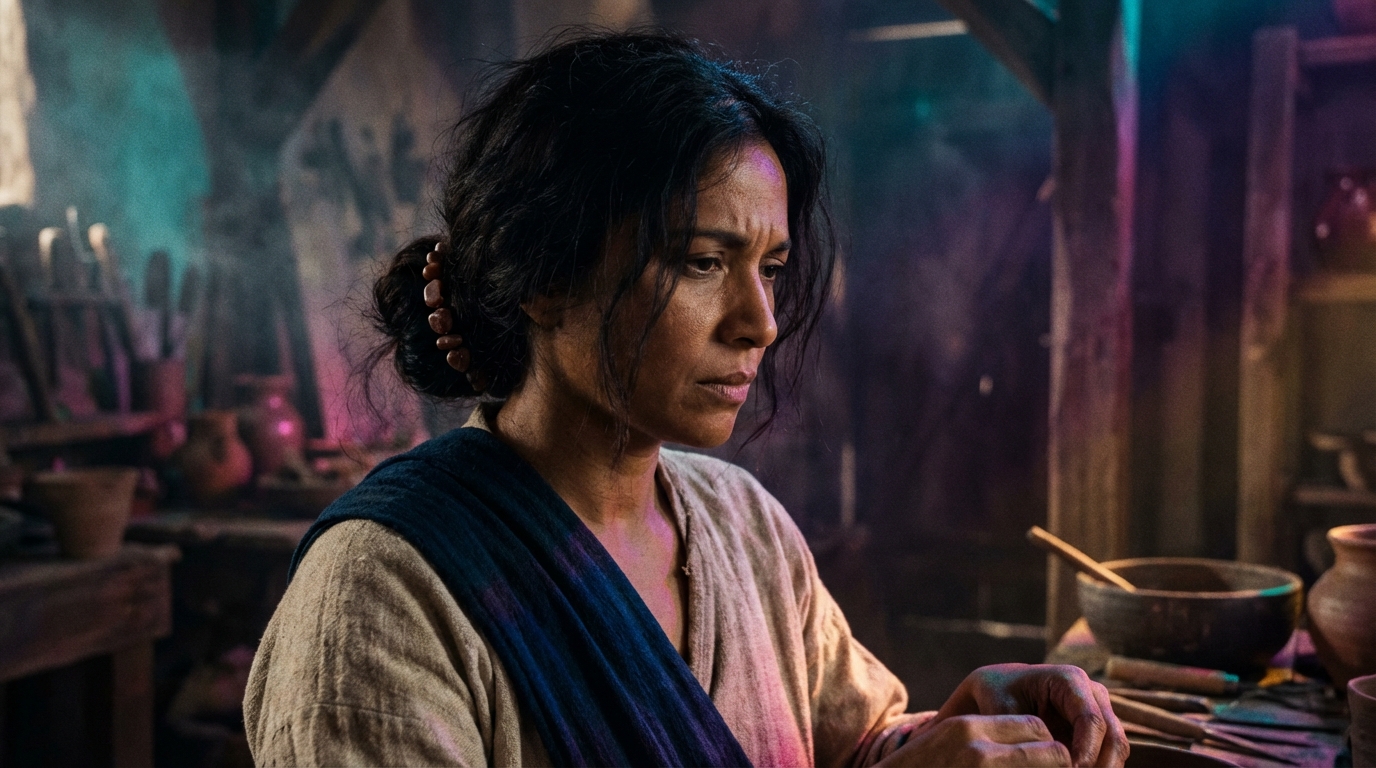
Amari daughter of Velu, born 6 May 2381 BCE in proto-Mohenjo-daro, was the eldest child of bead-maker Velu son of Kandan and Minnal daughter of Arasu. She married weighmaster Thondai son of Maran at twenty and raised five children — four surviving, one stillborn — in a household whose position in the settlement's granary administration placed her at the intersection of agricultural production and urban distribution. She outlived her husband by twenty-four years and spent her final decades as one of the southern quarter's oldest residents, consulted on matters of custom and memory. She died on 11 September 2302 BCE, aged seventy-nine.
The Craft Quarter Childhood
Amari was born on 6 May 2381 BCE in the craft quarter of proto-Mohenjo-daro, the eldest of three children born to bead-maker Velu son of Kandan and Minnal daughter of Arasu. She grew up in the eastern lanes where the sound of grinding wheels and the fine dust of worked carnelian constituted the daily atmosphere — a childhood measured in the rhythm of her father's bow drill and the quieter rhythm of her mother's arithmetic, the two sounds providing the complementary education that would define Amari's temperament for the rest of her life.
From Velu she absorbed the value of patient, careful work — the understanding that a task performed steadily and repeated daily accumulated into something that exceeded what any single day's effort could produce. Her father was not a brilliant craftsman. He was a reliable one, and the reliability sustained a household and a practice and a position in the craft quarter's economy for twenty-five years. Amari watched him drill beads with the focused absorption of a man whose identity was located in his hands, and she understood, before she was old enough to articulate the understanding, that the gap between adequate and exceptional was a fact to be acknowledged rather than a problem to be solved, and that the acknowledging — the honest assessment of what one's capacities permitted — was itself a form of competence.
From Minnal she absorbed something sharper. Her mother managed the household on a middle-tier craftsman's income with a precision that left no margin for waste and no room for the sentimentality that waste sometimes disguised itself as. Minnal counted. Minnal calculated. Minnal knew to the last unit of grain how far the household's resources would stretch and ensured that they stretched that far and no further. The frugality was not deprivation — the children were fed, the household was maintained — but it was a discipline, and Amari absorbed the discipline the way children absorbed the practices they observed every day of their formative years: completely, unconsciously, with a permanence that no subsequent experience would displace.
Her brothers — Arasu, born 18 September 2377 BCE, and Kandan, born 1 October 2370 BCE — occupied different positions in the household's daily economy. Arasu would inherit their father's bead-making trade. Kandan, the youngest, would apprentice as a potter before shifting to shell-working. Amari, as the eldest and only daughter, occupied the position that eldest daughters in craft quarter households routinely assumed — the extension of the mother's authority, the deputy whose domestic contribution supplemented the management that the mother directed. She helped Minnal before she understood what helping meant, the tasks assigned and completed with the unquestioning compliance of a child whose household did not explain its requirements because the requirements were self-evident and the explaining would have consumed time that the household's tight schedule could not spare.
Marriage to Thondai
Amari married Thondai son of Maran in approximately March 2361 BCE. She was twenty. Thondai was twenty-four, a weighmaster attached to the central granary — one of the men who stood at the intersection of agricultural production and urban distribution, ensuring that the standardised weights the Indus Valley civilisation prized were applied consistently to the grain that flowed through the settlement's storage and redistribution systems.
The position was not glamorous. It was administrative — the daily repetition of weighing, recording, and verifying, the maintenance of accuracy in a system whose functioning depended on the trust that accuracy produced. A weighmaster who measured inconsistently undermined the granary's credibility. A weighmaster who measured correctly was invisible — the accuracy expected, the precision unremarked upon, the contribution to the settlement's infrastructure acknowledged only in its absence, the way drainage was acknowledged only when it failed. Thondai measured correctly. He had inherited the position from his father, Maran son of Selvam, who had served the granary for decades before him, the administrative equivalent of the farming family's generational continuity on the southern fields.
Amari had watched enough of the craft quarter's precarious economics to value security above glamour. Her father's middle-tier income had sustained the household, but the sustaining had required her mother's relentless management, and the relentlessness had been visible to Amari throughout her childhood — the calculating, the stretching, the daily confirmation that the resources covered the needs with nothing remaining. Thondai's granary position offered a different economic architecture. The income was regular. The employment was stable. The household's survival did not depend on the market's appetite for carnelian beads or the quality of a single craftsman's output. The security was institutional rather than individual, and the distinction — the difference between depending on one man's hands and depending on the settlement's commitment to measuring its grain accurately — was a distinction that Amari valued with the particular intensity of a woman who had grown up in a household where the distinction had not existed.
The marriage was solid — affectionate without being demonstrative, built on mutual competence and the shared project of raising children in a settlement that rewarded reliability. Thondai was a quiet man whose professional life consisted of the same actions performed with the same precision day after day and whose domestic life reflected the same temperament. He did not argue. He did not raise his voice. He performed his duties and came home and ate his meal and spoke to Amari about the small events of the day with the unhurried thoroughness of a man who found the world's details genuinely interesting rather than merely obligatory. The interest was the quality Amari had not anticipated — the discovery that a quiet, administrative man whose life was conducted in units of measurement and quantities of grain possessed, beneath the professional precision, a curiosity about the texture of daily existence that made the evenings with him more engaging than the security of his position had led her to expect.
Children
Their first child, Minnal, was born on 29 August 2359 BCE — named for Amari's mother, the frugal arithmetician of the craft quarter, the naming carrying Minnal's particular competence into the next generation as a hope if not a guarantee. Pannal followed on 16 January 2356 BCE — named for Amari's paternal great-grandmother, the forceful manager of the farming household, the woman whose brisk efficiency had sustained Kandan's family through decades of agricultural life and administrative negotiation. Maran, the first son, arrived on 28 October 2354 BCE — named for Thondai's father, the weighmaster, the name connecting the boy to the granary tradition that two generations of his paternal line had served.
The fourth pregnancy, in 2350 BCE, ended in stillbirth. The labour lasted two days. The cord had wrapped around the infant's neck, the compression prolonged, the boy delivered lifeless after hours of effort that produced nothing except the particular exhaustion of a body that had been working toward an outcome that the cord had already determined. The child was not named. The absence of a name was not an absence of recognition — Amari knew what she had lost, and the knowing was specific rather than general, the loss of a particular child rather than the abstract category of infant death. Her recovery was slow. The slowness was physical — the two-day labour had extracted resources that required weeks to replenish — and it was also something else, a melancholy that settled into the space the dead child had vacated and that Thondai did not know how to address because Thondai's competence was the competence of measurement and verification and the melancholy was not a thing that could be measured or verified or corrected through the application of precision.
The melancholy lifted. It lifted not through resolution but through displacement — the daily demands of a household containing three living children requiring the attention that the melancholy had been occupying, the practical needs of feeding and clothing and managing gradually reclaiming the hours that grief had consumed. The lifting was incomplete. Amari carried the stillbirth in her body's memory the way Ilshu-Mahlah, her great-great-grandmother, had carried the stillbirth of her own third child decades earlier — as a wariness about subsequent pregnancies, a vigilance about the movements of the child inside her, the heightened attention of a woman who knew that carrying did not guarantee delivering alive.
Kaviri, the fifth child, was born on 5 December 2347 BCE — a daughter whose arrival was shadowed by the fear that the stillbirth had installed and whose first breath and first cry produced in Amari a relief that was indistinguishable, in its intensity, from the grief that had preceded it. Kaviri was healthy. The fear did not entirely lift until the evidence of the child's vigour had accumulated across enough weeks to persuade the part of Amari's mind that the stillbirth had made permanently cautious.
The Granary Household
The household that Amari managed occupied a position in proto-Mohenjo-daro's social structure that was distinct from both her parents' craft quarter and her husband's family's administrative tradition. The weighmaster's dwelling was situated near the granary — close to the settlement's centre, in a quarter where the streets were wider, the drainage better maintained, and the general infrastructure reflected the priority that the settlement's planners assigned to the administrative functions the quarter housed. The improvement over the craft quarter's eastern lanes was visible — cleaner water, broader lanes, drainage that functioned at the capacity its designers had intended rather than the diminished capacity that the eastern lanes' peripheral position imposed.
Amari managed the household with the competence her mother had modelled. The managing was easier here than it had been in the craft quarter — the regular income that Thondai's position provided eliminated the particular anxiety of a household dependent on a craftsman's fluctuating sales, and the margin between income and expenditure, whilst not generous, was wider than the margin Minnal had managed on Velu's earnings. The wider margin did not produce carelessness. Amari applied Minnal's discipline to Thondai's income with the same precision her mother had applied to her father's, the difference being that the precision now produced modest surplus rather than exact sufficiency — a surplus that Amari managed with the same attentiveness she would have applied to a deficit, because the management was the practice and the practice did not vary with the scale.
Maran, the eldest son, followed his father into the granary administration — the third generation of weighmasters in the paternal line, the institutional continuity that the granary system both demanded and rewarded. The position placed Maran at the same intersection his father occupied — agricultural production and urban distribution, the measurement of grain and the maintenance of the trust that accurate measurement produced. The son's entry into the father's profession was received by the household with the satisfaction that continuity generated in families whose position depended on institutional relationships rather than on the individual brilliance that craft quarter families relied upon.
Losses
Thondai died on 27 February 2328 BCE, at fifty-seven. The chest infection that killed him began as a cough during the cold season — a sound that Amari registered with the assessment her mother's example had trained her to perform, the evaluation of symptoms against the catalogue of outcomes that observation and experience provided. The cough settled into Thondai's lungs with the persistence that indicated the infection had established itself below the level where the body's ordinary defences could reach it. He spent his final weeks propped upright because lying flat made the breathing worse, the position maintained through the construction of a support from folded cloth and brick that Amari built against the wall of their sleeping room — an improvised solution to a physical problem, the practical intelligence that her father's patient craft and her mother's precise management had combined to produce in their eldest daughter.
Thondai died in the early hours of the morning, when the effort of drawing air exceeded his body's willingness to continue. Amari was beside him. She had been beside him through the weeks of the decline, managing the household and the illness simultaneously, applying to both the same discipline that her temperament required and that the situation demanded. The death did not surprise her. The infection's trajectory had been legible to a woman who had spent decades observing the bodies around her — Velu's six-month decline, Minnal's gradual failure, the stillbirth whose two-day labour had taught her what a body's defeat looked like from the inside. She knew the signs. She read them. She sat beside Thondai as the breathing stopped and the silence arrived and the room rearranged itself around the absence of the sound that had been filling it for weeks.
Maran's death on 6 June 2311 BCE was the loss that the trajectory of Amari's life had not prepared her for. Her son was forty-three. He had fallen from a granary loading platform — the elevated structure from which grain was transferred from storage into the vessels that transported it. He broke his back. He survived the fall by two months, the interval occupied by a progressive paralysis that moved upward from the legs and a pain that moved with it, the combination producing two months of consciousness in a body that was shutting down by sections. Amari attended him through the dying — the practical management of a body that could no longer manage itself, the feeding, the washing, the turning of a man whose paralysis prevented him from turning himself. The attendance was conducted with the competence her temperament demanded. The competence did not prevent the grief. The two coexisted — the efficient hands and the breaking interior — the way they had always coexisted in the women of this family, the capacity for management and the capacity for suffering occupying the same body without either diminishing the other.
Maran died. The granary position he had occupied was filled. The institutional continuity that three generations had maintained was broken, the weighmaster's line ending not through a failure of competence but through the particular hazard of a loading platform whose height the granary's designers had calculated for efficiency rather than safety. Amari was seventy at the time of her son's death, old enough that the settlement's social protocols assigned her grief to the category of losses that the elderly were expected to absorb — the accumulated diminishments of a long life, each subtraction smaller than the total that preceded it. The protocol was wrong. The loss of a child was the loss of a child. The age of the parent did not alter the scale of what was lost.
The Living Archive
The final decades of Amari's life were shaped by the particular authority that extreme longevity conferred in a community without written records. By her late sixties, she was one of the oldest residents of the southern quarter. By her seventies, she was the oldest. The distinction was not ceremonial — proto-Mohenjo-daro did not confer titles on its elderly or assign them formal roles in its governance structure. The distinction was functional. Amari remembered things. She remembered who had owned which field three decades earlier. She remembered the boundaries of workshops that had changed hands twice since their original occupants had died. She remembered the terms of agreements that the parties to the agreements had forgotten or disputed or died without recording, because the civilisation in which the agreements were made did not write its records in any script that the settlement's residents could read after the parties had departed.
The Indus Valley script existed. It appeared on seals and tablets and pottery throughout the settlement, the characters precise and consistent and utterly opaque to modern decipherment. The script recorded something — trade, administration, ownership, the categories of information that urban civilisations produced and that the management of complex economies required. But the script did not function, for the settlement's residents as a system whose contents could be accessed by anyone who had learned to read it. The Indus script's particular status — present everywhere, understood by some, accessible to most only through the mediation of the literate — meant that the settlement's informal records were maintained in the medium that preceded and outlasted all writing: human memory.
Amari's memory was the medium. She was consulted on matters of neighbourhood custom — who had done what, when, and under what terms. She was consulted on property disputes — where the boundary had been before the disputed wall was built, which household had maintained which drainage channel before the channels were consolidated. She was consulted on the genealogies that the settlement's families maintained as oral records — who had married whom, which children had survived, which trades the various branches of which families had practised. The consultations were informal. They were conducted in the courtyard of Amari's dwelling by neighbours who arrived with questions and departed with answers whose accuracy they accepted on the authority of a woman whose memory had proved reliable across enough instances to constitute a reputation.
The authority was not power. Amari did not leverage her knowledge into influence of the kind that the settlement's administrators wielded. She dispensed information. The dispensing was conducted with the same practical competence she had applied to everything — the assessment of the question, the retrieval of the relevant memory, the delivery of the answer in terms that the questioner could use. She did not embellish. She did not speculate. She provided what she knew and acknowledged what she did not, the distinction between knowledge and uncertainty maintained with the precision her mother would have recognised and approved.
Death
Amari daughter of Velu died on 11 September 2302 BCE, at seventy-nine years of age. She died in the night. Her heart stopped while she slept, the cessation producing no disturbance that her body registered or that her sleeping mind detected — the transition from alive to not-alive accomplished in the silence and the dark, without the labour of breathing that had accompanied Thondai's death or the prolonged consciousness that had accompanied Maran's.
Her granddaughter found her at dawn. The girl — one of Kaviri's children, who had been staying in Amari's household — entered the sleeping room to wake her grandmother and found her lying on her side as though sleeping, the position unchanged from the position she had assumed the previous evening, the expression on her face carrying the particular softness that the final hours had produced. The softness was not peace in the conventional sense — peace was a word that the living applied to the dead because the living needed the dead to be somewhere bearable. The softness was the absence of effort. Seventy-nine years of managing, calculating, remembering, attending, bearing, and continuing had produced a body whose final act was to stop, and the stopping had been performed with the same economy that Amari had applied to everything — no drama, no prolonged decline, no protracted farewell. The heart ceased. The breathing followed. The body remained in the position it had occupied at the moment of cessation, and the room held the silence until the granddaughter opened the door and the morning entered and the silence was broken by the sound of a girl discovering what the night had done.
She had outlived her parents, her husband, her eldest son, and most of her contemporaries. She had raised five children and buried two of them — the stillborn boy whose absence she carried for thirty-one years and Maran whose presence she carried for forty-three before the loading platform took him. She had managed households on two different incomes in two different quarters of a settlement that had grown, during her lifetime, from a town into the early stages of one of the ancient world's great cities. She had become, in her final years, the repository of a community's memory — the archive that the civilisation's undeciphered script could not provide, the woman whose recall of who had done what and when constituted the closest thing the southern quarter possessed to a written record.
The archive died with her. The memories she had carried — the boundaries, the agreements, the genealogies, the small facts of daily existence that accumulate into a community's understanding of itself — were not transferred. They could not be. Memory was not a material that could be stored in the way that grain was stored in the granary or beads were stored in the workshop. Memory was a function of the body that produced it, and when the body ceased, the function ceased with it, and the information it had contained was dispersed into the particular form of nothing that the death of an unrecorded person produced — not destruction, not erasure, but the simple unavailability of things that had been available the day before and that were, from the morning of 11 September 2302 BCE onward, no longer accessible to anyone.






