Alfred "Alfie" Ronald Harris
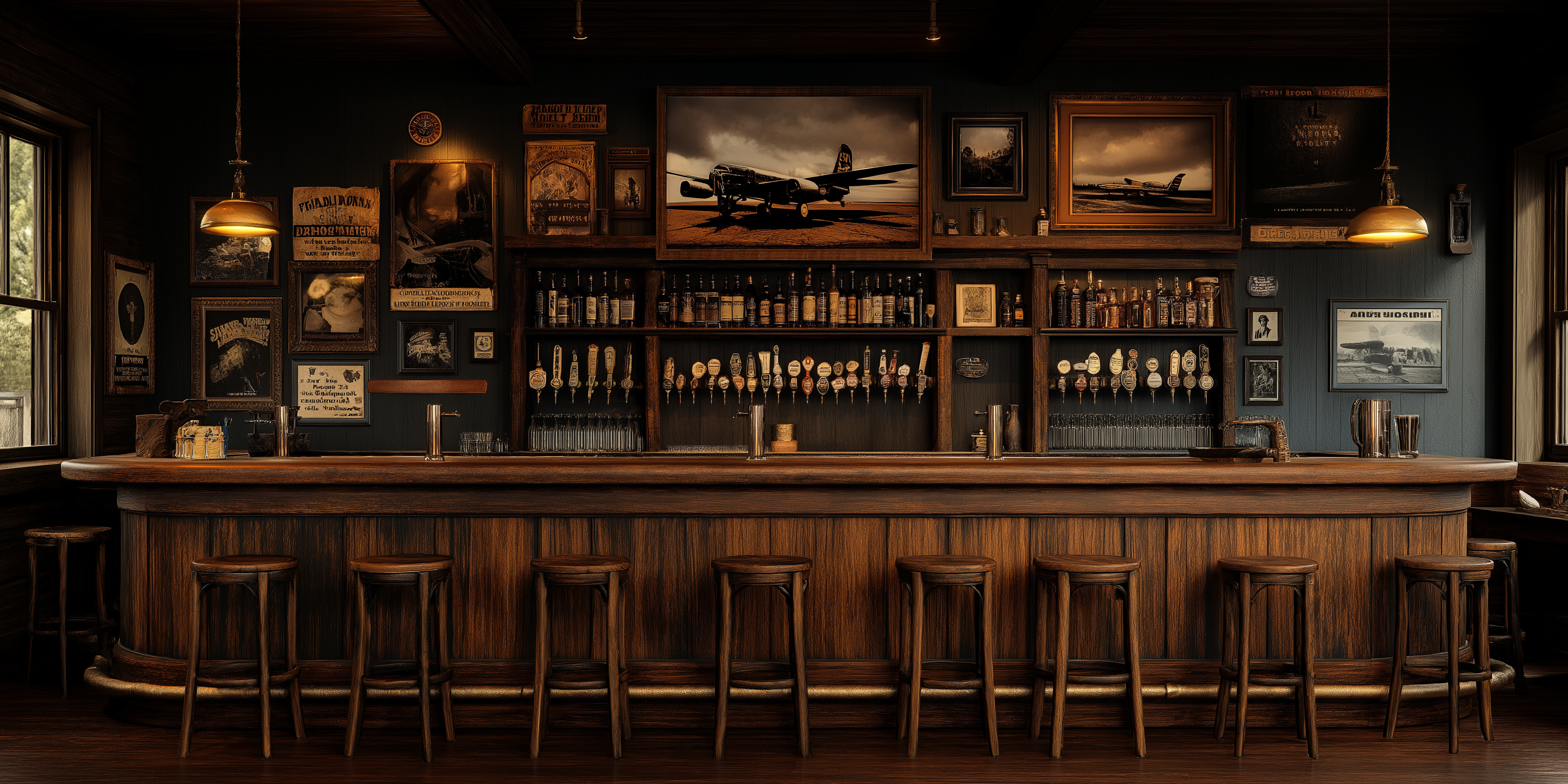
Alfred "Alfie" Ronald Harris was born on 14 September 1945 in Gawler, South Australia, the grandson of Kingsford Smith Pub founder Jack O'Connor. From teenage glass-collector to beloved publican, Alfie has spent over six decades behind the blackwood bar his grandfather installed in 1931, becoming inseparable from the establishment itself. His marriage to Rosalind Winters in 1969 transformed the pub into a true family enterprise, and together they raised two children within its walls whilst preserving the community spirit Jack O'Connor first kindled. On 29 October 1987, Alfie unknowingly witnessed a meeting that would reshape worlds—when young farmer Cody Jennings encountered the mysterious stranger Jeremiah Atkins beneath the mural of Kingsford Smith's trans-Pacific flight.
Early Life and Family
Alfred Ronald Harris was born on 14 September 1945 at Gawler and District Hospital, South Australia, two weeks after the formal end of the Second World War. His parents were Reginald Arthur Harris, a carpenter from Willaston, and Margaret Rose Harris (née O'Connor), the only daughter of Kingsford Smith Pub founder Jack O'Connor. Alfie was the middle of three children, with an older sister Elizabeth Anne (born 1942) and a younger brother Thomas William (born 1948).
The Harris family lived in a modest weatherboard cottage on Tod Street, approximately one kilometre from the Kingsford Smith Pub. Reginald's carpentry work took him across the Gawler district—constructing farm sheds, repairing homesteads, building furniture for local families—whilst Margaret divided her time between household management and occasional shifts at Hutchinson's Bakery on Murray Street. The household operated on the practical rhythms of working-class rural Australia: early mornings, physical labour, and the careful management of modest incomes.
Alfie's connection to the Kingsford Smith Pub began in infancy. As Jack O'Connor's grandson, he was a frequent presence at the establishment from his earliest years, carried through the main bar in his mother's arms, placed in a makeshift crib in the upstairs quarters during family gatherings, absorbed into the pub's atmosphere before he could walk or speak. Where his mother and uncles had grown up within the pub's walls and perhaps took its character for granted, Alfie approached it as a visitor enchanted by a world that seemed magical compared to the quieter domesticity of Tod Street.
His grandfather Jack recognised this fascination and encouraged it. The old publican—by then in his fifties and bearing the accumulated weight of war service, business management, and community responsibility—found in young Alfie an audience for the stories he had accumulated across decades. Tales of the Great War, of friendship with Charles Kingsford Smith, of the pub's early days when Gawler's farming community first gathered beneath the newly planted oak—all of these became part of Alfie's inheritance, absorbed during long afternoons in the beer garden whilst his grandfather pointed out regulars and explained the invisible threads connecting each patron to the town's broader history.
Education and Adolescence
Alfie attended Gawler Primary School from 1951 to 1957, followed by Gawler High School from 1958 to 1963. His academic performance was solid rather than exceptional, with particular strength in English and history—subjects that aligned with his natural inclination toward stories and the past. Mathematics proved more challenging, and the sciences held little appeal for a boy whose interests lay in human connection rather than abstract principles.
His teachers noted a sociable disposition that sometimes manifested as excessive conversation during lessons but also as genuine interest in classmates' lives and concerns. Alfie was the student who remembered birthdays, who noticed when someone seemed troubled, who could draw quiet peers into group activities through patient attention rather than forceful inclusion. These qualities—unremarkable in academic assessment but essential to his eventual vocation—were forming the publican he would become.
During his high school years, Alfie began working part-time at the Kingsford Smith Pub. His grandfather, now approaching seventy and increasingly affected by the accumulated toll of old war wounds, welcomed the assistance. Alfie's initial duties were modest: collecting empty glasses, sweeping the beer garden, restocking shelves under supervision. Yet even these tasks offered education unavailable in any classroom—lessons in reading human behaviour, in managing competing demands, in creating atmosphere through small attentions to comfort and cleanliness.
By sixteen, Alfie was pulling pints under Jack's watchful instruction. By eighteen, he could manage an evening shift independently, handling the rhythms of service, the occasional difficult patron, and the delicate social negotiations that pub management requires. His grandfather observed this development with satisfaction tempered by the particular melancholy of age—pride in succession mixed with awareness that his own time behind the bar was drawing toward its end.
Succession and Early Management
Jack O'Connor died on 15 September 1962, one day after Alfie's seventeenth birthday. The timing felt cruelly symbolic—as though the old publican had held on just long enough to see his grandson reach the threshold of adulthood before releasing his grip on life. The funeral drew hundreds of mourners to St George's Anglican Church, testament to Jack's standing in the community he had served for three decades.
The pub's immediate future fell to Michael O'Connor, Jack's eldest son and Alfie's uncle, who assumed management following his father's death. Michael was competent but uncomfortable in the role—he possessed the administrative skills necessary for licensing compliance and inventory management but lacked his father's natural affinity for the endless sociability that defined successful pub operation. Where Jack had seemed to draw energy from conversation, Michael found it draining; where Jack remembered every patron's name and circumstances, Michael struggled to maintain the personal connections that transformed customers into community.
Alfie completed his final year at Gawler High School whilst continuing to work shifts at the pub, increasingly aware that his uncle was struggling with responsibilities that sat uneasily on his shoulders. Upon graduation in late 1963, Alfie immediately transitioned to full-time work at the establishment, taking on more substantial duties whilst Michael focused on the administrative elements he found more manageable.
This arrangement lasted until early 1965, when Michael approached his nephew with a proposition: would Alfie consider assuming formal management of the Kingsford Smith? Michael had received an offer to manage accounts for an agricultural supply company in Adelaide—work that suited his temperament far better than daily pub operation. The family's stake in the establishment would remain unchanged, but day-to-day responsibility would transfer to Alfie.
At nineteen years old, Alfie accepted. The transition was formalised in March 1965, making him one of the youngest publicans in South Australia. His youth initially attracted scepticism from some older patrons—men who had drunk with Jack O'Connor for decades and questioned whether a teenager could maintain the standards the founder had established. Alfie won them over through the qualities his grandfather had recognised and cultivated: genuine interest in their lives, patient attention to their preferences, and absolute commitment to the establishment Jack had built.
Marriage and Family
Alfie's courtship of Rosalind May Winters began during their school years and deepened through the mid-1960s as both transitioned into adult responsibilities. Rosie—as she was universally known—was the daughter of Harold and Dorothy Winters, who operated a small orchard on Gawler's southern outskirts. She had trained in domestic science at Adelaide Technical College and worked briefly at the Gawler District Hospital kitchen before her relationship with Alfie drew her toward the pub's operations.
Their wedding took place on 12 April 1969 at St George's Anglican Church—the same venue where Jack O'Connor's funeral had been held seven years earlier and where Jack himself had married Evelyn Rose Parker three decades before that. The reception, naturally, was held at the Kingsford Smith, with Alfie's uncle Michael returning from Adelaide to help manage the bar whilst the groom celebrated with approximately 150 guests beneath the ancient oak.
Rosie's integration into the pub's operations transformed the establishment's culinary offerings. Where Alfie's grandmother Evelyn had established traditions of lamb roasts and bread-and-butter pudding, Rosie expanded the menu whilst maintaining continuity with beloved staples. Her shepherd's pie became a Thursday evening institution; her adaptation of Evelyn's pudding recipe preserved the original whilst subtly improving the custard consistency. The kitchen, under her management, began producing meals that drew patrons specifically for food rather than merely accompanying their drinking.
The couple initially lived in a small cottage on Jacob Street, but by 1972 had saved sufficient funds to purchase a larger property on Adelaide Road—close enough to the pub for convenient access but separate enough to provide domestic space distinct from the establishment that consumed so much of their working lives. This house would become the family home where their children grew up.
Emily Rose Harris was born on 3 March 1973 at Gawler and District Hospital. Her brother, Jack Ronald Harris—named for Alfie's grandfather—followed on 17 August 1976. Both children absorbed pub life from infancy, spending afternoons in the beer garden whilst their parents worked, learning to help with age-appropriate tasks as they grew, understanding from early ages that the Kingsford Smith was simultaneously family business and community institution.
The Publican's Craft
By the mid-1980s, Alfie had managed the Kingsford Smith for two decades and developed the particular skills that distinguished merely competent publicans from beloved ones. He knew every regular patron by name and preference—who drank Coopers and who preferred West End, who would nurse a single schooner for hours and who would need gentle monitoring after the third, whose marriages were struggling and whose children were excelling, whose farms were thriving and whose faced foreclosure.
This knowledge was deployed with careful discretion. Alfie never gossiped about patrons' circumstances, never revealed confidences shared across the bar, never used personal information to embarrass or manipulate. His awareness served a single purpose: creating an environment where each person who entered felt recognised and welcomed, where the accumulated weight of daily struggles could be temporarily set aside in the warmth of familiar company.
His approach to difficult situations reflected similar care. Patrons who became aggressive after excessive drinking were handled firmly but without humiliation—guided outside, offered assistance getting home, welcomed back the following evening without reference to the previous night's difficulties. Disputes between patrons were mediated with patient attention to both perspectives, solutions found that allowed all parties to maintain dignity. The dart league matches he organised provided structured competition that channelled masculine aggression into harmless rivalry.
The pub's role as community hub expanded under Alfie's stewardship. ANZAC Day observances, which Jack O'Connor had established in 1933, continued with increasingly elaborate dawn services in the beer garden. Charity fundraisers for local causes—the hospital, the volunteer fire brigade, families facing hardship—became regular fixtures. A small exhibition of local memorabilia, curated by Alfie from photographs and artefacts accumulated over decades, transformed one corner of the main bar into an informal museum of Gawler's history.
Physical Appearance and Manner
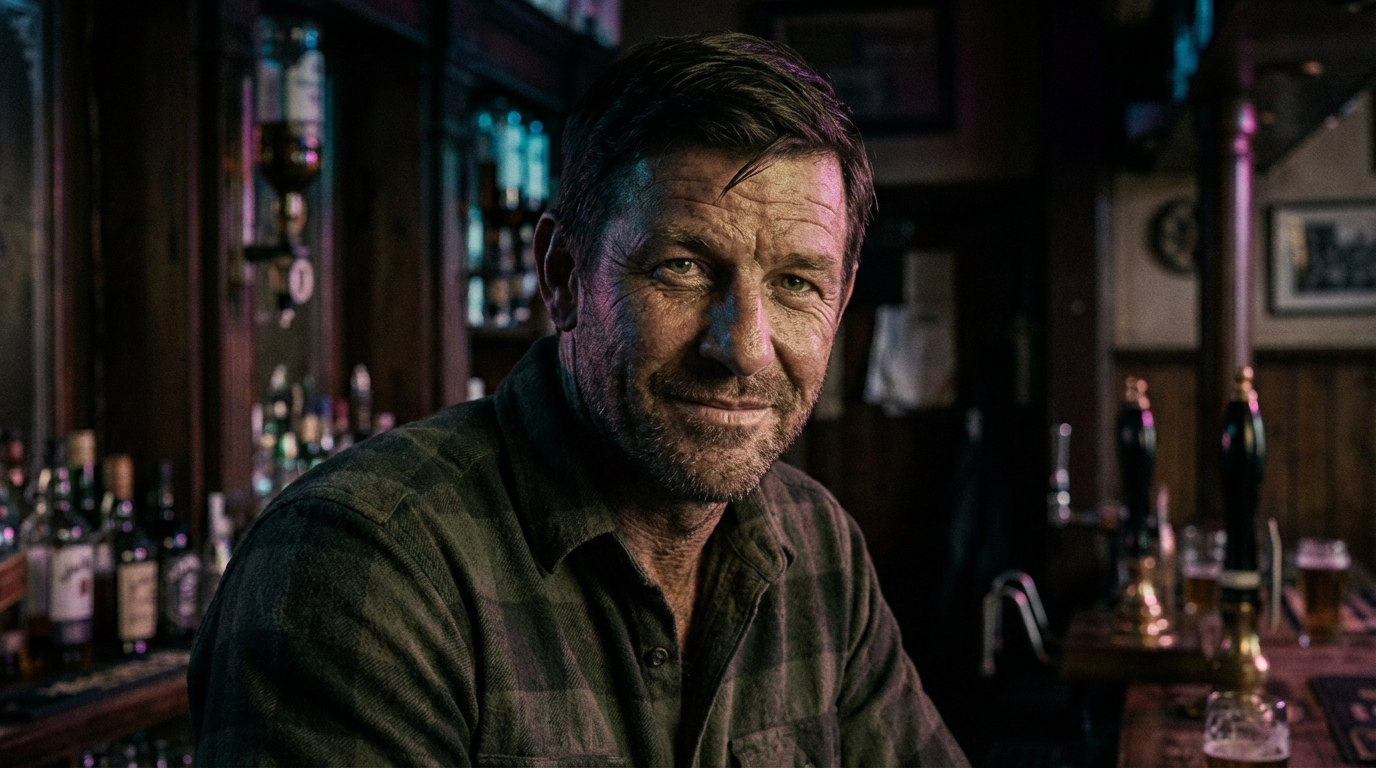
In October 1987, Alfie Harris was forty-two years old and had spent more than half his life working at the Kingsford Smith. His appearance reflected this history: a man of average height with robust build developed through decades of physical work—lifting barrels, moving furniture, maintaining the property his grandfather had built. His face carried the weathering of countless hours in the beer garden, smile lines etched deep around warm brown eyes that sparkled with genuine interest when engaging patrons in conversation.
His chestnut hair had begun greying at the temples, and his hands bore the calluses of his trade—slightly rough from constant washing, pulling taps, and the thousand small physical tasks that constitute pub management. He dressed practically: collared shirts with sleeves rolled to the elbow, sturdy trousers capable of surviving spills and physical work, comfortable shoes suited to long hours on his feet.
His manner behind the bar combined efficiency with warmth. He could maintain multiple conversations whilst pouring pints, tracking the room's emotional temperature whilst attending to immediate service needs. His voice carried the particular quality of someone accustomed to projecting over bar noise without shouting—a controlled resonance that could reach patrons at the far tables whilst maintaining conversational intimacy with those directly before him.
The Evening of 29 October 1987
The Thursday evening that would prove pivotal to events far beyond Alfie's knowledge began as countless similar evenings had before. He opened the pub at 10:00 a.m., managed the quiet morning hours, welcomed the gradual afternoon accumulation of familiar faces, and settled into the concentrated sociability of evening service.
Cody Jennings arrived around 6:15 p.m.—a regular patron Alfie had known since the young man reached legal drinking age, son of a farming family whose members had frequented the Kingsford Smith for generations. Alfie noted Cody's particular restlessness that evening without commenting on it; the publican's craft included knowing when observation should remain silent.
The stranger who entered around 7:30 p.m. registered immediately as unfamiliar—a man in his thirties with weathered features and travelling clothes, whose presence in a pub where every face was catalogued drew automatic attention. Alfie served him with characteristic hospitality, asking no questions beyond those necessary for service, extending the welcome that was every visitor's due.
When the collision occurred at the bar—Cody bumping the stranger's elbow, beer spilling across the blackwood counter—Alfie responded with practised efficiency, providing a replacement glass and defusing potential tension with casual warmth. He observed the subsequent conversation between the two men with the publican's professional interest in his patrons' interactions, noting the unusual intensity of their exchange without grasping its significance.
The evening progressed through its familiar rhythms toward closing time. Alfie watched Cody and the stranger depart together shortly after midnight, the young farmer having offered the traveller accommodation at the Jennings property. It seemed an act of characteristic rural hospitality—unremarkable in a community where such gestures remained common.
Alfie locked the doors, swept the floors, climbed to the upstairs quarters where Rosie had long since retired, and slept without suspecting that he had witnessed the final ordinary evening of Cody Jennings' life—or that the meeting facilitated by his grandfather's establishment would send ripples through dimensions he would never know existed.
Later Years
The Kingsford Smith Pub continues operating under Alfie's stewardship, though the passing decades have inevitably altered his role. His daughter Emily, who inherited both her father's sociability and her mother's organisational capabilities, has assumed increasing responsibility for daily operations since the early 2000s. Alfie remains a fixture behind the bar during evening shifts, his presence a living connection to the establishment's ninety-year history.
Rosie continues managing the kitchen, though she too has reduced her hours and trained younger staff in the recipes she refined over decades. Their son Jack teaches history at a secondary school in Adelaide—a career choice that pleased his parents, who saw in it continuation of the family's commitment to preserving and transmitting knowledge of the past, even if expressed through classroom instruction rather than bar-side storytelling.
Alfie continues tending the bar his grandfather built, preserving the mural Eleanor Whitfield painted in 1936, maintaining the traditions Jack O'Connor established nearly a century ago. He remains what he has always been: keeper of community memory, custodian of gathering space, the man whose warm welcome transforms strangers into regulars and regulars into something approaching family. That his establishment once served as the threshold between worlds—the place where a restless farm boy met the mentor who would guide him toward impossible destinies—adds a layer of significance invisible to him but essential to understanding the complex webs that connect provincial Australian pubs to forces operating across multiple realms.







