Alexander Javier Martinez
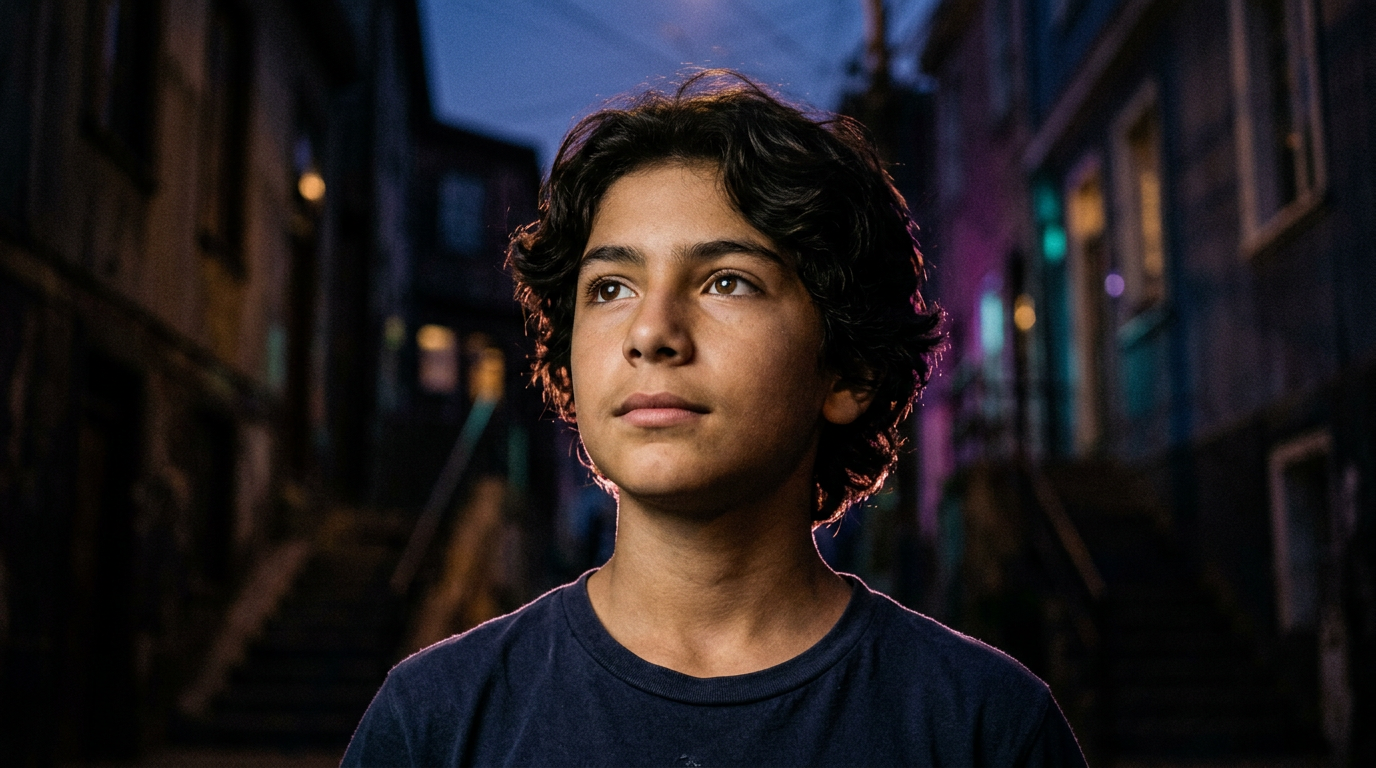
Alexander Javier Martinez, born on 5 March 2012 in Brisbane, was the only child of Javier Antonio Martinez, a Spanish-born science teacher, and Marta Lucía Martinez, a Chilean-Australian nurse. He was six when the school bus carried him into Clivilius, where Jenny and Nial Triffett took him in as their own. He mapped the unfamiliar sky above the settlement with the patient discipline his father had applied to the southern constellations, building celestial charts that gave Bixbus its first navigation references and seasonal markers.
The Boy Who Spoke to the Ceiling
Alexander Javier Martinez was born on 5 March 2012 at the Royal Brisbane and Women's Hospital, the only child of Javier Antonio Martinez, a secondary school science teacher, and Marta Lucía Martinez (née Vega), a registered nurse. The family lived in a rented flat in Toowong, on the second floor of a converted Queenslander whose timber stairs creaked with such predictability that Alexander, by the age of four, could identify which family member was ascending by the rhythm of their footsteps alone.
Javier was from Zaragoza, in north-eastern Spain. He had come to Australia in 2006 on a working holiday visa, intending to stay twelve months, practise his English, and return to the teaching career he had left behind at a secondary school in his home city. He did not return. He met Marta at a barbecue in West End three months after his arrival, and the twelve months became two years, and the two years became a partner visa, and the partner visa became a life in Brisbane that he could not have predicted and did not regret, though he missed his parents — Antonio and Carmen Martinez, both retired schoolteachers in Zaragoza — with an ache that distance dulled but never eliminated.
Marta's family were Chilean. Her father, Rodrigo Vega, had emigrated from Valparaíso in 1989 with his wife, Ana María Vega (née Sepúlveda), and their two young sons, Diego and Matías. They settled in Inala, in Brisbane's south-west, where Rodrigo worked as a panel beater and Ana María cleaned offices at night and studied bookkeeping by day. Marta was born in 1985, the youngest child and only daughter, and she grew up in a household where Spanish was spoken at the dinner table and English was spoken everywhere else, and where the expectation that the children would be educated, employed, and useful was communicated not through lectures but through the silent weight of what their parents had left behind.
She completed a nursing degree at the Queensland University of Technology and worked at the Royal Brisbane, rotating between wards with the professional equanimity of a person whose temperament suited the demands of shift work and whose patience was deep enough to absorb the worst of what a hospital produced. She met Javier when they were both twenty-one, and their courtship was conducted in a mixture of English and Spanish that settled, over the years, into a household language that was neither one nor the other but a fluid, private dialect that Alexander absorbed before he was old enough to know it had a name.
Javier taught science at a state secondary school in Indooroopilly. He was a competent teacher — clear, methodical, patient with students who struggled — but his passion was not the curriculum. His passion was the sky. He had been an amateur astronomer since his teens, when his father had given him a secondhand telescope for his fourteenth birthday, and the hobby had survived the move to Australia with the tenacity of something fundamental. He kept a telescope on the balcony of the Toowong flat and observed the southern sky with the disciplined regularity of a man who considered the universe a text that rewarded careful reading.
Alexander, from infancy, was his father's audience. Javier held him on the balcony at night and pointed at constellations — the Southern Cross, Scorpius, the Magellanic Clouds — and explained them in Spanish, because Javier's English, though fluent, could not carry the weight of his enthusiasm with the same precision. Alexander listened. He did not understand the words at two, but he understood the tone, and the tone said that the sky was important, and the importance settled into him like a language learned before memory.
For his fifth birthday, Javier gave Alexander a handheld star projector — a small plastic device that cast a rotating map of constellations onto the bedroom ceiling. It cost thirty dollars and it became the most important object in Alexander's life. He fell asleep watching it every night, the slow rotation of the artificial sky replacing the real one that the flat's ceilings obscured. He learned the names of the constellations from the projector before he learned them from the telescope, and he spoke to them — quietly, in the dark, in the Spanish his father used and the English his mother preferred and the mixture of both that was his own — as though the stars were listeners who deserved to be addressed.
He was a quiet child. Not withdrawn — he engaged with other children and with adults — but quiet in the way that suggested his attention was divided between the world in front of him and a world above it that only he was watching. He entered Brisbane Grammar School in Prep in 2017, and his teachers noted that his academic performance was solid, his behaviour unremarkable, and his tendency to stare out of windows during lessons was probably not defiance but the symptom of a child whose gaze was oriented toward distances that a classroom could not contain.
The Star Projector in the Wreckage
The overnight field trip to D'Aguilar National Park departed from Brisbane Grammar School on the morning of Saturday, 4 August 2018. Alexander was six years old and in Year 1. Marta had packed his bag and included the star projector, because Alexander had asked for it and because refusing would have produced a distress disproportionate to the request. Javier, who had a telescope viewing planned with his astronomy club that evening, kissed Alexander at the school gate and told him to look up, which was what Javier always said when they parted, and which Alexander understood as both instruction and benediction.
At D'Aguilar, Alexander was quiet among children who were not. He walked the guided trail without complaint but without the enthusiasm that Susan Clarke was accustomed to seeing in children encountering bushland for the first time. He looked at the canopy more than the understorey — tracking the flight of a wedge-tailed eagle for several minutes with an attention that Clarke noticed and misidentified as daydreaming. He did not collect specimens. He did not ask questions about the plants. When the group stopped at a clearing, Alexander sat on a rock and looked at the sky through the gap in the trees with the patience of someone who was waiting for something to appear.
The bus departed D'Aguilar on the morning of 5 August for the return to Brisbane. Alexander was seated toward the back, the star projector in his lap.
The bus passed through a Portal opened across a road in the Brisbane suburbs and collided with vehicles on the far side, in the landscape of Clivilius. The impact threw Alexander forward and sideways. His right wrist bent beneath him as he hit the floor between the seats, spraining the joint and producing a sharp, immediate pain that made him gasp. Bruising spread across his chest where the seatbelt had caught and held. The star projector flew from his hands and hit the back of a seat and cracked, the battery cover breaking free and the bulb inside shattering into fragments too small to recover.
He did not scream. He did not cry immediately. He lay on the floor of the bus between the seats, his wrist throbbing, his chest tight from the seatbelt bruise, and he stared at the broken projector where it had come to rest against a seat leg, its casing split, its tiny bulb gone. The loss was not logical — it was a thirty-dollar toy from an electronics shop in Indooroopilly — but to Alexander it was the sky itself, broken on the floor of a bus in a place that should not exist, and the sound he made when he finally cried was not the sharp wail of a child in pain but the low, bewildered grief of someone who had lost something they could not name.
An adult retrieved the broken projector and gave it back to him. Alexander held it against his chest with his good hand, the cracked casing pressing into his bruised sternum, and he did not let go of it for the rest of that day.
The Son the Triffetts Found
The wrist healed in three weeks. The bruising faded. The star projector did not heal. Alexander kept it — the cracked casing, the empty socket where the bulb had been, the battery cover reattached with salvaged tape — on whatever surface served as his bedside table in the weeks after the crash. He did not try to use it. He knew it was broken. But he held it at night the way he had once held it in bed in Toowong, and the gesture was enough to make the dark feel slightly less unfamiliar.
In the first weeks after the crash, the children were cared for communally — adults sharing responsibility for the youngest, the injured, the most distressed. Alexander was quiet in a way that the adults interpreted as coping and that was, in fact, a kind of suspended animation. He ate when fed. He slept when put to bed. He answered questions in English, which was the language of the adults around him, and he stopped speaking Spanish, not by decision but by absence — there was nobody to speak it with, and the words, unused, began to recede into a part of his mind that he could feel closing like a door in a house he was leaving.
Jenny Triffett noticed him. She noticed all the children — it was her job, once the Learning Grove began in September 2018, to notice — but she noticed Alexander in a particular way, because he reminded her of Sammy. Not in appearance or temperament — Sammy was boisterous where Alexander was contained, fair where Alexander was dark — but in the specific quality of his need, which was not for food or safety or entertainment but for a person who would claim him. The bus children had adults who cared for them. They did not have adults who belonged to them. The distinction was invisible to the older children, who had enough selfhood to survive without it. For a six-year-old, it was the difference between existing and living.
Jenny spoke to Nial. Nial, who had been in Clivilius since July 2018 and whose practical generosity was as reliable as his fencing, agreed without hesitation. By October 2018, Alexander was living with the Triffetts — Jenny, Nial, and four-year-old Sammy — in their quarters in Bixbus. The arrangement was not formalised, because Bixbus had no legal structures to formalise it. It was simply understood: Alexander was theirs. They were his. The word "adopted" was used by other people, not by the Triffetts, who treated him as a son and did not require a category for what they were doing.
Sammy accepted Alexander with the uncomplicated welcome of a four-year-old who had wanted a brother and did not care about the mechanism of his arrival. The two boys shared a room, shared meals, shared the particular chaos of a household where Nial built things and Jenny taught things and the boundaries between the two activities were never entirely clear. Alexander's silence, in the Triffett household, softened. He began to talk — not with the volume or frequency of Charlotte Davis, but with the tentative specificity of a child who was learning that his words would be heard and responded to and that the responding would be consistent.
He attended the Learning Grove from its earliest weeks, placed in the youngest group by Jenny — who was, in a complication that Alexander accepted without comment, both his mother at home and his teacher at school. His reading was adequate. His numeracy was stronger — he had a facility with numbers that his other academic work did not predict, a quiet mathematical competence that emerged when the subject was abstract enough to engage the part of his mind that had once tracked constellations. His concentration was uneven: exceptional when the subject interested him, absent when it did not, and the line between the two was not always predictable.
The afternoon practical sessions did not produce an immediate vocation. Alexander drifted between partner sites without settling. He was not drawn to plants, like Jacob Thomas. He was not drawn to animals, like Lucas White. He was not drawn to terrain, like Oliver Smith. He attended sessions at the Verdant Nursery and the Haven of Wilds and the workshop with the compliant disengagement of a child who was following instructions without being reached by them. The adults noted his willingness and his lack of enthusiasm and did not know what to do with the combination.
The change came slowly, in the way that changes in children often do — not through a single event but through the accumulation of ordinary moments. Sammy, at five, asked Alexander what the stars were. The question was unremarkable. The answer Alexander gave — pointing at the Clivilius sky through the window of their shared room, naming nothing, knowing nothing — was the first time he had looked up in months. It hurt. It hurt the way speaking Spanish had hurt in the early weeks, because it reminded him of something he had lost. But Sammy was waiting for an answer, and Alexander, who had learned by then that the Triffetts did not ask questions they did not want answered, looked at the unfamiliar stars and said, "I don't know. We could find out."
The transition to Bixbus School in late 2019 gave the finding out a structure. Alexander's mornings were spent in academic classes where his mathematics was the strongest in his cohort and his literacy was middling and his handwriting was neat in a way that suggested he cared about precision even when he did not care about the subject. His afternoons, gradually, shifted away from the partner sites and toward a self-directed project that the school staff accommodated because it was useful and because Alexander, when engaged, worked with a focus that his classroom performance did not suggest was possible.
His social life reflected the contained quality of his attention. He had Sammy, who was his brother in every way that mattered and whose presence filled the domestic space that might otherwise have been empty. He had the Triffetts, whose household gave him the stability that the other bus children built for themselves from friendship and routine. He had a small number of friends — quiet children, mostly, who did not require him to perform sociability and who accepted his silences without filling them. He was not isolated. He was simply private, in the way that a person becomes private when the most important things in their life — the broken projector on the shelf, the charts in the notebook, the Spanish words he whispered to himself before sleep — were things he did not know how to share.
He missed his parents in fragments. His father's voice explaining Orion's Belt. His mother's hands adjusting his school uniform. The smell of the flat in Toowong — coffee and laundry detergent and the faint chemical trace of his father's whiteboard markers. He loved the Triffetts. He loved them with the fierce, complicated loyalty of a child who had been chosen and who knew that being chosen was a gift and who felt, beneath the gratitude, a guilt he could not resolve — because loving Jenny and Nial felt, in some unreachable part of him, like a betrayal of Marta and Javier, and the feeling was irrational and persistent and he managed it the only way he knew how, which was to say nothing and to keep looking up.







