Alex Morgan Rivera
Alex Morgan Rivera, born on 18 July 1984 in Black Hallows, is a Wildlife Biologist and Rehabilitation Specialist at the Black Hallows Breeding Facility. A third-generation facility worker and avian specialist, Alex trained at the Hallows Academy and the Greyson Institute before joining the facility's staff in 2007. He married Lena Richter in 2012, and they have two children, Sofia and Tomás. The post-2022 arrival of the CGRN and the Clivilian Ecological Seeding Programme placed Alex at the centre of the facility's most significant expansion, a transformation he supported professionally whilst grappling with its impact on the community he had known his entire life.
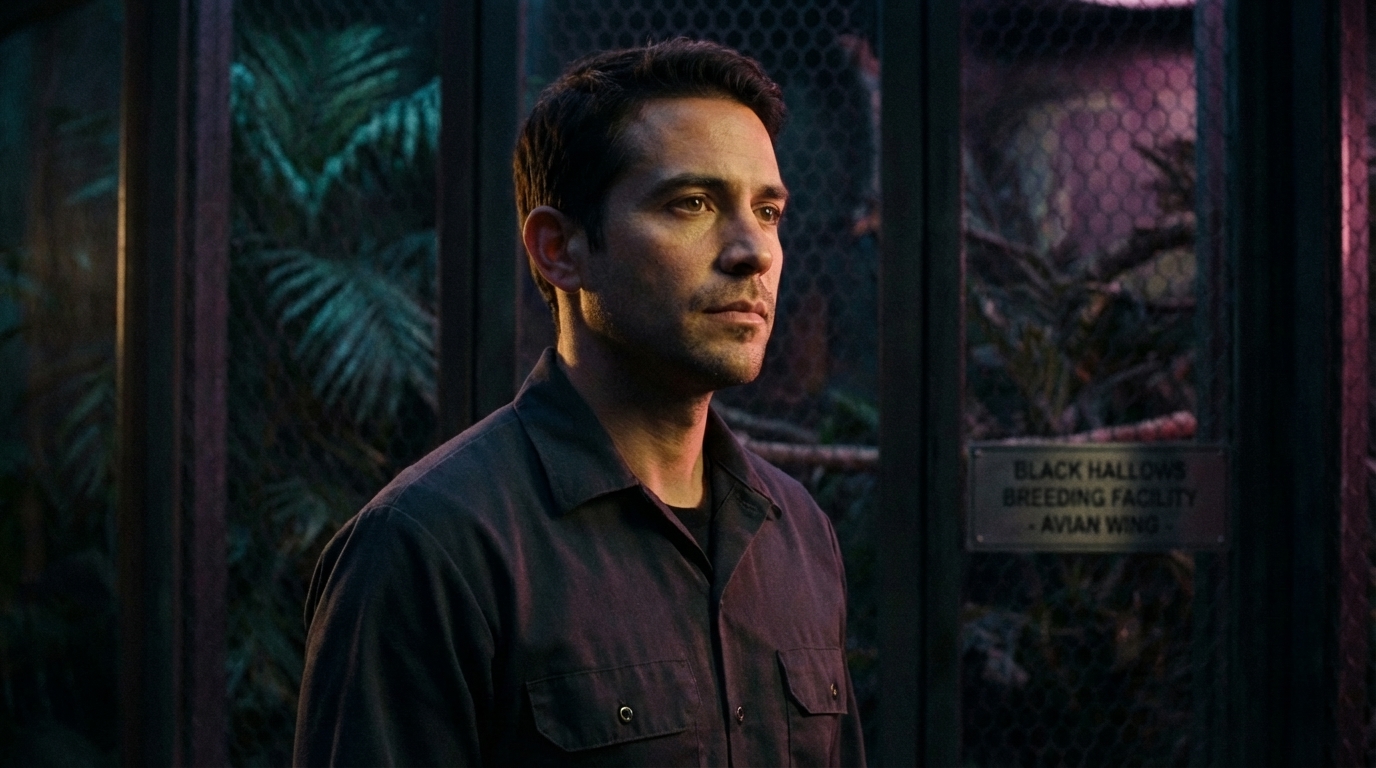
Early Life and Family
Alex Morgan Rivera was born on 18 July 1984 in Black Hallows, the first child of Miguel Tomás Rivera and Clara Estela Rivera, née Vos. His father Miguel, born on 11 September 1952, was a wildlife biologist at the breeding facility specialising in the genetic management of avian breeding populations. His mother Clara, born on 28 April 1955, was a descendant of the Vos family line that traced back to the settlement's founding party and worked as an agricultural supervisor in the facility's botanical nurseries on the plains. His sister, Isabel Clara Rivera, was born on 22 November 1987 and later joined the facility's ecological field teams.
The Rivera family was the third generation to work at the breeding facility. Alex's paternal grandparents, Eduardo Luis Rivera and Hilde Rivera née Kraus, had arrived in Black Hallows from Grenzfeld in 1907, and the family's association with the facility — particularly with its avian programmes — had become a defining part of their identity within the settlement.
Alex grew up in one of the stone-built houses along the base of the cliff line, within walking distance of both the facility's research headquarters in the cliff complex and the outdoor enclosures on the plains. Black Hallows in the late 1980s and 1990s was a settlement of approximately 4,000 to 5,000 people, and the facility employed a significant proportion of them. His childhood was shaped entirely by the facility and the close-knit community that surrounded it.
His early fascination was with birds. His paternal grandfather Tomás Eduardo Rivera, who had retired from the facility in 1986, remained a familiar presence around the avian enclosures well into his later years. It was Tomás who first took Alex into the raptor pens at the age of five and showed him the Ivory-Tailed Condors — a species whose breeding lineage the Rivera family had helped maintain since the 1930s. Alex's earliest clear memory, which he recounted frequently in later years, was of standing beside his grandfather watching a condor spread its wings in the early morning light.
Tomás Rivera died on 9 April 1997, when Alex was twelve. The loss was formative. Alex later described his grandfather as the person who taught him that working with animals was not a job but an obligation — that the species in the facility's care depended on people who understood them as living things with needs and temperaments that demanded respect, not as specimens to be managed.
Education
Alex enrolled at the Hallows Academy in 1999 at the age of fifteen, entering the animal husbandry programme. The programme combined classroom instruction in animal biology, nutrition, and veterinary fundamentals with extensive practical placements in the facility's enclosures. Alex spent the majority of his training years working directly with avian species under the supervision of handlers who had known his father and grandfather. He graduated in 2003.
He continued his studies at the Greyson Institute from 2003 to 2007, studying evolutionary biology and avian genetics under the supervision of Dr. Maren Holz. Holz was extending Helena Black's adaptive compression framework to the study of behavioural evolution — the question of how Clivilian conditions altered not just the physical characteristics of species but their instincts, social structures, and reproductive strategies.
Alex's research focused on the Ivory-Tailed Condor population, documenting the behavioural divergence between the facility's captive lineage and the descriptions of the species recorded in the acquisition records from 1918. His findings — that the condors had shifted from solitary scavengers to cooperative hunters over the course of a century — contributed to a broader body of work at the Institute on the pace and direction of Clivilian behavioural adaptation.
Career and Marriage
Alex joined the breeding facility's staff as a Wildlife Biologist in March 2007, assigned to the avian programmes that his father Miguel continued to oversee. His early years were spent in the raptor and large bird enclosures, where his combination of academic training and the intuitive handling skills developed through a lifetime around the facility's birds made him effective in ways that neither qualification alone could have produced.
He was appointed Rehabilitation Specialist in 2011, a role that gave him responsibility for the care and recovery of injured or stressed birds across the facility's collection. The work required both veterinary knowledge and the behavioural sensitivity to assess when an animal's distress was physical, environmental, or psychological. Alex developed a reputation among his colleagues for his ability to read avian behaviour with a precision they attributed partly to training and partly to an instinct that the Rivera family seemed to carry for the animals they worked with.
On 8 June 2012, Alex married Lena Richter in a ceremony held on the plains below the cliff complex, attended by most of the settlement's population. Lena, born on 19 March 1986 in Black Hallows, was a Hallows Academy graduate who worked as a land manager in the facility's ecological restoration zones, maintaining the grasslands and scrubland that Dr. Ivor Galloway's programmes had established in the 1960s and 1970s. The Richter family had deep roots in Black Hallows — Lena was a descendant of Clara Richter, who had married Maxwell Black in 1893, making the Richter line one of the settlement's founding families.
Their daughter, Sofia Lena Rivera, was born on 2 September 2014. Their son, Tomás Miguel Rivera — named for Alex's grandfather and father — was born on 17 January 2018. The family lived in the same stone house along the cliff base where Alex had grown up.
The years between 2012 and 2022 were, by Alex's own account, the most settled and productive of his career. He managed the facility's avian rehabilitation programme, contributed to breeding protocol development for several bird species, and maintained the daily routine of early morning visits to the Ivory-Tailed Condor enclosure that he had kept since his first year on staff. The facility operated at a steady, unhurried pace, and the staff knew one another by name, by family, by the enclosures they tended and the species they had spent their careers studying.
The Post-2022 Transformation
The completion of the Black Hallows Express Rail Line in 2022 ended that stability. Alex supported the CGRN connection and the resources it brought. He had spent fifteen years working within the constraints of a facility that lacked the equipment, the species diversity, and the external knowledge to fulfil its founding ambitions, and he recognised the arriving investment as genuinely transformative.
When the first consignment of thirty-seven Earth-sourced species arrived at the rail terminal in 2023, Alex was among the senior staff who oversaw the intake and quarantine process — applying every skill he had developed over his career to species he had never previously encountered in the living form.
The Clivilian Ecological Seeding Programme, proposed by Bixbus in mid-2023, placed Alex's avian expertise at the centre of the facility's expanded mission. He was appointed to the Seeding Programme's Avian Selection Committee, responsible for determining which bird species would be bred for release across the region and in what ecological combinations. The role was a significant elevation and reflected the facility's recognition of both his scientific credentials and his practical experience.
He joined the Black Hallows community council in 2024, voting consistently in favour of the Seeding Programme's framework whilst advocating for the preservation of the facility's scientific authority over breeding decisions. He mentored newly arrived Bixbus-recruited staff, sharing the practical knowledge his family had accumulated over three generations.
The professional opportunities came at a personal cost that Alex acknowledged to colleagues but rarely discussed publicly. The settlement he had known his entire life was disappearing under an influx that brought the population from 6,500 to over 100,000 within two years. The stone house where three generations of Riveras had lived was now surrounded by construction extending across the plains in every direction.
The enclosures where Alex had learned his craft from handlers who had known his grandfather were being expanded, redesigned, and staffed by specialists from Bixbus who brought expertise but not history. The Hallows Academy, where he had trained in a cohort of fourteen, was operating across four campuses with thousands of students.
His wife Lena's work had been directly disrupted. Several of the restoration zones she had managed for years were reclassified as sites for new enclosure complexes, and the grasslands that Galloway's teams had spent decades establishing were repurposed for species arriving faster than the infrastructure could accommodate. Lena transferred to the Seeding Programme's field operations in 2024, applying her land management expertise to the preparation of release sites along the CGRN corridor, but the transition was difficult.
Their daughter Sofia, eleven in 2025, attended a Hallows Academy satellite campus on the plains alongside hundreds of students whose families had arrived within the past two years. Their son Tomás, seven, had no memory of the settlement before the CGRN connection.







