Aeliana Maeve Drikarsus (née Prescott)
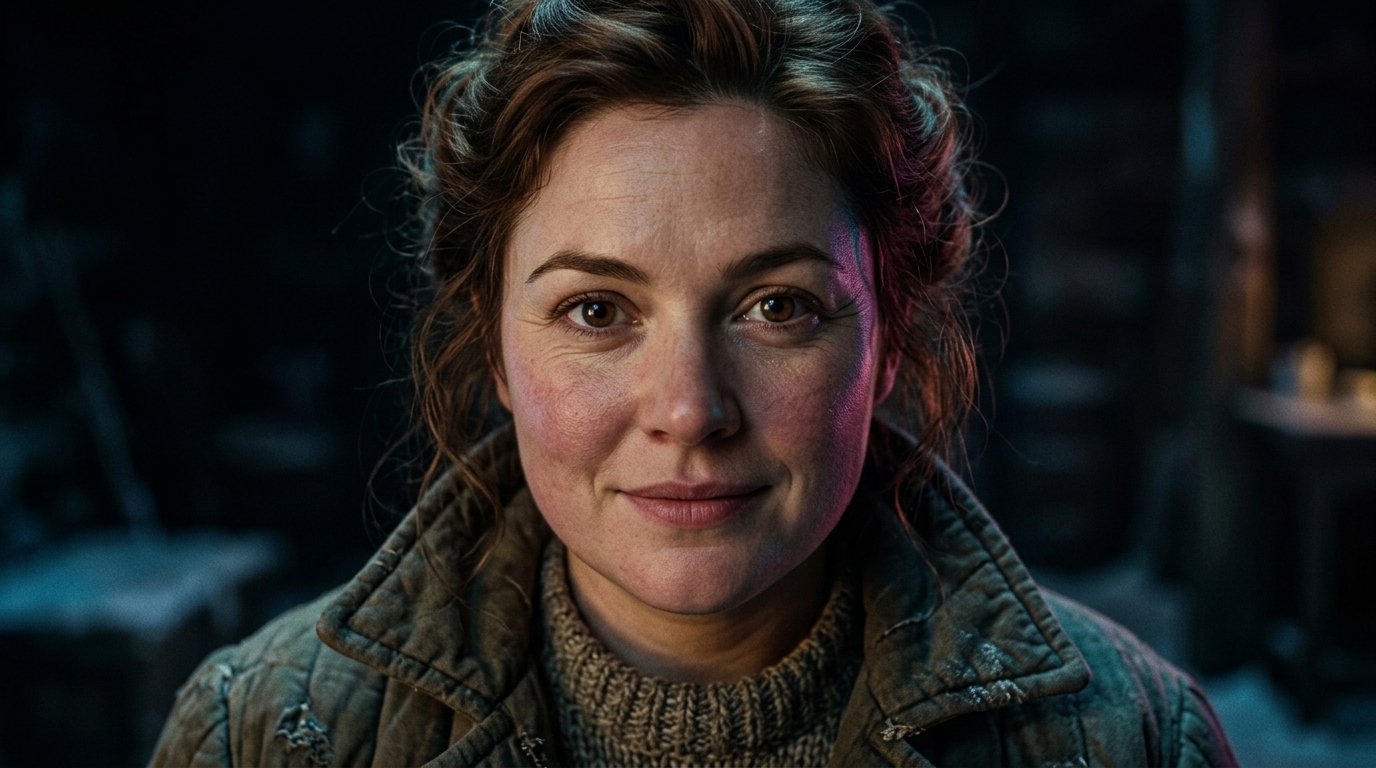
Aeliana Maeve Drikarsus (1957–2018), née Prescott, was a Bristol-born environmental scientist who followed her husband Eldrik through the Portal to Belkeep in 1988, expecting a green beginning and finding a frozen settlement that defeated her science as it had his. She became Belkeep's teacher and its unofficial comforter, giving ice-born children a whole Earth they would never see. She could soften her cold husband but not save her son Lewyyd from becoming him, and died in 2018, worn out at sixty.
A Bristol Girl
Aeliana Maeve Prescott was born on 3 June 1957 in Bristol, into a household that gave her, early and in equal measure, the two things she would spend the rest of her life offering other people: an understanding of living things and a genuine care for them. Her father, Harold Prescott, was a botanist of some reputation, and her earliest memories were of his greenhouse—its damp warmth, its ordered rows, the patient attention he paid to every growing thing. Her mother, Evelyn, born a Hartwell, was a nurse, and from her Aeliana learned the harder lesson beneath the softness: that people, like plants, needed tending, and that tending was labour rather than sentiment, exhausting and frequently unthanked.
She was, by every account of her that survived, a warm and open child, curious about everything and quick to attach herself to people and places. But there was a particular cast to her warmth that would matter enormously later: Aeliana believed in things. She believed the world was fundamentally worth saving, that beauty was worth preserving for its own sake, and that hope, held against the evidence, was closer to a moral obligation than a weakness. In the green and temperate Bristol of her childhood this cost her nothing. It would cost her a great deal in a frozen valley on the far side of a Portal, though she never once allowed it to be said that she regretted keeping it.
The Conservation Years
Aeliana read Environmental Science at the University of Bristol, following the pull of her father's greenhouse into the wider study of how living systems held together and how badly humanity was pulling them apart. She came of age intellectually in the 1970s, as the environmental movement was finding its voice, and she threw herself into it with the whole of her considerable warmth. It was through that movement, rather than any shared classroom, that she met Eldrik Drikarsus—a marine biology student from Hull, severe where she was open, exacting where she was expansive, as sparing with words as she was generous with them.
What drew them together was never obvious to anyone else and never entirely obvious to them, but it held. Aeliana saw something behind Eldrik's coldness worth warming, and Eldrik, who trusted almost nothing, trusted her. They married in 1978 and spent the years that followed as a working partnership as much as a marriage, carried by their shared cause to rainforests and coral reefs and threatened coastlines—he gathering the evidence, she doing the far harder work of persuading actual human beings to care about it. Where Eldrik connected with data, Aeliana connected with people, and between them they were more effective than either could have been alone. She was the reason communities listened; he was the reason they had something true to hear.
Those were, in retrospect, the happiest years of her life, though she did not know it at the time. The work was hard and the victories were few, but she was doing what she believed in, beside a man she loved, in a world that—for all its damage—was still recognisably her own. She was young, and useful, and surrounded by the green and living things she had loved since her father's greenhouse. Nothing that came afterward, in the frozen valley on the far side of the Portal, ever gave her quite that particular happiness again, and some part of her must have understood, in the settlement's hardest years, that she had traded it away for a hope that did not survive contact with Belkeep.
Following Him Through
By the mid-1980s the two halves of the marriage had begun to diverge in one crucial respect. Eldrik was souring—a decade of losing battles had convinced him that the world would not be saved by careful people with evidence—while Aeliana, constitutionally, could not stop believing. So when Cody Jennings offered them a place among the founders of a settlement in an untouched world, the same proposition meant opposite things to each of them. To Eldrik it was an escape from a planet he had given up on. To Aeliana it was not a retreat at all but an adventure: a chance to help build something new and good from the very beginning, in a pristine world where the old one's mistakes need not be repeated.
She went, in the end, for all of those reasons and for one more she would never have phrased so plainly—she went because Eldrik was going, and because she had long since decided that her place was wherever she could hold his hardening at bay. On 12 September 1988 they stepped through the Portal together. Aeliana crossed into Clivilius with more hope in her than despair, and that hope meant the reality waiting on the far side would betray her expectations far more cruelly than it betrayed her husband's. He had expected little. She had expected a beginning.
What Belkeep Was
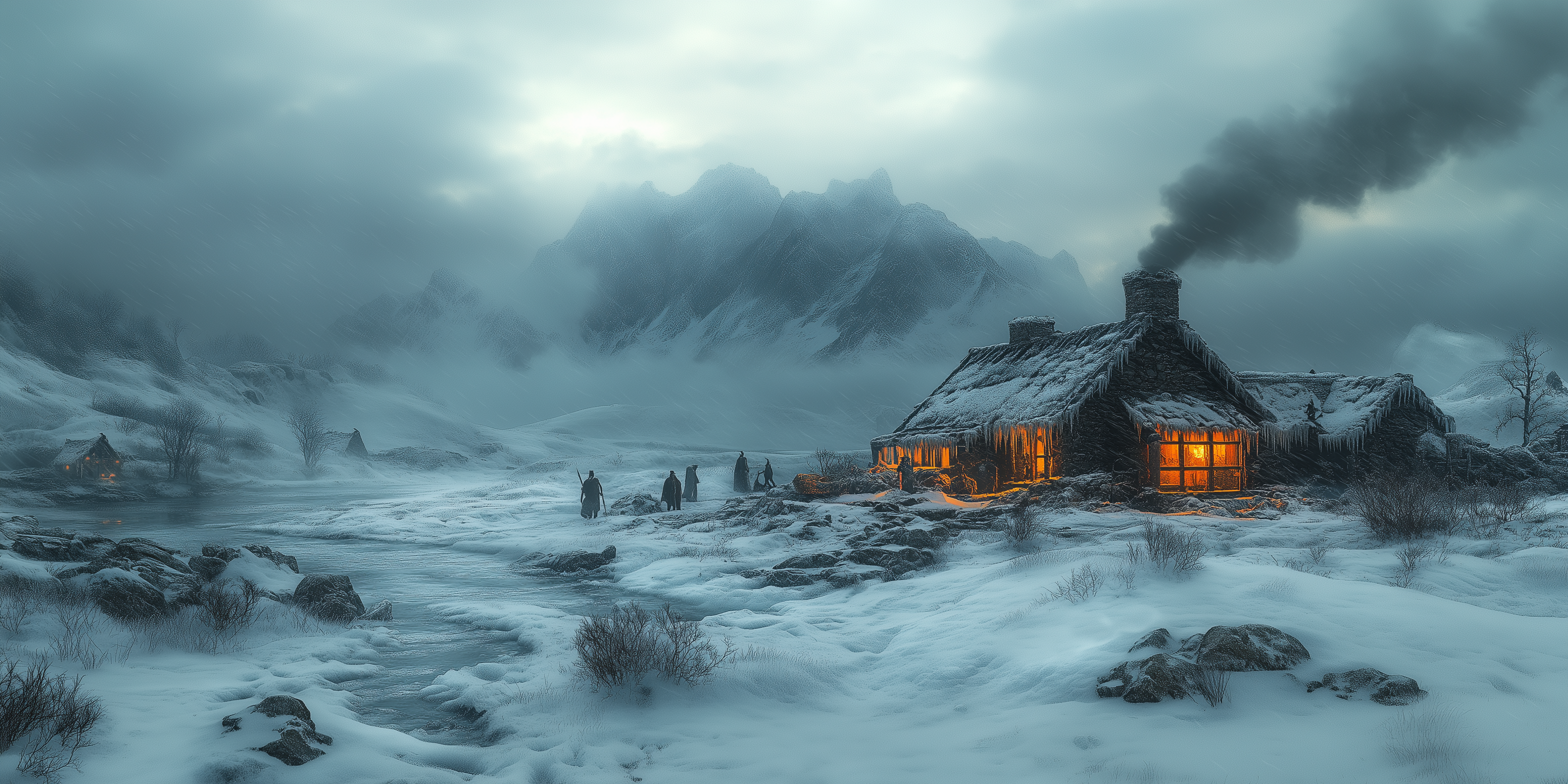
Belkeep was not a pristine new world waiting to be tended. It was a frozen valley locked in perpetual winter, where survival devoured every hour and beauty was something the cold killed along with everything else. The environmental science that had been Aeliana's whole training proved, like her husband's, very nearly useless: there was almost nothing to cultivate, the growing things she understood did not grow, and the intricate living systems she had built a career around studying had no equivalent in a place that seemed designed to sustain as little as possible. She salvaged what she could—coaxing the meagre indoor growing the settlement managed, learning the little that could be foraged—but the woman who had crossed worlds to help build a green beginning found herself somewhere green survived only as a memory.
It would have broken a more brittle kind of hope. Aeliana's bent instead. She did not stop believing the settlement was worth her whole heart; she simply redirected the belief from the land, which would not answer it, to the people, who badly needed it. If Belkeep would not let her grow gardens, it would let her grow something else.
The Teacher
What Aeliana grew was children. She became Belkeep's teacher, the woman who took the settlement's young—a generation being born into ice, who had never seen and would never see a living tree, a moving ocean, a summer—and set about putting a world inside their heads that they could not reach with their bodies. She taught them to read and to reckon, but more than that she taught them Earth: its forests and oceans, its colours and creatures, the temperate green places she had come from, her father's greenhouse, the reefs she had once worked to save. She gave trapped children the whole of a planet they would live and die without ever touching.
The teaching itself was a daily improvisation. She had no textbooks beyond the few she had carried through the Portal and no materials the settlement could spare, so she taught from memory and invention—drawing the shapes of leaves in the frost on a window, describing the smell of rain on warm earth to children who had known only the smell of cold. She learned to explain colours to minds that had no referent for most of them, the particular green of a summer field or the blue of water that was not ice, and to answer questions that broke her a little to hear: what a forest sounded like, whether it was true that on Earth the sky was sometimes warm. She never let the children see that the questions hurt. She simply answered them, as fully and as beautifully as she could.
Whether this was a kindness or a cruelty was a question Aeliana wrestled with privately and never entirely resolved. To fill a child who could never leave Belkeep with longing for warmth and colour and open space might be the gift of an inner life, or it might be a slow torture—teaching them, in precise detail, exactly what they would go without. She chose to believe it was the former, that a mind with a world in it, even an unreachable world, was richer and more human than a mind holding nothing but ice, and she taught on that belief for thirty years. The alternative was to let the settlement's children grow up knowing only what surrounded them, and that she could not bring herself to allow.
The Warmth for Two
The marriage held, but Belkeep tested it in ways the conservation years never had. On Earth Aeliana had been able to soften Eldrik in company, to stand between his severity and the world; in the settlement the company thinned, the severity deepened, and there was less and less she could do to reach the man hardening in front of her. She did not stop loving him. She simply learned to love a colder and colder version of him, and to carry, mostly alone, the emotional weight of a household and a community that a man like Eldrik could keep alive but could never warm.
It was lonely work, and she rarely let the loneliness show, because showing it would have asked something of people who had nothing spare to give. She was the one everyone came to—for comfort, for counsel, for the plain experience of being met with warmth in a place that offered little of it—and being that person for an entire settlement is a labour that empties you quietly, without anyone quite noticing, least of all the people you are filling. Aeliana gave and gave, and the giving cost her, and she counted the cost worth paying, and both of those things were true at once.
Her mother's nursing surfaced in her, too, in a role no one appointed her to and everyone came to depend upon. It was Aeliana who sat with the sick when the settlement's thin medical provisions had run out of anything else to offer, Aeliana who was present when people died, and Aeliana who stayed afterwards with those they left behind. In a place that produced grief with brutal regularity and had no formal means of tending it, she became the settlement's unofficial answer to sorrow—at its bedsides and its burials, absorbing losses that were not hers to carry because someone had to and no one else reliably would. It was, in its way, the truest continuation of her science: she could not heal the world, so she tended the people the world was breaking.
Her Children
Her two children divided her inheritance between them. Lyra—quick, open and warm—was recognisably her mother's daughter, and in her Aeliana had the comfort of watching her own spirit carry into the next generation. Lewyyd was another matter. From the beginning the boy took after his father, watchful and closed, easier with competence than with feeling, and Aeliana spent his childhood pouring warmth into a child who received it gratefully and reflected almost none of it back.
Then, when Lewyyd was fifteen, the settlement made him Chief, and Aeliana watched the last of the boy in him harden into the office. It was the great helplessness of her life. She had been able to soften her husband; she could not soften her son, because the thing closing him was not only his father's temperament but the crushing weight of a responsibility no child should ever have carried, and against that she had nothing to offer but a warmth he had already taught himself to hold at arm's length. She loved him without reservation and watched him become a man who could not quite allow himself to be loved. She went to her grave, one suspects, having never entirely stopped hoping he might one day thaw—and having privately known that he would not.
Widow
Eldrik died out on the ice in 2010, and Aeliana became, at fifty-three, a widow in a settlement that had itself begun quietly to die. She had eight years left, and she spent them much as she had spent the previous twenty—teaching, tending, keeping warmth alive in a cooling place—but now without the difficult man whose hardening had been, for three decades, her private and unwinnable project. She grieved him in the practical, undramatic way Belkeep grieved everyone, and she carried on, because the children still needed teaching and the settlement still needed someone to come to.
Her son was Chief throughout those years, and close by, and yet the distance between them never really closed. Lewyyd honoured his mother in the correct, contained way he did everything, and Aeliana met his reserve with a patience that never quite gave up on him, but the warmth she offered him mostly went the way it always had—received, acknowledged, and not returned. Lyra was the greater comfort of her widowhood, the daughter in whom her own spirit still ran warm, and it was in Lyra's company more than anywhere that the old Bristol Aeliana still occasionally surfaced, the one who had believed the world worth saving before the ice had a chance to argue.
Her solace in those years was what it had always quietly been. She painted—not for anyone's cultural heritage, whatever the settlement later liked to make of it, but for herself and for her pupils, mixing from memory the greens and blues of a world she would never see again so that the children she taught might at least meet them rendered in pigment. And she read, and reread, the handful of books she had carried through the Portal thirty years before, the same treasured volumes softening a little further with each passing, her one thin thread back to the Bristol girl who had believed the world worth saving. The settlement declined around her—births ceasing, the population thinning and greying—and Aeliana, who had built her whole self on hope, kept hers largely by the simple expedient of refusing to look too hard at where it was all heading.
The Quiet Death
Aeliana Maeve Drikarsus died on 15 May 2018, at the age of sixty, worn out rather than struck down—an unhurried failing of the body in a place that granted few people the mercy of a quiet death. Where her husband had been taken violently by the ice, Aeliana simply wore through, in the settlement she had spent three decades warming, tended at the last by the community she had tended all her life. She died in the same year as Cody Jennings, the founder who had first brought her through the Portal, and the two losses together marked the year Belkeep passed visibly and finally beyond its best.
There was a mercy in the timing that Aeliana never knew she had been given. She died three years before her son, and so was spared the one grief that would surely have broken even her hope—burying the boy she had never stopped trying to reach. She died believing Belkeep was slowly failing, but with Lewyyd still alive to fail alongside it, and she was gone long before the settlement's rediscovery and relocation might have told her that the ending she feared was not, after all, the only one that awaited it.
The warm woman from Bristol, who had crossed worlds expecting a beginning and spent her life instead keeping a dying place's heart beating, was buried in the frozen valley she had filled with as much of a green Earth as memory and pigment could hold—a long way from the greenhouse where she had first learned to love growing things.







