Adolfo James Forte
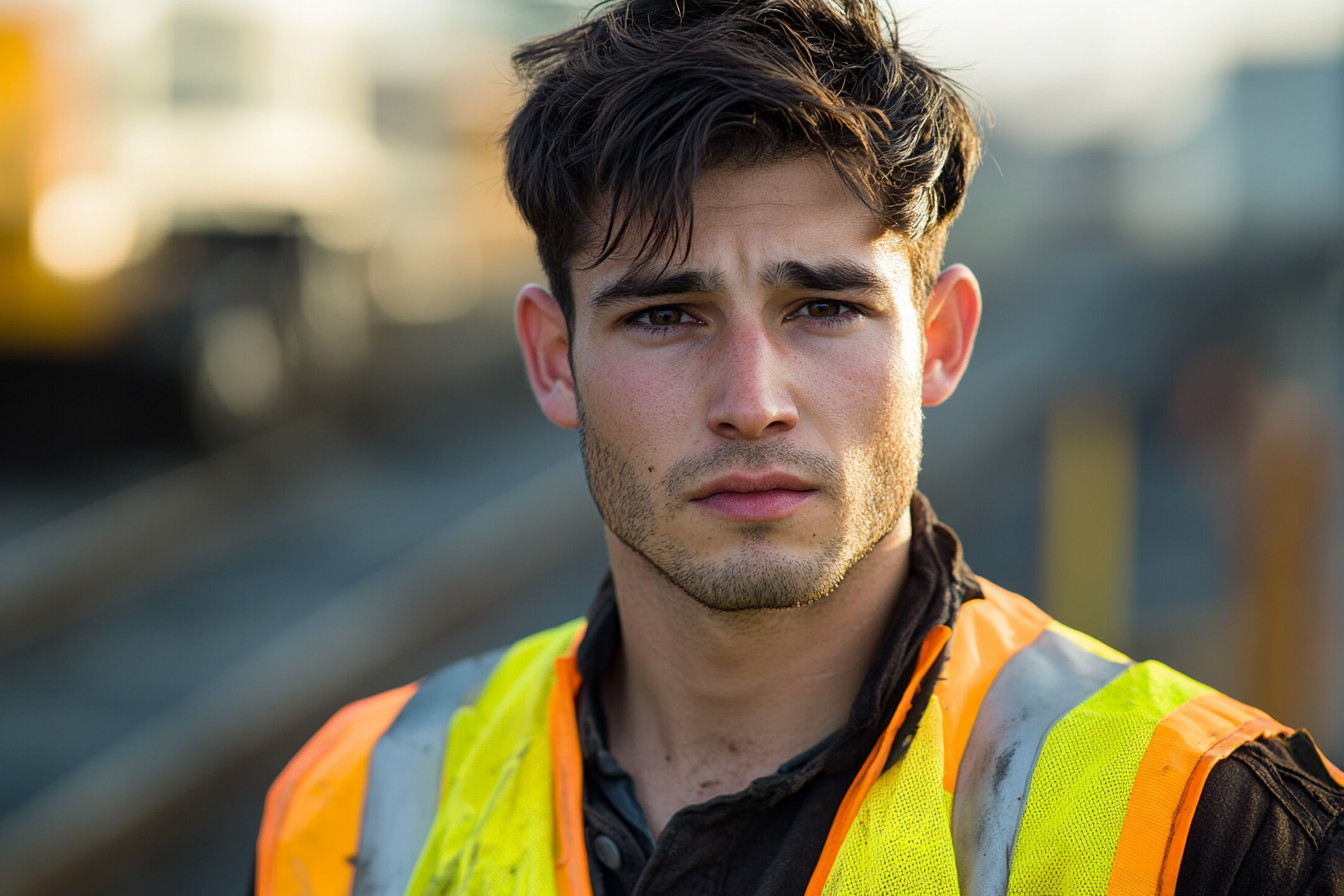
Adolfo James Forte (b. 17 March 1998, Bristol) was a Bristol-born track layer, the son of an electrician and a nurse, who answered a cryptic advertisement for 'frontier infrastructure specialists' and, bound by confidentiality, was taken through the Portal into Clivilius in 2019. There he helped build the CGRN Bixbus–Brierly Line, the first railway of a hidden world, and went on to lay track across its growing frontier. His family, told only that he was on a classified mining project, never learned where he had truly gone.
The Electrician's Boy
Adolfo James Forte was born on the 17th of March 1998, a grey Tuesday, in a strained delivery suite at Southmead Hospital in the north of Bristol, while his father stood at the bedside with the helpless expression of a young electrician who could mend almost anything except this. His parents were Devin Forte, a Bristol sparks who wired half the new-builds on the city's northern edge, and Libby Forte (née Hocking), a ward nurse who had grown up in the West Country and could take the temperature of a room as quickly as a patient. They were not well off, but they were steady, and steadiness in that house counted for a great deal.
The name was the one unusual thing about him. Adolfo was his great-grandfather's name, an old man from the Apennine hills near Bardi who had come to Bristol between the wars among the wave of Italians who fetched up in the West of England and the South Wales valleys, many of them running little cafés over which whole families lived. The Fortes had long since traded the café for the trades and the Italian for broad Bristolian vowels, but the name had survived three generations and landed, faintly incongruous, on a working-class boy in a Southmead comprehensive who was forever correcting the register and answering, more often than not, to "Dolf." He carried the name without much thought for most of his life, a small inheritance from a country he had never seen.
His sister, Roselyn, was born in 2001, and the two of them were close in the uncomplicated way of siblings who share a small house and a smaller television. He was the quiet one and she was the bright, talkative one, and he spent a good part of his childhood as her reluctant protector and audience, a role he pretended to resent and secretly liked. If he loved anyone easily in those years, without the guardedness that came over him later, it was Roselyn.
What he loved otherwise was machinery. Devin took the boy along to job sites from the time he was big enough not to be a liability, and Adolfo would sit for hours watching the orderly logic of a thing being wired and made to work, happier among cables and conduit than among people. He was not a clever boy in the way the school measured cleverness, and he knew it, and it left a small permanent chip on his shoulder. But he had good hands and an unusual patience for getting a physical thing exactly right, and somewhere in those site visits with his father he formed the conviction that would shape his whole life: that the people who actually built and mended the world were worth more than the people who merely talked about it.
Hands, Not Books
He was never going to be a university boy, and he never wanted to be. He went to Bristol Technical School rather than chase the academic path, and there, among the lathes and the wiring boards and the practical papers, he came into his own at last — not top of the class, but unmistakably good at the things the class was actually for. He left in 2016 with no particular regret and a clear sense of direction, which was rarer among his year than the qualifications themselves.
What drew him, in the end, was not his father's trade but the railways. There was something in the scale of track work that answered a need in him — the physical labour of it, the teamwork, the long visible line of a thing you had built with your own back that would still be there, carrying people, long after you had moved on. He took an apprenticeship with South Western Railway, learning to lay and maintain track across the lines of the South West, and the work suited him completely. It was hard, weather-beaten, unglamorous labour, and he was good at it, and he was content in a way he rarely managed to be anywhere else.
By his early twenties he had a solid reputation on the South Western lines as a young man who turned up, kept his head down, and did the job properly. He was not much of a talker and not at all a charmer; he made few close friends and was easy to overlook in a crowded mess hut. But the foremen knew his worth, and that was the only audience whose opinion he had ever cared about. He might have spent a quiet and decent working life on the branch lines of the West of England, and a part of him would always wonder, later, whether that would not have been the better road.
The Advertisement
The advertisement that changed his life was deliberately vague. It sought "frontier infrastructure specialists" for a major remote project, offered wages that made him read the figure twice, and said almost nothing else — no location, no employer he recognised, only a promise of serious money for serious work in a place it declined to name. A more cautious or more comfortable man might have left it alone. Adolfo, two years into the branch lines and restless with a vague hunger he could not have put into words, answered it.
He was twenty-one, and the timing caught him at exactly the right angle. He had broken off a relationship that had been going nowhere; he was tired of the same wet sidings and the same small horizons; and underneath it all sat the ordinary, powerful wish of a working man to get out, to see something, to come back with money in the bank and a story worth telling. The recruiters, when they came, were polished and incurious about everything except whether he could do the work and keep his mouth shut. There were forms, and then there were more forms — confidentiality agreements thick enough that he signed most of them without reading, because the money was real and the questions felt above his pay grade.
He did not ask the things he should have asked. He told himself it was a mining contract somewhere far off the map, because that was the shape the recruiters let him assume, and because it was easier than admitting how little he actually knew about what he had signed up for. When he told his family he had taken a classified job on a remote mining development and would be hard to reach for a while, he believed roughly half of it himself. Libby worried, the way mothers do; Devin was proud and a little envious; Roselyn made him promise to call. He promised. It was the first of a great many promises about contact that the job would quietly make impossible to keep.
Through the Door
How he travelled to the work was the part he was never able to explain to anyone, least of all himself. He was taken, with a batch of other recruits, through a doorway he was given no real account of, and came out the other side somewhere that was plainly, impossibly, not the world he had left that morning. The light was wrong. The hills were wrong. There was a river where no river he knew should be, and a young, raw, dust-coloured settlement spreading along its banks under a sky that did not sit right with anything in his memory. The company called the place Bixbus. It told him almost nothing else.
He was a labourer, not a Guardian and not an executive, and the people who ran the crossing made it clear that the larger questions — what this place was, how the doorway worked, who truly stood behind the whole enterprise — were not part of his contract. He was told what he needed to lay track and no more. For a man accustomed to understanding the machines he worked with, it was a deep and lasting unease, the sense of being a useful pair of hands in a scheme whose shape was kept deliberately above him. But the wages were as real as promised, and the work, at least, was work he understood, and so he did what working men in his position have always done: he took the job at face value, kept the unease in a back pocket, and got on with it.
Bixbus, in those first months, was mud and scaffolding and improvisation, a frontier town being thrown up at speed in a region of rolling, dusty hills. It had been founded only the year before he arrived, and it had the rough, lawless energy of any boomtown, swollen with imported labour and corporate ambition. Adolfo found lodgings, found his feet, and found, to his quiet surprise, that he did not much miss the rain of the South West. What he missed was harder to name and slower to arrive.
Sixty Kilometres
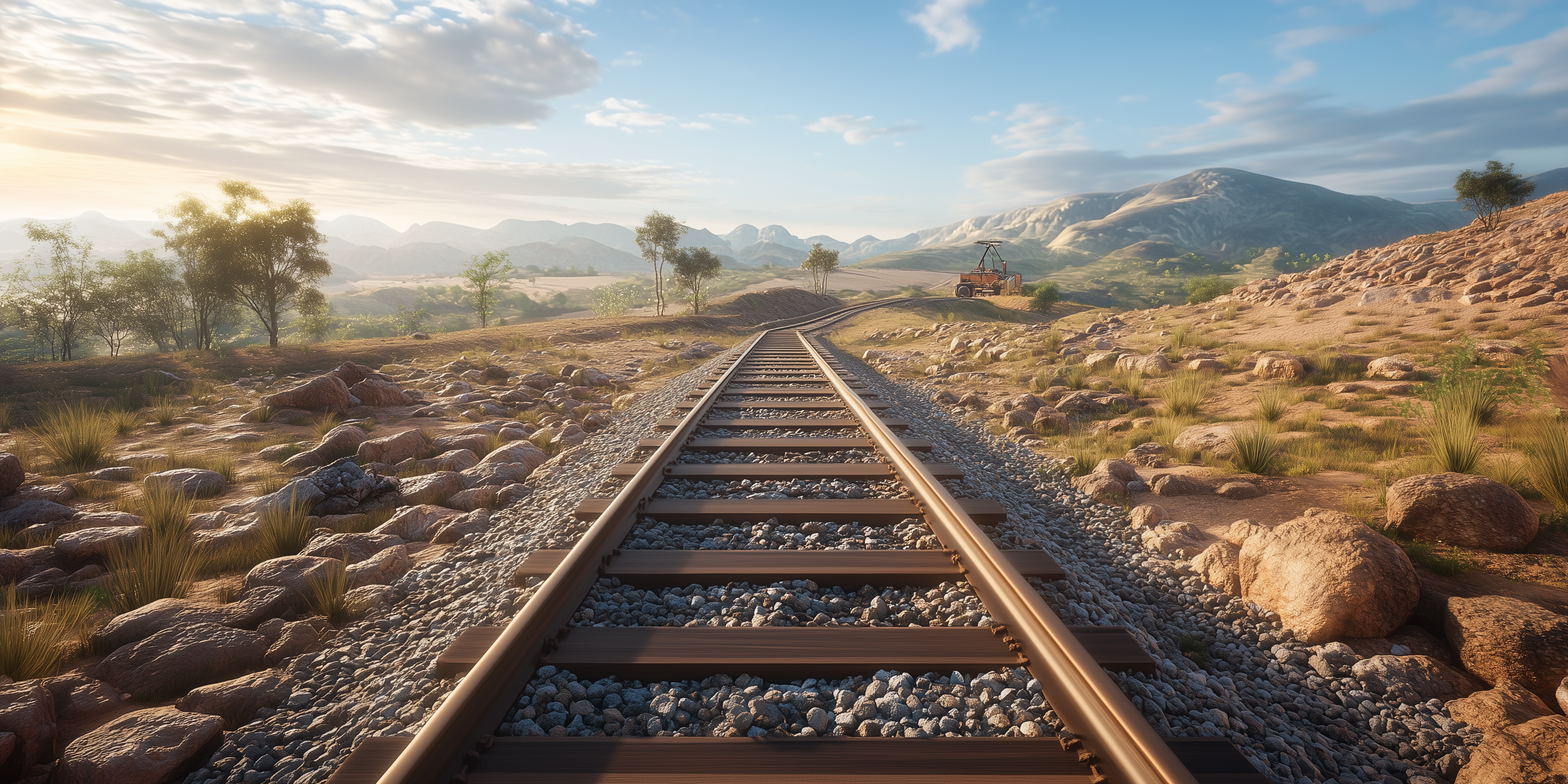
The work he had been brought across for was the railway — sixty kilometres of new line running northwest out of Bixbus to the older settlement of Brierly, the first major railway of what would become the Clivilius Global Rail Network. Construction had begun in September 2019, under a hard, fair foreman named Aaron Semple, and Adolfo was assigned to the core crew of track layers who would carry the line across some of the most unforgiving ground he had ever worked.
It was a brutal job. The terrain fought them the whole way; the weather was extreme and unfamiliar; and the cuttings were prone to landslides that could erase a week's progress in an afternoon and, on one black occasion that stayed with Adolfo long after, came down across a working party and broke the back of a young labourer named Petrov, who never walked properly again. The crew worked long, dangerous days for their generous wages, and they earned every penny. Adolfo, who had crossed a world to be there, threw himself into it with a single-mindedness that bordered on self-erasure, because the work was the one part of his strange new life that still made plain sense.
At the Brierly end the resistance was of a gentler kind. Brierly was old, agrarian and proud, a settlement of vineyards and deep traditions whose leaders had feared from the first that a railway would wash their inherited way of life out from under them, and who had agreed to the line only for the promise of carrying their celebrated wines to wider markets. The Brierly folk met the dusty, foreign track gangs with a wariness that never quite warmed, and Adolfo, an outsider twice over, learned to do his work under cool eyes and keep to his own crew.
He was not, whatever the company's later accounts liked to suggest, a born leader. He was something less glamorous and more useful: the man who did not crack. When sections went wrong and tempers frayed and the younger lads looked round for someone steady, it was Adolfo they drifted toward, less because he commanded than because he simply kept working, methodically and without drama, until the problem was solved. Responsibility settled on him the way it settles on the reliable, half by default, and he carried it without ever quite wanting it. When the first official train ran the length of the finished line on the 1st of December 2020 — the line completed, against the odds, that December — he watched it go with the bone-deep, wordless satisfaction of a man looking at something true that he had helped to build.
The Weight of the Mining Story
The railway was the easy part. The hard part was the lie, and it grew heavier with every month that passed.
He had told his family he was on a classified mining project, and the cover held, because it had to. There were no photographs he could send, no location he could name, no straight answer he could give to the simplest question about where he actually was, and so he learned to deflect, to keep his calls short and vague, to let the silences do the work that honesty could not. His mother's worry curdled slowly into hurt; his father stopped asking the questions that never got answered. Worst of all was Roselyn, who had made him promise to keep in touch and who could tell, in the way younger sisters can, that her brother had gone somewhere he would not let her follow. When she had a child of her own, a few years on, Adolfo became an uncle to a nephew he had never met and could not visit, whose growing up reached him only in fragments, late and secondhand. The secret cost him, in the end, exactly the people it had been meant to protect.
He was not built for deception, and it wore grooves in him. He grew quieter and more closed than he had ever been, a man with an enormous thing inside him that he could share with no one who mattered and only obliquely with the crewmates who carried the same impossible secret. He took to walking out alone into the wild country beyond Bixbus on his rest days, further and more recklessly than was wise, drawn to the empty places where there was no one to lie to and nothing to explain — a habit his crew worried about and he refused to discuss. And underneath the loneliness ran a slow, corrosive question he could never resolve: what exactly he was building, and for whom, in a world the company would not explain and the people who owned it would not show their faces. He had crossed an impossible threshold for money and adventure, and he had got both, and somewhere along the way he had begun to understand that he might never be allowed fully to come home.
The Long Line
The Bixbus–Brierly line was only the beginning, for the network and for him. As the dusty outpost he had arrived in swelled, within a few short years, into a sprawling city of millions and the capital of an entire hidden world, the rail network spread outward from it across the frontier, and Adolfo spread outward with it. As one of the few men who had been there from the first sixty kilometres, he became a fixture of the expanding railways — a veteran of the network's beginnings, in time a foreman in his own right, passing on to greener and stranger recruits the hard-won craft of laying a true line across difficult ground.
He made a kind of life in Bixbus, of the sort that men make when going home is not an option. He had his work, which he was proud of and good at; he had his crews, who trusted him; he had the wild country and his long solitary walks; and he had, underneath all of it, a quiet, permanent ache for a grey city across a threshold he could not recross, for a mother and a father growing old without him and a sister whose child he would never hold. He had set out, a restless boy of twenty-one, to lay some track and make some money and come back with a story. He had laid more track than he could ever have imagined, in a place whose story he was forbidden to tell — and he had built, with his own back and his good hands, the steel beginnings of a world that the people he loved would never know existed.







