Aaron James Hughs
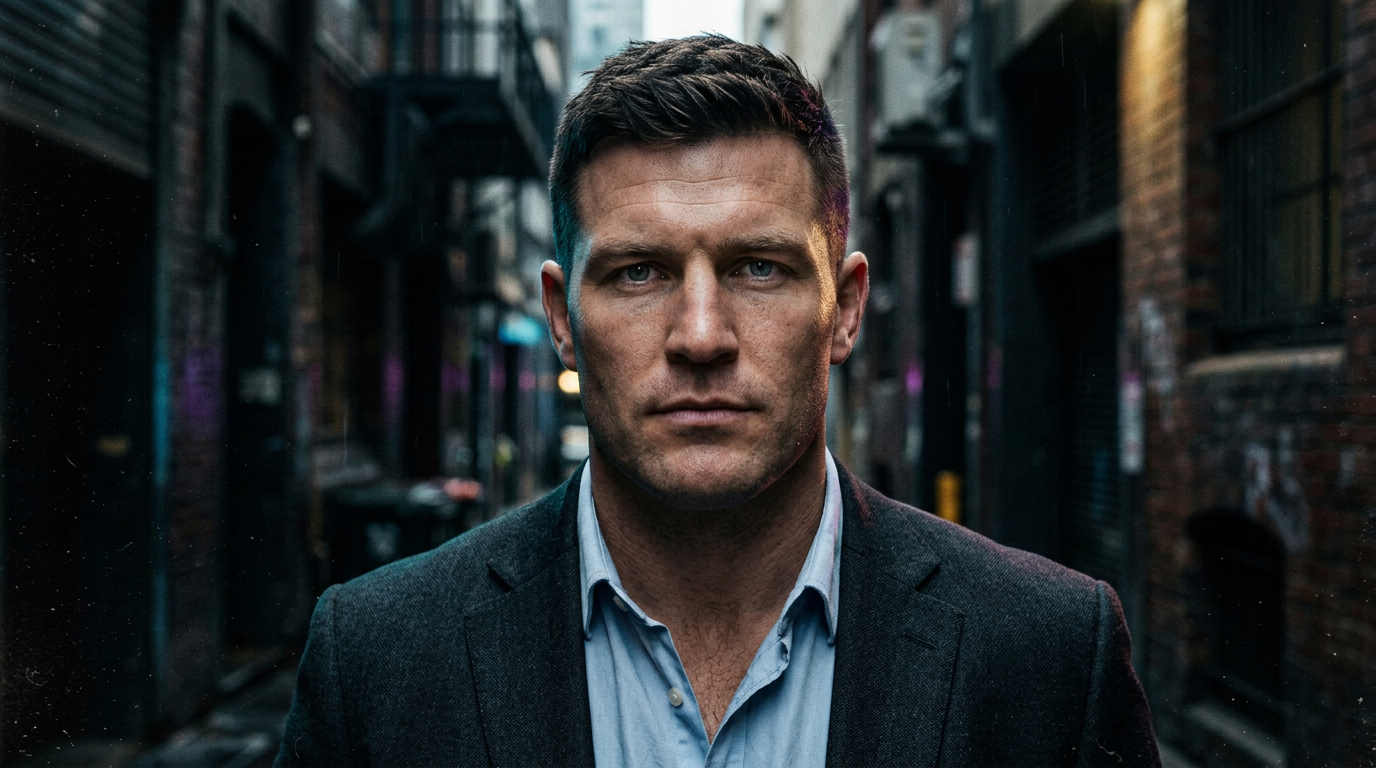
Aaron James Hughs, born on 12 November 1990 at the Queen Elizabeth Hospital in Woodville, South Australia, was the first child of firefighter David Thomas Hughs and primary school teacher Margaret Elaine Hughs (née Elliott). He grew up in working-class western Adelaide, studied criminal justice at the University of South Australia, and joined the Adelaide Metropolitan Police in 2013. After a decade in uniform policing the northern suburbs, he achieved his long-held ambition of detective rank in late 2023.
The Fireman's Boy
Aaron James Hughs was born on 12 November 1990 at the Queen Elizabeth Hospital in Woodville, the first child of David Thomas Hughs and Margaret Elaine Hughs (née Elliott). David was a firefighter with the South Australian Metropolitan Fire Service, stationed at the Hindmarsh brigade since 1984. Margaret taught Year 2 at Woodville Primary School, a ten-minute walk from the fibro house on Bower Street where the family lived for the entirety of Aaron's childhood. The house was modest — three bedrooms, a Hills hoist in the back yard, a strip of lawn that David mowed every second Sunday with a petrol Victa that sounded like it was dying but never did.
The western suburbs of Adelaide in the early 1990s were working-class in the old sense: trades, shift work, public service jobs, union memberships renewed without thinking. Woodville sat between the industrial stretches of Port Road and the residential grid that ran toward Findon and Kidman Park. It was not a rough neighbourhood, but it was not affluent either. Children walked to school. Parents knew each other through sport, through the parish, through the fact that everyone's houses were built from the same Housing Trust plans and the fences between them were low enough to talk over.
David Hughs was a quiet, physically capable man whose authority in the household derived less from anything he said than from the simple fact of what he did for a living. He left for shifts in the dark and returned smelling of smoke, and the stories he told at the dinner table — when he told them at all — carried a matter-of-fact weight that made other fathers' work sound clerical by comparison. Aaron absorbed the ethos long before he understood it: you showed up, you did the job, you did not complain about the parts that frightened you.
Margaret was warmer and more verbal, the parent who asked about homework, mediated playground disputes, and maintained the household's social calendar. She had grown up in Elizabeth, the daughter of a factory supervisor and a secretary, and had been the first in her family to attend university. Her teaching career was a point of quiet pride. She read to Aaron constantly when he was small — not literary novels, but adventure stories, Biggles and Paul Jennings and the kind of books that kept a restless boy turning pages.
Olivia Claire Hughs arrived on 3 May 1994, when Aaron was three and a half. The age gap was wide enough that the siblings never competed for the same territory. Aaron assumed a protective role early and maintained it. He walked Olivia to school, carried her bag when she was tired, threatened boys who bothered her with a seriousness that exceeded his capacity to follow through. Olivia, who was gentler and more studious, tolerated his protectiveness with the patience of someone who understood it was more about him than about her.
The Selective School
Aaron attended Woodville Primary School from 1996 to 2002, where his mother taught in a different wing. He was an average student academically — capable enough when interested, indifferent when not. His teachers noted that he was physically large for his age, calm in disputes, and better at reading people than reading books. He played football for the Woodville-West Torrens Under-12s, where his size and willingness to absorb contact made him a serviceable key defender despite limited finesse.
In 2003, he began at Underdale High School, the nearest state secondary school, but transferred after Year 8 to Adelaide High School on Margaret's insistence. Adelaide High was a selective-entry government school in the city's west end, drawing students from across metropolitan Adelaide on the basis of academic aptitude or specialist programme enrolment. Aaron's entry came through the school's general intake rather than its gifted stream — Margaret had pushed for the application, believing the school's academic culture would provide structure her son was unlikely to find at Underdale.
She was partly right. Adelaide High demanded more than Underdale had, and Aaron rose to the demand without excelling beyond it. He performed well in subjects that interested him — legal studies, psychology, physical education — and adequately in those that did not. His social sciences teachers were the first to note what would become a recurring observation throughout his life: Aaron had an unusual ability to read the emotional temperature of a room. He noticed when someone was upset before they said anything. He defused arguments between peers not through authority but through a kind of quiet spatial awareness, positioning himself in the right place and saying the right thing at the right moment.
He was not a natural leader in the conventional sense. He did not seek attention, did not run for student council, did not captain any team. But he was the person people gravitated toward when something had gone wrong — a quality that had less to do with charisma than with the fact that he was reliably calm when others were not.
During his final years at Adelaide High, Aaron took up boxing at a gym in Torrensville run by an ex-professional named Vince Catalano. The gym was old-school — concrete floor, a single heavy bag, a ring with frayed ropes — and Catalano's training philosophy emphasised discipline and technique over aggression. Aaron took to it immediately. The structured repetition suited his temperament, and the controlled physicality offered something football had not: a space where his size was an advantage rather than a blunt instrument. He trained three evenings a week and continued long after he left school.
Criminal Justice
Aaron completed his SACE in 2008 with marks that were respectable without being remarkable. He had known since Year 11 that he wanted to enter law enforcement — not firefighting, which would have been the obvious path given David's career, but policing, specifically the investigative side. The distinction mattered to him. Firefighting was reactive: you responded to what had already happened. Policing, as he understood it, offered the possibility of working backward from consequence to cause, of understanding why things went wrong rather than merely attending to the wreckage.
In February 2009, he enrolled in the Bachelor of Criminal Justice at the University of South Australia's City West campus. The degree covered criminology, behavioural psychology, forensic science, and law enforcement procedures — a broad foundation that treated policing as a discipline rather than merely a trade. Aaron was a more engaged student at university than he had been at school. The coursework connected to something that genuinely interested him, and the lecturers treated their students as future professionals rather than children to be managed.
He supplemented his studies with part-time work in private security, mostly weekend shifts at licensed venues in the city. The work was tedious more often than it was eventful, but it taught him things the university could not: how alcohol changed people's behaviour in predictable patterns, how a confrontation could be averted by adjusting your position rather than raising your voice, how the difference between a situation that escalated and one that didn't often came down to thirty seconds of the right decision-making. He paid attention. He filed it away.
He also completed an internship with the South Australia Police during his final year, shadowing officers on patrol in the northern suburbs. The experience confirmed what his coursework had suggested: that policing was less about physical intervention than about observation, documentation, and the ability to remain steady when everything around you was not. He graduated in November 2012 and applied immediately to the Adelaide Metropolitan Police.
The Badge
Aaron entered the South Australia Police Academy in early 2013 and graduated later that year. His instructors noted his composure under pressure and his aptitude for conflict resolution — qualities that were valued in a training environment that had shifted, over the preceding decade, away from the paramilitary model and toward community-oriented policing. He was assigned to general duties at the Elizabeth police station, covering the northern suburbs that he had glimpsed during his university internship.
Elizabeth and its surrounding suburbs — Salisbury, Craigmore, Smithfield, Davoren Park — were among Adelaide's most socioeconomically disadvantaged areas. The work was a daily immersion in domestic violence, drug offences, property crime, mental health crises, and the grinding consequences of intergenerational poverty. Aaron handled it with the steadiness his instructors had predicted, though the toll was cumulative rather than dramatic. He did not come home from any single shift traumatised. He came home from all of them a little quieter than he had been before.
By 2016, he had established himself as a reliable and methodical constable. His supervisors noted his thoroughness at crime scenes — he documented evidence with a precision that exceeded the norm for a general duties officer — and his effectiveness in de-escalation. He was not the officer who subdued violent offenders through force. He was the officer who talked them down, who stood in the right place, who read the room. Colleagues who worked alongside him during those years described a presence that was simultaneously imposing and unthreatening — a man whose physical size suggested he could handle anything and whose manner suggested he would prefer not to.
In early 2018, he was selected for a temporary attachment to the Adelaide Criminal Investigation Bureau, working under Detective David Santos on a series of property offences in the northern suburbs. The attachment was intended as professional development — an opportunity for a constable with investigative aptitude to gain experience alongside seasoned detectives. It placed Aaron in Santos's orbit at precisely the moment when a more significant case arrived.
The Alley in Craigmore
On 1 August 2018, Aaron was one of four officers dispatched to a residential property in Craigmore under Detective Kelly Muscat's operational command, acting on intelligence relayed by Detective Karl Jenkins of the Tasmania Police. Jenkins had identified Luke Nathaniel Smith as the primary suspect in a series of disappearances in Hobart and had reported that Smith had been sighted at Adelaide Airport that morning, believed to be heading for his parents' home. The team — Muscat, Senior Constable Mia Chen, Aaron, and Constable Jack Ridley — arrived to find a quiet house with no occupants, a half-cleared bulk food storage room, and an atmosphere of domestic eccentricity that initially suggested nothing more alarming than a family of preppers.
The assessment shifted when Chen discovered fresh blood on the garden shed. Aaron saw what happened next: two males, neither of whom had been visible at any point during the search, vaulted the rear fence at speed. He gave chase on foot without hesitation, following them through a reserve of eucalyptus trees behind the property, across Yorktown Road, and into the service area behind the Craigmore Shopping Centre. The men entered a narrow alley between two buildings — a passage with no through-access and no visible exit.
When Aaron reached the alley, it was empty. Two men had entered a dead-end passage and were not there. No doors, no fire escapes, no gaps in the fencing. He searched the full length and found nothing. He reported the loss to Muscat, who relayed it to Santos.
The experience stayed with him. Not as trauma — nothing about the chase had been physically dangerous — but as an unresolved problem. He had watched two men run into a space from which there was no exit and had arrived seconds later to find it empty. The forensic report offered no explanation. The case file remained open. Aaron did not talk about the alley often, but those who knew him well enough to ask recognised that it occupied a particular place in his thinking — not an obsession, but a splinter, something that resisted the orderly logic he applied to everything else in his professional life.
The Long Shift
After the Craigmore incident, Aaron returned to general duties but carried with him the professional credibility that the attachment to Santos's team had provided. His application for a permanent investigative role was supported by Santos, who noted Aaron's crime scene discipline and his capacity to remain composed under operational pressure. The recommendation carried weight, though the path from constable to detective in the South Australia Police was not a fast one. Positions were limited. Seniority mattered. Aaron waited.
He was promoted to Senior Constable in 2020, a step that reflected consistent service rather than any single achievement. The promotion came during the early months of the COVID-19 pandemic, when policing in South Australia shifted abruptly toward border enforcement, quarantine compliance, and the management of a population whose relationship with authority had grown more strained than anyone had anticipated. Aaron spent weeks at metropolitan checkpoints, verifying travel exemptions and absorbing the frustration of people who were frightened and angry and had nowhere else to direct it. The work bore no resemblance to criminal investigation. He did it without complaint.
Through the early 2020s, he continued to build his investigative credentials. He completed additional qualifications in forensic evidence handling and behavioural analysis through the police training college, courses that supplemented his university degree with the practical specifics of crime scene work. He was assigned to several short-term investigative task forces — a series of armed robberies in the northern suburbs in 2021, a domestic violence homicide in Salisbury in 2022 — where his methodical approach and attention to detail earned commendations from supervising detectives.
The detective appointment he had been working toward came in late 2023, when he was accepted into the Criminal Investigation Branch at the Holden Hill station. The posting covered the north-eastern suburbs, a different geography from the northern corridor he had patrolled as a constable, but the work was what he had always wanted: sustained investigation rather than reactive response, the slow assembly of evidence rather than the immediate management of crisis. He was thirty-three. It had taken a decade.
The Weight Carried Quietly
Aaron's personal life followed a pattern common among officers who entered policing young and gave themselves to it fully. He had relationships — a serious girlfriend during his university years, another during his mid-twenties — but neither survived the particular demands of shift work, emotional unavailability, and the creeping detachment that accumulated over years of absorbing other people's worst moments. He was not cold. He was guarded. The distinction was real but difficult for partners to experience as anything other than distance.
By thirty-five, he lived alone in a ground-floor flat in Prospect, a suburb close enough to the city for convenience but quiet enough to feel removed from it. The flat was spare and orderly — a single man's space kept with a discipline that owed more to habit than to any particular aesthetic sensibility. He ran in the mornings before shift, trained at a boxing gym in Kilkenny twice a week, and hiked in the Adelaide Hills on his days off, usually alone, occasionally with Ridley, who had remained a close friend since the Craigmore callout.
His relationship with his family remained the most stable thing in his life. He visited his parents in Woodville most Sundays, eating Margaret's roast in the same kitchen where he had eaten it as a child. David had retired from the fire service in 2022 at sixty, and the adjustment had not come easily — a man whose identity had been defined by the job struggled to fill the hours without it. Aaron recognised the pattern. He said nothing about it. Olivia, now a special education teacher at a primary school in Glenelg, occasionally pointed out the resemblance between father and son with a directness Aaron found uncomfortable precisely because she was right.
He continued to volunteer with youth mentoring programmes in the northern suburbs, running boxing sessions and speaking at schools about decision-making, conflict resolution, and the realities of policing. The work mattered to him in ways he found difficult to articulate. He had spent enough years in Elizabeth and Salisbury to understand that the difference between a teenager who ended up in the system and one who didn't was often a matter of timing — the right conversation at the right moment, the presence of one adult who noticed before things went wrong. He could not have explained why this felt like the most important part of his week. It simply did.
Aaron James Hughs had built a career on steadiness, on the ability to remain calm when the situation demanded it and methodical when the evidence required it. He was not brilliant. He was not reckless. He was thorough, patient, and present — qualities that attracted less attention than they deserved and that, in the long accumulation of a career in law enforcement, proved more valuable than anything louder. At thirty-five, he held the rank of detective, lived alone in a quiet flat in Prospect, trained at a gym where nobody cared what he did for a living, and carried the memory of an empty alley in Craigmore that still, after eight years, did not make sense. He had not stopped thinking about it. He had simply learned to think about it quietly.







