4135.62 · March 3, 1815 AD
A Watch to Set Him Free
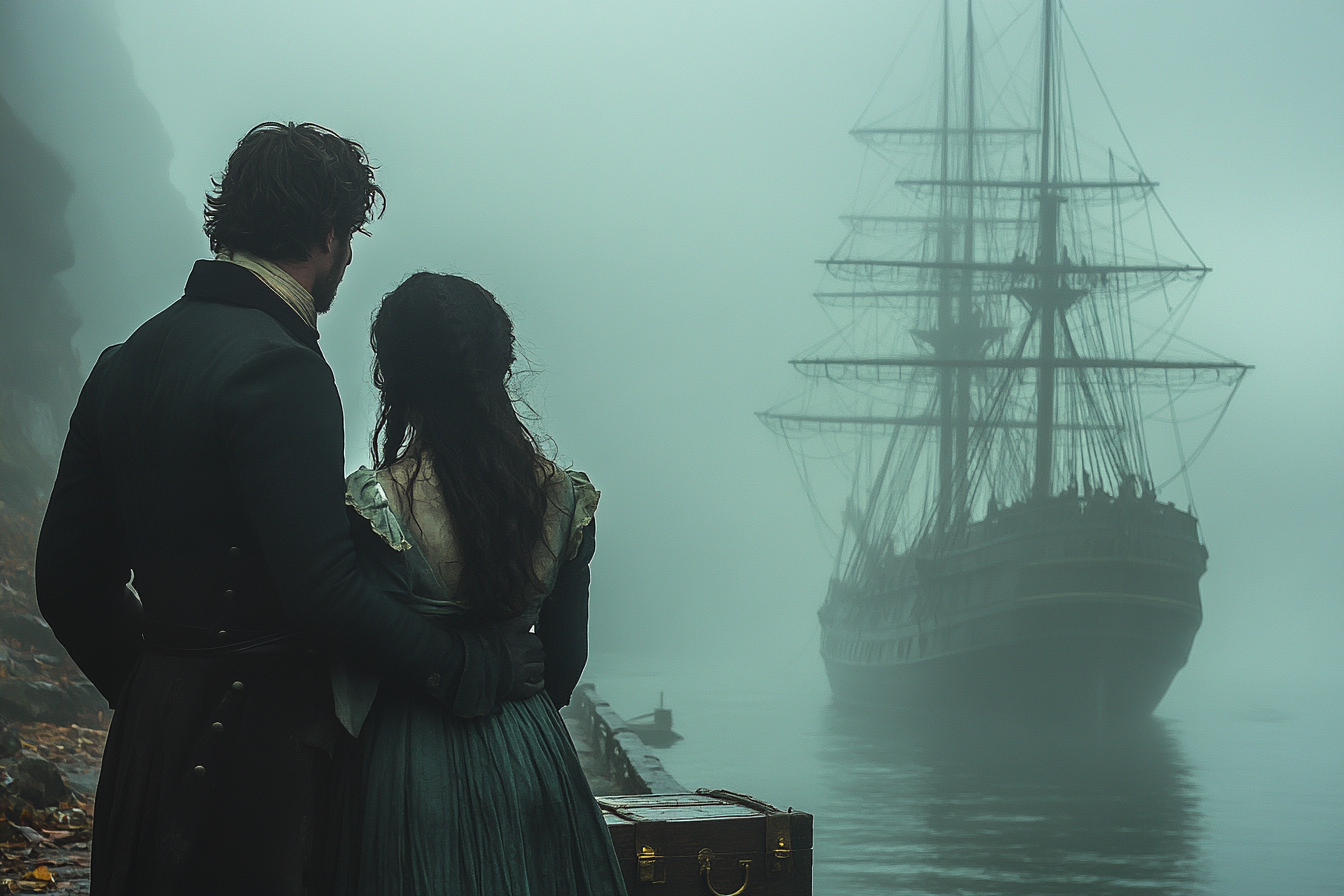
Dawn breaks wrapped in fog as William prepares to board the ship that will carry him away from Sydney forever—but first, there is one last meeting in the Domain, one final gift, and one impossible promise that will cost them both more than either can bear to count.
"If you truly love someone, you don't bind them to you. You give them what they need to become who they were meant to be."— Eliza Donnelly
William did not sleep the night before his departure.
He lay in his narrow bed, staring at the ceiling of the room that had been his home for almost two years, and felt the hours pass like blood draining from a wound. Outside his window, Sydney breathed its nocturnal rhythms—the distant calls of night watchmen, the bark of dogs in darkened streets, the occasional clatter of a late carriage on cobblestones. Sounds he had grown so accustomed to that he no longer heard them. Sounds he would never hear again.
His sea chest stood packed by the door, containing everything he owned in the world. It was not much—some clothes, a few books Eliza had given him, the letters of introduction that Reginald Donnelly had provided. The sum total of seven years in the colony, reduced to what one man could carry.
He thought of his parents, who had never learned what became of their son after the courthouse doors closed behind him. He thought of Portsmouth, of the narrow streets where he had played as a child, of the docks where he had learned to work and to dream. He thought of Jack Hawley, whose betrayal had set all of this in motion—the hatred still there, banked but not extinguished, waiting for some future kindling.
But mostly, he thought of Eliza.
She had asked to see him one final time before the Doris sailed. A last meeting in the Domain, she had said, her voice steady even as her eyes betrayed the cost of that steadiness. One more afternoon in their sanctuary before the world reclaimed them both.
He had agreed, of course. He would have agreed to anything she asked, would have walked into fire or thrown himself from cliffs if she had requested it. That was the nature of what he felt for her—absolute, unquestioning, terrifying in its completeness.
Dawn came wrapped in fog—a thick, grey shroud that rolled in from the harbour and settled over Sydney like a mourning veil. The sun, when it rose, was visible only as a pale disc behind the mist, its light diffused and uncertain. The air tasted of salt and eucalyptus and something else William could not name, something that felt like endings.
He dressed with care, choosing the suit that Eliza had insisted on having made for him—fine wool in a deep blue that she said matched his eyes, tailored to fit his frame with an elegance he had never before possessed. It felt like armour, this suit. Like a costume for the man he was trying to become.
The face that looked back at him from the small mirror above his washstand was not the face of the boy who had stood in the Portsmouth courthouse, terrified and uncomprehending. It was harder, this face. Leaner. The eyes held depths they had not possessed before—knowledge of suffering and survival, of loss and endurance, of love that could not be kept and hatred that refused to die.
William Jeffries, aged twenty-nine years, freed convict, bound for Van Diemen's Land. A man with a past he could not escape and a future he could not see.
He picked up his sea chest and walked out of the room without looking back.
The fog had begun to lift by the time William reached the Domain, though tendrils of mist still clung to the lower branches of the eucalyptus trees and pooled in the hollows of the land. The harbour below was invisible, swallowed by grey, but he could hear the sounds of the docks—the shouts of workers, the creak of rigging, the bells of ships preparing for departure.
The Doris would be among them, taking on final supplies and passengers, her captain consulting tide tables and weather reports. In a few hours, she would slip her moorings and begin the journey south. In a few hours, William would stand at her rail and watch Sydney recede into memory.
But not yet. Not quite yet.
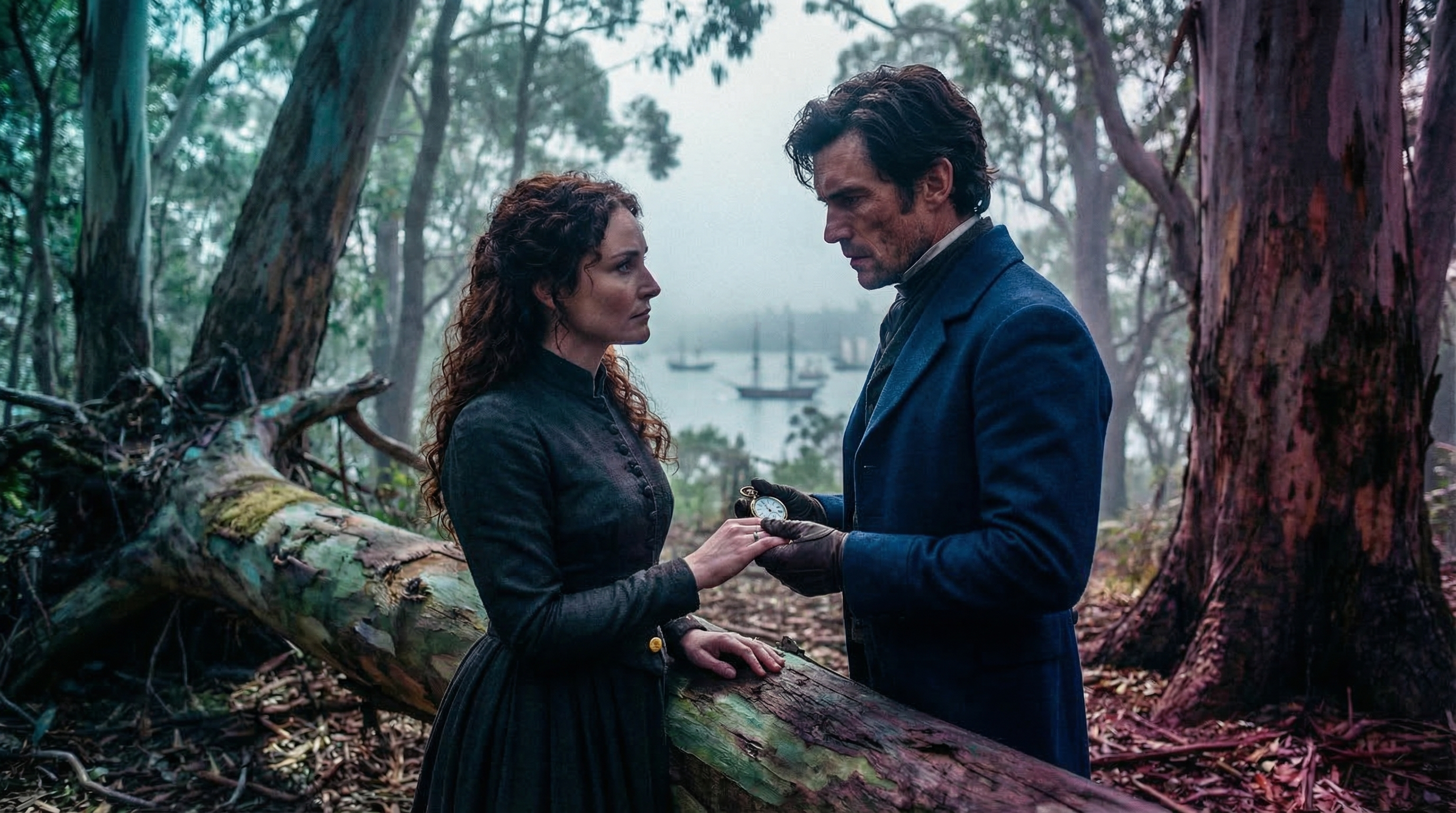
Eliza was waiting in their clearing, as he had known she would be. She sat on the fallen tree where they had spent so many Sunday afternoons, her hands folded in her lap, her face turned toward the path he would emerge from. She had dressed simply—a dark blue gown that seemed chosen to echo his suit, her copper hair pinned loosely, no parasol despite the uncertain weather.
When she saw him, she rose. She did not smile. Neither did he.
They stood for a moment, separated by a few feet of earth that felt like an ocean, looking at one another with the desperate intensity of people trying to memorise what they were about to lose. William catalogued every detail of her face—the exact shade of her eyes, the way her hair caught the diffused light, the small scar near her left eyebrow that she had never explained and he had never asked about. He wanted to carry her with him, every line and shadow, into whatever future awaited.
"You came," she said, and her voice broke on the second word.
"Did you think I wouldn't?"
"No." She shook her head, a single tear escaping to trace a silver path down her cheek. "No, I knew you would. I just... I wasn't certain I could bear it if you did."
She reached into the pocket of her gown and withdrew something small, wrapped in dark velvet. Her hands trembled as she held it out to him.
"I have something for you," she said. "A gift. Something to remember me by, though I know—" Her voice caught again, and she had to pause, breathing deeply before she could continue. "Though I know I'm about to ask you not to remember me at all."
William took the package, feeling its weight in his palm. It was heavier than he had expected, solid and substantial. He unwrapped the velvet carefully, his fingers clumsy with emotion, and felt his breath stop in his throat as the contents were revealed.
A pocket watch.
It was beautiful—silver, finely crafted, its case engraved with an intricate pattern of leaves and vines that seemed almost alive in the grey morning light. The workmanship was exquisite, clearly the product of a master craftsman, worth more than William had earned in years of labour on the docks.
But it was not the watch's beauty that stole his breath. It was what it represented.
A watch. A stolen watch had destroyed his life, had torn him from everything he knew and loved and cast him to the far side of the world in chains. A watch had been the instrument of Jack Hawley's betrayal, the false evidence that had condemned him to seven years of servitude and a lifetime of stigma.
And now Eliza was giving him a watch as a token of love.
"Open it," she whispered.
William pressed the catch, and the case sprang open to reveal a face of cream-coloured enamel, the numbers painted in elegant black script. But his eyes were drawn immediately to the inside of the cover, where words had been engraved in a flowing hand:
To W.J.
May your future be as bright as our love.
Forever yours, E.D.
The words blurred as tears filled William's eyes—tears he had not shed since the day he had been sentenced, since the moment when the judge's gavel had fallen and his old life had ended. He had taught himself not to weep, had buried that capacity beneath layers of discipline and determination. But now, standing in a fog-shrouded clearing with a silver watch in his hands and the woman he loved before him, the walls he had built crumbled to nothing.
"Eliza," he managed, his voice ragged. "I can't—this is too much—"
"It's not enough," she said fiercely, stepping forward to cup his face in her hands, to force him to meet her eyes. Her own tears were flowing freely now, but her voice held steady by sheer force of will. "Nothing could ever be enough. But I wanted you to have something beautiful to carry with you. Something that tells the truth about what you deserve, even if the world refuses to see it."
"A watch," William said, half-laughing despite the tears, hearing the absurdity of it even as he understood its perfection. "Of all the things you could have given me—"
"I know." Eliza's smile was watery but real. "I know what a watch cost you. That's why I chose it. A watch took everything from you. Now a watch marks the beginning of everything you'll become. The symmetry seemed... right."
He pulled her close then, wrapping his arms around her with a desperation that frightened him, breathing in the lavender scent of her hair, feeling the warmth of her body against his. She clung to him with equal ferocity, her fingers digging into the fabric of his coat as though she could anchor him to this moment, to this place, to her.
They stood like that for a long time, neither speaking, the fog drifting around them and the sounds of the awakening harbour rising from below. William could feel Eliza's heart beating against his chest—or perhaps it was his own; he could no longer tell where he ended and she began.
Finally, she pulled back. Her face was ravaged by tears, but her eyes held something new—a resolve that seemed to cost her everything she had.
"William," she said, and her voice had changed, had acquired an edge that cut through the fog of emotion surrounding them both. "I need you to promise me something."
"Anything."
"Don't write to me."
The words struck him like a physical blow. He stared at her, uncomprehending, certain he had misheard.
"What?"
"Don't write to me," Eliza repeated, and now he could see what the words were costing her—the way her jaw tightened, the tremor in her hands, the fresh tears that spilled even as she forced herself to continue. "Don't send letters. Don't ask after me through my father's associates. Don't—" Her voice broke, and she had to pause, pressing a hand to her mouth until she could speak again. "Don't look back, William. Not ever."
"Eliza, I can't—"
"You can. You must." She gripped his hands, her fingers ice-cold despite the mild morning. "Listen to me. Please. This is the hardest thing I've ever asked of anyone, and I need you to understand why I'm asking it."
William said nothing. He could not have spoken if his life depended on it.
"If you write to me," Eliza continued, her voice low and urgent, "I will write back. I won't be able to help myself. And then we'll spend years exchanging letters, pining for each other across hundreds of miles of ocean, building a fantasy of reunion that can never happen. You'll hold yourself back, waiting for a future with me that doesn't exist. And I'll do the same—refusing suitable marriages, turning away opportunities, clinging to a hope that will only bring us both to ruin."
"You don't know that—"
"I do know it." Her eyes blazed with a certainty that silenced him. "I know myself, William. I know that if there's any thread connecting us—any possibility, however remote—I will spend my life pulling on it. And you will too. We'll waste ourselves on what might have been instead of building what could be."
She released his hands and stepped back, wrapping her arms around herself as though she were cold despite the mild air.
"You're going to Van Diemen's Land to build a new life," she said. "A life free from the constraints that would strangle you here. You'll have opportunities—real opportunities—to become the man you were always meant to be. You'll meet people who don't know your past, who will judge you only on your abilities and your character. You might even—" She faltered, but forced herself onward. "You might even meet someone. Someone who can give you what I cannot. A future. A family. A life lived in the open instead of hidden in clearings and counting rooms."
"I don't want someone else. I want you."
"I know." The words were barely audible. "God help me, I know. And I want you. But wanting isn't enough, William. Love isn't enough. Not when the world stands between us like a wall we cannot climb."
She moved toward him again, reaching up to touch his face with fingers that trembled despite her efforts to still them.
"If you love me," she said, "truly love me, then give me this. Go to Van Diemen's Land and throw yourself into your new life with everything you have. Don't hold anything back. Don't preserve some corner of yourself for a woman you'll never see again. Become everything you're capable of becoming—not for me, but for yourself. Build something magnificent. And when you think of me—if you think of me—let it be with gratitude for what we had, not grief for what we lost."
"You're asking me to forget you."
"No." She shook her head, a ghost of a smile crossing her tear-stained face. "I'm asking you to remember me in a way that sets you free instead of binding you. Remember that someone loved you. Remember that you were worthy of that love. And then let me go."
The fog had lifted whilst they spoke, the sun breaking through in shafts of gold that illuminated the clearing with an almost painful clarity. Below them, the harbour had emerged from its shroud—ships at anchor, boats moving between them, the whole vast machinery of colonial commerce awakening to another day.
The Doris would be waiting. The tide would not delay for grief.
William looked at the woman before him—at Eliza Donnelly, merchant's daughter, who had seen a convict and loved him anyway, who had taught him to believe in himself when all evidence suggested belief was folly. She was asking him to walk away from her without looking back, to sever the thread that connected them and sail into an unknown future alone.
It was the hardest thing anyone had ever asked of him. Harder than the labour at Parramatta, harder than the endless nights on the Resolution, harder than standing in the courthouse whilst Jack Hawley walked away and the magistrate condemned. Those trials had been imposed upon him from without. This one, he had to choose.
But as he stood there, feeling the weight of the watch in his pocket—her watch, her gift, her final act of love—William understood what Eliza was truly asking. She was not asking him to forget her. She was asking him to honour what they had shared by living fully, by refusing to let their impossible love become a cage that trapped them both.
She was setting him free. And in doing so, she was breaking her own heart as thoroughly as she was breaking his.
"I promise," he said, the words tasting of ash and iron. "I won't write. I won't look back. I'll go to Van Diemen's Land and I'll build... something. I don't know what yet. But I'll build it, and I'll think of you when I do—" His voice cracked, but he pressed on. "I'll think of you with gratitude, as you asked. For seeing me. For believing in me. For loving me when you had every reason not to."
Eliza's composure finally shattered. She fell into his arms with a sob that seemed to come from somewhere deeper than grief, somewhere where the foundations of self were laid. William held her as she wept, his own tears falling into her copper hair, his heart breaking with each ragged breath she drew.
"I love you," she gasped against his chest. "William, I love you, I love you, I will always—"
"I know," he said, because he did. "I know, Eliza. And I love you. Always. No matter what happens, no matter how far I go or how long I live. That doesn't end. That can't end."
"But you have to let it go."
"I have to let it go." The words were like swallowing broken glass. "I have to let you go."
They held each other until the harbour bells began to ring, signalling the approaching hour of departure. The sound cut through their grief, reminding them that the world continued to turn regardless of their pain.
Eliza pulled back first. She wiped her face with hands that shook, drew a breath that seemed to cost her everything she had, and somehow—impossibly—found the strength to smile.
"Go," she said. "Go now, before I lose what little courage I have left and beg you to stay."
William reached out and touched her face one last time, tracing the line of her cheekbone, the curve of her jaw, the lips he would never kiss again. He wanted to say something—something profound, something that would encapsulate everything she meant to him, everything they had shared, everything they were sacrificing.
But there were no words sufficient to the moment. Language itself seemed inadequate, a pale shadow of the reality that was tearing them apart.
"Goodbye, Eliza," he said simply.
"Goodbye, William."
He turned and walked away. Each step was a small death, a severing of something vital that had kept him alive through all the years of hardship and struggle. He did not look back—he had promised, and he would keep that promise even if it killed him—but he heard her weeping behind him, heard the sound of her grief echoing through the clearing they had made their own.
The path through the Domain stretched before him, leading down toward the harbour, toward the ship that would carry him to his future. William walked it with his eyes fixed forward, his jaw clenched against the sobs that wanted to escape, the watch pressing against his heart like a brand.
He did not look back.
He would never know that Eliza stood in the clearing long after he had gone, watching the path where he had disappeared until the sun climbed high and the morning turned to noon. He would never know that she pressed her hand to her mouth to stifle the screams that wanted to escape, that she fell to her knees on the earth they had shared and wept until she had no tears left.
Some things are better left unknown. Some griefs are too sacred for witnesses.
The Doris rode at anchor in the harbour, her masts reaching toward a sky that had turned brilliant blue as the morning fog burned away. She was a handsome vessel—not large, but well-maintained, her hull freshly painted and her rigging taut. The kind of ship that inspired confidence in her passengers, that suggested competence and care.
William made his way through the chaos of the docks, his sea chest balanced on his shoulder, moving by instinct through the crowds of workers and passengers and well-wishers. The familiar sounds of the harbour surrounded him—the shouts and curses, the creak of cranes, the splash of oars in water—but they seemed to come from very far away, muffled by the roaring silence in his head.
He found the boarding point and joined the queue of passengers waiting to embark. There were perhaps thirty of them—a mix of free settlers, government officials, and men like himself, seeking opportunity in the southern colony. They spoke among themselves with the nervous energy of people embarking on journeys into the unknown, but William stood apart, wrapped in a silence that discouraged approach.
The gangplank stretched before him, a narrow bridge between the life he was leaving and the life he was about to begin. He had walked a gangplank like this once before, seven years ago, when he had descended from the Resolution onto Australian soil with bleeding feet and a breaking heart. That journey had felt like an ending—the death of everything he had been, everything he had hoped to become.
This journey felt like something different. Not an ending, exactly. But not quite a beginning either. Something in between—a passage through darkness toward a light he could not yet see.
The Doris cast off at noon, her sails unfurling to catch the harbour breeze, her bow turning toward the open sea. William stood at the stern rail, watching Sydney recede—the buildings of the town growing smaller, the familiar shoreline stretching and flattening, the whole world he had known for seven years contracting into a line on the horizon.
He could not see the Domain from here. Could not see the clearing where Eliza waited, or wept, or had perhaps already begun the long walk back to a life that no longer included him. The distance was too great, the angle wrong, the details lost to the vastness of harbour and sky.
But he looked anyway. He looked because he could not help himself, because his eyes sought her even when his mind knew she was invisible, because the heart does not take orders from the will no matter how fiercely that will insists.
The watch was warm against his chest, heated by his body, ticking steadily beneath the fabric of his shirt. Her gift. Her final act of love. A timepiece that marked not hours but something larger—the boundary between what he had been and what he would become.
The harbour mouth approached, the heads rising on either side like the pillars of some ancient gate. Beyond them lay the open ocean, the long passage south, the shores of Van Diemen's Land where Samuel Hartley waited with opportunities William could not yet imagine. Beyond them lay a future—unknown, uncertain, but his to shape.
William stood at the rail as Sydney slipped away behind him, as the last glimpse of the only home he had known in seven years faded into blue distance. The wind filled the sails above him with a sound like breathing, like sighs, like the whisper of everything he was leaving behind.
He did not weep. He had no tears left.
But his hand found the watch through the fabric of his coat, pressing against it as though he could somehow press against her—could somehow bridge the distance that was opening between them with every passing moment, could somehow hold onto what he had promised to release.
The open sea stretched before the Doris, vast and grey-green and indifferent to the small dramas of human hearts. William watched the wake spreading behind the ship—a white furrow in the water that marked their passage, that would fade within minutes as though they had never been there at all.
That was how it worked, he supposed. You passed through the world, you left your mark, and then the world closed over you as though you had never existed. The only things that lasted were the things you built—the relationships you forged, the work you accomplished, the lives you touched along the way.
He had touched Eliza's life. She had touched his. Whatever happened from this moment forward, that could not be undone. The months they had shared—the conversations, the lessons, the stolen kisses in a fog-shrouded clearing—those were woven into the fabric of who they both were. They would carry pieces of each other forever, even if they never spoke again.
Perhaps that was what she had meant. Perhaps that was what letting go truly meant—not forgetting, but integrating. Carrying the love forward not as a wound but as a gift, a foundation, a source of strength for whatever challenges lay ahead.
The coast of New South Wales had vanished now, swallowed by the curve of the earth. There was nothing behind the Doris but ocean—nothing ahead but ocean—the ship suspended between worlds, between lives, between the man William had been and the man he was becoming.
He released the watch and straightened his shoulders. The gesture felt deliberate, almost ceremonial—a physical declaration of intent.
Eliza had asked him to live fully. To throw himself into his new life without reservation. To become everything he was capable of becoming.
Very well. He would honour that request. He would take her love and her belief in him and he would forge something magnificent from them—not for her, as she had insisted, but for himself. For the boy who had been wrongly condemned. For the man who had survived against all odds. For the future that lay before him, unknown and terrifying and blazing with possibility.
William Jeffries turned his face to the south, to the wind, to whatever waited beyond the horizon.
He did not look back.
And tomorrow, he would leave her forever.







