4135.83 · March 24, 1815 AD
A Warning from the Shadows
William Jeffries encountered Samuel Hartley for the first time on his eighth day in Hobart Town. The merchant emerged from his private office in a state of evident decline—dishevelled, unsteady, showing the effects of prolonged drinking. Despite his condition, Hartley delivered a cryptic warning to his new clerk: not everything in the place was what it appeared to be.
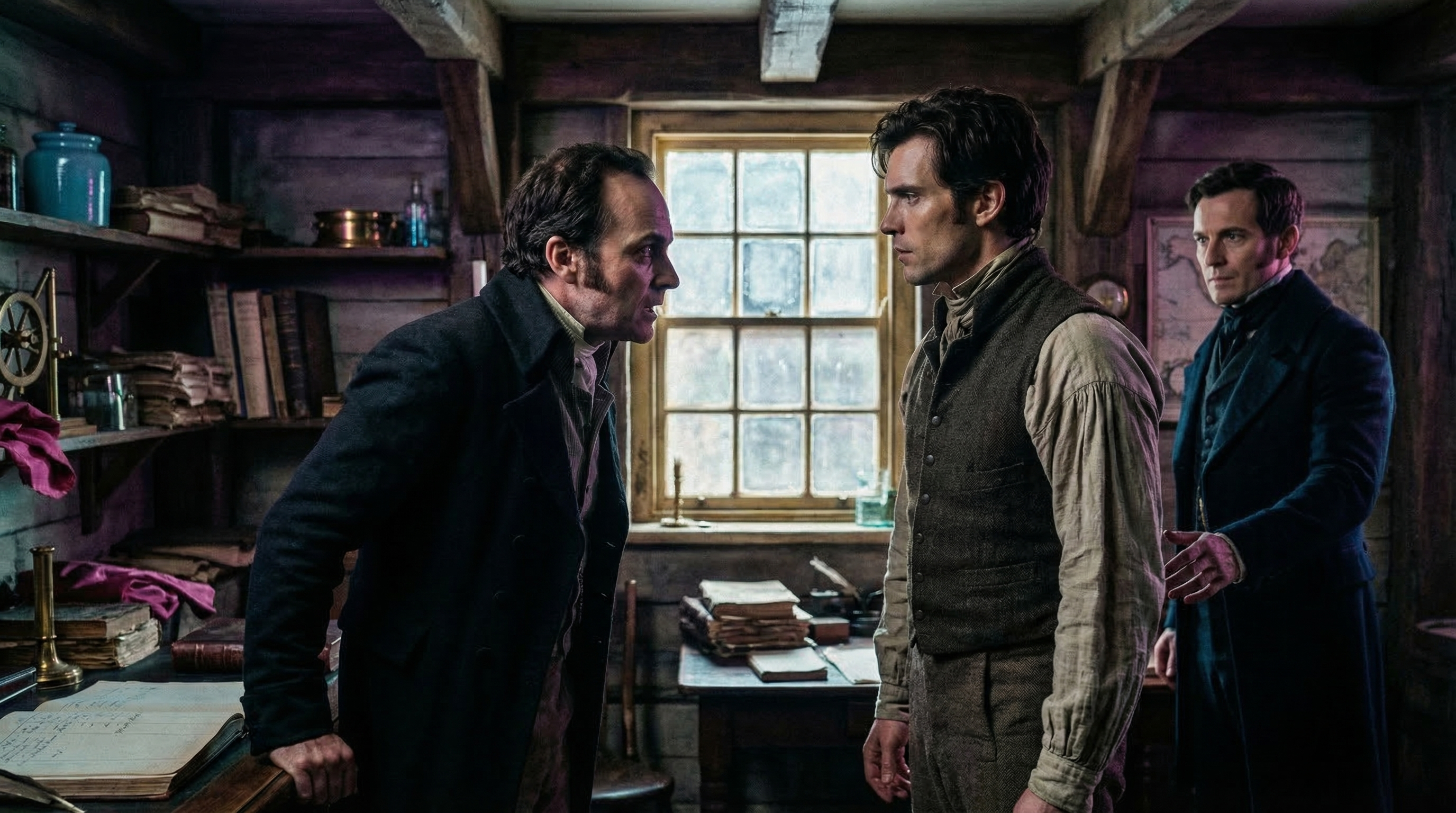
The merchant who owned the enterprise bearing his name emerged from the private office at the rear of the building shortly before noon on the twenty-fourth of March. William Jeffries had been employed at S. Hartley & Associates for eight days without encountering Samuel Hartley himself—had known him only through Ezekiel Blackwood's careful explanations of his employer's indisposition and the evidence of decline visible in the ledgers, where Hartley's handwriting had grown progressively more erratic before ceasing altogether some two years prior.
The man who shuffled into the main office bore little resemblance to whatever figure of commercial capability had once built this enterprise. Hartley appeared to be perhaps fifty years of age, though he looked older—his face puffy and florid, his eyes bloodshot, his once-fine clothes hanging loosely on a frame that had clearly diminished from its former bulk. He moved with the uncertain gait of someone whose relationship with sobriety had become intermittent at best.
His attention fixed on Jeffries with the unfocused squint of a man trying to bring the world into clarity. He demanded to know who this stranger was, seated at a desk in his establishment.
Jeffries rose, uncertain of the protocol for such an encounter. He introduced himself, mentioned the letters from Reginald Donnelly in Sydney, explained that he had arrived the previous week to take up a clerking position.
The name Donnelly seemed to produce a reaction—Hartley pronounced it as though it tasted sour, calling the Sydney merchant an old fox still sending his strays. His gaze sharpened momentarily as he studied Jeffries with an intensity at odds with his general dishevelment. He observed that Jeffries had the look of the transports about him, asked directly whether he had spent time in chains.
Seven years, Jeffries confirmed. His sentence was complete.
Hartley's response carried the bitter weight of hard-won wisdom. Nothing was ever complete in the colony, he declared. The stain followed a man no matter how far he ran or how high he climbed—always waiting to drag him back down. Whatever dreams Blackwood might sell, whatever promises of advancement he might offer, they should not obscure the fundamental truth that all transported men remained marked. The Crown never truly released what it claimed.
Before Jeffries could formulate a response, Blackwood appeared at his employer's elbow with the solicitous firmness of a man accustomed to managing such situations. He reminded Hartley of correspondence requiring attention, steering him gently back toward the private office.
Hartley allowed himself to be redirected, but paused at the door. His eyes met Jeffries's with a lucidity that seemed to cut through the fog of alcohol, sharp and sudden. He delivered his final words as warning rather than observation: the new clerk should watch himself carefully. Not everything in this place was what it appeared to be.
The door closed behind the merchant. Blackwood's expression betrayed nothing, though a certain tension seemed visible in the set of his shoulders. He dismissed Hartley's words as the product of declining faculties—moments of clarity that grew less frequent as time passed. The new clerk should not put too much weight on anything his employer said.
Jeffries returned to his ledgers, but Hartley's warning echoed in his thoughts. The merchant might be a drunk and a disappointment, but his eyes in that final moment had held something that demanded attention. A man did not build an enterprise like this without understanding the world around him. Whatever had destroyed Samuel Hartley, it had not entirely extinguished his capacity for seeing what others might prefer to keep hidden.
Not everything in this place was what it appeared to be.
Jeffries was beginning to understand precisely how true that might prove.






