
4134.314 · November 10, 1814 AD
A Chance Encounter at Campbell Cove
William Jeffries, a ticket-of-leave convict working as a cargo checker at Sydney's commercial wharves, met Eliza Donnelly, daughter of the prominent merchant Reginald Donnelly, when she arrived to inspect her father's shipments. Their conversation regarding discrepancies in a tea consignment marked the beginning of an acquaintance that would prove consequential for both parties.
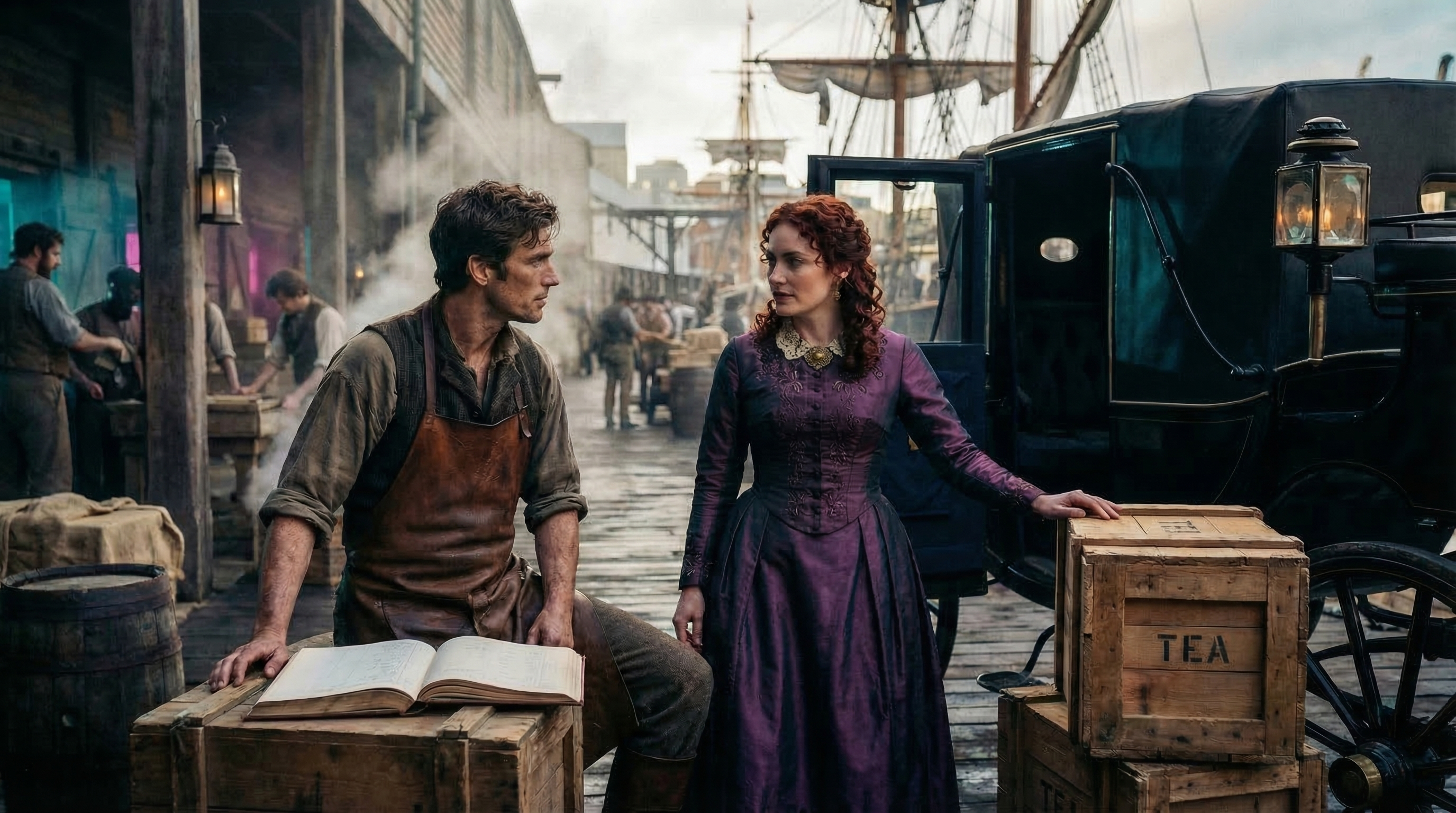
The commercial wharves at Campbell Cove presented their usual scene of controlled chaos on that November morning, with merchant vessels crowding the harbour and labourers swarming over the docks to handle cargo from half a dozen ships. Among those conducting the colony's business was William Jeffries, a twenty-nine-year-old ticket-of-leave man employed by the harbour master's office as a checker—a position that placed him at the intersection of commerce and opportunity, tallying goods against manifests and noting discrepancies that others might overlook.
Six years had passed since Jeffries had stumbled down the gangplank of the HMS Resolution onto Australian soil. The intervening time had transformed him from a frightened youth into something altogether different—a man tempered by labour at the Parramatta government farm, educated in the particular skills that colonial survival demanded, and sufficiently disciplined to earn his ticket of leave after five years of model behaviour. He had been working the Sydney docks for eighteen months, building a reputation for thoroughness that made him valuable to merchants who wished their shipments accurately recorded.
The arrival of a private carriage at the waterfront drew the attention of workers accustomed to conducting business in shirtsleeves and honest sweat. The equipage was handsome without ostentation, its black lacquer finish and polished brass fittings speaking of wealth maintained with taste rather than vulgarity. The woman who descended from it moved with the confident bearing of one accustomed to navigating worlds that most dockworkers would never enter.
Eliza Donnelly was twenty-two years of age, the daughter of Reginald Donnelly, whose warehouses dominated this stretch of the harbour front. Unlike most women of her station, she took an active role in her father's commercial affairs, personally inspecting shipments and maintaining standards that had resulted in the dismissal of at least one dishonest clerk the previous autumn. Her presence on the docks was unusual but not unprecedented, and those who knew her reputation understood that her visits were conducted with purpose rather than idle curiosity.
The Donnelly shipment that morning included consignments of tea from Canton, and it was this cargo that brought Miss Donnelly to Warehouse Three, where Jeffries had been verifying counts against the captain's manifest. The checker had already noted a discrepancy—three crates short of what had been declared at departure—and had formed opinions about whether the shortage represented pilferage during the voyage or falsification before loading.
The encounter between the merchant's daughter and the former convict occurred in the shadow of stacked cargo, surrounded by the sounds and smells of a working harbour. Whatever passed between them in that conversation was not recorded by any official observer, but the harbour master's subsequent arrival found Miss Donnelly speaking with Jeffries regarding the tea discrepancy, and her manner suggested that she had found his observations worth hearing.
Harbour Master Whitfield, a corpulent man whose administrative talents were exceeded only by his instinct for self-preservation, inserted himself into the exchange with the anxious servility he reserved for those possessed of money and influence. His attempt to minimise the significance of the shortage and redirect Miss Donnelly's attention to matters more flattering to his administration met with limited success. The merchant's daughter made clear that Jeffries had noticed patterns that the harbour master's office had apparently overlooked, and that she intended to mention his diligence to her father.
The implications of such notice were not lost on anyone present. Whitfield's expression suggested that the checker would face consequences for having shown up his superior before an important client. Jeffries himself betrayed little reaction, though he must have understood that he had crossed a boundary that men of his station were expected to respect. Miss Donnelly departed shortly thereafter, escorted by the harbour master toward her father's warehouses, leaving behind a dockside that returned quickly to its ordinary rhythms.
Yet something had shifted in that brief encounter. A ticket-of-leave man had spoken to a merchant's daughter as an equal—or near enough—and she had listened. He had offered analysis rather than mere facts, had demonstrated a mind that years of convict labour had failed to dull, and she had defended his competence before the very official who controlled his working life. Such moments, insignificant in isolation, sometimes proved to be hinges upon which larger events would turn.
William Jeffries returned to his ledger as the morning advanced, his hands performing their familiar duties whilst his thoughts remained fixed upon the woman with copper hair and emerald eyes who had looked at a convict and seen a man worth speaking to. The harbour master's clock marked the passage of hours. The chaos of commerce continued unabated around him. And somewhere in the warehouses of Campbell Cove, Eliza Donnelly conducted her inspection, perhaps giving no further thought to the checker who had caught her attention—or perhaps, like Jeffries himself, finding that the encounter lingered in her mind longer than reason could justify.
The tenth of November 1814 concluded without further incident of note. The significance of what had begun that morning would only become apparent in the weeks and months that followed.







