Yunta, South Australia, Australia
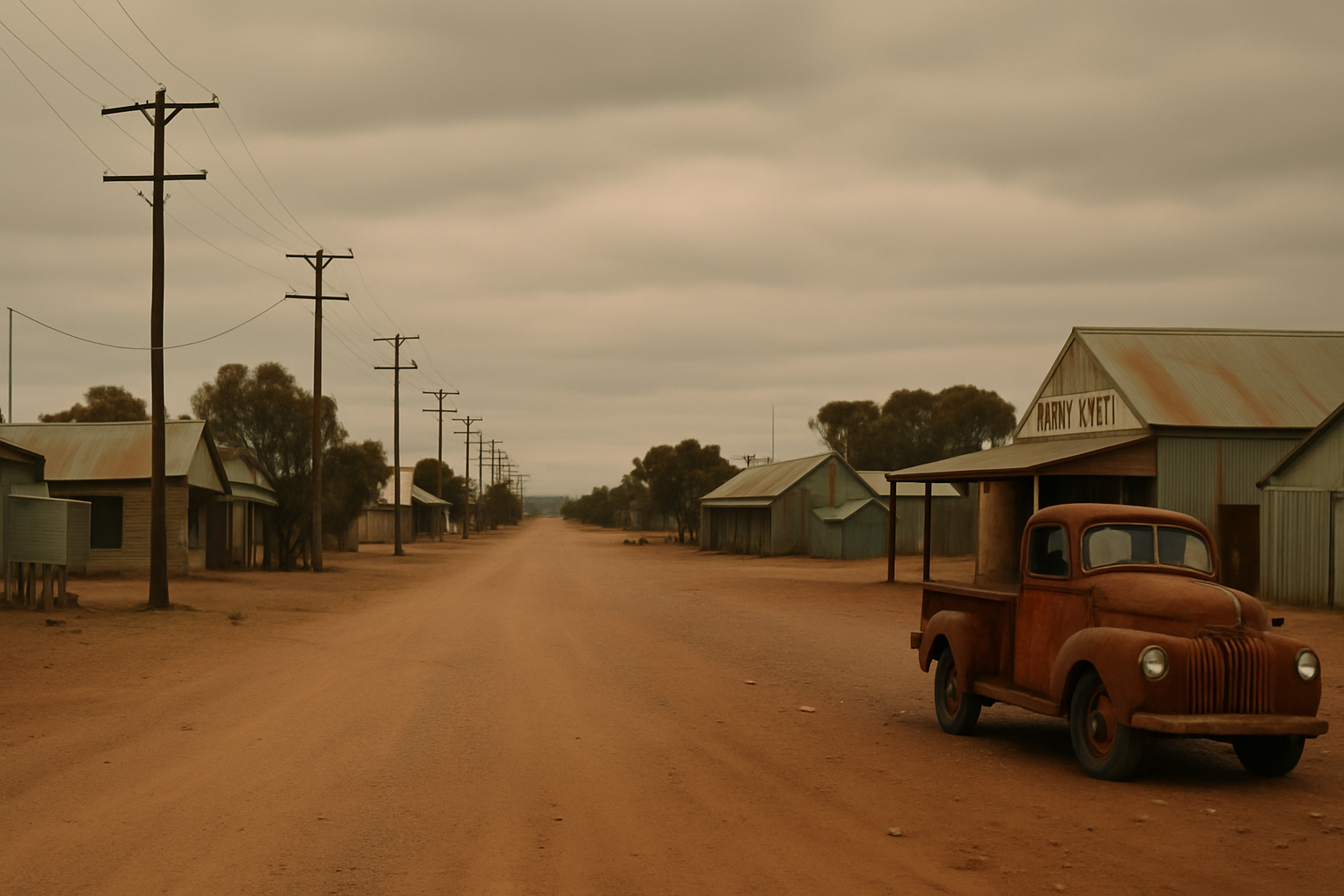
Yunta rises from the red dust of South Australia's mid-north, approximately three hundred kilometres northeast of Adelaide, where railway tracks once carried dreams and copper veins promised fortune. This remote settlement has witnessed agricultural innovation, mining booms, and quiet decline, yet endures as waystation for travellers navigating between Adelaide and Broken Hill. In 2018, its strategic isolation drew both compassionate rescue and covert Guardian operations into its weathered streets.
Origins and Railway Foundations
The land upon which Yunta stands belongs to the traditional country of the Ngadjuri people, whose connection to this harsh yet generous landscape extends across countless generations before European colonisation disrupted ancient patterns of seasonal movement and resource management. The red earth and scattered mulga scrub held meaning within Indigenous knowledge systems long before surveyors plotted township boundaries or engineers calculated railway gradients.
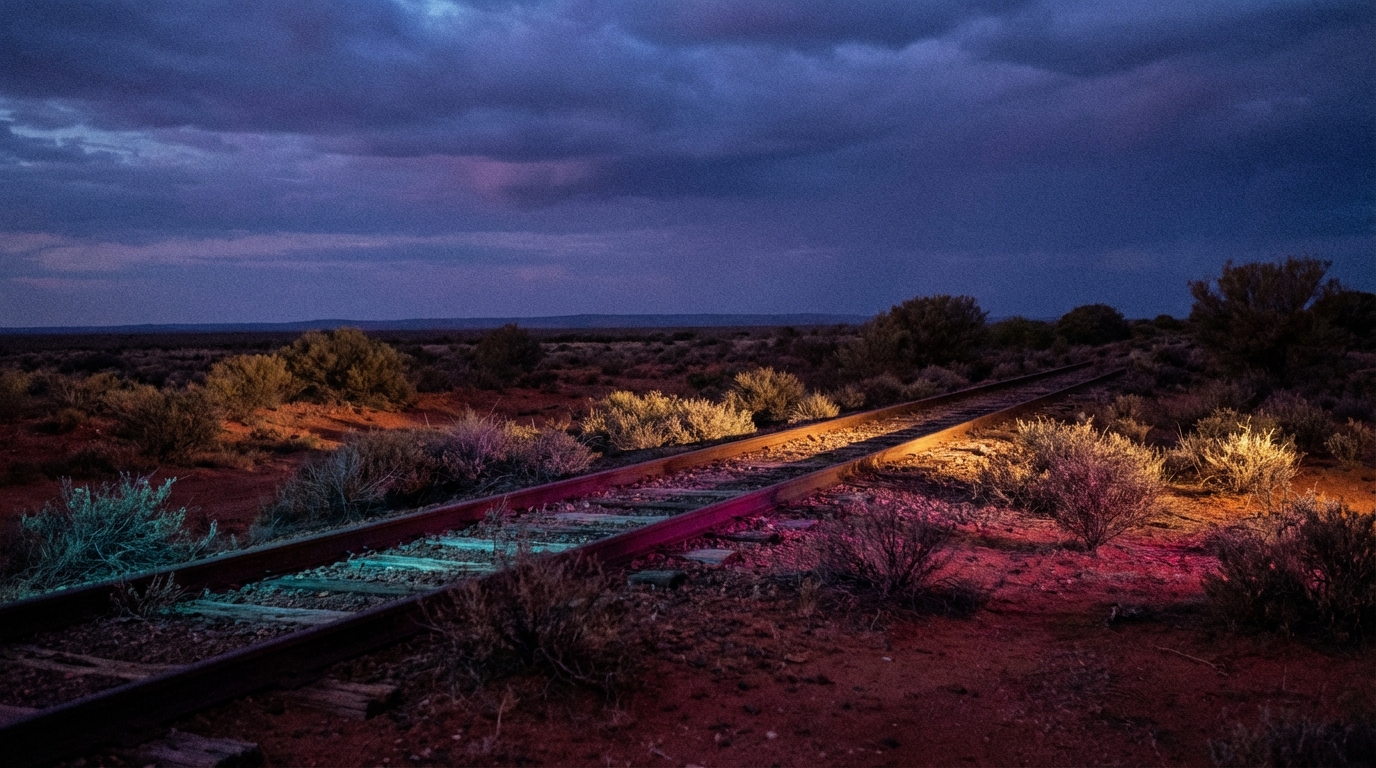
European settlement arrived with the railway. The Peterborough to Broken Hill line, constructed during the late nineteenth century, required watering stations and maintenance depots at regular intervals across the semi-arid landscape. Yunta emerged as one such strategic point, its location determined not by agricultural promise or mineral wealth but by the prosaic requirements of steam locomotion: sufficient distance from preceding stations to necessitate water replenishment, adequate flat ground for sidings and maintenance sheds, proximity to whatever sparse water sources the countryside might yield.
The township that coalesced around these railway facilities bore the typical characteristics of such settlements: a cluster of corrugated iron structures, a general store serving passing traffic, accommodation for railway workers and their families, and the gradual accumulation of services that any permanent population requires. The name Yunta itself carries Aboriginal origins, though precise meaning has become obscured through generations of colonial adaptation and orthographic variation.
Throughout its early decades, the settlement functioned primarily as railway waystation—a place of brief pauses rather than permanent destinations. Travellers changed trains or waited for connections, railway crews rotated through maintenance schedules, and the rhythms of steam locomotion imposed their own temporal structure upon daily life. The town existed because the railway required it to exist, its population rising and falling with the fortunes of the line it served.
Agricultural Innovation: Henry Thompson's Legacy
The arrival of Henry James Thompson in 1892 transformed Yunta's relationship with the surrounding landscape. Born in 1859 to Scottish immigrant copper miners in Burra, Thompson brought to the district an agricultural vision that defied conventional wisdom about the region's productive capacity. Where established pastoralists saw marginal grazing country suitable only for extensive sheep runs, Thompson perceived possibilities for intensive cultivation—provided traditional farming methods could be adapted to local conditions.
His homestead, established four miles northeast of the township on 640 acres of Crown land, became laboratory for systematic experimentation with dry-farming techniques. Thompson understood that survival in this environment demanded innovation rather than mere persistence. His approach combined careful observation of natural water patterns with engineering solutions that captured and directed whatever rainfall the capricious climate provided.
The contour banking systems Thompson developed demonstrated sophisticated understanding of hydrology and soil management. These structures channelled runoff from rare but intense rainfall events into storage areas where moisture could penetrate deeply into the soil profile, sustaining crops through the long dry periods that characterised the regional climate. His mallee windbreaks protected vulnerable seedlings from the desiccating winds that stripped moisture from unprotected ground, whilst his systematic crop breeding programme developed wheat varieties capable of producing acceptable yields with as little as eight inches of annual rainfall.
Thompson's methods attracted attention well beyond Yunta's immediate district. His 1915 book, Dry Land Farming in South Australia, documented techniques that influenced agricultural practice across Australia's marginal wheat belt and earned international recognition. The Royal Agricultural Society awarded him their Gold Medal, whilst the University of Adelaide conferred an honorary degree upon a man whose formal education had extended no further than basic colonial schooling.
Yet Thompson's legacy contains elements that transcend conventional agricultural history. His journals, preserved within family collections and local archives, record unexplained "night observations" documented using cryptic symbols that correspond to no known writing system. The underground chambers he constructed beneath his homestead—ostensibly for root vegetable storage—exhibit anomalous magnetic properties that have puzzled subsequent investigators. The geometric patterns formed by his contour banking systems become apparent only from aerial perspective, their shapes corresponding to no recognised farming purpose. Whether these mysteries represent the private eccentricities of an isolated genius or evidence of knowledge channelled from sources beyond conventional explanation remains unresolved.
Thompson died in Yunta in 1932, his agricultural innovations having enabled permanent farming settlement across previously marginal lands. The techniques he developed continue influencing dry-land cultivation practices, whilst the stranger elements of his legacy await explanation.
The Copper Boom: O'Malley's Discovery
The discovery of copper deposits in 1905 transformed Yunta from struggling railway settlement into thriving mining town virtually overnight. William Patrick O'Malley, born on St Patrick's Day 1867 in Castlemaine, Victoria, to Irish immigrant gold miners, had spent decades honing prospecting skills across Western Australia's goldfields before systematic exploration brought him to South Australia's mid-north.
O'Malley's discovery, four miles north of the township, revealed copper ore of remarkable purity—twelve percent in some samples, well above the threshold for profitable extraction with contemporary technology. The Yunta Copper Mining Company, which he established following the find, attracted investment that funded three main shafts and processing facilities capable of handling substantial ore volumes.
The population surge proved dramatic. From approximately 150 residents before the discovery, Yunta swelled to nearly 800 by 1907 as miners, their families, and the service providers who sustained mining communities flooded into the district. Hotels, shops, boarding houses, and entertainment venues proliferated along streets that had previously accommodated only railway workers and the occasional pastoralist. The township acquired the infrastructure of permanence: churches, a school, improved water supply, regular mail services connecting residents to distant family and broader commercial networks.
O'Malley introduced innovative extraction techniques that increased recovery rates to eighty-five percent, including differential flotation methods that separated valuable copper from waste rock more efficiently than conventional processing. His technical contributions earned respect within mining circles, though personal tragedy marked his years of success. Two infant sons died in childhood, followed by his daughter Mary in 1914 and wife Agnes in 1918. These losses, combined with declining ore grades and the 1913 global copper price collapse, initiated the slow decline that would eventually see the mines close by 1923.
Like Thompson's agricultural legacy, O'Malley's mining history harbours disturbing anomalies. His field notebooks contain three weeks of cryptic entries immediately preceding the discovery—symbols matching no known writing system, diagrams suggesting geological formations that shouldn't exist at those depths. The abandoned Number Three shaft exhibits temperature variations and magnetic deflections that defy physical explanation, whilst preserved ore samples contain isotopic signatures found only in meteoritic material. His final words, recorded by attending physicians, spoke of being "the key to a door that should have stayed locked"—a sentiment that local Aboriginal traditions echo in warnings about certain treasures that should remain sleeping beneath ancient stones.
O'Malley died in 1928, his final years marked by poverty and alcoholism after the fortune he'd built evaporated with the mines' closure. The copper deposits he discovered yielded over twelve thousand tonnes of ore before exhaustion, their extraction transforming Yunta's character whilst leaving geological mysteries that subsequent investigators have never fully resolved.
Decline and Persistence
The closure of the copper mines initiated Yunta's long retreat from boomtown prominence to its present status as remote outback settlement. Population declined as miners departed for more promising fields elsewhere, their families and the services sustaining them following in steady exodus. Hotels closed, shops shuttered, and the infrastructure of prosperity gradually crumbled into the red dust from which it had risen.
The railway continued providing economic foundation, though technological change progressively eroded even this support. Diesel locomotives eliminated the need for frequent watering stops, reducing Yunta's strategic importance within the transport network. Road freight increasingly competed with rail services, whilst declining agricultural activity in surrounding districts meant fewer goods requiring transport in either direction.
Throughout these decades of contraction, certain families maintained commitment to the settlement that circumstances had made their home. The pastoral stations surrounding Yunta continued operation, their workers and families providing stable population base even as transient mining communities departed. The railway employees who remained formed another anchor, their presence ensuring that some services continued even as others disappeared.
The establishment of Yunta Primary School in 1911 had created an institution that would outlast the mining boom, providing educational continuity for children whose families stayed when others left. The school's corrugated iron classroom, erected near the telegraph station to accommodate growing enrolments during the copper years, adapted to declining numbers through multi-age teaching arrangements that made virtue of necessity. A single teacher instructing pupils across multiple year levels became standard practice, the intimacy of small classes compensating for limited specialist resources.
The Tillett Family: Generations of Service
The Tillett family exemplifies the quiet devotion that sustained Yunta through decades when easier options beckoned elsewhere. Rosemary Ellen Tillett, née Jarrett, arrived in the settlement in 1960 following her marriage to diesel mechanic Franklin Dean Tillett. Born in 1941 in the railway town of Quorn to boilermaker Harold James Jarrett and Margaret Florence Williamson, Rosemary brought to Yunta the practical resilience characteristic of South Australian country women.
Her twenty-two years of service at Yunta Primary School, commencing in 1962, evolved from initial employment as part-time cleaner into unofficial counsellor, administrator, and community organiser. The role expanded to fill whatever needs arose: baking scones for fundraising drives, managing textbook repairs, ensuring that children studying via correspondence received their materials on schedule despite the vagaries of outback postal services. Her initiative, the "March Scones & Stationery Drive," became beloved fixture supporting bush families scattered across hundreds of kilometres of surrounding country.
Franklin Tillett, known throughout the district as "Frank the Fixer," spent his working life travelling to remote stations maintaining the diesel machinery upon which pastoral operations depended. His absences lasted weeks at a time, leaving Rosemary to manage household and community responsibilities whilst raising their children in circumstances that demanded self-reliance from an early age.
Their daughter Marnie Louise Tillett, born in 1966, attended Yunta Primary School from 1971 to 1978. Under the guidance of teacher Judith Harland, whose emphasis on practical skills complemented conventional academics, Marnie developed aptitudes for mechanical work that would eventually see her managing the Outback Crossroads Roadhouse—the petrol station and convenience store that serves as Yunta's vital lifeline for travellers navigating the long stretch between Adelaide and Broken Hill.
The family absorbed tragedy alongside triumph. Dean Tillett, Rosemary and Franklin's son, died in a motorcycle accident in 1989, a loss that tested the family's resilience and contributed to Franklin's gradual decline until his death in 2004. Yet Rosemary continued serving her community through Royal Flying Doctor Service fundraising that generated over forty-five thousand dollars and advocacy that established crucial rural mental health services throughout the region.
Now aged eighty-four in 2025, Rosemary Ellen Tillett remains one of Yunta's last permanent residents, maintaining meticulous records that hint at purposes deeper than conventional community service. Her documented "special deliveries" correlate with patterns that only those familiar with Guardian movement might recognise, whilst Franklin's preserved tool collection contains precision instruments marked with measurements corresponding to neither metric nor imperial systems—suggesting that beneath her conventional life of service lay connections to networks operating beyond the visible boundaries of small-town existence.
Geographic Character and Isolation
Yunta occupies territory that demands respect from those who traverse it. The landscape stretches in every direction—flat, sparse, dominated by muted earth tones that blend into one another until distinguishing ground from sky becomes matter of careful attention rather than casual observation. Mulga scrub punctuates the red soil, its twisted forms suggesting stubborn survival rather than comfortable growth. The horizon extends to distances that make mockery of urban scale, the curve of the earth itself becoming perceptible across such vast emptiness.
The climate enforces its own discipline upon human activity. Summer temperatures exceed forty degrees Celsius with reliable regularity, the heat taking on character that long-term residents describe as predatory—patient, relentless, waiting for lapses in preparation or judgement. Winter brings cold nights that surprise visitors expecting uniform warmth, frost occasionally silvering the red dust before dawn burns it away. Rainfall averages less than three hundred millimetres annually, distributed unpredictably across months that may receive nothing or sudden deluges that transform dry creek beds into temporary torrents.
The settlement itself clusters along the main road connecting Adelaide to Broken Hill. A handful of buildings comprise the township proper: the Outback Crossroads Roadhouse with its petrol pumps and convenience offerings, the post office maintaining communication links with the wider world, scattered residences housing the diminished permanent population, and the weathered structures that recall more prosperous eras without pretending they might return.
The roadhouse functions as commercial and social centre for both residents and the steady stream of travellers whose journeys require Yunta's services. Truckers hauling freight between state capitals stop for fuel and food; tourists navigating the outback pause for refreshment and directions; locals gather for the kind of casual conversation that constitutes community life in places where neighbours may live dozens of kilometres apart.
Chickens wander freely through the township—a characteristic detail that visitors find either charming or disconcerting depending upon their relationship with livestock. These hardy birds have become unlikely symbols of Yunta's enduring spirit, their persistent presence weaving through daily life with the indifference of creatures perfectly adapted to their environment. They scratch in the dust, investigate visitors' vehicles with beady-eyed curiosity, and occasionally feature in the kind of impromptu events that distinguish outback communities from their urban counterparts.
The Rescue of Vincent: July 2018
The events of 30 July 2018 transformed Yunta from unremarkable waystation into setting for an act of spontaneous compassion that would acquire significance beyond its immediate circumstances. Beatrix Evelyn Cramer, travelling from Hobart to Broken Hill via the Barrier Highway, stopped at the Outback Crossroads Roadhouse for fuel and supplies—a routine pause on a journey whose ultimate purposes extended far beyond ordinary travel.
Inside the roadhouse, Beatrix overheard a conversation between local man Bill and the woman behind the counter. Bill's tone carried the flat inevitability of someone discussing an unpleasant necessity: his new dog didn't like his old goat, Vincent. The dog had been biting at Vincent's legs, drawing blood. Nobody wanted an elderly goat. The conclusion seemed foregone: "I think I'm just gonna 'ave to shoot him."
The exchange possessed the casual horror of rural pragmatism—decisions about life and death delivered with the same emotional register as complaints about weather or fuel prices. For Beatrix, whose life had recently been disrupted by revelations about dimensional portals and her sister's transformation into something beyond ordinary human experience, the conversation crystallised into moral imperative that bypassed deliberation entirely.
Outside, she located Bill's silver Toyota Land Cruiser parked along the fence line, Vincent visible within one of the dog cages bolted to its tray. The goat's dark eyes regarded her with the mild unconcern of an animal unaware of the fate being discussed metres away. Acting before calculation could intervene, Beatrix opened the cage, wrestled the surprisingly heavy animal toward her own vehicle, and deposited him among hastily gathered hay on the back seat.
The rescue expanded beyond initial intentions when half a dozen brown hens appeared around the car, their collective attention suggesting expectations that transcended their species' capacity for abstract thought. The ringleader, a stout hen with burnt-toffee feathers, advanced with swagger that brooked no argument. "Oh, come on then," Beatrix sighed, accepting her new role as farmyard liberation coordinator.
Vincent the goat and his improvised poultry entourage accompanied Beatrix through the Portal into Clivilius, where they would find sanctuary within the developing community at Bixbus. The rescue itself might have remained minor footnote in Yunta's history had subsequent events not revealed the settlement's deeper significance within Guardian operations.
Strategic Operations: August 2018
Eleven days after Beatrix's impromptu animal rescue, Yunta provided setting for a more calculated intervention. The Guardians' establishment of Bixbus in Clivilius demanded resources that the nascent community lacked legitimate means of acquiring—fuel foremost among them, essential for generators, vehicles, and the infrastructure that sustained human existence in a dimension where conventional supply chains didn't exist.
The decision to intercept a fuel tanker emerged from desperate necessity rather than criminal inclination. Beatrix and Luke Smith, both newly recruited into Guardian operations, identified Yunta as optimal location for the interception. The settlement's remoteness minimised witnesses; its position along established transport routes guaranteed regular tanker deliveries; the sparse population reduced complications that might arise in more populated areas.
The operation unfolded with precision that belied its improvisational origins. Beatrix staged a distraction that drew the tanker driver's attention whilst Luke secured the vehicle. The tanker was driven to a secluded location and transported through a Portal to Bixbus, its contents providing fuel supplies that sustained the community through its precarious early months.
The incident made local news and attracted police investigation, though authorities never identified the perpetrators or understood the destination of the stolen cargo. For Yunta, the event represented one more strange occurrence in a settlement whose history contained more than its share of unexplained phenomena—from Thompson's cryptic observations to O'Malley's anomalous mining sites to the various small mysteries that residents had learned to accept without demanding explanation.
