4075.104 · April 14, 1755 AD
Wolves at the Supper Table
Reunited with her sisters around a humble supper of stew and laughter, Elspeth shares carefully edited tales of the Emporium's wonders—but when she mentions Lady Aberfoyle, her mother's reaction suggests the noblewoman's name carries a weight far heavier than silk. As Violet begs for a bedtime story with happy endings, Elspeth begins to understand that the fairy tale she's stumbled into may contain wolves far closer to home than she ever imagined.
"My mother warned me to keep my ears closed. She was about ten hours too late."
"Elspeth! You're home!"
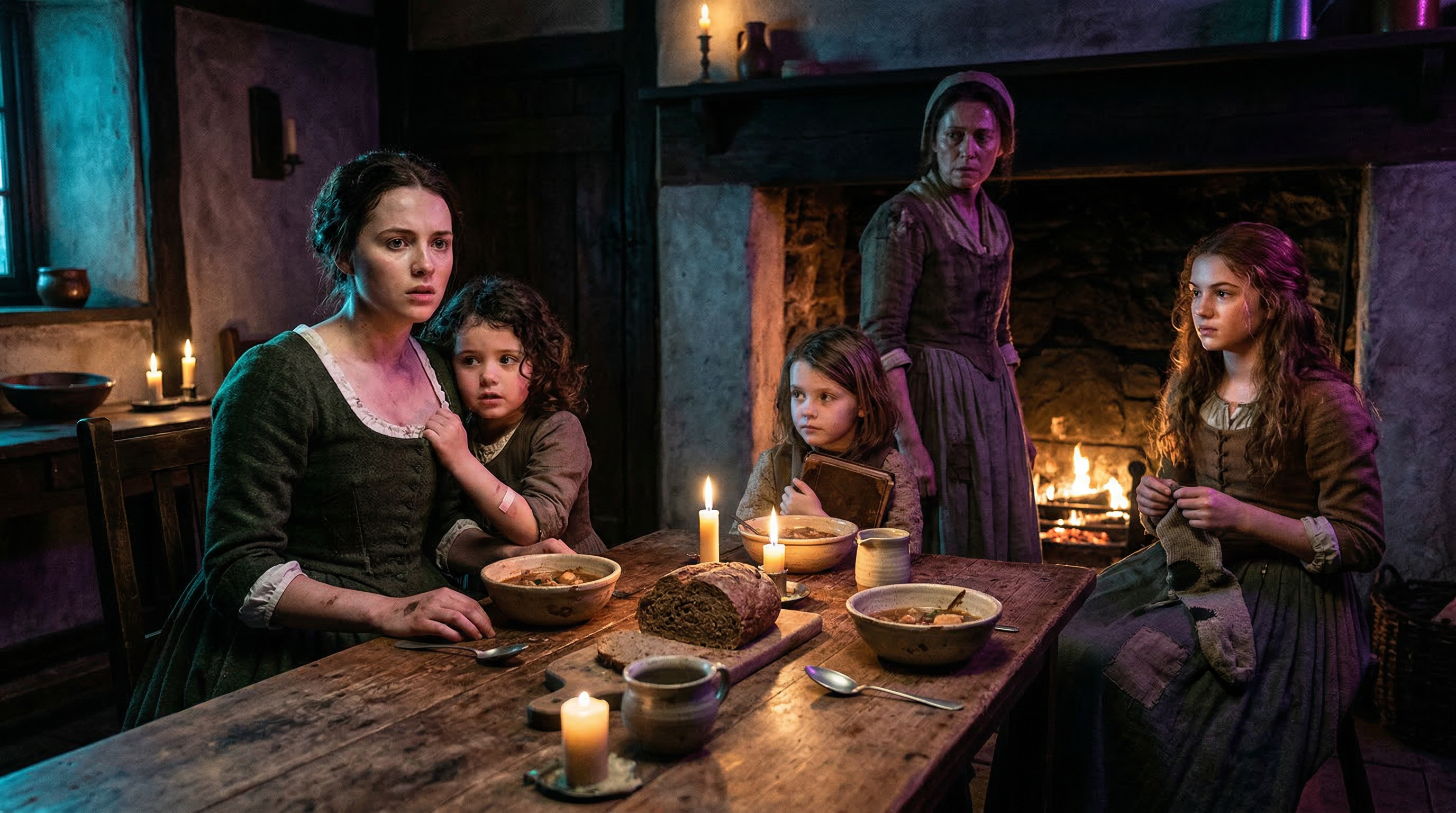
The excited cry came before I had even fully crossed the threshold. Violet bounded across the room with all the energy of her nine years, her dark curls bouncing like springs as she threw her arms around my waist with enough force to nearly knock me off balance. In the warm glow of the hearth fire, her eyes sparkled with an innocence that seemed increasingly precious in these trying times—a flame I was determined to protect at all costs.
I laughed, feeling the tensions of the day begin to melt away in the face of such unbridled enthusiasm. "Easy there, Wee Vi," I said, using the nickname that never failed to make her scrunch up her nose in mock indignation. "You'll have me over if you're not careful."
"I'm not wee," she protested, though the effect was rather undermined by the way she had to crane her neck to look up at me. "I'm nearly ten. That's practically grown."
"Practically ancient," I agreed solemnly, smoothing a wayward curl from her forehead. As I did so, I caught sight of a small, freshly-bandaged cut on her forearm, the clean white linen stark against her skin. "What's this?"
Violet's cheeks flushed pink, and she suddenly found great interest in the worn floorboards. "It's nothing," she mumbled. "I was trying to help Mam with the cooking and the knife slipped. But I didn't cry," she added quickly, lifting her chin with defiant pride. "Not even a little bit."
A pang of guilt pierced my heart. I should have been here, helping with the chores, shouldering the burden that now fell to my younger sisters. Instead, I had spent the day in a world of silk and secrets, of whispered confidences and hidden pockets. The contrast between the Emporium's opulence and my family's modest circumstances had never seemed starker.
"Let the poor lass breathe, Violet." Effie's voice cut through my thoughts, tinged with amusement and the first hints of the woman she was becoming. She looked up from where she sat by the fire, a half-mended shirt in her lap. The dancing flames cast her features in a golden glow, and I was struck anew by how much she had changed in recent months—the delicate arch of her cheekbones more pronounced, the curve of her neck more graceful. At thirteen, she was already showing signs of real beauty.
"We've all been dying to hear about her day," Effie continued, her needle never pausing in its steady rhythm, "but there's no need to squeeze it out of her like you're wringing a dishcloth."
"I wasn't squeezing," Violet protested. "I was hugging. There's a difference."
"Not the way you do it," Effie replied, but she was smiling.
I watched my sister's fingers move deftly over the mending, her stitches neat and even in a way that would have earned approving nods from even the exacting seamstresses at the Emporium. She had taken on so much responsibility since our father's death, growing up far too quickly for my liking. Where once there had been a carefree child with ribbons in her hair, now sat a young woman with adult concerns evident in the serious set of her mouth.
From the kitchen area came the sound of a pot being stirred, the wooden spoon scraping rhythmically against cast iron. My mother emerged from the steam that rose from the cooking pot, wiping her hands on her apron. The lines of worry that had become a permanent fixture on her face since my father's death seemed to soften as she took in the sight of me.
Yet I could not help but notice the dark circles under her eyes, the slight stoop to her shoulders that spoke of long days and restless nights.
"Welcome home, my dear." She crossed the room to embrace me, her arms thin but strong. The familiar scent of lavender and wool enveloped me, mingled with the earthy smell of the stew simmering on the fire, and for a moment I felt like a child again, safe in my mother's arms, sheltered from the complexities of the world beyond our door. "We've been anxious to hear how your first day fared. But first, let's get some food in you. You look done in."
As if on cue, my stomach rumbled—loudly enough to draw a giggle from Violet and a raised eyebrow from Effie.
"I may have forgotten to eat," I admitted.
"Forgotten to—" My mother shook her head, though there was fond exasperation rather than true censure in her expression. "Elspeth Stewart, what am I to do with you? Come, sit. The stew's been waiting, and it won't improve for being kept longer."
I allowed myself to be ushered to the table. The worn wood was scarred and stained, each mark telling a story of family meals shared, of laughter and tears, of triumphs and hardships weathered together. Unlike the pristine surfaces at the Emporium, this table wore its history proudly.
As my mother bustled about, ladling generous portions of stew into bowls that had been in the family for generations, Katrina appeared from the small room she shared with Violet. A book was clutched to her chest like a talisman—Miller's Gardener's Dictionary, I noted, its leather binding worn soft from use. How she had acquired even this older edition I could not say, though I suspected one of the market vendors had parted with it cheaply, not knowing its worth. For an eleven-year-old, it was ambitious reading, but Katrina had never been an ordinary eleven-year-old.
Of all my sisters, Katrina was the most serious, her quiet demeanour masking a sharp intellect that reminded me painfully of our father. Her eyes, the colour of freshly turned earth, seemed to see right through me as she took her seat at the table.
"How was it, truly?" she asked, her voice soft but intent. "Was it as grand as they say?"
"Grander," I replied, accepting a bowl of stew from my mother with a grateful nod. The rich aroma of beef and vegetables filled my nostrils, and my mouth watered in anticipation. This was simple fare, a far cry from the delicacies that graced the tables of the Emporium's clients, but to me it was finer than any feast.
"The Emporium... it's like stepping into another world entirely. The fabrics, the gowns—you've never seen anything like it. Silks that change colour when you move them, lace so fine it looks like it was spun by faeries, velvets so deep you could lose yourself in their pile."
"Faeries don't spin lace," Katrina observed. "They're creatures of folklore, not textile manufacture."
"Katrina," my mother said mildly. "Let your sister tell her story."
"I was merely pointing out—"
"We know what you were pointing out," Effie said. "You always are. Now hush and let Elspeth talk. Some of us want to hear about the fashions, not receive a lecture on the mythological accuracy of metaphors."
Katrina subsided with a faint huff, though I caught the ghost of a smile at the corner of her mouth. For all their bickering, my sisters loved each other fiercely—a bond forged stronger in the crucible of our father's death.
As we settled around the table, I found myself recounting the day's events in more detail, painting a picture of the Emporium and its inhabitants. I described Moira MacKenzie, with her regal bearing and penetrating grey eyes, and Agnes Fraser, the senior seamstress whose gruff exterior concealed a wealth of knowledge and unexpected kindness.
"It sounds magical," Violet sighed, her own stew forgotten as she leaned forward, elbows on the table despite the gentle admonishment this earned from our mother. "Like something out of a fairy tale."
"Fairy tales have a habit of containing wolves and witches," Katrina murmured, but quietly enough that only I caught it.
Effie set aside her mending and leaned forward, hunger for something beyond stew evident in her gaze. "But what of the fashions? Did you see the latest styles from London and Paris? Are they truly wearing those enormous skirts that require them to turn sideways through doorways?"
"I did," I nodded, thinking of the exquisite gowns I had seen, each one a work of art. "There was one in particular—a midnight blue silk that seemed to change colour as it moved, like the sea beneath a full moon. It was for Lady Aberfoyle, for some important soirée tomorrow evening."
As I spoke, I carefully avoided mentioning the small folded paper I had glimpsed hidden in the gown's folds. The omission felt necessary, though I could not have explained precisely why.
At the mention of Lady Aberfoyle, a sudden hush fell over the table. I looked up, surprised, to see my mother and Katrina exchanging a significant glance—a wordless communication that spoke volumes to those who knew how to read it.
"Lady Aberfoyle, you say?" My mother's voice was carefully neutral, but I detected an undercurrent of something beneath it. Concern? Fear? "That's... interesting."
My spoon paused halfway to my mouth. "Do you know her, Mam?"
"Not personally, no." She shook her head—perhaps a bit too quickly. Her eyes darted to the window, though the shutters were closed tight against the evening chill. "But one hears things, working in the houses of the well-to-do. Lady Aberfoyle has quite the reputation."
"What kind of reputation?"
It was Katrina who answered, her voice low and measured. "They say she's involved in... politics. The kind that aren't spoken of in polite company." She glanced at Violet, who was now far more interested in coaxing the family cat out from beneath the sideboard with scraps from her bowl than in our conversation.
My mind raced, connecting this new information with the whispered conversations I had overheard at the Emporium, the sense of secrecy that seemed to permeate every interaction. "What do you mean, politics? Surely it's not unusual for the nobility to be involved in such matters?"
My mother sighed, setting down her spoon. She looked older suddenly, the weight of unspoken worries etched into the lines of her face.
"It's not just any politics, Elspeth. There are... factions in the city, in all of Scotland really. Those who support the current order, and those who..." Her voice dropped to barely above a whisper. "Those who dream of a different future. Dreams that some would call treason."
The word hung in the air between us, heavy as a stone.
"You must be careful, Elspeth." My mother reached across the table to grasp my hand, her grip tight and urgent. "These are dangerous times, and the Emporium... it may be more than it seems. One careless word in the wrong ear could bring disaster not just on yourself but on all of us." Her eyes held mine with fierce intensity. "Promise me you'll keep your head down and your ears closed."
I thought of Agnes's warnings, of Moira's penetrating gaze, of the folded paper slipped so deftly into that hidden pocket. Keep your head down. Keep your ears closed. The same advice, from two very different women.
"I promise, Mam," I said. "I'll be careful."
The words felt strange on my tongue—not quite false, but not quite true either. I would indeed be careful. But I was beginning to understand that in the world I had entered, being careful might not be enough.
The conversation turned to lighter topics after that—Effie's progress with her embroidery, the book Katrina was reading, a humorous incident involving Mrs MacPherson's unruly goat that had somehow found its way into the kirkyard and eaten half the minister's garden. Violet contributed a long and winding story about a dream she'd had involving a talking fish and a castle made of cheese, which made very little sense but had us all laughing nonetheless.
Yet even as I smiled and nodded and contributed what I could to the conversation, my mind kept returning to my mother's words. Dreams that some would call treason. What dreams? Whose dreams? And how did Lady Aberfoyle—how did the Emporium itself—fit into a pattern I could sense but not yet see?
As I helped clear the table after the meal, stacking bowls and wiping surfaces clean, I caught sight of my reflection in the small, tarnished mirror that hung on the wall—a family heirloom that had once belonged to my grandmother. The face that looked back at me seemed different somehow. Older. More serious. There was a spark of something new in my eyes that had not been there this morning.
It was the face of someone standing on the threshold of something she did not yet understand.
"Elspeth?" Violet tugged at my sleeve, the cat now draped over her shoulder like a furry, purring shawl. "Will you tell me a story before bed? A proper one, with adventures and princes and happy endings?"
I looked down at her upturned face, so full of hope and trust, and felt something tighten in my chest. Whatever secrets swirled around me, whatever dangers lurked in the shadows of the Emporium and beyond, this was what mattered. This was what I was fighting to protect.
"Aye, Wee Vi," I said, taking her hand. "I'll tell you a story. The best one I know."
As I led her towards the room she shared with Katrina, I felt my mother's eyes upon my back—watching, worrying, wondering what storms might be gathering on the horizon.
I did not look back. Some burdens were too heavy to share, even with those we loved most.







