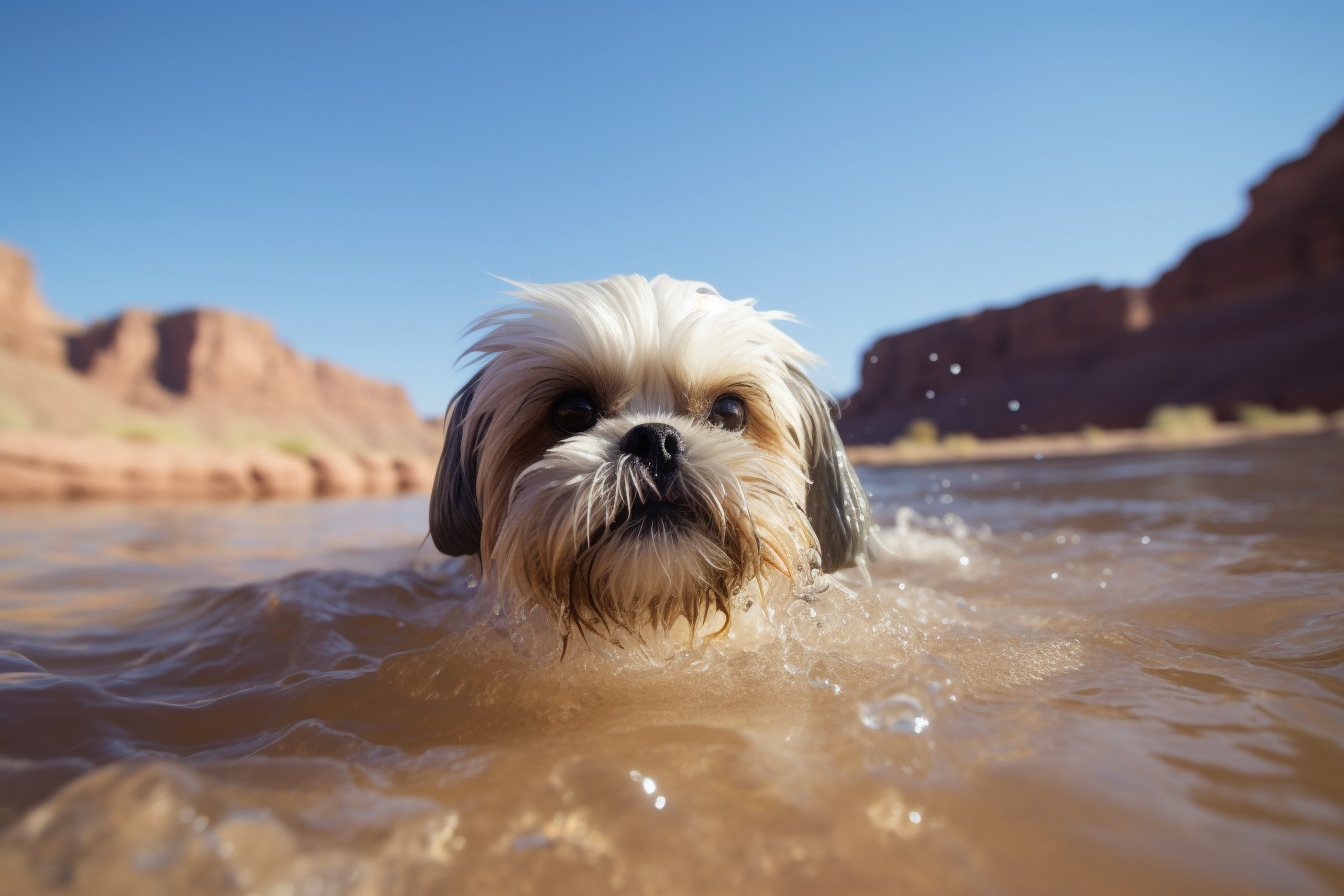
4338.207 · July 26, 2018 AD
What Counts as Winning
Jamie wakes to find Henri raiding the supply bag, his wound healing faster than any infection should allow, and his body finally willing to cooperate with simple tasks like standing upright. After Glenda's blessing—and an awkward encounter involving fresh underwear—he heads for the lagoon with Duke, testing whether yesterday's surrender has actually bought him something worth having.
"Clean underwear and a wound that's actually healing—remarkable what passes for a good morning when your baseline has dropped far enough."
"Henri!" My whisper cut through the tent's stillness with more authority than my weakened state probably warranted. "Get your head out of it!"
The command achieved precisely nothing. Henri's small brown and white head remained buried in the large bag of supplies, his entire body wiggling with the enthusiasm of discovery. Every sniff was an expedition, every rustle of packaging a treasure hunt. The concept of obedience had clearly been filed under 'optional' in his fluffy little brain.
Duke sat beside his brother, watching the proceedings with the patient dignity of an elder statesman observing a younger colleague's indiscretions. His expression seemed to convey weary tolerance—Yes, Henri is being Henri. What else is new?
I caught Duke's eye, the question forming before I'd fully thought it through. "Are you hungry?"
Stupid question. When are they not hungry?
A quiet chuckle escaped me at the absurdity of asking dogs about their appetite. Duke's reaction was instantaneous—a twirl of pure canine joy, his entire body rotating with the excitement of impending food. Henri's head finally withdrew from the bag, both dogs now united in their expectation, their earlier preoccupations forgotten in the face of the magic word.
"Come on then."
The effort of moving from the mattress was a test I hadn't anticipated. My body protested—not with the screaming agony of yesterday, but with the deep ache of healing tissue and muscles that had spent too long horizontal. Every joint seemed to have rusted overnight, requiring conscious effort to unlock.
But I moved. That was something. Yesterday, movement had been impossible. Today, it was merely difficult.
I approached the bag Henri had been investigating, pulling out a tin of dog food and squinting at the label in the tent's dim light. "Diced kangaroo and vegetables."
The words sat in my mouth like a dare.
"Delicious," I added, my face twisting into an expression of exaggerated horror. The thought of what constituted 'diced kangaroo' was best left unexplored. Whatever it was, it smelled like something that had died twice and been resurrected specifically to punish human nostrils.
Duke's response to the mere presence of the tin was electric. His back legs began moving in a dance that seemed to have no connection to his front half—pure, unadulterated happiness expressed through the medium of uncoordinated movement. Henri, lacking his brother's grace but matching his enthusiasm, bounced around Duke in chaotic circles, a furry pinball of anticipation.
At least someone's happy about breakfast.
The food bowls sat beside the toy box, waiting. A dilemma presented itself—one of those small decisions that somehow felt more significant than it deserved.
"Dust?" The question floated from my lips as my gaze drifted towards the tent entrance, imagining Duke and Henri eating outside. The Clivilius dust that coated everything, that worked its way into every crevice and fold, that had become the signature colour of this entire dimension.
"Or no dust?" My eyes shifted back to the bowls. Having them eat inside meant containing the mess, but also meant containing the smell—and the sound.
God, the sound.
I knew what was coming. Had lived with these two long enough to know that mealtime was an auditory assault that made construction sites seem peaceful by comparison.
"Oh well. No dust it is."
The resignation in my voice was complete. I opened the tin—the smell hitting me like a physical force—and divided the contents between the two bowls. Roughly half in one, the remainder in the other. The concept of equal portions was meaningless to dogs who would inevitably swap bowls multiple times, circling and trading until every morsel had been consumed from both containers.
No sooner had the food hit the bowls than two eager heads dived in.
The sounds that followed were exactly as horrific as anticipated. Open-mouthed chewing. Wet, sloppy smacking. The occasional snort when enthusiasm outpaced the physical capacity to breathe and eat simultaneously. Each noise sent a shiver down my spine, a visceral reaction to table manners that would have horrified Emily Post into an early grave.
The aroma didn't help. Diced kangaroo and vegetables, now being masticated with gleeful abandon, produced an olfactory experience that defied description. Somewhere between wet dog, roadkill, and regret.
We need to find somewhere else for their meals. Immediately. For the sake of my sanity and my ability to keep down my own food.
The boys remained oblivious to my growing resolve, their messy feast continuing unabated. A reminder that love sometimes meant tolerating things that would otherwise be intolerable.
For the first time since waking, my thoughts turned to the wound.
The sore on my chest—the coal burn that had nearly killed me, the infected mess that Glenda had carved open and drained—had been a constant presence in my awareness for days. Even medicated, even sleeping, some part of me had remained conscious of its existence.
Now, with the dogs occupied and the morning settling into quiet, I found myself curious.
My fingers eased under the edge of the dressing, lifting it gently to steal a glance at what lay beneath. The movement was tentative—prepared for the worst, expecting the angry red of continuing infection.
What I saw instead made me smile.
The wound was healing. Actually, genuinely healing. The tissue beneath looked cleaner than it had any right to be, the angry swelling reduced to something almost normal. The improvement from yesterday was dramatic—not just incremental progress, but a genuine transformation.
Clivilius kept its promise.
The thought arrived unbidden, carrying with it the memory of that voice in the lagoon. The offer of new life. The surrender I'd made without fully understanding what I was agreeing to. Whatever transaction had occurred, whatever bargain had been struck, the results were undeniable.
The pain that had been my constant companion for days had faded to a dull ache—present but manageable, background noise rather than the screaming alarm it had been. I could breathe without wincing. Could move without wanting to scream.
Relief flooded through me, lightening something I hadn't realised had grown so heavy. For the first time since arriving in this dimension, I felt something that might have been hope.
Maybe I'm not dying after all.
The small victory with my wound set a lighter tone for what followed.
I turned my attention to the suitcase that contained what remained of my earthly possessions—clothes packed for a trip that had become permanent exile. My supply of clean underwear was finite, a reminder of our isolation from the conveniences I'd once taken for granted.
A splash in the river is no substitute for a proper wash. But I can at least wear fresh clothes.
The thought was a blend of resignation and appreciation. Clean underwear wasn't much, but in circumstances like these, small comforts became significant.
I retrieved a fresh pair, beginning the careful process of changing. It was a ballet of balance and coordination—my body still not fully cooperating, one foot suspended in air, aiming for the leg hole with the concentration of a surgeon performing delicate work.
The tent zipper ripped through the morning's quiet without warning.
The flap pulled back with unexpected swiftness, revealing Glenda in the entrance, her eyes going wide as she registered what she was interrupting.
"Oh, I'm so sorry."
Her eyes closed immediately, a swift gesture of respect and embarrassment. She turned her back and retreated, the flap falling closed behind her with a gentle swish that seemed to echo in the aftermath.
A chuckle erupted from me—loud, genuine, bouncing off the tent walls. Not embarrassment, not anger, but pure amusement at the absurdity of the moment. Of all the things that could go wrong in an inter-dimensional prison, being caught with my pants literally down by the doctor who'd saved my life ranked somewhere between ridiculous and hilarious.
"I didn't expect you to be up and moving," Glenda's voice floated through the canvas, tinged with surprise and what might have been relief.
Another chuckle escaped me. "It's okay."
I finished what I'd started, pulling on the fresh underwear with movements that were now hurried by circumstance rather than physical limitation. Then I navigated to the entrance, poking my head through the flap to find her.
The sudden appearance of my head made Glenda jump, her body tensing before relaxing when she realised it was just me—not some new threat, just the half-naked man she'd accidentally walked in on.
Duke chose that moment to make his presence known.
With the determination of a dog on a mission, he bulldozed his way through the small opening, nearly tripping me in his haste to reach the outside world. He dived nose-first into the dust, then darted off with an energy that seemed excessive for any hour, his tail waving like a victory flag as he embarked on his morning investigations.
Henri was the opposite. He peered out from the tent's shadows with the caution of someone assessing a potential trap. Every new experience required evaluation, consideration, a weighing of risks versus rewards.
I crouched down, extending a hand towards him. "Come on, it's not so bad out here."
My voice was soft, coaxing—the tone I'd used a thousand times to ease his hesitation about everything from new foods to unfamiliar visitors. Henri's head tilted, processing the invitation. Then, with a tentative step that suggested he was doing me a favour rather than following my lead, he emerged into the Clivilius morning with disinterested grace.
Brothers. Same parents, completely different personalities.
With the canine exodus complete, I turned my attention to getting properly dressed.
A clean t-shirt felt almost luxurious against my skin—soft fabric instead of the sweat-stained remnant I'd been wearing for far too long. The boardshorts were the same ones from yesterday, bearing visible evidence of recent adventures, but alternatives were limited. They would have to do.
Finally ready, I stepped out of the tent and into the day.
The air was fresh—genuinely fresh, carrying the promise of new experiences and the warmth of the rising sun. It was a moment of transition, from the private cocoon of the tent to the vast expanse that surrounded us. The Clivilius landscape stretched in every direction, red and brown and seemingly endless.
"How are you feeling this morning?" Glenda's voice cut through the crisp air, concern evident despite her professional tone.
"Much better." I stretched my arms above my head, testing the limits of my recovery. The motion was smooth, only the faintest pull from the wound beneath the dressing. "My chest doesn't feel nearly as sore."
"That's good news."
The conversation shifted as an idea formed—unexpected but welcome. "I was about to go and take Duke for a walk." The thought had arrived fully formed, surprising me with how appealing it sounded. "We've both been rather cooped up the last twenty-four hours. I think it'll do us both some good."
Movement. Fresh air. The simple pleasure of walking with my dog. After everything that had happened, it seemed like exactly what I needed.
"I agree." Glenda's response was immediate, but her next words carried a different edge. "Can I change your dressing before you go?"
It was phrased as a question but delivered as a gentle insistence. The practical side of my brain recognised the wisdom—going for a walk with a wound that hadn't been properly tended was asking for trouble.
"Sure."
I pulled my shirt over my head, exposing the wound to the morning light and Glenda's scrutinising gaze. The vulnerability of the moment was diminished by the knowledge of what lay beneath—healing tissue rather than infected disaster.
She removed the soiled dressing carefully, her focus intense as she examined what had been revealed. "It is looking much better."
The professional assessment aligned with my own amateur observations. A smile found its way to my lips, an unspoken acknowledgement of shared relief.
"Why don't you go lay back down while I grab some fresh dressings from the supply tent."
Glenda's suggestion landed somewhere between advice and directive. The thought of returning to the tent—even briefly—was immediately unappealing.
"Really?" The surprise in my voice carried an edge of annoyance. I'd just escaped the canvas prison. The freedom of the outdoors beckoned. Going back felt like regression.
"Just for five minutes," Glenda insisted. "If we had a chair, I'd say you could sit, but we don't."
The words were practical, but they struck a nerve.
Why does Glenda have to remind me just how much this place sucks?
No chairs. No proper furniture. No basic conveniences that civilisation had spent millennia developing. Just dust and tents and the constant reminder that everything familiar had been stripped away.
"Yet," Glenda added quickly, a hint of hope threading through her voice. "We don't have a chair, yet."
The qualifier was meant to soften the blow, to suggest improvement was possible. But the frown had already settled on my face, a silent echo of internal protest.
"Fine."
The word huffed out of me with resignation and the faintest trace of petulance. I retreated into the tent, lowering myself onto the mattress that had become far too familiar over the past days.
The sensation of settling back registered immediately—stale sweat clinging to my skin, the pungent evidence of days without proper hygiene creating an atmosphere that was distinctly unpleasant. The air inside the tent was thick with the scent of exertion and unwashed human, a cocktail that made me acutely aware of my own need for cleanliness.
I need a shower. A real one. With hot water and soap and the ability to wash away more than just the physical grime.
The thought was a luxury I couldn't afford to dwell on. Showers didn't exist here. Hot water was a memory. The river would have to serve, but even that was a pale substitute for the ritual of proper bathing.
Glenda returned swiftly, her presence bringing action and purpose. She poured fresh water over my chest, the cool liquid a small mercy against overheated skin.
"This really is looking much better already," she observed, her voice carrying professional approval. "Your burns look superficial. Most of the damage appears to have been from the splinter."
The charcoal. That fragment of burnt wood that had lodged in my chest and festered, nearly killing me before Glenda had cut it free.
"I really don't feel much pain now at all," I admitted, the statement true in a way that still surprised me.
"And you've had no complaints with any upper body movements?" Her hands worked as she spoke, securing fresh gauze over the wound.
"None."
The smile that accompanied my answer was genuine. Whatever Clivilius had promised, whatever bargain I'd made in that lagoon, the results were beyond what I'd dared hope for.
"Well, that's great news." Glenda's light tap on my shoulder signalled the end of her work.
I sat up quickly, eager to escape the tent's confines. Duke would need to relieve himself after breakfast—the urgency of canine biology waited for no one—and the likelihood of him having already marked territory near the tent wasn't something I wanted to contemplate.
"But," Glenda interjected, her hand pressing gently against my chest in a halting motion, "I still need you to take another couple of antibiotic capsules."
Is that really necessary?
The silent protest formed and dissolved in the same moment. Of course it was necessary. Infections didn't care about impatience or eagerness to move on.
"You'll need to take several daily for the next few days to make sure it doesn't get infected."
I snatched the capsules from her outstretched hand, throwing them back with a gulp of water that seemed to echo in the quiet morning. "Thanks."
The word was brief, the gratitude genuine but overshadowed by eagerness to move forward. I wiped my mouth with the back of my hand and pulled my t-shirt back over my head, reclaiming some semblance of readiness.
"You're good to go."
Glenda's words came with a reassuring pat on my back—a send-off into the day that awaited.
"But don't go too far, and the moment you start to feel tired or any dizziness, you need to stop and rest. Then as soon as you are able, make your way back to camp."
The instructions were clear, practical, delivered with the authority of someone accustomed to giving medical advice to patients who might not want to hear it.
I nodded, absorbing the words and the gravity behind them. Part of me still wrestled with frustration at Luke's decision to bring Glenda here without consultation—adding another person to our impossible situation, another mouth to feed, another complication.
But standing there, feeling the effects of her care, I couldn't deny the necessity of her presence. Without her expertise, I'd be dead. The charcoal would have continued its poisonous work. The infection would have spread. I would have joined whatever statistics existed for people who died of preventable causes in inter-dimensional exile.
But why did she agree to this?
The question lingered in my mind, unanswered and nagging.
What drove someone like her to leave behind whatever life she had, to venture on a one-way ticket into the unknown with strangers?
It seemed a decision that spoke of either extraordinary courage or extraordinary foolishness. A sense of adventure, perhaps. A dedication to helping others regardless of setting. Or maybe she simply hadn't understood what she was agreeing to.
Or most likely, just plain ignorance or stupidity.
The uncharitable thought was reflex—the defensive mechanism that had protected me for so long. But it felt hollow now, after everything she'd done.
"I'll go downstream," I declared as we emerged from the tent, the fabric doorway fluttering closed behind us. "There's a lagoon just around the bend. I'll take Duke with me. He'll love it."
The lagoon. The place where everything had changed. Where Clivilius had spoken and I'd surrendered. The memory pulled at something I wasn't sure I was ready to examine, but the water itself was undeniably beautiful.
"And Henri?" Glenda's inquiry drew my attention to the other member of our canine family.
My gaze found Henri, meandering near the campfire with the unhurried deliberation that defined his approach to everything. His paws picked carefully through the dust, each step a considered decision rather than Duke's reckless enthusiasm.
"I don't think Henri's going to make it too far." A chuckle escaped at the understatement. Henri's idea of adventure was a new corner of a familiar room.
"I'll keep an eye on him." Glenda's offer carried warmth—genuine fondness for the cautious little dog who'd stolen her medical supplies.
"Thanks."
The gratitude was simple, sincere. I turned my attention to Duke, who was still enthusiastically investigating every inch of ground within nose-reach.
"Come on, Duke."
His head snapped up at the sound of his name, the expression one of immediate understanding. A brief moment of connection passed between us—the silent agreement that it was time for adventure.
His tail began wagging before his legs started moving, the excitement building even as we prepared to depart. Whatever lay ahead—the lagoon with its strange properties, the mysteries of Clivilius that remained unsolved, the complicated business of surviving in an impossible place—at least we'd face it together.
Man and dog. The oldest partnership in human history, transported to the newest frontier imaginable.
