4338.210 · July 29, 2018 AD
Two Words on Torn Paper
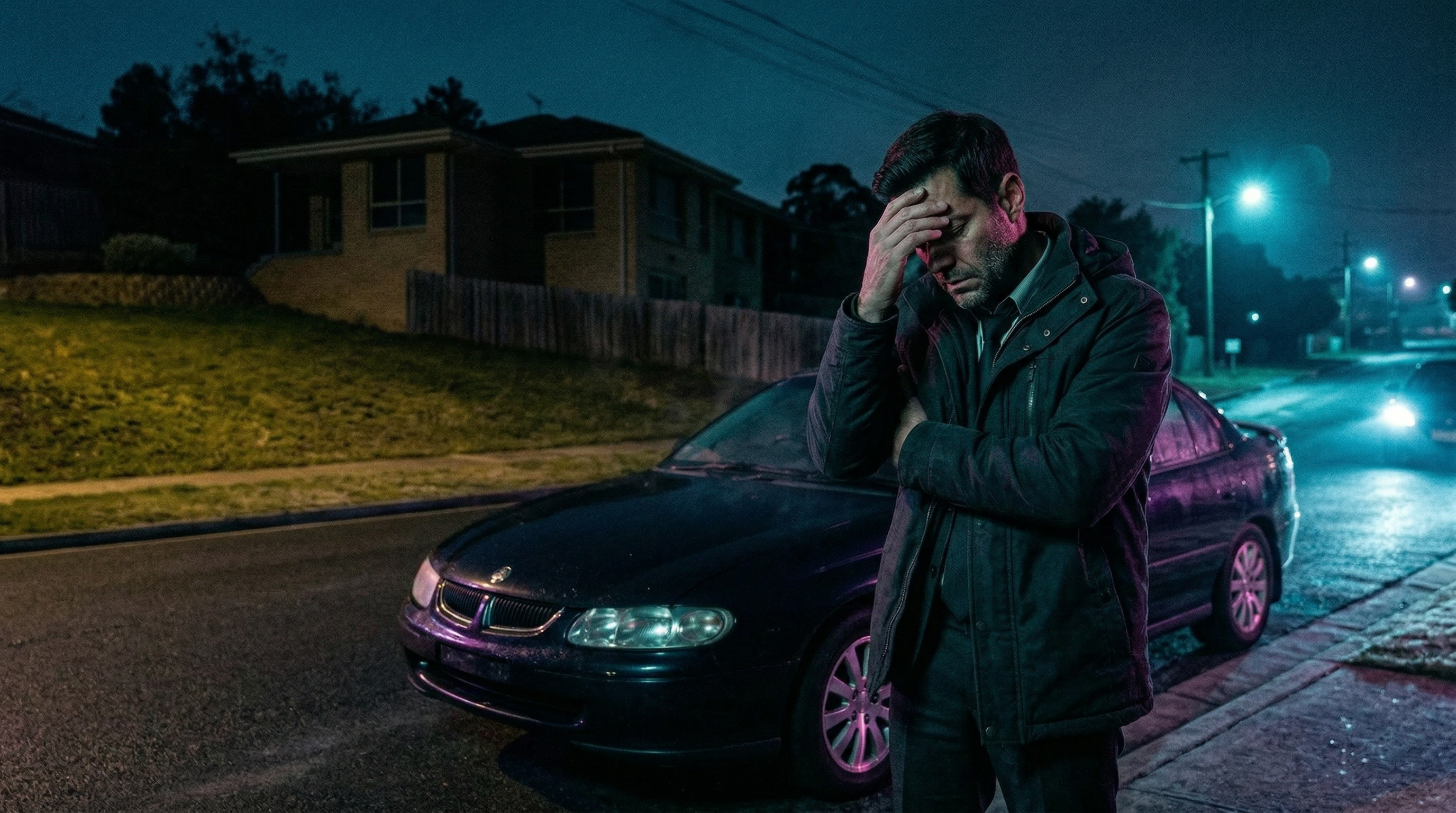
Past midnight in a freezing car outside the Berriedale residence, a name Karl Jenkins has dismissed for fifteen years stops being dismissible. Killerton Enterprises — a Californian construction firm with no Australian footprint — was never supposed to matter. But in the small hours, with Jamie Greyson missing and Claiborne's possession of the paper still unexplained, coincidence stops functioning as an explanation and Karl is left with something worse: the possibility that Jamie's fear had been reporting, not paranoia, and that Karl had answered it with his fist.
There was a Killerton Enterprises. Karl Jenkins had found it years ago — a construction firm headquartered in San Francisco, founded in the nineteenth century, operating across fifty-three countries with the kind of corporate pedigree that rendered the name unremarkable through sheer institutional mass. It built libraries and skyscrapers and renewable energy installations. It had a board of directors and a public profile and a history that read like a monument to Californian ambition. It had no Australian operations. No Queensland presence. No footprint anywhere on a continent where a frightened man had carried the company's name in his pocket like contraband.
Karl had chosen coincidence. For fifteen years, the Californian firm had served as the explanation that permitted the drawer to stay locked — the answer that foreclosed the question, the rational dismissal that allowed two words on a torn scrap of paper to remain filed alongside other relics of a Queensland past that Tasmania was built to replace. Jamie had been paranoid. Jamie had been disintegrating. The name on the paper connected to a construction company on the other side of the Pacific, and the connection between that company and Jamie's claims of surveillance was no connection at all.
Past midnight, with frost colonising the inside of a windscreen behind which Karl had been sitting long enough to lose the ability to distinguish vigil from paralysis, coincidence was failing.
The failure did not arrive as revelation. It arrived as erosion — the slow collapse of a structure that had been bearing weight it was never engineered to support. The Californian company existed, yes. But Jamie's reaction when Karl held up the paper on the mudbank at Moggill Creek had not been the reaction of a man whose pocket had contained something meaningless. It had been the reaction of a man watching the last wall between himself and something he could not outrun being breached by the one person he had trusted enough to stand near it. And Karl had read that reaction correctly at the time — had understood, in the specific way that detectives understand things they cannot yet prove, that the paper mattered — and had then spent fifteen years overruling that understanding with a Californian website and the professional comfort of a coincidence that required no further investigation.
Claiborne's possession of the same scrap had detonated the coincidence that morning. But the full weight of the detonation was only now arriving, in the particular clarity that the small hours imposed on minds that had exhausted every other defence against the truth. If the paper was meaningless — if Killerton Enterprises was simply a construction firm in San Francisco with no relevance to Jamie Greyson or Tasmania or anything that mattered — then Claiborne would not have carried it in his jacket pocket for years. Would not have filed it in whatever archive he maintained for instruments of leverage. Would not have uncurled his fingers with the deliberate patience of a man who understood that what lay in his palm would restructure the relationship between himself and the detective standing opposite him.
The paper mattered. It had always mattered. And Karl had spent fifteen years choosing the explanation that permitted him not to find out why.
He tried to type Jamie's name into a message on his phone. The act collapsed after four letters — thumb hovering, screen brightness harsh against the darkness, the cursor blinking its patient accusation. Reaching out could drive Jamie deeper into hiding. Could expose him to whoever had been watching. Could create a digital record of a connection Karl had spent his entire Tasmanian career ensuring did not exist in any retrievable form. He deleted the letters and the cursor returned to empty space, measuring the distance between the man holding the phone and the man he might have been if he had listened at Moggill Creek instead of swinging.
Jamie's fear had not been paranoia. The recognition settled into Karl's awareness with the weight of something that had been waiting to land for a decade and a half — patient, certain, arriving not as deduction but as the specific grief of understanding too late. The surveillance Jamie described, the sleeplessness, the way he flinched at sounds and scanned tree lines and spoke in implications he would not anchor to specifics — these had been the behaviours of a man reporting what was happening to him to the one person he believed might act on the information. And that person had dismissed the report as delusion, had escalated frustration into violence, had watched Jamie fall into a river and then moved to another state and locked the evidence in a drawer and called it coincidence for fifteen years because coincidence was cheaper than the alternative.
The alternative was that Karl could have helped. Could have investigated. Could have taken the name on the paper and applied to it the same relentless attention he applied to every other case that crossed his desk, and might have found something that the Californian website did not explain and that a late-night search through business registries could not reach. The alternative was that Jamie had been in genuine danger, and Karl had been the detective standing closest to the truth, and he had responded by punching Jamie and relocating to an island at the bottom of the world.
The house across the road held its darkness with the composure of something that had decided what it would and would not reveal. The frost thickened. The dashboard clock advanced through numbers that Karl had stopped reading as time and started experiencing as evidence of his own inability to act — each digit a minute spent sitting in a car choosing neither to leave nor to enter, neither to investigate nor to abandon, suspended in the specific purgatory of a man who had finally understood that the case he was working was not a case he had been assigned but a case he had been inside for fifteen years, and that the distance between investigator and subject was a fiction he had constructed from Californian coincidences and locked drawers and the steadfast refusal to consider that a construction company on the wrong side of the Pacific might be exactly the right company after all.







