Thomas Henry Crosswell
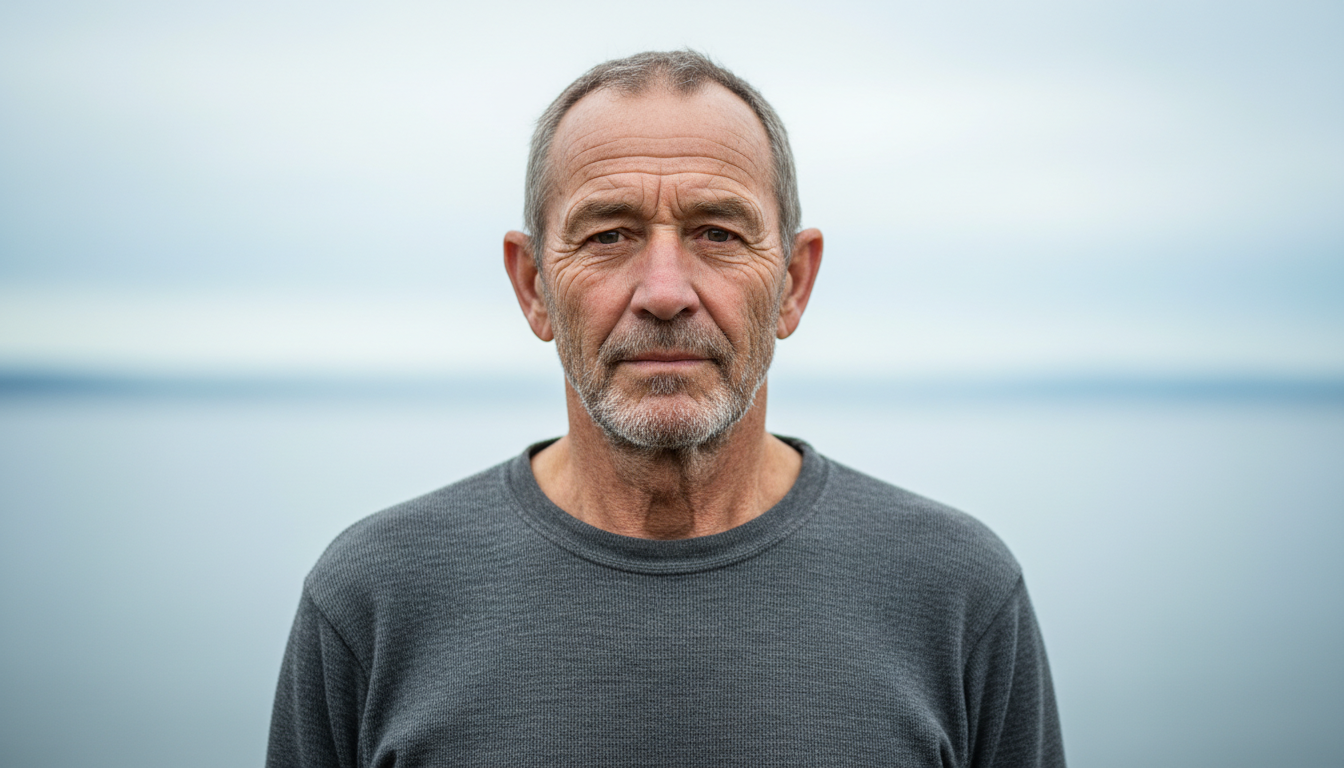
Thomas Henry Crosswell was a fourth-generation deep-sea fisherman from Margate, Tasmania, whose life embodied the maritime traditions of the D'Entrecasteaux Channel. Born on 3 May 1947, he captained the Alida Rose for over three decades, earning respect for his quiet competence and instinctive seamanship. A devoted husband to Margaret and father to three children—particularly Glen, whose investigative patience echoes his father's maritime discipline—Thomas died suddenly on 17 August 2003, leaving a legacy of stoic resilience and weathered wisdom.
Early Life and Crosswell Heritage
Thomas Henry Crosswell was born on the 3rd of May, 1947, in Margate, a coastal township twenty kilometres south of Hobart along the D'Entrecasteaux Channel. The post-war years had brought renewed optimism to Tasmania's southern communities, and Thomas arrived into a world still shaped by wartime sacrifice and maritime tradition.
He was the only son of Richard Alaric Crosswell (1920–1982), a naval engineer who had served in the Pacific theatre before returning to Tasmania's crayfishing industry, and Alida Rose Crosswell (née Bennett) (1923–1970), a woman of Dutch heritage whose quiet strength and austere grace held the household together through Richard's long absences at sea.
The Crosswell name had been synonymous with the Channel's fishing industry for four generations. Thomas's great-grandfather, Samuel Nathaniel Crosswell (1869–1941), had worked the oyster beds off Bruny Island in the 1890s before establishing a small-scale crayfish operation based from Electrona. His grandfather, Henry Thomas Crosswell (1898–1969), expanded the enterprise during the inter-war years, transitioning from hand-hauling to mechanised winches and acquiring a second vessel.
Richard Crosswell inherited this legacy but brought a naval engineer's precision to the work—modernising equipment, improving safety protocols, and teaching his son that the sea rewarded preparation over bravado.
The Crosswell home sat on the edge of Margate proper, close enough to hear the gulls and smell the salt but removed from the town's modest commercial centre. The weatherboard cottage, built in the 1920s with timber milled from nearby forests, bore the patina of generations: sagging floorboards worn smooth by boots, walls yellowed from wood smoke and tobacco, a back verandah cluttered with rope coils, cray pots, and engine parts in various states of repair.
Thomas's mother kept a small vegetable garden and raised chickens, whilst his father maintained the workshop where nets were mended and tackle prepared. It was a life defined by the rhythms of the tide and the demands of the catch, where childhood play naturally involved splicing rope, gutting fish, and learning to read weather in the colour of clouds.
Education and Maritime Apprenticeship
Thomas attended Channel District School, a modest brick building serving the scattered families of the southern reaches. His education was practical rather than academic—he could calculate fish prices and fuel costs before he could parse complex sentences, understood the mechanics of hydraulics before mastering algebra.
Teachers noted his seriousness, his tendency to observe before speaking, his capacity for patience unusual in a boy his age. He was neither troublesome nor particularly social, existing in that middle ground where competence earned quiet respect without demanding attention.
By the age of nine, he could splice rope with the precision of a tradesman. By twelve, he knew the productive cray spots along the Channel by heart, recognising underwater topography through subtle changes in surface current and wave pattern. By fourteen, he possessed an almost preternatural ability to read weather—interpreting barometric shifts, cloud formations, and wind direction with the instinct of someone whose survival depended on such knowledge.
His formal schooling ended at sixteen, not through failure but through inevitability. The Crosswell tradition did not accommodate academic ambitions, and Thomas himself felt no pull towards books or examinations. The sea called with the authority of inheritance.
In 1963 he began working full-time as a deckhand on his uncle's trawler, the Margaret Ann, learning the harder lessons that theory could never teach: the weight of heavy nets in rough seas, the exhaustion of eighteen-hour shifts, the brutal efficiency required when hauling gear before weather turned, the silent language shared between experienced fishermen that needed no translation.
The Alida Rose: Restoration and Independence
By 1970, at just twenty-three years old, Thomas had accumulated enough knowledge, skill, and modest savings to consider vessel ownership. His mother's death from breast cancer in April of that year had left him with a small inheritance—enough for a deposit if combined with a bank loan and the promise of guaranteed catch contracts.
He found his opportunity in a derelict 36-foot timber fishing vessel languishing on the slipway at Electrona, her planks warped, engine seized, and wheelhouse rotted beyond immediate repair. The vessel, originally built in 1948 and christened Southern Promise, had been abandoned by her previous owner after a catastrophic engine failure left her stranded during a winter storm.
What others saw as salvage, Thomas recognised as potential. Over the following year, he undertook a complete restoration—stripping the hull back to bare timber, replacing ribs and planking, sourcing a reconditioned diesel engine from a mate in Kingston, rewiring the electrical system, and rebuilding the wheelhouse with recycled materials and borrowed tools.
He worked weekends, evenings, and any spare daylight, often alone but occasionally with his father's guidance or a friend's labour in exchange for future deck work. The restoration became a meditation, each plank shaped and fitted a small victory against decay, each system tested and proven a step towards independence.
On the 12th of March, 1971, the vessel was relaunched with a new name painted in careful white lettering across her stern: The Alida Rose. Thomas chose the name to honour his late mother, whose quiet resilience and Dutch heritage had shaped him more profoundly than he could articulate.
The Alida Rose would become his livelihood, his reputation, and eventually his legacy—a vessel that witnessed thirty-two years of Southern Ocean weather, carried thousands of tonnes of rock lobster and fish, and earned the grudging respect of the Channel's fishing community.
Maritime Career and Professional Reputation
From the wheelhouse of that timber vessel, Thomas commanded a career defined by steady competence rather than spectacular success. He specialised in southern rock lobster during the premium winter season, targeting the deep-water grounds between Bruny Island and Tasman Peninsula where the largest specimens fed.
In summer, he diversified into blue grenadier and occasional flathead, adjusting his methods to seasonal availability and market demand. In later years, as fishing quotas tightened and competition intensified, he ventured on longer-range expeditions towards Macquarie Island for Patagonian toothfish—trips that required weeks at sea, extreme endurance, and the kind of calculated risk-taking that separated professionals from amateurs.
Thomas's reputation among southern Tasmanian fishers grew not through volume or wealth, but through consistency and character. He maintained old ways when others embraced new technologies—preferring paper charts to GPS, celestial navigation to electronic bearings, and an almost superstitious trust in the barometer over weather forecasts.
He rarely drank whilst at sea, always paid his crew fairly (if sparingly), and believed in the sanctity of silence during fog. His instincts for finding fish bordered on the uncanny—veterans spoke of his ability to position the Alida Rose over productive ground with seemingly minimal effort, as though he could sense the ocean's abundance through hull vibrations and water colour alone.
Yet Thomas was no romantic. He understood fishing as brutal work requiring endurance, precision, and the willingness to endure discomfort without complaint. He kept his vessel meticulously maintained, his gear in perfect order, and his debts minimal.
The Alida Rose never broke down at sea, never missed a delivery deadline, and never carried more risk than the catch warranted. This reliability made Thomas a sought-after partner for co-operative ventures and a trusted supplier for Hobart's better restaurants, even as the industry around him consolidated into corporate operations and foreign-flagged vessels.
Marriage to Margaret Joan Delaney
Thomas met Margaret Joan Delaney in the spring of 1972 at a regional dance held in the Snug Memorial Hall, an annual event that drew young people from the scattered communities along the Channel. They were introduced by a mutual cousin on Margaret's mother's side, and the match seemed improbable on first inspection.
Margaret was a newly appointed schoolteacher from New Norfolk, educated beyond Thomas's experience, articulate where he was taciturn, drawn to books and ideas whilst he lived through hands and instinct. Yet something in their initial conversation suggested compatibility beneath the surface differences—a shared seriousness of purpose, a mutual respect for competence, an understanding that partnership required balance rather than sameness.
Their courtship unfolded over the following year through letters (Margaret's eloquent and considered, Thomas's brief but sincere), occasional Sunday drives along the Channel, and meetings that felt more like negotiations than romance. Margaret appreciated Thomas's lack of pretence, his directness, the sense that he said what he meant and meant what he said.
Thomas, for his part, found in Margaret an intelligence that did not intimidate but instead complemented his practical knowledge—she could explain weather patterns through atmospheric science whilst he demonstrated them through lived experience, and both approaches held validity.
They married on the 17th of March, 1973, in a modest ceremony at St. Matthew's Anglican Church in New Norfolk, attended by both families, a contingent of fishermen in uncomfortable suits, and several of Margaret's teaching colleagues. The reception, held in the church hall, featured sandwiches, sponge cakes, and a keg of beer that Thomas's father had contributed.
There was no honeymoon to distant locations—instead, the newlyweds spent a long weekend at Coles Bay on the east coast, walking beaches and eating fish and chips from paper, before returning to the weatherboard cottage in Margate that would become their family home.
Partnership and Domestic Life
The Crosswell marriage proved a study in complementary forces. Where Thomas's world was governed by tide tables, catch quotas, and diesel engines, Margaret brought structure through lesson plans, household budgets, and moral frameworks derived from literature and philosophy.
He departed before dawn and returned after dark during fishing season, often exhausted and smelling of brine and diesel, whilst she maintained the domestic sphere with the same precision she applied to her classroom. Their conversations were never effusive but carried depth—discussions about the children's progress, decisions about household repairs, occasional debates about politics or religion where they discovered they disagreed without needing to convert one another.
What bound them was mutual respect rather than passionate intensity. Margaret never resented Thomas's absences at sea; she understood that the work defined him and provided for the family. Thomas, in turn, never questioned Margaret's authority in matters of child-rearing, education, or household management.
He trusted her judgement as she trusted his seamanship—both exercising competence in their respective domains without encroaching on the other's territory. Theirs was not a marriage of dramatic gestures or public affection, but one of quiet loyalty, shared purpose, and the kind of partnership that deepens through decades rather than burning bright and brief.
Fatherhood and the Crosswell Children
The Crosswells' family grew across seven years, bringing three children into a household already shaped by maritime rhythms and educational discipline. Fiona Elise Crosswell arrived on the 8th of November, 1975—the academic high-flier who would eventually study medicine in Melbourne, becoming a paediatric surgeon and maintaining distance from her Tasmanian roots.
Glen Thomas Crosswell followed on the 8th of February, 1978—the middle child who most embodied his father's temperament. Where Fiona chased excellence and Martin courted chaos, Glen absorbed the lessons of observation, patience, and the weight of unspoken responsibility.
Martin James Crosswell completed the family on the 14th of June, 1982—the restless spirit who tested boundaries and required the most parental negotiation, eventually finding steadiness in cabinetry and craftwork after a turbulent adolescence.
Thomas's relationship with his children was defined by action rather than words. He was not a father who offered praise easily or engaged in lengthy conversations about feelings. Instead, he taught through demonstration: how to mend nets without wasting cordage, how to respect weather warnings as gospel, how to listen without interrupting.
Glen, in particular, spent long hours aboard the Alida Rose during school holidays and weekends. Thomas never explicitly invited him—it was simply understood that if Glen appeared at the dock before dawn, he would be given work. Those shared hours on cold mornings, hauling gear in silence or navigating back to port through fog, became the primary medium through which father and son communicated.
Thomas showed Glen how to read tide tables, how to splice rope with fingers numb from cold water, how to gut fish with economy and respect. More importantly, he modelled a kind of masculine competence that required no performance—authority exercised through quiet confidence, problems solved through patient observation, emotions contained but not denied.
For Fiona, Thomas represented stability and expectation. He attended her school performances when fishing allowed, contributed financially to her Melbourne education without complaint, and expressed pride through nods rather than speeches. For Martin, Thomas became both anchor and frustration—the father who never panicked but also never quite understood his youngest son's need for motion and noise.
Thomas's parenting philosophy, such as it was, could be summarised simply: provide for your family, teach what you know, trust them to find their own paths. He never attended parent-teacher meetings (that was Margaret's domain), rarely helped with homework, and avoided the kinds of emotional conversations that modern parenting demanded.
Yet his children knew he would repair anything broken, drive anywhere at any hour if they needed him, and defend them with the same quiet ferocity he brought to steering through storms. This was fatherhood as he understood it—not soft words or easy affection, but the bone-deep commitment to their survival and success.
Character, Reputation, and Private Life
Among Margate's fishing community and the broader Channel population, Thomas Henry Crosswell occupied a particular position—neither celebrated nor controversial, but respected in the way that competence earns respect without requiring fanfare. He was known for his stoic demeanour, his refusal to panic regardless of circumstance, and his almost mythic ability to find fish when others returned empty.
Though often seen as taciturn, Thomas revealed a different character in specific contexts. At the kitchen table, with a cigarette in hand and a dram of whisky within reach, he became a captivating storyteller. His tales, half fact and half poetry, were filled with maritime omens, missing trawlers that sailed into fog and never returned, unlikely rescues, and the kind of superstitions that only made sense to those who lived at the sea's mercy.
Local children called him "Old Neptune," a nickname that spread through Margate Primary School and stuck despite Thomas never acknowledging it. The moniker captured something essential about him—the sense that he belonged more to the ocean than to land, that he carried salt water in his veins, that he understood the Southern Ocean's moods with the intimacy of a lifelong relationship.
Among his peers—the other fishers, the dock workers, the marine mechanics—Thomas was respected for his calm in crisis. Stories circulated about the time he single-handedly brought the Alida Rose back to port after his deckhand fell ill with suspected appendicitis, navigating through a winter gale with one man unconscious below deck. Or the afternoon he towed a disabled yacht to safety whilst other vessels sailed past, refusing payment and dismissing gratitude with a shrug.
He avoided politics and gossip with equal determination, preferring direct conversation and firm handshakes to the indirect communication that dominated small-town social life. He read history books in the evenings—particularly accounts of Antarctic exploration and naval campaigns—listened to ABC radio every morning whilst preparing gear, and never missed the local Anzac Day parade, standing silent in his father's naval medals.
Thomas drank moderately—beer on Friday evenings at the pub, whisky on special occasions—but never to excess. He smoked rollies for most of his adult life, a habit that likely contributed to his later health problems but which he refused to abandon despite Margaret's concerns.
He maintained friendships with other fishers through shared work rather than socialising, respected the unwritten codes of the industry (never stealing another man's spot, always rendering assistance at sea regardless of personal cost, protecting the resource for future generations), and held grudges silently when those codes were broken.
Decline, Health, and Final Years
The late 1990s brought subtle but accumulating signs that Thomas's body was beginning to fail under decades of physical labour and maritime exposure. He had always been powerfully built—broad across the shoulders, thick through the chest, with hands that could bend steel shackles and a constitution that seemed impervious to cold, exhaustion, or illness.
But by 1997, at just fifty years old, he began experiencing episodes of breathlessness after hauling heavy gear, persistent pain in his lower back that he dismissed as "getting old," and a weariness that sleep no longer fully remedied. His face, already weathered by sun and salt, took on a grey quality that Margaret noticed but Thomas refused to discuss.
She urged him repeatedly to see a doctor—Dr. Patricia Wilmot in Kingston had a good reputation and experience with working men who avoided medical attention. Thomas deflected every suggestion with variations of the same response: he was fine, it was nothing, he'd been working harder than usual, he just needed rest.
The truth, which Margaret suspected but Thomas would never admit, was that he feared what a doctor might find. To acknowledge illness was to acknowledge vulnerability, and vulnerability threatened the identity he had built across fifty years. He was Thomas Crosswell, captain of the Alida Rose, a man who endured rather than complained.
His final fishing seasons, from 2000 to 2003, were increasingly punctuated by absences and shortened trips. He began declining longer expeditions, citing crew availability or market conditions when the real reason was physical limitation. Other fishers noticed but said nothing—there was an unspoken understanding that you allowed a man his dignity, even as you watched him slow.
Glen, by then established in the Tasmania Police, attempted several times to discuss his father's health. These conversations followed a predictable pattern: Glen would raise concerns gently, Thomas would deflect or change the subject, and both would retreat into the silence that had always been their most fluent language.
Margaret tried a different approach, leaving medical pamphlets about hypertension and cardiovascular health on the kitchen table, booking appointments that Thomas would cancel, recruiting their family doctor to call him directly. Nothing worked. Thomas Crosswell would sail until he couldn't, and that was the end of the discussion.
Death and Funeral
On the morning of the 17th of August, 2003, Thomas arrived at the Electrona docks before dawn to prepare the Alida Rose for a solo winter run targeting deep-water crays off the Tasman Peninsula. It was unusual for him to work alone—he typically employed at least one deckhand for safety and efficiency—but the trip was meant to be brief, and he had always preferred solitude when thinking through problems.
The weather forecast was reasonable: moderate swells, light winds, good visibility. Thomas completed his pre-departure checks with the methodical thoroughness that had characterised forty years at sea—fuel, navigation lights, radio, safety equipment, provisions. He cast off just after six o'clock, the Alida Rose's diesel engine coughing to life in the grey pre-dawn light.
Sometime around nine thirty, whilst preparing gear in the engine room, Thomas suffered a massive stroke. There were no witnesses, no radio call, no opportunity for intervention. He would have felt the sudden catastrophic pain, the loss of motor control, the terrifying awareness that something fundamental had ruptured. He died within minutes, collapsing amongst the coils of rope and hydraulic machinery that had defined his working life.
The Alida Rose continued drifting on autopilot for several hours before another fishing vessel, the Southern Cross captained by Thomas's long-time colleague Michael Tarrant, noticed her unusual position and absence of activity. Tarrant radioed repeatedly without response before coming alongside and boarding. He found Thomas in the engine room, already hours dead, and immediately called for assistance.
The official cause of death was recorded as acute cerebrovascular accident—a stroke caused by long-undiagnosed and untreated hypertension, exacerbated by decades of physical strain, poor diet, and the chronic stress of a dangerous profession. He was fifty-six years old.
The news rippled through Margate and the wider Channel fishing community with the particular grief reserved for those whose deaths felt both shocking and somehow inevitable. Thomas had seemed indestructible, yet everyone who knew him had noticed the decline, the warnings unheeded, the stubbornness that was both his strength and his limitation.
His funeral, held at St. David's Cathedral in Hobart on the 24th of August, drew over two hundred mourners. The cathedral, far larger than Thomas would have chosen, was necessary to accommodate the extraordinary turnout—fishers from across southern Tasmania, dockhands who had known him for decades, marine suppliers, restaurant owners who had bought his catch, former schoolmates, distant relatives, and families from Margate who had watched him grow from boy to legend.
Glen wore his father's fishing jacket beneath his formal police uniform—a heavy woollen garment stained with salt and fish oil that smelled of the sea and tobacco. It was an act of tribute that required no explanation. Martin placed a rusted compass from the Alida Rose atop the casket, its brass casing corroded but its needle still true. Fiona, who had flown from Melbourne and would return immediately after the service, read a poem about currents and memory that she had written on the plane, her voice steady but her hands trembling.
Margaret sat in the front pew with a rigidity that those who knew her recognised as profound grief held under iron control. She did not cry during the service—that would come later, in private, in the particular loneliness of the house that now echoed with absence. But those close enough could see the tremor in her jaw, the whiteness of her knuckles as she gripped the funeral programme, the way she seemed smaller somehow, as though Thomas's death had diminished her physical form.
The service included hymns Thomas had never sung, Biblical passages he had never discussed, and eulogies that attempted to capture a man who had always resisted being captured. Michael Tarrant spoke about Thomas's seamanship and integrity. Glen, in carefully prepared remarks, described his father's quiet lessons in patience and observation. Reverend Malcolm Hendricks, who had known Thomas only slightly, nevertheless delivered words about faithful service and lives lived with dignity that resonated precisely because they avoided false intimacy.
The burial followed at Cornelian Bay Cemetery, overlooking the Derwent River—close enough to salt water that Thomas might have approved. The fishing community organised a small armada of vessels that motored past the cemetery during the committal service, sounding their horns in maritime salute—a gesture that broke Margaret's composure completely, her silent grief finally finding voice in wracking sobs that Glen and Fiona supported between them.







