4338.207 · July 26, 2018 AD
The Weight of Quiet Roads
As Jane drives Karen home through the hushed countryside of Hobart, an unusual stillness at Luke’s house stirs unease. Their quiet journey, shadowed by fog and memory, reveals more than expected—about friendship, intuition, and the places stories might lead.
"Some silences are empty. Others feel like they're listening."
We walked the short distance from the bus stop to Jane's place in that rare kind of silence—the companionable sort that doesn't reach for words, doesn't chase the quiet away, but leaves it space to breathe. Our shoes scuffed softly along the verge, where damp gravel gave underfoot with a muted crunch, the kind of sound that felt like it belonged more to memory than the present. The night air pressed cool against my face, dry and still, not bitter but insistent—seeping through the seams of my coat, curling in past the collar like a reminder of winter's discipline.
Along the gutter's edge, shallow pools glimmered beneath the streetlamps, the water thin-skinned and delicate, catching and holding the haloes of sodium light. Leaves floated in them like shipwrecks—flattened gum and plane leaves browned at the edges, surrendered weeks ago and now just drifting. Every now and then, the wind nudged the surface into a ripple, but mostly, the world held still.
Up ahead, Jane's porch light offered its small, unwavering welcome. It cast a steady amber glow down the steps, skimming across the uneven paving stones with the gentleness of habit. The light touched the remnants of last year's ivy, curled and skeletal against the weatherboard, the sort of detail you stop seeing when you live with it too long. But tonight it caught my eye—the way the stems clung on, brittle and stubborn. I felt, for a moment, an odd kinship with it.
The house itself seemed to settle—a low, warm presence in the night. A kind of readiness. The way a home holds its own pull, especially one like Jane's, layered with years of routine and unspoken understanding. Even from here, I could feel it—comfort, yes, but also structure. Like walking into the spine of something solid.
As we neared the car, Jane slowed, her keys dangling from her fingers. They caught the porch light now and then, glinting in a thin metallic rhythm. She glanced sideways, her voice casual but already leading me off the driveway. "Mind if I bring Fern?" she asked. "She hasn't been out all day. Gets sulky if she misses her evening circuit."
I smiled, already seeing Fern in my mind—those solemn, expectant eyes trained on the door like she'd been waiting for the ritual to begin. "Of course not," I said. "Wouldn't dream of denying her a joyride."
Jane's lips tugged into a small, private smile—the kind that didn't reach for approval, only surfaced when something had gone exactly as expected. Without another word, we turned from the car and took the narrow path up to the front door. The steps creaked beneath us, but not in complaint. Just in recognition.
She opened the door with that easy, confident movement particular to people who only ever lock up when they're heading out for more than a night. Inside, the warmth met us immediately—a soft, lived-in heat that smelled faintly of woodsmoke and the lingering edge of burnt toast. Underneath it all was something subtler, sharper… lemon balm, perhaps, steeping in an old teapot, its scent lifting faintly from the kitchen like memory made vapour.
"Val?" Jane called gently as she stepped in, her voice quiet enough not to disturb, but sure enough to carry through the house. "I'm taking Karen up the mountain. Bringing Fern for the ride."
From somewhere deeper in the house, I heard the delicate clink of china—the unmistakable sound of a teacup being set on a saucer. Not hurried. Not surprised. Just acknowledged. Then Valerie's voice followed, smooth and composed as ever, even now: "She's already been sitting by the door like she knew. Take her rug—it's freezing out."
We stepped inside just far enough for the warmth to begin its slow, deliberate work—finding its way into the folds of my coat, nosing up my sleeves, beginning to loosen the cold that had settled deep into my joints during the long ride home. It wasn't immediate, that warmth—it arrived in increments, like the thaw of an old ache. But it was real. And welcome.
The front hallway held its stillness. Dimly lit, it bore the hush of a house already halfway into evening—only the soft spill of amber light from the kitchen cut through the shadows, pooling across the slate tiles in long, uneven shapes. That light seemed to stretch rather than fall, the way it does in still homes where time slows after dark.
From within the warm ellipse of the kitchen glow, I caught sight of Valerie's silhouette at the sink—her back turned, posture straight despite the hour, her dark hair pinned into that familiar, no-nonsense twist she wore like a signature. She moved slightly at the sound of our footsteps, one shoulder shifting, then gave a brief, companionable wave over her shoulder.
"Evening, Karen."
"Evening," I returned, my voice a touch hoarse from the cold air and the quiet. I began unzipping my coat, easing it open just enough to let the warmth find my skin properly. "You've got the cosiest house in Tasmania tonight."
"Benefits of a woodstove and nowhere to be," she said, her voice dry, edged with that gentle wryness that always made her sound like she was sharing the joke rather than telling it. Then she disappeared around the corner, the soft slap of her slippers on old timber trailing behind her like punctuation.
There was a hush, then a shift—a presence I hadn't yet seen, but somehow had known would be waiting. Fern was already stationed on the mat, perfectly positioned like a sentry with ears alert and tail beginning its steady thud-thud-thud against the floorboards. A beat of welcome, measured and expectant. She didn't move, didn't rush—she simply looked up with those dark, liquid eyes full of dignity and assumption. This, clearly, was her moment. And we were late.
She was older now, more grey than not, the cream threading through her muzzle softening what had always been a serious face. A kelpie-labrador cross, built for utility but possessed of an expression that suggested she understood more about the workings of the world than most humans I knew. There was a particular seriousness to Fern's gaze—a philosopher's disappointment tempered by patience. And a touch of theatre, always. She had paws too large for stealth, a gait too solid for subtlety, and a habit of announcing her feelings with long, pointed sighs that seemed to rise from somewhere behind her ribs.
Jane crouched beside her with the ease of long habit, one knee cracking faintly in protest as she moved. She gave Fern's ears a brisk rub, knuckles dragging through fur grown wiry with age, and clipped the lead on with a gentle clink of metal.
"Come on, fuzzball," she murmured. "You're on escort duty."
Fern rose with ceremonial gravity, the way someone might if they'd been personally appointed to guard the perimeter of the known world. And in her own way, perhaps she had. There was something steadying in that—even on the strangest days, some creatures still knew their role and performed it without question.
Just as we turned to go, the soft shuffle of slippers signalled Valerie's return. She moved with that same composed economy she always had—wrapped not just in her thick cardigan but in the assurance of someone who never rushed unless fire or flood made it strictly necessary.
In her hands she held a small, cloth-wrapped bundle, cupped gently but without fuss. The fabric was plain—striped cotton, probably once a tea towel—folded in that old, careful way that spoke of kitchens and muscle memory. Whatever lay inside, it had been thought about.
"Here," she said simply, placing it into my hands with a small sense of ceremony. The warmth passed from her palms to mine in that brief exchange, and for a moment it was more than bread in my hands—consideration, timing, and that rarest of instincts: knowing what someone needs before they ask.
"There's a few slices of pumpkin loaf in there. Still warm. Fig and walnut, too. For when you get home."
I looked down at it, my fingers curling instinctively around the soft heat. "Oh—Val," I said, the words catching slightly at the edge of my breath. Genuinely moved, though not at all surprised. "You didn't have to."
"I know," she replied, with the no-nonsense tone of someone who'd stopped apologising for being kind. "But we've all had long days. Consider it edible mercy."
The warmth of it seeped through the fabric—subtle, but there. I tucked the parcel carefully into my bag, securing it between the notebooks and the fold of my scarf. Already, I could picture it waiting on our kitchen bench at home—still faintly warm, resting beside Chris's old chipped mug. A simple anchor in a space that, lately, had carried a little too much silence.
"Thanks," I said, meaning it more than I could articulate just then. "You're a good woman."
"Don't tell anyone," she called back, already retreating down the hallway, her voice light, edges softened by distance. The faint creak of the floorboards followed her, and then she was gone—back into the rhythm of the evening, like she'd never left it.
Fern trotted alongside us down the front steps with the steady, dignified pace of a dog who'd been entrusted with a small but important task. Her nails clicked against the stone in a soft, deliberate rhythm—tick, tick, tick—like a metronome keeping time not just to her stride, but to the hush that had settled around the house. Something about the sound suited the hour. A day folding in on itself.
The air outside had changed. It clung low now, a settled cold, gathering in the dips of the garden where shadows pooled and the grass shone faintly with damp. Somewhere nearby, the soil released that unmistakable scent of evening earth—dark, loamy, and damp from yesterday's rain. The kind of smell that makes you aware of roots and mulch and the slow work happening beneath your feet. It followed us all the way to the kerb.
Jane opened the back door with one hand, the other already shaking out a folded rug. The movement was casual, habitual—something done a hundred times before and never remarked upon. She spread it across the back seat with practised ease, smoothing one edge without looking.
Fern, without prompt or hesitation, climbed in with a grunt, her joints creaking slightly as she hoisted herself up. She turned three tight circles—a canine rite older than memory—before settling into a coil, spine curved just so. She let out a long, theatrical sigh as she did, and her breath misted the window beside her into a soft, opaque bloom.
"Right," Jane said, exhaling as she shut the door with a satisfying thud. "Everyone accounted for."
We climbed in. The car had been sitting cold under the dark for hours, and it made no effort to hide it. The seat beneath me felt damp with stored chill, its fabric pressing the cold straight through the material of my trousers and into my skin. Not the kind of cold that startled, but the kind that worked its way in slowly, curling around bone and joint. The kind that lingered. I pulled my coat tighter, fingers catching slightly on the worn inner lining where it had begun to fray. Then I closed the door behind me, the muted thunk of it sounding strangely final—like a boundary had been drawn between the outside world and whatever came next.
Fern shifted in the back, gave another low, breathy huff, and then stilled. Her eyes, half-lidded, flicked briefly in our direction before closing again. It was the look of someone prepared to sleep through the journey, and who'd rather not be interrupted with idle conversation.
I rubbed my palms together briskly, the friction doing little to soften the dryness from the day's cold. My skin felt tight over the knuckles, raw at the edges where I'd picked at it absent-mindedly during the afternoon's wait. A physical echo of the day's small accumulations.
Jane leaned across the console and adjusted the heater dial with her usual deliberateness—never abrupt, always sequential. Low first, then half a beat later, a notch higher. As if the car, like Fern, had to be coaxed into motion, persuaded that warmth was warranted.
She glanced sideways at me, eyes briefly catching the dashboard light. "Alright?"
"Yeah. Just a long day," I murmured, fastening my seatbelt with a small click. The fabric was cold too, stiff against my chest. "Thanks for this."
Jane nodded, unhurried as always. She moved the gear lever with the same confidence she applied to most things—no fuss, no flourish, just done right the first time. "Can't have you wandering the backroads of Glenorchy like some lost marsupial."
That drew a smile out of me. Small, crooked, but real. The sort that sneaked in when your guard was down and reminded you there were still soft corners in the day. It loosened something in my chest I hadn't realised I'd been holding.
The heater vents gave a hesitant rattle and then began to stir—barely a whisper at first, a thread of air sliding along the floor mats and brushing against my ankles like a tentative greeting. I leaned slightly into it, eyes half-closed for a moment. The warmth came slowly, unhurried, gathering at my ankles—just enough to remind you what comfort felt like.
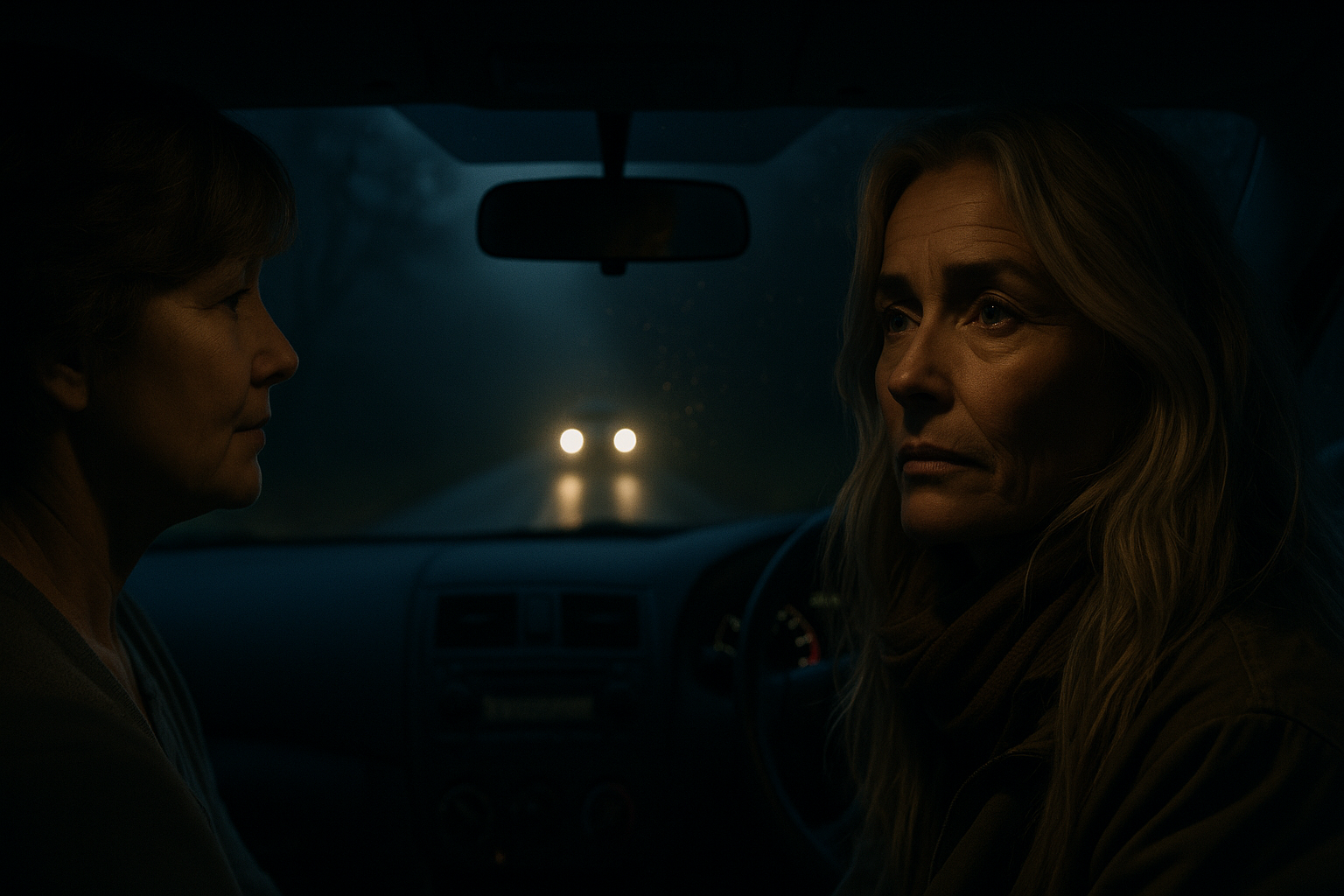
She pulled out from the driveway with her usual unhurried care, easing the car down onto Berriedale Road as though the night itself were something fragile that required handling. Jane never rushed the edges of things—turns, conversations, departures. She treated them like living creatures, wary of startling them. The tyres rolled over the bitumen with a soft crunch, a sound almost too gentle for the load they carried, and underneath it all was the low, steady thrum of the engine—a kind of mechanical heartbeat pulsing into the hush.
Inside, the heater was finally beginning to earn its keep. Warmth unfurled slowly around our legs, soaking into the fabric. I could feel it gathering in the folds of my trousers, teasing the edge of my scarf where it met the skin at my collarbone. It wasn't full comfort yet, but it was getting there—the sort of warmth that asked for patience and paid it back in kind.
The silence between us had shape, texture. It wasn't the strained quiet of two people avoiding words, nor the kind that settles after a fight. Ours was the silence of long acquaintance, built over years of shared lifts and weather-worn commutes. It had grown familiar through the repetition of early mornings and late returns, through muddy shoes and lukewarm thermoses. It knew when to fill a space, and when to stay out of the way.
We'd travelled this way so many times, I could have sketched the journey from memory: Jane's dependable way of navigating turns, the gentle lift of her foot before a bend, the way her hands rested with relaxed precision at ten and two. There had been early starts with travel mugs warming our palms, windscreen wipers smearing rain into milky arcs. There had been nights like this, too—still and slow, with only the road ahead and the shared knowledge of where we were going and who we were to each other.
Streetlights passed overhead in measured intervals, casting warm pools of gold that spread across the pavement in elliptical haloes. The light washed over crumbling garden walls, over letterboxes leaning askew with the years. Front yards blurred into themselves—overgrown lavender, rusted fenceposts, bins left just a little too long on the kerb. It was a kind of suburban lullaby, the soundless music of houses sleeping.
Jane reached forward and flicked the wipers. The blade swept away the fine mist gathering on the windscreen—the residue of warmth meeting cold. A small act, but it felt strangely intimate. A way of keeping the world clear.
Just ahead, the turn came into view—Wallcrest Road, branching left in its usual, unassuming way. And there it was: Luke's place. The split-level brick with the deep slope of garden we'd all once remarked on during a week of heavy rain, when the mulch had slid halfway down to the back fence. It sat there now, crouched in its corner lot, the roofline neat against the black swell of the hillside behind.
Jane's eyes slid towards it, her voice thoughtful and low. "Huh. Dark."
I followed her gaze. The house looked… hollow. No porch light. No bedroom glow behind the thin blinds. Not even the usual pale hum of the kitchen fluorescents, which Luke tended to leave on like a kind of lighthouse. Just a single, uninterrupted dark—thick and unmoving. It didn't feel asleep so much as absent.
"He's usually got something on, doesn't he?" she asked, her voice almost reluctant, as though she was aware of the line between idle comment and real concern.
I nodded slowly. "Always the kitchen light, at least."
We passed it at a crawl, tyres whispering over the bend as the house slipped past our window and dissolved into shadow. I kept my eyes on it until it vanished behind a curtain of hedges and a curve in the road. There was nothing to be seen. But even so, something about it hung in me—like a detail I'd forgotten to write down in a field journal, but couldn't stop circling back to.
It wasn't unusual. That's what I kept telling myself. People go out. People sleep early. But this didn't feel like ordinary silence. It felt arranged. Deliberate. As though someone had turned everything off not because they were leaving—but because they didn't want to be found.
After the strangeness of his call, and the long absence from the morning bus queue, the stillness sat heavier than it ought to have.
"Wonder what he's doing," Jane said after a moment. Her tone was light, but not careless. It was the kind of wondering people allow themselves when the night is quiet and the road is long—neither suspicion nor gossip. Just that soft curiosity neighbours are permitted.
"Getting ready for breakfast at ours, apparently," I said, the words leaving my mouth with a dry trace of humour. They sounded easy, but they didn't quite land. They hovered between us, light and oddly shaped. Not quite an answer.
Jane didn't respond. She nodded once, eyes back on the road, and the car slipped into the darker stretch of bitumen ahead—where the edges of suburb gave way to the slow rise of bushland. Trees gathered at the verges, tall and silent, their silhouettes layered against the deeper dark like sentinels waiting for something to begin.
We passed beneath the last of the suburban lights, their golden spill giving way behind us like a curtain lowering on the familiar world. Beyond it, the road darkened. The sodium glow faded, and with it went the safety of clear edges and easy landmarks. Ahead, the world narrowed into dark and suggestion—just outlines and glints, shapes half-seen, half-invented.
The car's headlights pressed a narrow path through the black, illuminating only what was directly in front of us. The rest—the trees, the sky, the hills climbing silently above—was left to memory and instinct. The road began to wind its way upwards, coiling through the foothills like something not quite sure where it was going, unsure of its own logic. It curved with hesitation and the occasional jerk of intent, like a thought forming mid-sentence.
I knew this route by feel now. Its dips and cambers lived somewhere in the soles of my feet, in the lean of my body when a turn approached. Years of late-night returns had etched it into my muscle memory. But even the most familiar paths start to feel strange when the bush closes in.
Out here, the trees grew taller, closer, their presence no longer scenic but watchful. The stringybark and peppermint gums leaned over the bitumen like listeners at a door, their long limbs arching towards each other across the road. The headlights picked out their trunks—pale and ghosted with dew—like bleached vertebrae rising out of the understorey. The car's motion cast quick, startled shadows that fled across the windscreen, thin and wild.
Mist had begun to collect at the verges. It crept low along the ground, thicker in the dips and hollows where the air turned colder. It moved with eerie patience, not yet dense, but enough to suggest that the land was exhaling, slow and deep. A rhythm older than roads, and I always felt it here.
I turned my face towards the window, letting it all slip past in slow, silent frames. The land knew me, and I knew it—every rise, every flash of quartz in the cut bank, every sudden clearing that opened and closed as we passed. It should have felt comforting. And on the surface, it did. But beneath the hum of the tyres and the gentle warmth seeping from the vents, something in me shifted.
It was subtle—no spike of alarm, no dread—but a tension threaded into the quiet. Like the faint tremble of the earth just before a train arrives. A low, interior vibration. Not fear. Not quite. But the awareness of something gathering. A prelude.
"You seemed a bit quiet after that call," Jane said, her voice soft enough to stay contained between the dashboard and the windscreen. It was a voice meant only for me—low, certain, unfussed. "Is everything okay with Luke?"
I didn't answer straight away. Let the question sit for a beat, as if weighing its own presence in the car. "I'm not sure," I said at last. The truth was slow to surface. "It wasn't what he said. More how he said it. Like he was circling something."
"Hmm." Her eyes stayed on the road, but I felt her attention shift. The way her fingers steadied on the wheel, how her shoulders lifted half a centimetre higher. She wasn't just listening now—she was assessing, triangulating the emotional weather. "It's not like him to call, full stop."
"No," I said, watching the trees lean and fall back in the flicker of headlights. "He's always been warm, but not exactly… forward."
The road dipped sharply into a gully, the incline catching the car's suspension with a low, murmuring groan. Our headlights tilted down with the angle, sweeping the verge in a brief arc—and for a heartbeat, they caught movement. A flash of fur, a glint of eyes like silver studs reflecting back at us before the possum vanished into the undergrowth. Gone in a blink. Just the idea of it remained, rustling somewhere in the bracken.
I turned my gaze back to the window. The glass was cooler now, edged with mist. My reflection had begun to blur—features soft and ghosted, floating just beneath the surface. I barely recognised the face looking back. It felt less like me and more like the memory of someone I used to be, half-lost in the dark beyond the glass.
The contrast struck me all at once: the warm push of the heater against my legs, and just beyond it, the thick cold waiting outside. The bush pressed in close here—dense, ancient, almost territorial. My seat felt suddenly too small, my coat too tight, my skin too aware.
"I keep thinking about the stories he used to tell us on the bus," I said, my voice breaking the quiet like a small stone tossed into still water. "All that nonsense about recurring dreams. Whole places he'd described like he'd actually been there."
Jane gave a soft snort, her breath fogging faintly in the beam of the dash light. "Clivilius," she said, the word wrapped in that dry tone reserved for old, harmless absurdities. The name landed between us like an old playing card—creases worn deep, still faintly absurd. "The city of bridges, right?"
"And azure skies," I added, the phrase tumbling out of me by muscle memory alone.
"He had a name for everything," she murmured, the corner of her mouth lifting in a crooked smile. "The red sand. The flourishing trees. Those freaky stone dogs he reckoned stood guard at the gates. Said it all came from dreams. I just assumed it was... well, Luke."
"Same," I said, but the word sat strangely now. Thin. Rehearsed. Like a garment I'd outgrown without noticing until I tried it on again.
The heater hummed on steadily, its warm current tracing a lazy line along my shins. It should have comforted me—it usually did—but the air had thickened now, something just beneath the surface of our conversation that made the silence feel less like a pause and more like an observer. Listening.
Jane cleared her throat, a small sound, but deliberate. "Do you think he believed it?"
"I don't know," I said, slower than I expected. The answer had to surface first. "At the time, I didn't think much about it. But looking back now... maybe he did. Or maybe he just wanted someone to listen."
She nodded faintly, eyes still forward. It wasn't agreement, not quite. More like acknowledgement. A thought filed for later.
The car rolled on through the dark, its beams cutting the mist in patient strokes. The outside world narrowed further, the road steepening under our wheels as if it, too, had an opinion about where we should be going.
Then, after a beat: "And now he wants breakfast."
I managed a small smile. "Yeah. And maybe something else."
The bush crowded in with sudden closeness—trunks rising tall and bone-pale, packed in tightly like watchers at the edge of an old path. Shadows swayed and reformed in the headlight beam, never quite still. It was like driving through lungs. Like the world around us was breathing in time with the engine's low hum.
The sensation turned in my gut, not quite dread, but its near neighbour. It felt as though we were travelling inward, not forward—deeper into something held and old. As though the landscape had curved closed behind us, drawing a line we hadn't noticed crossing.
Jane reached out without ceremony and nudged my elbow—a small, grounding touch, but solid enough to bring me back to myself. Her voice was low, steady. "You're spiralling. Come back to the road. Nearly there."
I nodded, forcing out a long breath—the sort that reminded you you were still tethered. Still here.







